Uzhhorod Castle: A Historic Fortress and Museum in Ukraine

Site at a Glance
- Rating
- 4.5
- Popularity
- High
- Country
- Ukraine
- Primary era
- Early Modern
- External website
- Open
- Eras represented
- Medieval, Early Modern
- Civilizations
- Hungarian
- Site type
- Military
- Remains
- Castle
On this page11 sections
History
Uzhhorod Castle is a fortress in Uzhhorod, Ukraine, whose present stone castle was begun around 1320 under Hungarian rule and later developed in late Renaissance and Baroque forms. It stands on Castle Hill and grew into the fortified center of Ung County, later serving as a noble residence, theological seminary, and museum.
Early Strongholds and Hungarian Conquest
The earliest written references to Uzhhorod Castle date from the ninth century, although the date and exact location of the first fortification remain uncertain. The earliest described stronghold was a wooden fort with an inner enclosure and a palisade above a settlement associated with the White Croats, a Slavic population mentioned in medieval traditions concerning parts of the Carpathian region.
The territory was traditionally ruled by Prince Laborec and was described as belonging to him in the Gesta Hungarorum, a medieval Latin chronicle about the Hungarian conquest and early Hungarian history. During the Hungarian conquest in the late ninth century, the settlement and fort were captured and burned. Laborec fled toward Zemplín, where he was killed, and the river later called the Laborec became associated with his memory. The Hungarian leader Álmos also died during the fighting and was buried at the Zemplín hillfort, where Czechoslovak archaeologists later found a richly gold-adorned burial.
After the Hungarian takeover of the lowlands of Zakarpattia, a substantial stone castle associated with Ung County was established around the turn of the tenth and eleventh centuries. It resisted an attack by Cuman forces led by Khan Kutesk in 1086. The Mongol invasion of 1241 and 1242 destroyed the earlier earthwork fortification. King Béla IV, who promoted stone castle construction after the invasion, ordered the strengthening of fortifications, although one account places the succeeding castle at present-day Gerény rather than definitively on the site of the modern castle.
The Drugeth Castle
In 1312, Charles Robert of Anjou, also known as Charles I of Hungary, granted Uzhhorod Castle and its lands to the Neapolitan brothers Philip I Drugeth and John I Drugeth. They had helped suppress the revolt of Peter Petény. The Drugeths, a powerful noble family of Neapolitan origin, controlled the estate from the fourteenth century until the late seventeenth century.
Philip Drugeth began constructing the present castle around 1320. László Drugeth of the Homonnai branch completed the work roughly three decades later. The fortress was repeatedly adapted to new military requirements. A major reconstruction took place in 1598 during the tenure of Stephen Drugeth, who served as ispán, the official responsible for administering a Hungarian county, in Ung and Zemplén Counties. This rebuilding probably established much of the castle’s present appearance.
Political Conflict and Bercsényi’s Residence
The castle changed hands during the political struggles that followed the Battle of Mohács. Stephen Bocskai held it from 1602 until he returned it to George Drugeth in 1606. Gabriel Bethlen captured it in 1619, forcing George Drugeth to flee to Poland. In 1684, forces led by Imre Thököly, a leader of the late seventeenth-century anti-Habsburg Kuruc movement, occupied Uzhhorod and captured the castle. The last Drugeth lord was later executed at Košice for remaining loyal to the emperor.
Miklós Bercsényi acquired Uzhhorod in 1691. During his tenure, the castle was strengthened, and its palace was richly furnished. It held a substantial art collection and library. Bercsényi’s close association with Francis II Rákóczi, who later led the Hungarian uprising against Habsburg rule from 1703 to 1711, helped encourage Rákóczi’s involvement in organizing the revolt.
The Rákóczi War and Habsburg Control
During the Rákóczi War of Independence, the town prepared for a siege by storing six months of grain and gathering livestock. About 300 to 400 Hungarian nobles and Jesuits took refuge in the castle. In autumn 1703, Rusyn peasants under Ivan Beca occupied nearby settlements, seized livestock, captured Uzhhorod, and surrounded the fortress. Their attacks used scythes, axes, old firearms, ladders, and carts of straw, but the defenders repelled them. After a prolonged siege, the fortress surrendered in early 1704.
Francis II Rákóczi prevented reprisals against the guards, expelled the Jesuits from Uzhhorod, and prohibited attacks on feudal estates. He ordered the execution of Albert Kiss for disobedience. In 1707, the castle ceremonially received envoys of Peter I during negotiations with Rákóczi’s representatives. After the uprising was defeated in 1711, the castle passed to the Habsburg authorities. Paintings, furniture, valuable tableware, weapons, and other possessions were removed to Vienna. A fire damaged the castle in 1728, and restoration followed several years later. Imperial troops occupied it until 1771.
Seminary, Museum, and Conservation
In 1775, Maria Theresa transferred the castle to the Mukachevo Greek Catholic diocese. A Greek Catholic church follows Byzantine-rite worship while recognizing the authority of the pope. The diocese converted the castle into a theological seminary. This change destroyed the palace’s ceremonial hall, while the castle church was demolished because of its poor condition.
The religious institution was disrupted after Zakarpattia became part of Czechoslovakia following the Treaty of Trianon. Soviet forces occupied the theological college in 1944, and the Communist Party ordered its closure in 1946. In 1949, Soviet authorities abolished the Greek Catholic Church and incorporated it into the Orthodox Church. The Greek Catholic community continued illegally for about fifty years until its legalization in 1989.
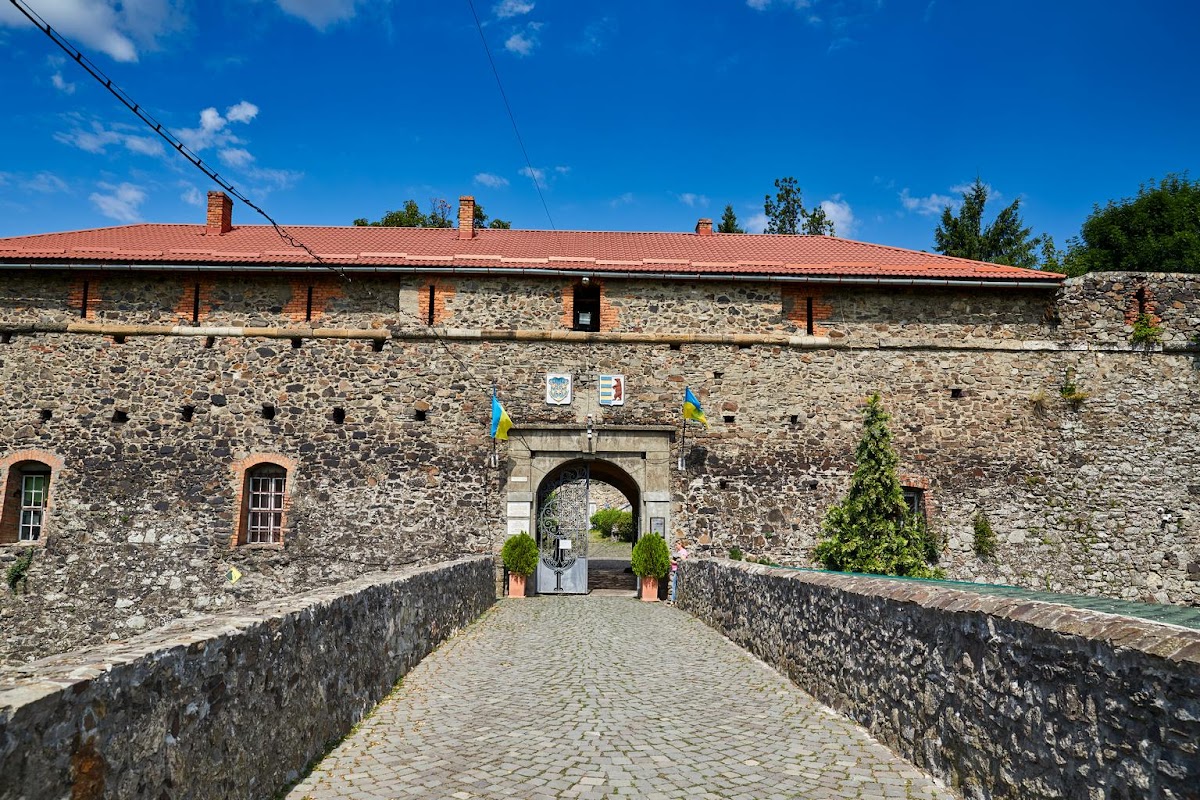
Since 1947, the castle has housed the Zakarpattia Regional Museum of Local History and its art gallery. Temporary exhibitions are also held within the complex. Restoration in the 1960s repaired the gate, the southwestern facade, and several door and window frames, and created a new bridge over the moat. Uzhhorod Castle is protected in Ukraine as a monument of architecture of national significance.
Remains
Defensive Enclosure
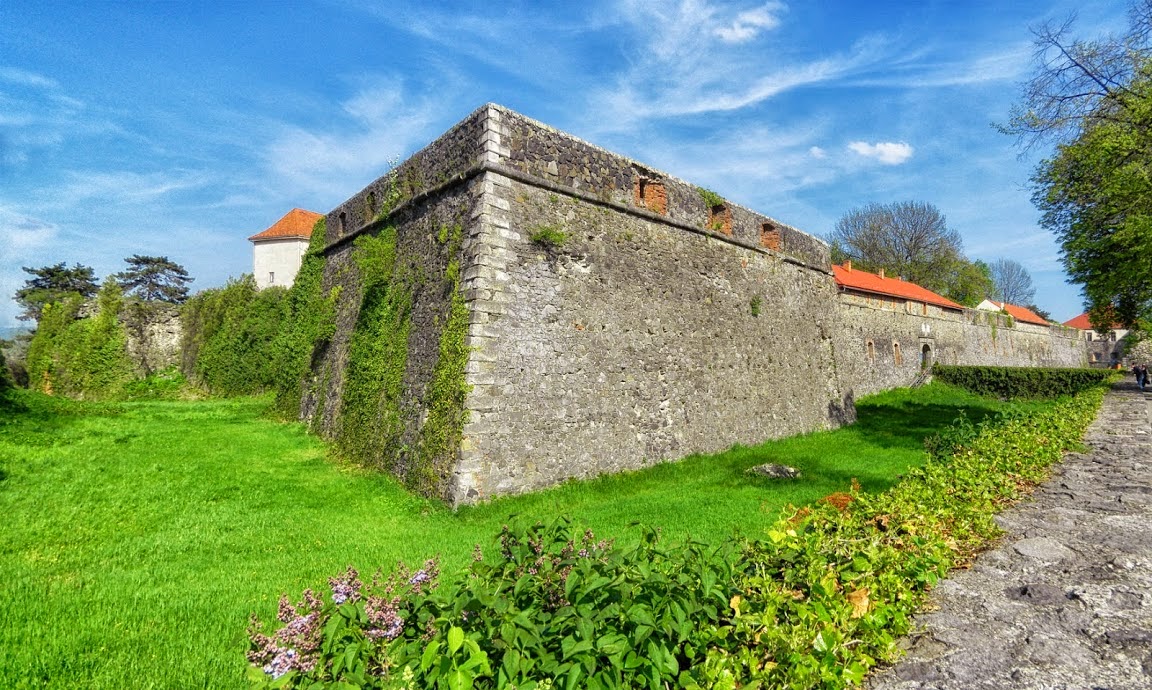
The castle complex occupies about 8.5 hectares, including approximately 6 hectares of garden, on the volcanic Castle Hill. Its irregular quadrilateral plan follows the hill’s relief. Stone enclosing walls were reinforced with four ear-shaped bastions, projecting fortifications designed to allow defensive fire along the adjoining walls, and a triangular or keel-shaped bastion on the northern side. The bastion platforms carried guns, while their corners were faced with square blocks of white stone.
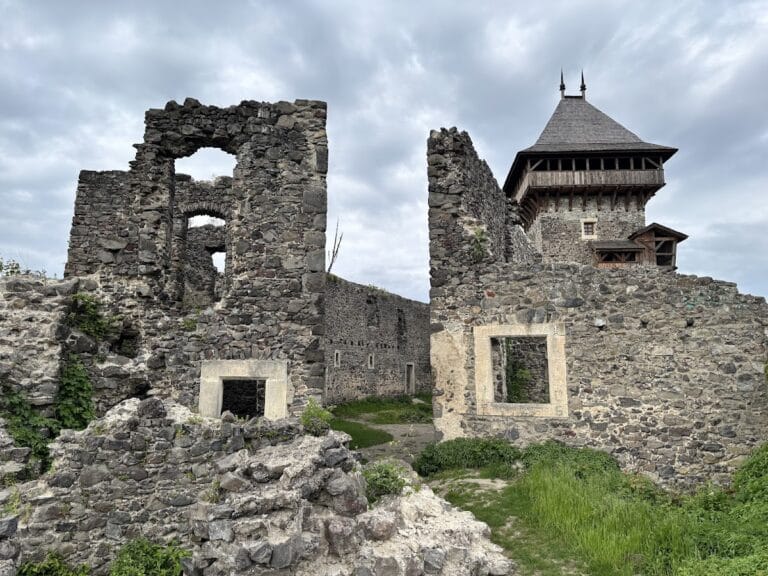
Approach to the fortress crossed a system of moats. On the accessible sides, the outer moats were about 15 to 20 metres wide and 8 to 10 metres deep. A drawbridge led to the entrance gate, and openings for its lifting chains remain visible. The outer wall is approximately 2.5 to 3 metres thick and about 10 metres high, with substantial sections still standing. On the northern side, high and smooth defensive walls rise above a precipice, while a steep rock or cliff on the northeast made approach difficult. The surviving architecture combines late Renaissance and Baroque characteristics, with the late Renaissance forms associated particularly with northern Hungary.
Inner Palace and Underground Chambers
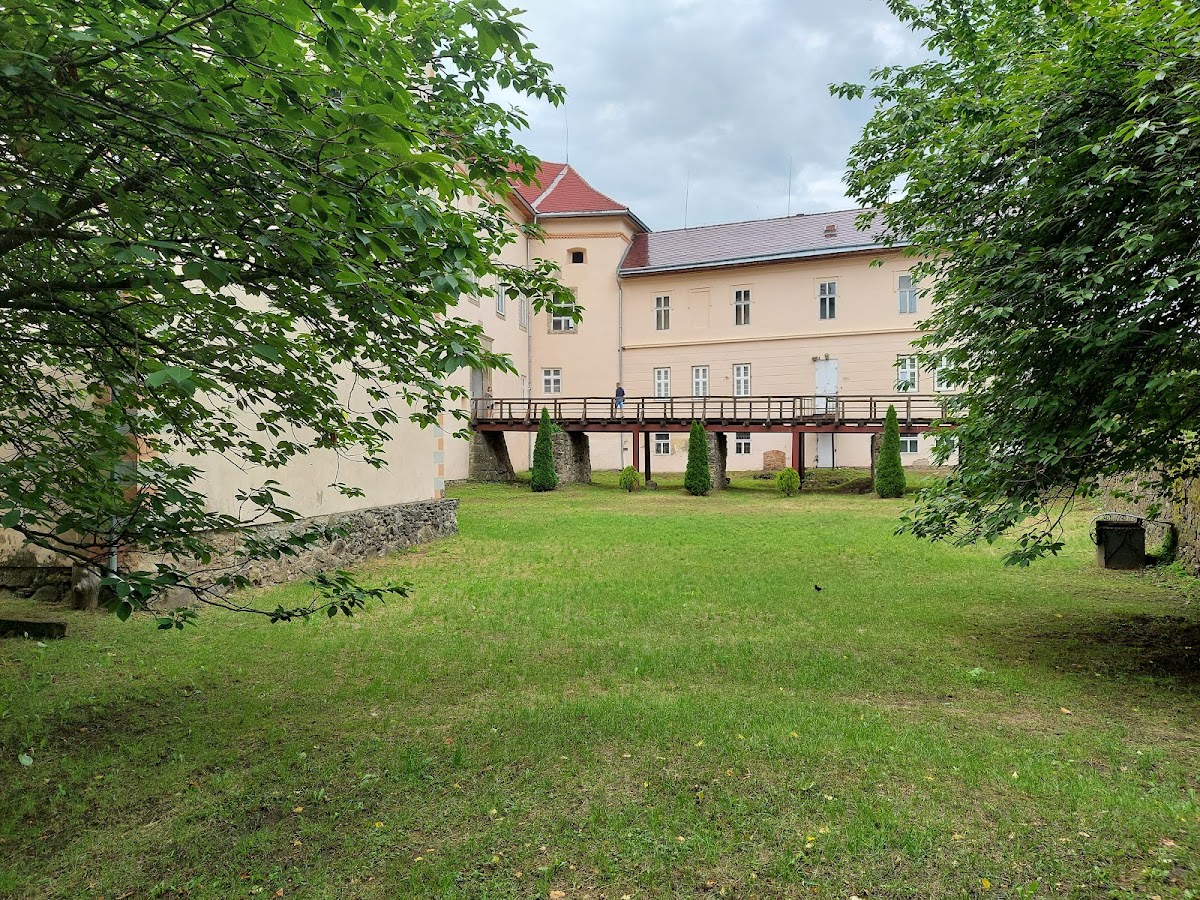
The palace stands opposite the main entrance in the northeastern part of Castle Hill, at the edge of the steep slope. This severe, two-storey rectangular building has a square tower at each corner. The upper tower walls are about 2.5 to 3 metres thick and contain dark loophole openings. The palace served as the inner citadel and occupied the dominant position within the defensive system.
A deep moat protected the palace on three sides, while an eastern drawbridge closed its entrance when raised. The building incorporates the natural slope, so its northern section rises directly above the precipice. Underground casemates, vaulted protected chambers within the fortification, served as storage rooms in peacetime and shelters during sieges. The underground area also included a prison and a torture chamber. The inner courtyard retains traces of a former arched gallery and contains a well nearly 30 metres deep.
Castle Church and Chapel
A castle church dedicated to St. George was referred to in writing in 1248 and stood in the courtyard or castle garden. Archaeological excavation exposed its foundations, which were conserved and incorporated into the museum presentation. The church was demolished in the eighteenth century, and its complete reconstruction has not been undertaken.
The castle chapel or church hosted the Union of Uzhhorod on 24 April 1646. On that occasion, 63 Orthodox priests from the Mukachevo diocese swore allegiance to the pope and accepted union with Rome, establishing the Greek Catholic affiliation in the region.
Garden Sculptures and Memorials
A bronze Turul sculpture stands in the grounds. The Turul is a mythical bird in Hungarian tradition, associated with dynastic origins and national symbolism. The sculpture was transferred in 1945 from a monument at Vilok commemorating Francis II Rákóczi’s victory over Austrian forces in 1703. The original monument had been demolished, and the sculpture arrived without its sword and pedestal.
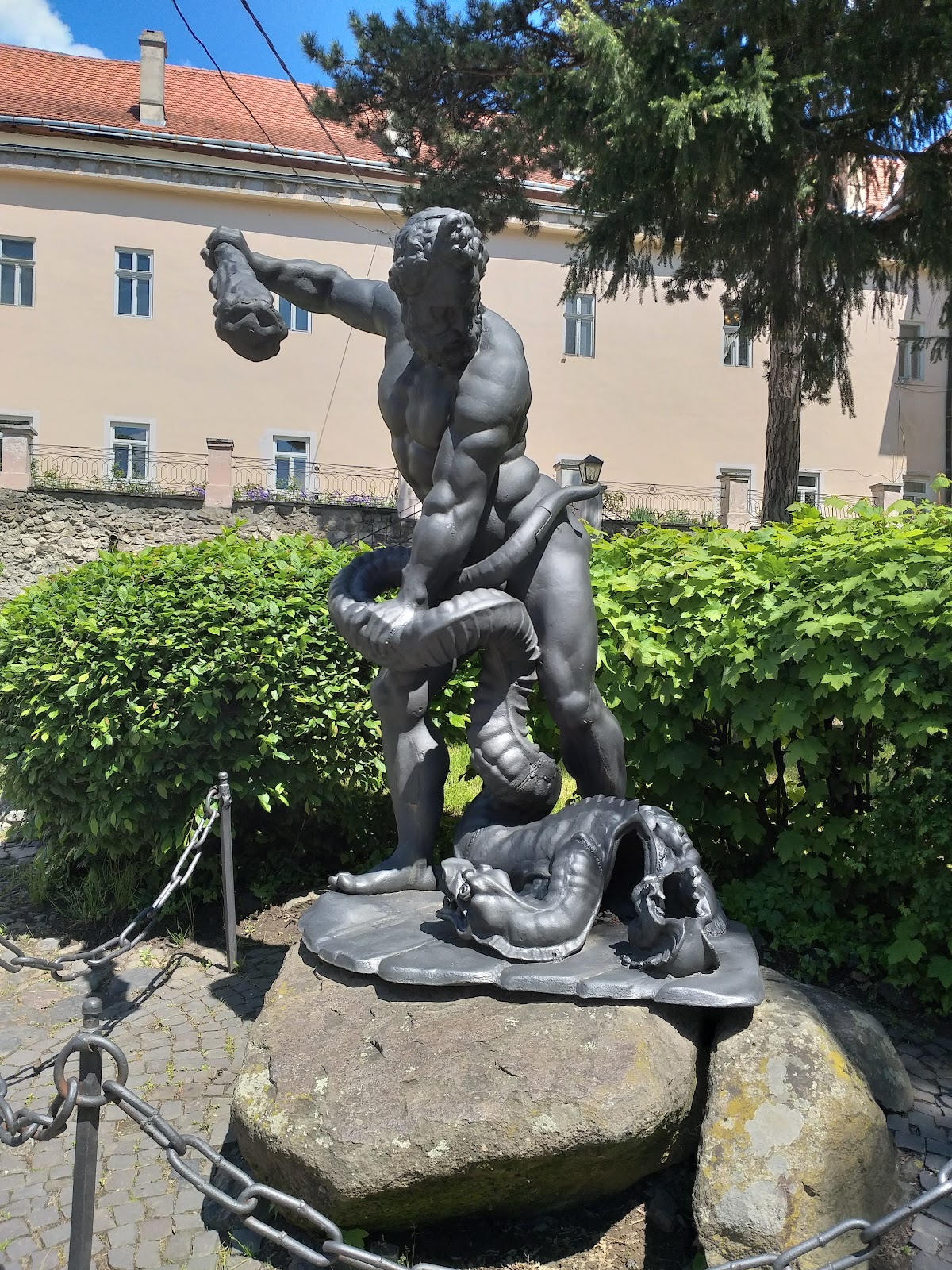
The park also contains the remains of a bronze fountain representing a copy of the ancient Greek sculptor Lysippus’s Resting Hermes. Hermes was a Greek god associated with travel, communication, trade, and transitions. The sculpture formerly stood at a Soviet-era sanatorium in Uzhok, has lost its arms, and requires restoration. Two nineteenth-century cast-iron sculptures, Hercules and the Lernaean Hydra and Resting Hermes, are also part of the castle park. A bust of Miklós Bercsényi was installed in the inner courtyard in winter 2012, followed by a bust of his wife, Christina Csáky, on 8 November 2013.