Vinné Castle: A Medieval Hilltop Fortress in Slovakia



Site at a Glance
- Rating
- 4.5
- Popularity
- Low
- Country
- Slovakia
- Primary era
- Medieval
- External website
- Open
- Eras represented
- Medieval, Early Modern
- Civilizations
- Hungarian
- Site type
- Military
- Remains
- Castle
On this page11 sections
History
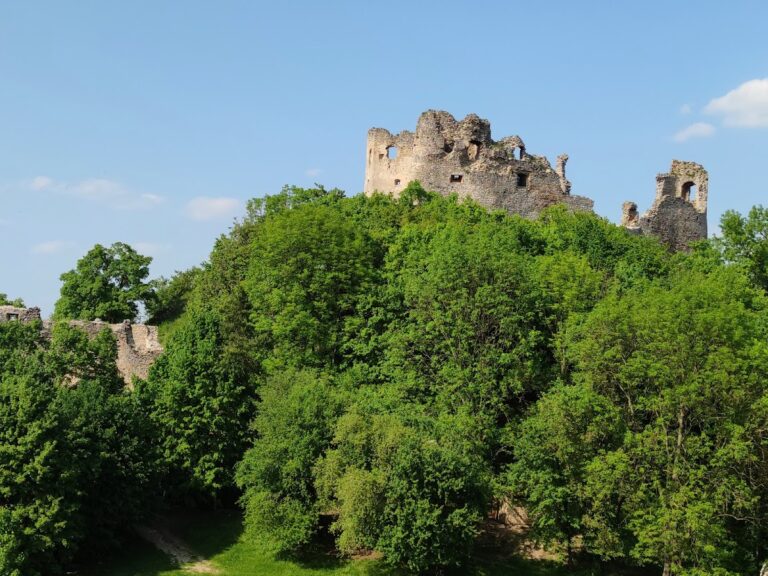
Vinné Castle is a medieval hilltop fortress near Vinné in Slovakia, probably built in the second half of the thirteenth century or no later than the early fourteenth century within the Kingdom of Hungary. Its purpose was to protect a trade route leading from Hungary to Poland, and it formed part of a defensive system that also included the nearby castles of Brekov and Jasenov. The castle was also known as Vinná Castle and, in earlier records, as Nogmihal or Nagy Mihály.
Medieval Origins and Conflicts
The castle was attacked and damaged in 1312 by the Omodejovci, a powerful Hungarian noble family opposed to King Charles Robert of Anjou. Vinné is explicitly mentioned in 1335, when it contained two towers, a palace, an old gate, a chapel dedicated to Saint Margaret, and a house. Raiding bands operating in the surrounding area repeatedly caused further damage.
Vinné belonged to nobles from Michalovce and formed part of the Michalovce estate. In 1466, it suffered heavy damage during fighting between Matthias Corvinus, king of Hungary, and Casimir IV, king of Poland. The conflict reflected the wider military and political rivalry affecting the borderlands of the two kingdoms.
Rebuilding and Decline
The castle was repaired and fortified at the beginning of the sixteenth century. During that century, it was repeatedly drawn into conflicts between the local nobility and the court in Vienna. Imperial troops damaged it again when they captured the castle in 1594.
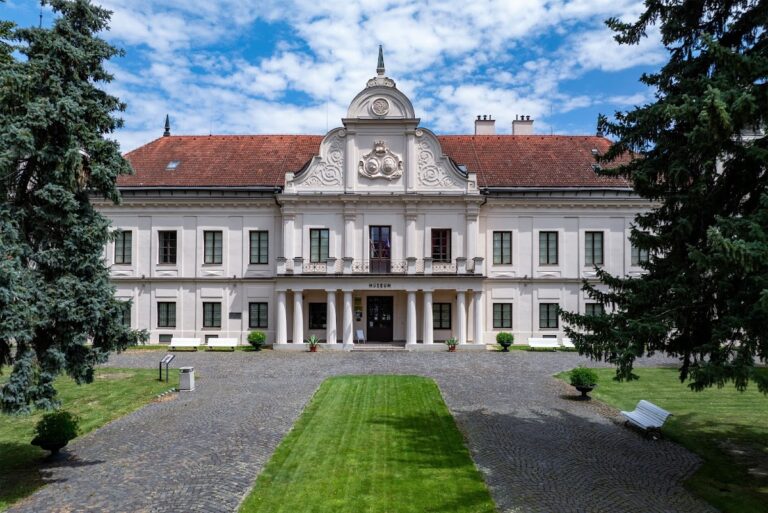
The Sztáray family later repaired Vinné, but did not greatly strengthen its defenses. The castle was captured in 1623 during the uprising led by Gabriel Bethlen, a major opponent of Habsburg rule, and again in 1644 after a campaign by George I Rákóczi. By the middle of the seventeenth century, the Sztárays had abandoned the uncomfortable fortress as a residence. They moved to the settlement below and built a manor house, while residences and manor houses in Vinné and Michalovce became more attractive than the mountain stronghold.
Following the suppression of the anti-Habsburg uprising of Francis II Rákóczi, the Hungarian Diet, the kingdom’s representative legislative body, ordered the castle’s demolition in 1711. Vinné has remained a ruin since the early eighteenth century.
Protection and Conservation
Vinné Castle became a Slovak national cultural monument in 1963. The castle hill was included in the Vinné Castle Hill Nature Reserve, established in 1984 over 51.96 hectares with fourth-degree nature protection and expanded in 1988. The reserve protects warm-loving forest-steppe and forest communities on the southern slopes.
Rescue and reconstruction work on the ruin has continued since 2011 under the civic association Zemplínsko-užská hradná cesta, a member of Zachráňme hrady. The municipality of Vinné organized and financed the opening-up of the castle and the clearance of surrounding vegetation. Later conservation has continued under the civic association, helping preserve the surviving structures and make the ruin accessible.
Remains
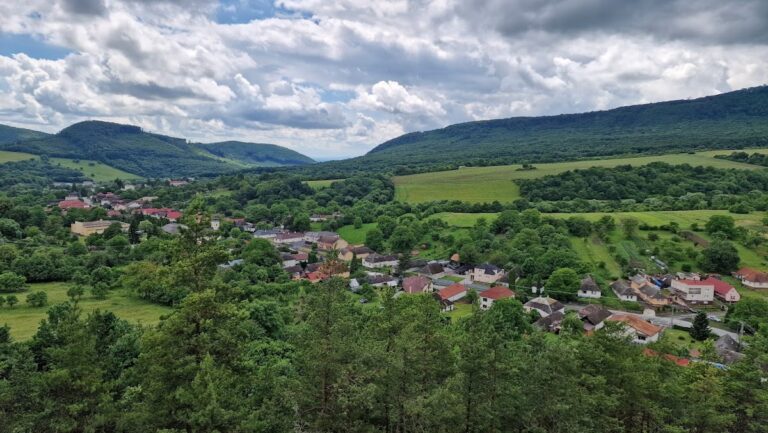
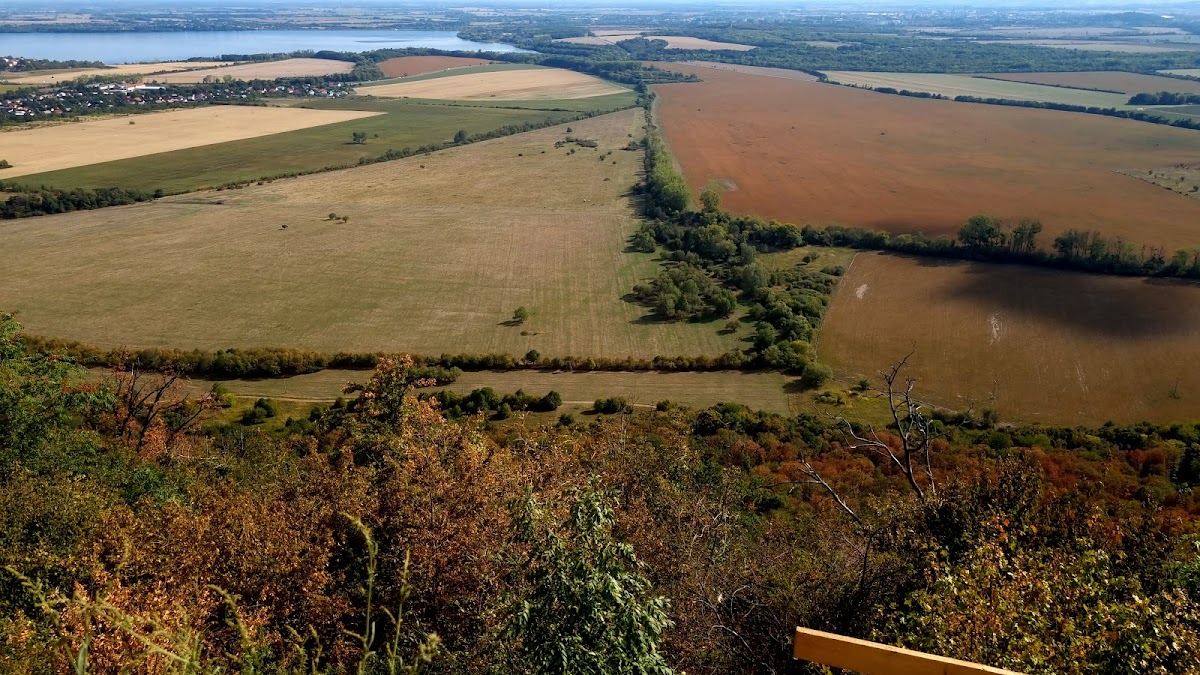
Vinné Castle occupies a volcanic, cone-shaped andesite hill at approximately 320 to 325.3 metres above sea level on the southern or southwestern edge of the Vihorlat Mountains. Its irregular, almost triangular plan follows the shape of the hill. Surviving fortification sections enclose the former courtyard, while massive earthworks once surrounded the castle. From the hill, the landscape extends across the East Slovak Lowland, with views toward Michalovce and the Zemplínska Šírava reservoir.
Fortifications and Entrance
Mantle Wall and Towers
The earliest defensive arrangement was a mantle-wall fortification, a thick outer shell against which later buildings were placed. The first phase included a tower and probably a three-room palace approached from the courtyard. Further structures were added inside and outside the defensive circuit. Because the difficult terrain restricted expansion during the final phase, the castle’s defenses were strengthened instead.
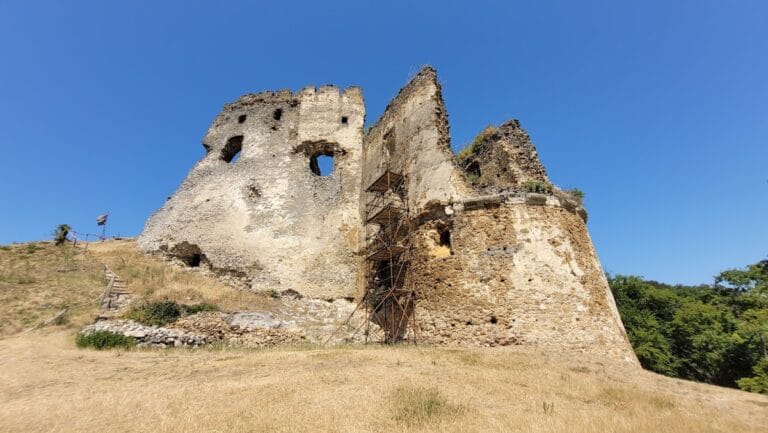
By 1335, the fortification had two towers and an old gate. A description from 1449 presents a similar arrangement. One tower contained cellars and four stories, while the castle also had a dungeon and two residential buildings. The eastern entrance was protected by a rectangular tower, whose surviving remains form the passage beneath which visitors now enter.
Palace and Residential Buildings
Eastern Residential Range
Buildings attached to the eastern fortification retain parts of Renaissance vaults, meaning vaulted structures associated with Renaissance building practice. The Gothic tower preserves stone ashlar work, formed from carefully laid dressed blocks, together with window and door openings and sections of old plaster.
Palace and Service Structures
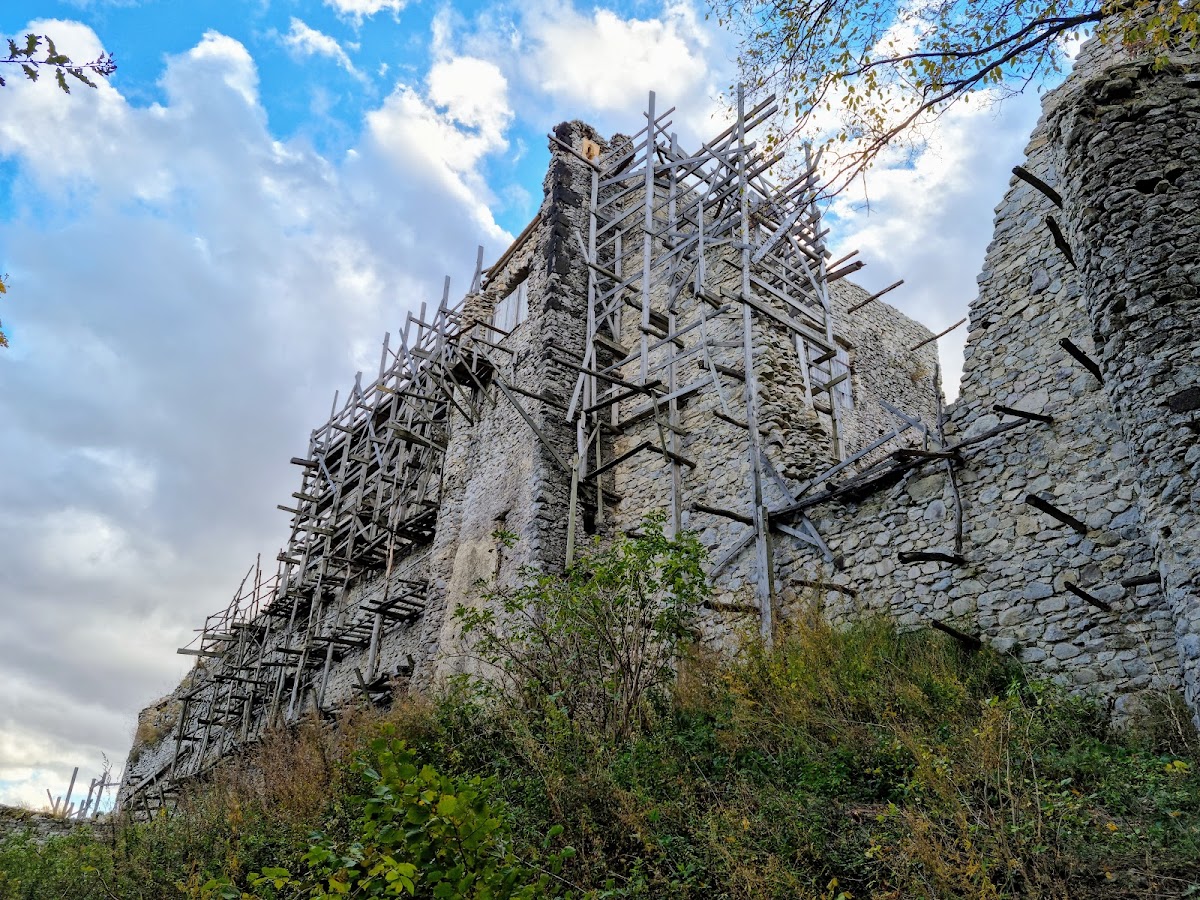
The palace contains traces of fireplaces and a niche, while vaulted cellar spaces survive beneath it. A drain or outlet remains in the outer wall. Agricultural and service buildings were attached to this part of the castle, linking the residential area with the practical functions of the fortified complex. A temporary technical roof protects the palace from adverse weather and further deterioration.
Archaeological Finds and Landscape Evidence
Archaeological research uncovered nearly 2,000 copper coins dating from 1858 to 1860, stored in an earthenware jug. Other finds include brightly colored Renaissance stove tiles, fragments of facade decoration, metal keys, arrowheads, and ceramic remains. Together, these objects illuminate the castle’s later occupation and the material culture associated with its rooms and defenses.
An intact grapevine was also found at the castle. It is estimated to be approximately 200 years old and may belong to the rare Neuburg variety. Local tradition holds that it was once the only surviving vine in the whole Kingdom of Hungary, adding a later cultural association to the physical remains of the fortress.