Admiralty House: The First Lord of the Admiralty’s Official Residence
Site at a Glance
- Popularity
- Very High
- Country
- United Kingdom
- Primary era
- Early Modern
- Eras represented
- Early Modern
- Civilizations
- British
- Site type
- Domestic
- Remains
- Elite Residence
On this page11 sections
History
Admiralty House is a government building in Westminster, London, United Kingdom, built as a residence for the First Lord of the Admiralty, the senior political head of the government body that administered the Royal Navy. Constructed from 1786 to 1788 and opened in 1788, it has neoclassical interiors, drawing on ancient Greek and Roman architecture, and is the smallest building in the historic group of former British Admiralty buildings.
Earlier houses and construction
Before Admiralty House was built, the site contained two seventeenth-century houses. Walsingham House was the London home of Lady Walsingham, a lady-in-waiting and friend of Elizabeth I. Pickering House belonged to Sir Gilbert Pickering. Both houses were later moved elsewhere in the city: Walsingham House to Tower Ward and Pickering House to St James.
During 1782–1783, Richard Howe, a senior naval officer and politician who then served as First Lord, requested a private residence. Samuel Pepys Cockerell, a protégé of architect Sir Robert Taylor, designed the house.
The First Lord’s residence
Admiralty House served as the official home of successive First Lords until 1964. Winston Churchill lived there during his terms in the office from 1911 to 1915 and from 1939 to 1940. During the Second World War, the house also accommodated the Royal Navy’s commander-in-chief and hosted state and ceremonial events. War affairs were handled in the adjoining Ripley Building.
In 1962, US President John F. Kennedy met British Prime Minister Harold Macmillan at the house.
Government use after 1964
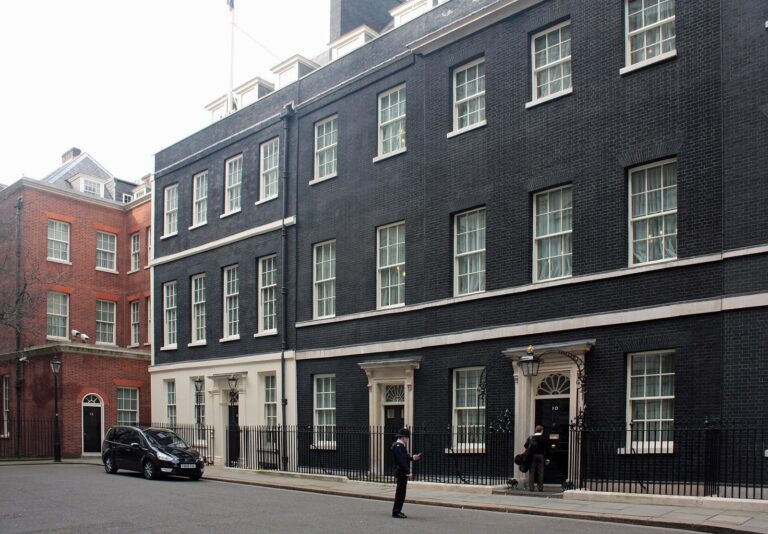
In 1964, the Admiralty was dissolved and a Department of the Navy was established under the new Ministry of Defence. Admiralty House continued in government use, including for official and ceremonial purposes. Several prime ministers stayed there temporarily during renovations at 10 Downing Street, the prime minister’s official residence and office. In 1991, John Major moved in while repairs followed a mortar attack on Downing Street.
Admiralty House is Grade I listed, the highest statutory category for buildings of exceptional interest. The wider Admiralty buildings group is Grade II listed, a category for buildings of special interest.
Remains
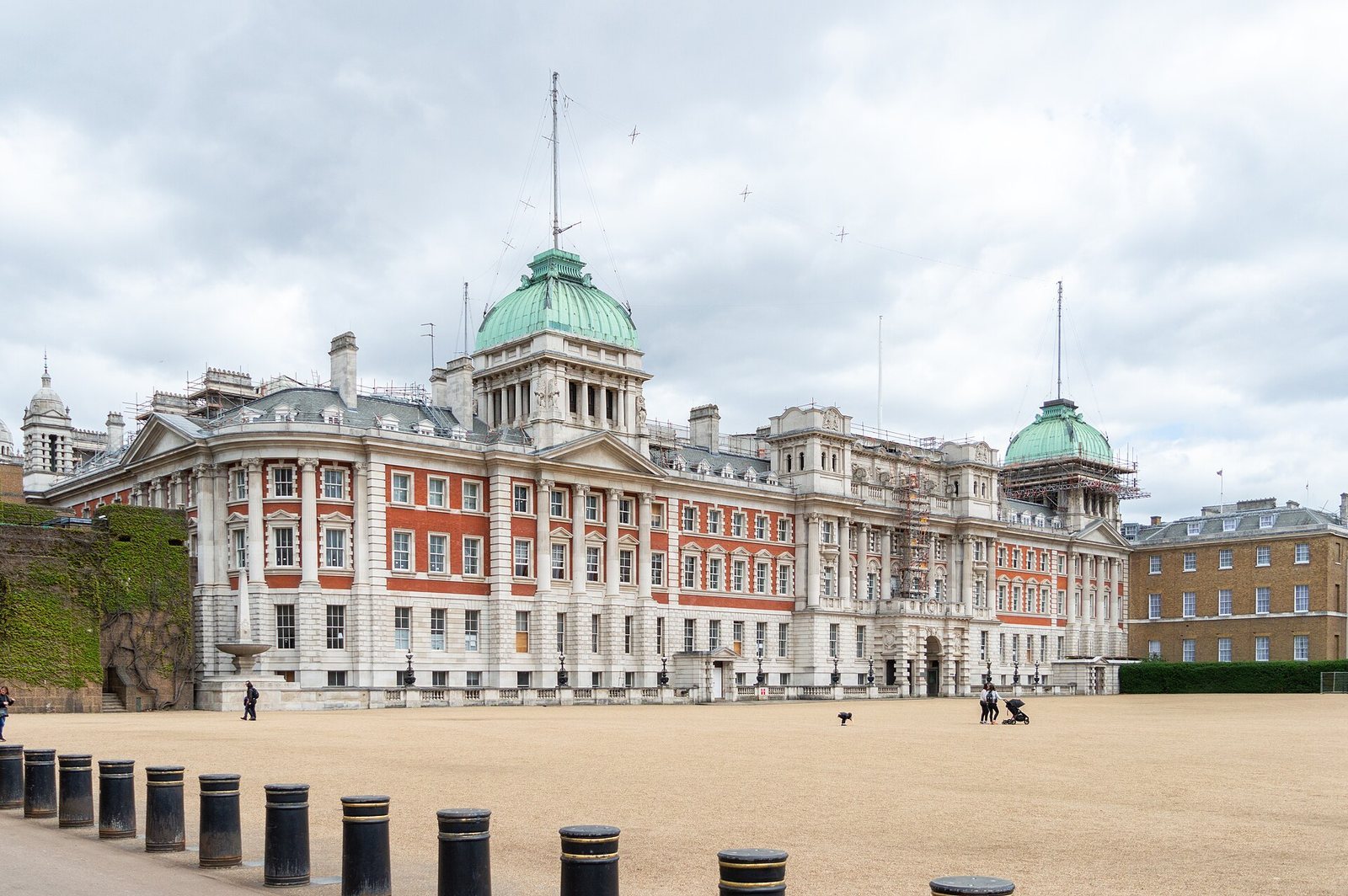
The yellow-brick house has three main storeys and an attic, making four levels in total. It stands between the Ripley Building to the north and Whitehall 36 to the south; Whitehall 36 lies between the house and the Horse Guards building. The northern part of Admiralty House is connected with the Ripley Building and the Admiralty Extension. The Extension projects northwest to form the northern end of Horse Guards Parade, and its east wing makes up the western façade of the Old Admiralty. A basement connection joins Admiralty House to the Old Admiralty’s southern exit beneath its corner.
Exterior
Whitehall façade
The principal façade faces Whitehall. It is arranged in three broad, symmetrical sections, with the central section set back. A narrower additional section at the southern end is also recessed.
Façade facing Horse Guards Parade
The rear façade faces Horse Guards Parade across a small garden. It has five sections of equal width and depth, each with three windows, one on each floor. Its brown appearance contrasts with the surrounding buildings.
Interiors
Entrance hall and interior finishes
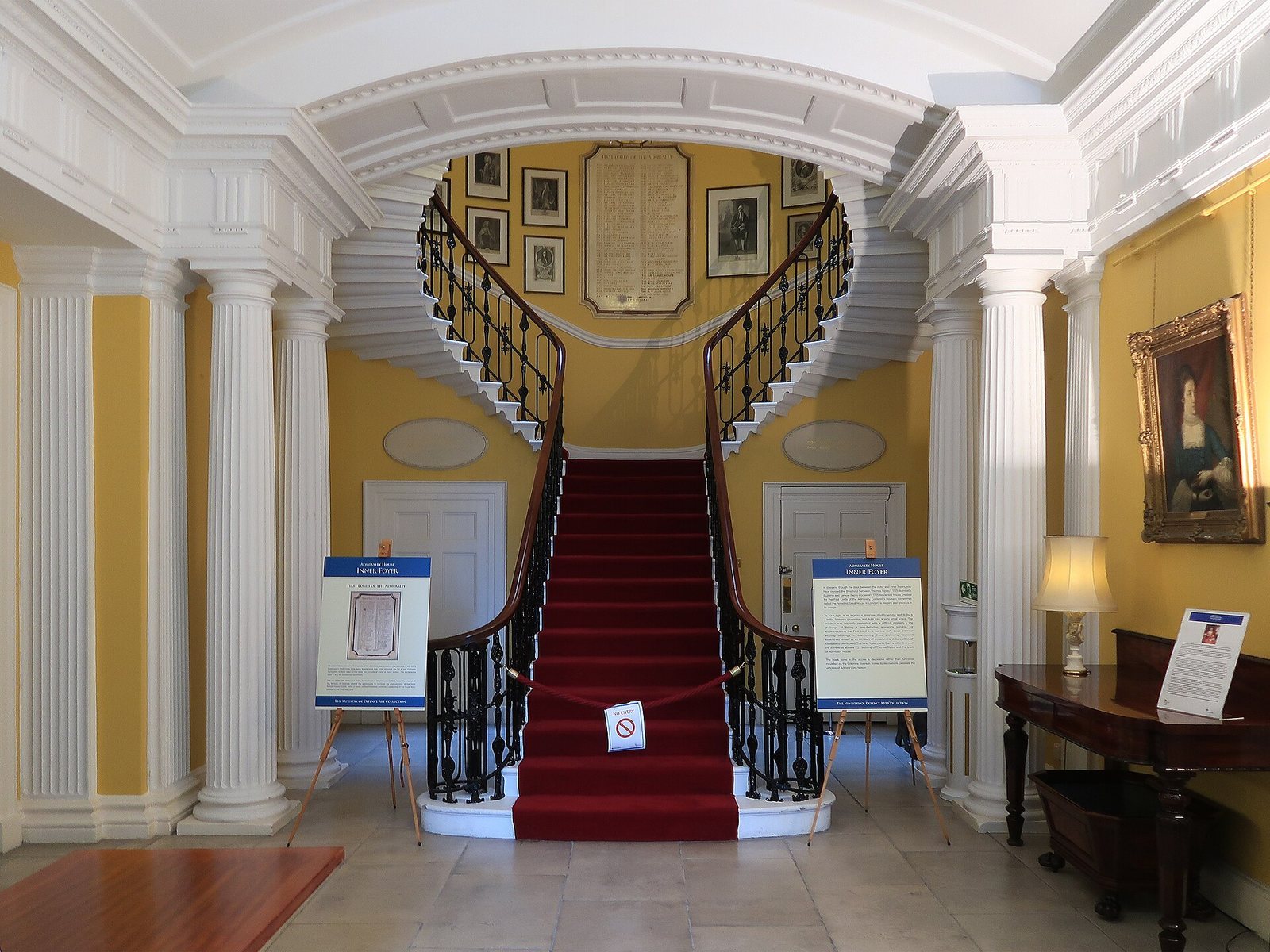
The ground-floor entrance hall and principal staircase are notable features. The interiors combine brightly coloured finishes, stucco, a decorative plaster finish, fine furnishings, paintings and portraits.
Ceremonial Room and Music Room
The Ceremonial Room and Music Room are notable spaces. The Music Room faces Horse Guards Parade. Museum displays occupy its west wall, while large paintings of seascapes and warships hang on the north wall. These works are comparable to, but larger than, the paintings in the Old Admiralty boardroom.