Church of Michael the Archangel in Troparyovo, a 17th-Century Orthodox Church in Moscow
Site at a Glance
- Popularity
- High
- Country
- Russia
- Primary era
- Early Modern
- Eras represented
- Early Modern
- Civilizations
- Russian
- Site type
- Religious
- Remains
- Church
On this page14 sections
History
The Church of Michael the Archangel in Troparyovo is a Russian Orthodox church in Moscow, Russia, built in the late 17th century as Russian church architecture shifted from Ukrainian three-domed forms toward the Moscow, or Naryshkin, style, known for its richly decorated exteriors. Its principal dedication commemorates the Miracle of the Archangel Michael. The church stands in the former village of Troparyovo, now part of Moscow’s Troparyovo-Nikulino district. The Novodevichy Convent, a Russian Orthodox women’s monastery, owned the village and paid for the stone church. The church belongs to the Moscow Diocese, an ecclesiastical district administered by a bishop, and since its return to worship it has served as a patriarchal metochion, a church community under a patriarch’s direct authority.
Wooden predecessor and stone church
A wooden church dedicated to Michael stood in Troparyovo before the present building. It was rebuilt twice, most recently in 1669, and then burned. Construction of the stone church began in 1693 and was completed in 1694. An antimension, a consecrated cloth used for the Orthodox Eucharist and usually containing a relic, was issued for the church that year.
Changes in the 19th century
During Napoleon’s 1812 invasion of Russia, the church suffered minor damage as French forces retreated along the Old Kaluga Road. Repairs were completed in 1823. From 1838, the Church of the Kazan Icon of the Mother of God at Bogorodskoye-Voronino was affiliated with the Troparyovo church.
Closure, restoration and reopening
Soviet authorities closed the church in the late 1930s. The enclosure was destroyed, the interior was ransacked and the bells were thrown down. During the 1960s, the building was used as a Mosfilm scenery warehouse. In 1964, architects from the Mosoblrestavratsiya association surveyed the church and restored its cupolas; the exterior was restored in the late 1970s.
Residents sought permission to reopen the church and hoped to restore it for worship by the 1980 Moscow Olympics. Metropolitan Juvenaly supported their efforts, but the Communist Party’s Central Committee rejected the proposal, stating that the number of churches should not increase. In 1988, Moscow authorities approved the building’s transfer to the Moscow Patriarchate as part of the millennium observance of Rus’s traditional conversion to Christianity in 988. The transfer was delayed while the Moscow Art Combine continued to occupy the building.
Metropolitan Vladimir (Sabodan), then Metropolitan of Rostov and Novocherkassk and administrator of the Moscow Patriarchate, consecrated the church on 23 February 1989. It was the first church in Moscow to reopen after the persecutions. The church is active and holds federal cultural-heritage status in Russia.
Remains
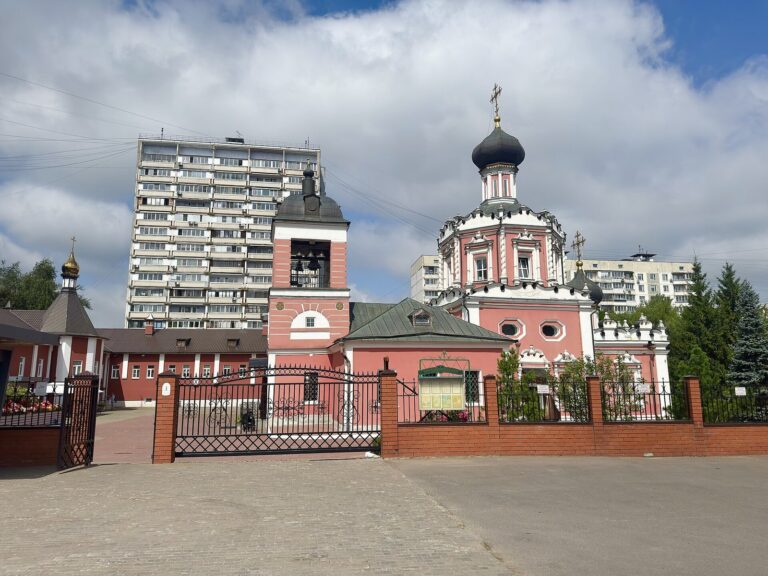
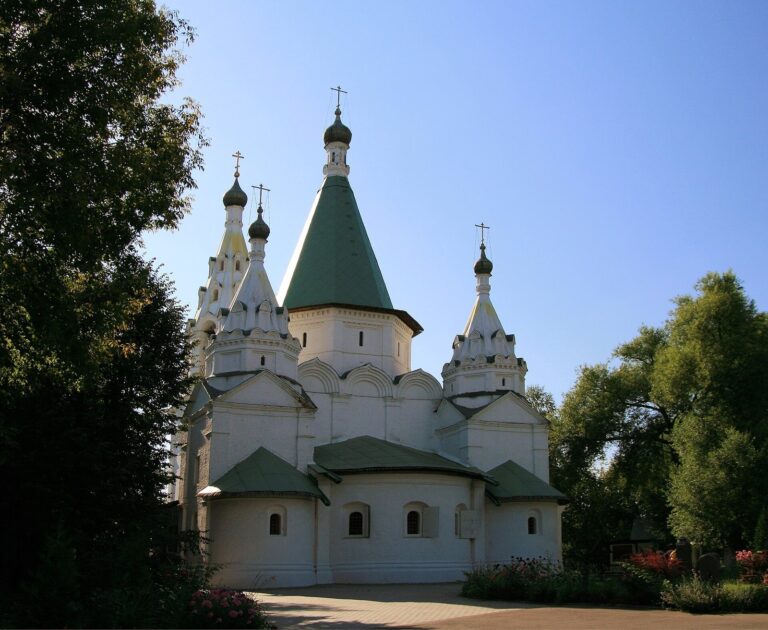
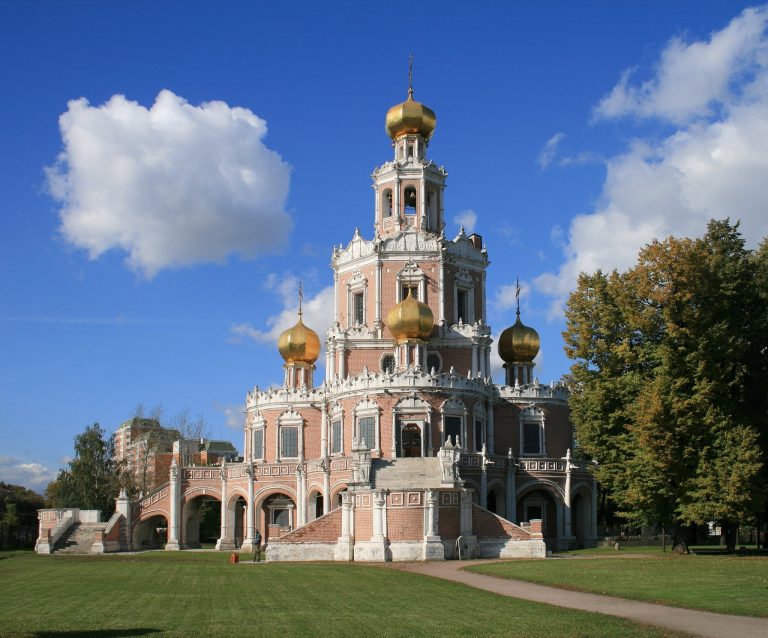
The symmetrical brick complex consists of a tall central church, an adjoining refectory, or church hall, and a three-tier bell tower aligned with the western entrance. Its forms and ornament reflect the architectural transition of the period.
Main church
Central block
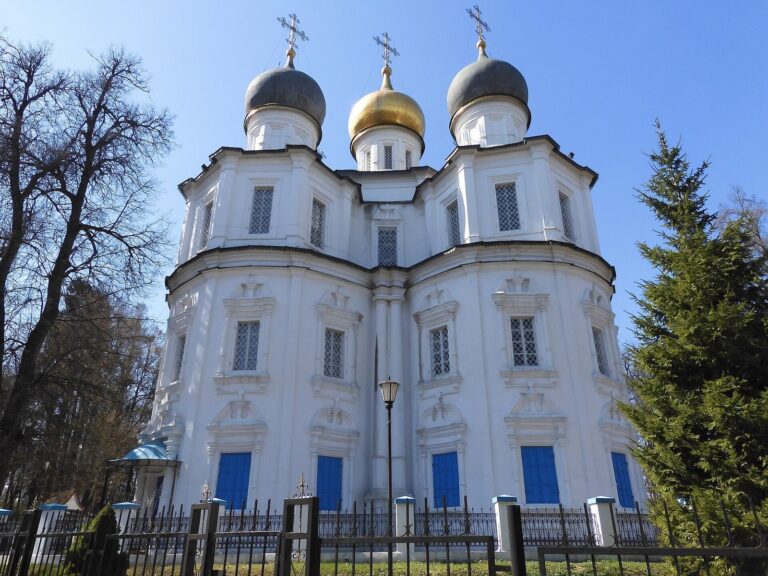
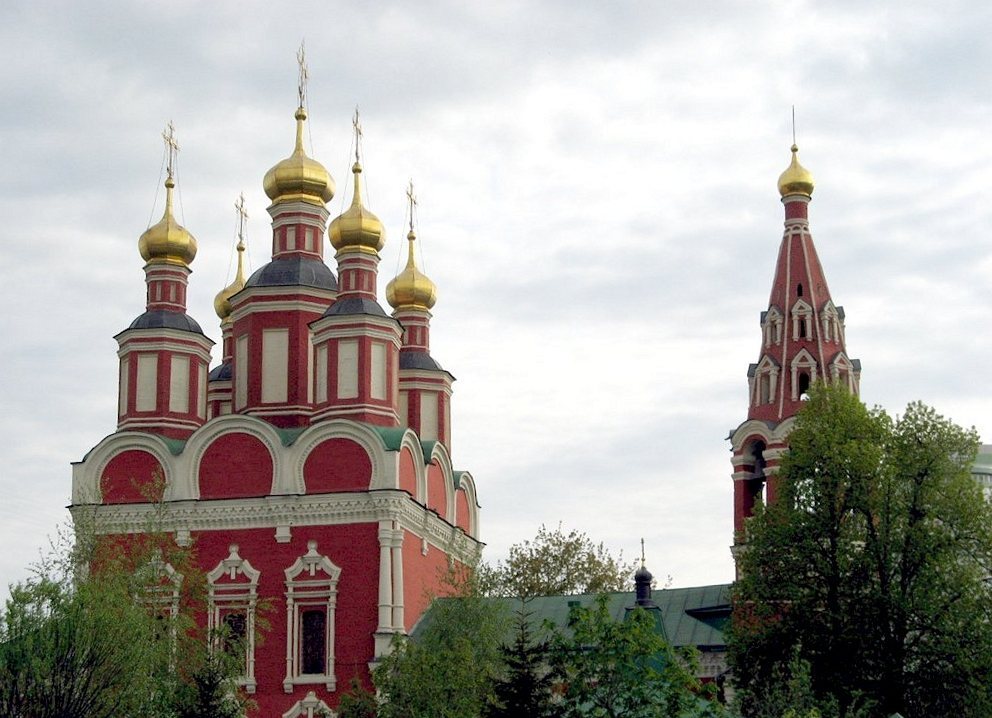
The central block is a tall, square space without internal pillars, with windows arranged in two vertical tiers and a three-part apse, the projecting end containing the altar area. Five domes crown the building. Decorative arched roofline forms, called kokoshniks, imitate zakomaras, curved gable-like roof endings. The dome supports, or drums, rise in two tiers: larger octagonal lower sections carry small domes, while miniature octagonal drums above them support small, faceted gilded cupolas. The domes and crosses are gilded.
Facade
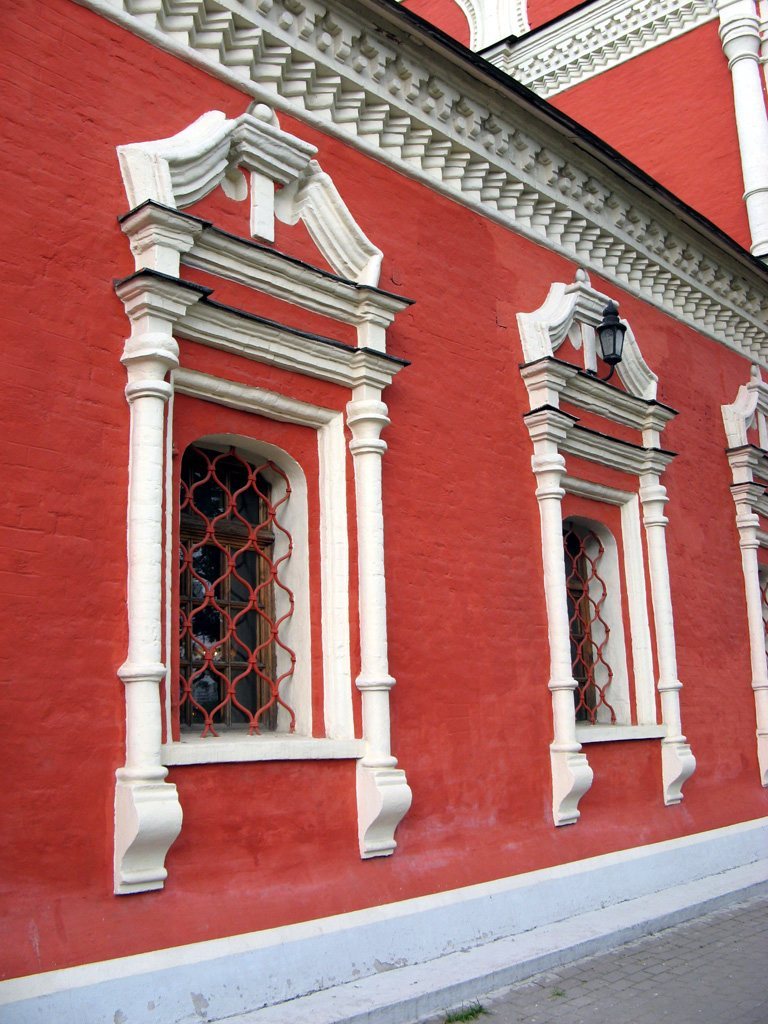
The facade combines elaborate decoration with forms associated with rural churches. Carved surrounds frame the windows, and a broad frieze runs below imitation curved gable forms. Columns ornament the corners and divide the semicircular sections of the apses.
Altars and icons
The church has one iconostasis, the screen of icons separating the sanctuary from the main worship space. Copies of the Don and Smolensk icons of the Virgin Mary stand on either side of its central Royal Doors, which lead into the sanctuary. The refectory contains two side altars, dedicated to the Procession of the Precious Wood of the Life-Giving Cross, an Orthodox feast centered on veneration of the Cross, and to the martyr Charalambos. Other venerated images include Anna Kashinskaya; It Is Truly Meet, honored on 24 June; Unfailing Cup, honored on 18 May; Nicholas the Wonderworker, on 22 May and 19 December; George the Victorious, on 6 May; and Matrona of Moscow, on 2 May. The Don and Smolensk icons are honored on 1 September and 10 August, respectively.
Relics
An 18th-century icon incorporates a reliquary cross, a container for relics, and depicts the saints whose relics it holds. They include the apostles Peter, Paul and James; Stephen the Apostle and Archdeacon; Nicholas the Wonderworker; John the Merciful; Grand Prince Alexander Nevsky; Daniel of Moscow; Sergius of Radonezh; Alexander of Svir; and Panteleimon the healer. Relics of Anna Kashinskaya and Charalambos are also among the objects specially venerated at the church.
Bell tower
The tower has two square stages supporting an octagonal open bell chamber, which is capped by a tent-shaped roof with dormer openings. Its decorative scheme recalls mid-17th-century Moscow ornamental architecture, an earlier Russian style known for elaborate detail. The tower may predate the main church and may be the oldest part of the complex. Interrupted cornices where it meets the refectory’s western wall are cited as evidence of its earlier construction. The bell collection includes new bells cast at a Ural factory during the church’s revival in the late 1980s. It also includes an older bell that parishioners concealed during the closure and that was kept at a theater opposite the church until 1989.
Church grounds
Gates and community buildings
The gates of the former enclosure survive on the grounds. Later additions include a clergy house containing a baptismal church and a library, as well as a Sunday school.
Chapel and memorial
A chapel dedicated to Saint Vitaly is used for memorial services after morning worship. On the eastern side of the grounds, a memorial sign commemorates Troparyovo villagers who died in the Second World War.