Church of the Assumption of Mary in Gliwice: A Historic Wooden Parish Church


Site at a Glance
- Rating
- 4.6
- Popularity
- Low
- Country
- Poland
- Primary era
- Medieval
- External website
- Open
- Eras represented
- Medieval, Early Modern, Modern
- Civilizations
- German, Habsburg, Holy Roman Empire
- Site type
- Religious
- Remains
- Church
On this page15 sections
History
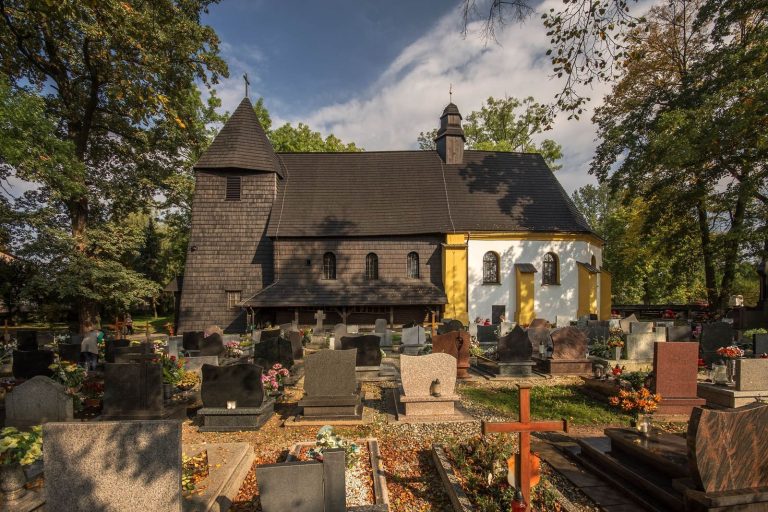
The Church of the Assumption of Mary in Gliwice, Poland, is a Roman Catholic wooden church probably built in 1493 in the historic wooden-building tradition of Upper Silesia. It originated in Zębowice near Olesno and is regarded as one of the oldest surviving log-built structures in the region. Today it belongs to the parish dedicated to the Assumption of the Blessed Virgin Mary and is part of the Diocese of Gliwice, a territorial jurisdiction overseen by a bishop.
Early history and Baroque alterations
The earliest surviving description of the church dates from 1679. It mentions a free-standing bell tower and painted interior decoration. During the seventeenth and eighteenth centuries, the building was altered and received Baroque elements. In 1777, the carpenter Wojciech Kokot added a new tower to the nave. The interior was further enriched during the eighteenth century, and Johann Gaida produced new painted decoration in 1878.
The church also bears evidence of the violence of the Third Silesian Uprising. An artillery shell entered from the side of the presbytery, the part of the church surrounding the main altar. It passed near the high altar, pierced the balustrade of the music gallery and the organ, and lodged in a transverse beam. The shell did not explode and was discovered when the church was later dismantled.
Transfer to Gliwice
A new brick church was built in Zębowice in 1911, after which the wooden church was sold to the municipal authorities of Gliwice. In 1925, it was moved to the city’s Central Cemetery and reconstructed under the direction of Robert Josefek, with supervision by the municipal architect Karl Schabik. Karol Platzek transferred the painted decoration from the walls and ceilings. The church was reconsecrated on 12 September 1925 and entered use in 1926 as an auxiliary funeral chapel and place of prayer.
The building gradually deteriorated because it was not adequately maintained. It was closed for liturgical ceremonies toward the end of the 1970s, although parish authorities had sought its renovation since 1960. After 1989, the municipal authorities decided to rescue the monument, which had by then reached a state of complete ruin.
Reconstruction and parish use
In 1992, the church was dismantled and its individual elements were conserved. The transfer to a new location began in 1997, and the building was reconstructed between 1998 and 2000 on the grounds of the former Starokozielski Cemetery, now within Starokozielski Park. The work was completed through the efforts of the municipality and the Diocese of Gliwice.
On 15 August 2000, Bishop Jan Wieczorek consecrated the reconstructed church. It then functioned as a rectoral church, meaning that it was placed under the care of a rector rather than serving as the seat of a parish. After a new parish dedicated to the Assumption of the Blessed Virgin Mary was established on 1 July 2004, the church became its parish church.
The transfer from Zębowice included the crypt and the coffins of the church’s founders. In 1927, three bells and a new organ were ceremonially consecrated. The bells were named Saint Mary, Saint Josephus, and Saint Maximilianus. The Marian bell was dedicated to those killed in the First World War and carried a commemorative inscription. The church is included in the Wooden Architecture Trail of Silesian Voivodeship and is entered in Poland’s register of cultural monuments under registration numbers 322/60, dated 7 March 1960, and A/539/2019, dated 22 August 2019.
Remains
The church is a single-nave, non-oriented wooden building. Its higher nave is followed by a narrower presbytery aligned toward the northwest rather than the east. The nave and presbytery use log construction, with horizontally laid interlocking oak and pine timbers, while the tower uses post construction. The surviving building combines its medieval wooden core with later Baroque changes and the results of twentieth-century reconstruction.
Exterior structure
Nave and presbytery
The nave contains a music gallery, and a sacristy adjoins the presbytery. Above the sacristy is a patron’s gallery, an elevated space historically associated with the founder’s or patron’s private participation in services. The nave and presbytery are covered by shingled gable roofs, while their walls are also protected with shingles.
Western tower
A single rectangular wooden tower is attached to the western front of the nave. It contains the bell stage and is crowned by an onion-shaped dome with a lantern. The tower holds the 1927 bell identified as Maximilian. A smaller lantern-like roof turret with an onion dome rises above the nave and serves as a bell turret.
Interior furnishings and decoration
Altars and devotional features
The eighteenth-century Baroque high altar contains an image of Our Lady of the Scapular and sculptures of Saints Peter and Paul. Two nineteenth-century side altars stand within the church. The left altar contains an image of Saint Bridget, while the right shows Saint Anne teaching Mary. These side altars are Classical in style. The altars were transferred from Zębowice along with the building.
Organ, pulpit, and holy-water stoups
The interior contains an eighteenth-century organ with a restored case, as well as a pulpit and two eighteenth-century holy-water stoups. These furnishings were also moved from Zębowice. The organ was damaged when the unexploded artillery shell entered the church during the Third Silesian Uprising, and the shell later remained lodged in a transverse beam until the building was dismantled.
Painted decoration
Painted decoration covers the interior walls and ceilings. The eighteenth-century polychromy, meaning painted architectural decoration, was recreated during the most recent restoration. Above the nave, the ceiling depicts the Eye of Providence, a Christian symbol of God’s watchful presence, surrounded by symbols from the Litany of Loreto. The presbytery ceiling shows the Coronation of the Virgin Mary, while the area above the patron’s gallery depicts Saints Victor and Amelia.
Objects and cemetery setting
Transferred devotional sculpture
A wooden figure of Ecce Homo, a Christian image of Christ presented before the crowd before his crucifixion, dates from 1505 and also came from Zębowice. It is now located in the former Cistercian monastery-and-palace complex at Rudy rather than inside the church.
Former Starokozielski Cemetery
The church stands on the preserved part of the former Starokozielski Cemetery. Its surroundings contain a small number of surviving gravestones, the Chapel of Saint Hyacinth, a cross bearing a figure of Christ, a statue of the Virgin Mary, and numerous trees.