Church of John the Baptist in Narzym: A Teutonic Order Church in Poland


Site at a Glance
- Rating
- 4.6
- Popularity
- Very Low
- Country
- Poland
- Primary era
- Medieval
- External website
- Open
- Eras represented
- Medieval
- Civilizations
- Teutonic Order
- Site type
- Religious
- Remains
- Church
On this page8 sections
History
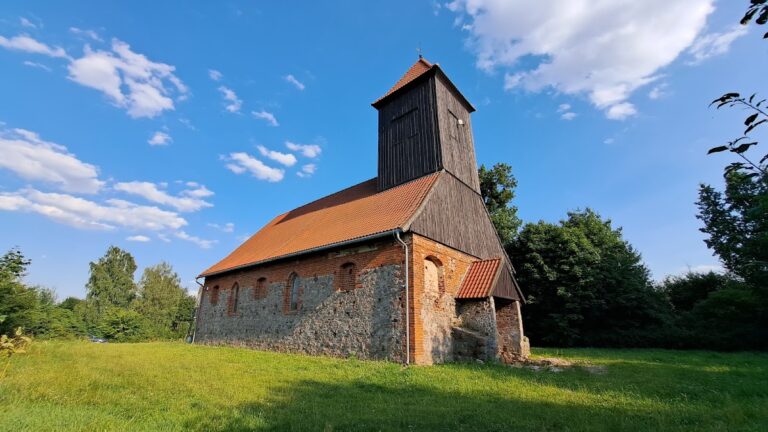
The Church of John the Baptist in Narzym is a medieval church in Poland, built before 1400 in the construction tradition of the Teutonic Order. Its foundations belong to the fourteenth century, and a church already stood there shortly after the village was founded. Historically known as Wildenau, the church was rebuilt and renewed through several later phases while retaining lower wall sections from its earlier structure.
Teutonic and Lutheran foundations
A fire in 1410, during the wider conflict associated with the Battle of Tannenberg between the Teutonic Order and a Polish-Lithuanian alliance, led to rebuilding at the end of the fifteenth century. The work used the lower portions of the earlier walls that had survived. The Reformation, the sixteenth-century movement that established Protestant churches, brought the church into Lutheran use in the Duchy of Prussia. The first Lutheran clergyman served there until 1536.
The church initially stood under aristocratic patronage. In 1591, the Catholic patron appointed Marcus Hirschberger, a clergyman of that confession, after which territorial authorities took control of the patronage. Bartholomäus Eichler served until 1603, followed by Andreas Cassobowius, Paul Millossius, Matthias Langius, Christoph Langius, Andreas Slopianka, Matthias Kobylenski, Johann Friedrich Jackstein, Andreas Trojan, Ernst Philipp Alexius, Paul Samuel Paulini, Samuel Marcus, Johann Carl Hagenau, Karl Theodor Dopatka, Friedrich Wilhelm Boettcher, Georg Wilhelm Braun, Friedrich Benjamin Moeller, Eman. Ed. Moritz Rekoß, Adolf Gustav Jacobi, Hermann Heinrich Tomuschat, Emil Hugo Louis Siedel, Julius Ad. G. von Popowski, Reinhold Hugo Wilhelm Link, August Julius Horn, Otto Emil Rauch, Carl Heinrich Heldt, Hermann Wilck, Erwin Horn, and Walter Bernhard Zwirner. Their recorded terms extended from the sixteenth century to 1945.
Parish changes and postwar use
Until 1923, Narzym belonged to the Neidenburg church district within the East Prussian ecclesiastical province of the Church of the Old Prussian Union. It entered the newly created Soldau church district in 1910. In 1923, congregations in the Soldau area were transferred to the Działdowo Diocese of the United Evangelical Church in Poland. Before 1945, the Narzym parish included the village and twelve villages or settlements.
The Second World War, followed by the flight and expulsion of the population, ended the local Protestant congregation. Before 1945, Narzym also belonged to the Roman Catholic parish of St. Adalbert in Soldau. After the war, Roman Catholic church members took the former Protestant church for their worship. It was dedicated to John the Baptist and initially served as a filial church, meaning a church dependent on a larger parish, at Iłowo-Osada. Narzym became an independent parish in 1963 and now belongs to the Działdowo Deanery, the Brodnica region, and the Diocese of Toruń. The building was adapted for Roman Catholic worship after 1945, followed by a major restoration in 1980.
Remains
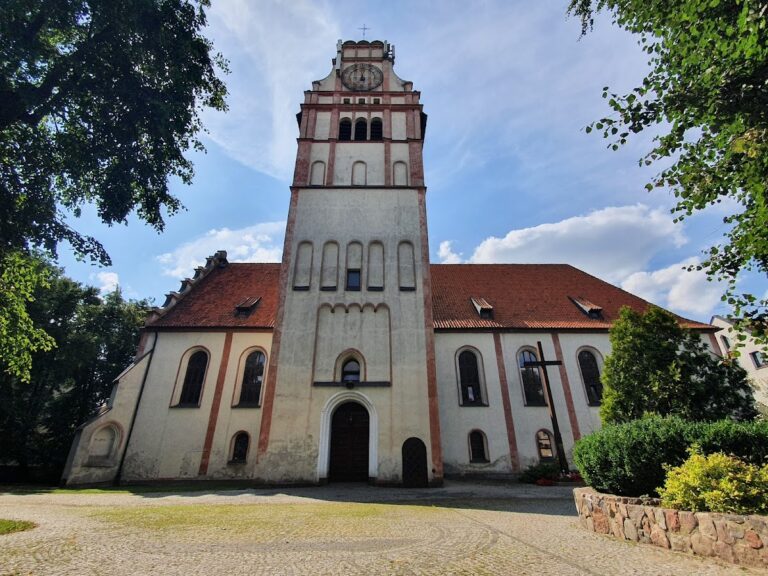
The church stands in the centre of Narzym at the corner of Robotnicza Street and Wierzborska Street. It is a fieldstone-and-brick building whose present form incorporates lower wall sections from the medieval church. Later rebuilding and renewal altered the structure, while plaster applied across the building in the mid-nineteenth century gave its exterior a unified finish.
Medieval structure and tower
Gothic entrances
Two Gothic entrances remain on the south and west sides. Their pointed arches belong to the medieval construction tradition, as did the pointed-arched window openings formerly used by the church. At the west end, a three-storey stone tower forms the principal vertical element. A Prussian eagle stood on its summit for several decades.
Interior and furnishings
The interior is covered by a flat ceiling, while the chancel has a plain ceiling. A simply made wooden pulpit dating from around 1700 formerly stood above the altar. The wooden baptismal font has a pewter bowl, preserving a material link with the church’s changing liturgical history.
Organ and bells
A small new organ made by the organ builder Zielinksi was installed in 1818. In 1911, the church acquired an instrument made by Carl Novak of Klein Jerutten, which was severely damaged during the Second World War. The present peal consists of two bells cast in Danzig in 1927. The original pair had been cast in Elbing in 1650, with diameters of 2 feet 2 inches and 2 feet, and was lost during the First World War.