Mönchskirche: The Ruined Franciscan Monastery Church in Bautzen


Site at a Glance
- Rating
- 4.4
- Popularity
- Very Low
- Country
- Germany
- Primary era
- Medieval
- Eras represented
- Medieval, Modern
- Civilizations
- German, Holy Roman Empire, Kingdom of Bohemia
- Site type
- Religious
- Remains
- Church
On this page12 sections
History
Mönchskirche is the surviving ruin of a former Franciscan monastery church in Bautzen, Germany. Built from around 1240 in the early Gothic period, it formed part of a Franciscan complex southeast of the Ortenburg, the city’s historic castle. The church was dedicated to the Virgin Mary and became an important religious, administrative, and social center in Bautzen’s old town. It is also known by the Sorbian name Mniša cyrkej.
Foundation and Franciscan administration
Construction of the church and monastery began around 1240. Local tradition associates the donation of the site with members of the landed nobility, including Thiesko von Pannwitz. A note in the Görlitz necrology names Brandenburg Margrave Otto the Pious as a supporter of the foundation. Since Otto acquired the Bautzen and Lusatian territories only between 1243 and 1253, preparations for the project probably continued during that period.
In 1248, Pope Innocent IV granted a forty-day indulgence, a formal remission of temporal punishment associated with sin in medieval Catholic practice, to those who contributed to completing the church and other monastery buildings. The church was therefore finished after 1248. The monastery belonged to the Franciscan province of Bohemia, an administrative region of the order established in 1239, and became the seat of its own custodia, or provincial subdivision. Continuing national tensions led to its temporary removal from Bohemia in 1263 and its definitive incorporation into the Franciscan province of Saxonia in 1274.
Religious and civic life
The monastery served a broad local community. Citizens, craftsmen, patricians, and nobles were buried in the church and its precinct. Bishop John III of Meissen reportedly withdrew to Bautzen in 1398 after conflicts with his cathedral chapter and requested burial in the church, where he was interred in 1408. Sermons were delivered in Sorbian, while numerous donations reflected the friars’ standing among the population.
The monastery’s refectory, or communal dining hall, hosted assemblies of the regional nobility. The bailiff also pronounced judgments there during court proceedings. The Franciscans maintained a house of studies for members preparing to enter the order and possessed houses, woodland, interest income, and regular payments in grain, herrings, and other foodstuffs. They held the right to use, but not own, the so-called Monks’ Sheep Farm, where cattle, pigs, sheep, and chickens were kept for their needs. The church also possessed liturgical equipment, some of it expensive.
The friars’ presence in the city caused disputes with the secular clergy, the diocesan priests serving under a bishop rather than belonging to a religious order. The main disagreements concerned fees for baptisms, marriages, and burials, which the secular priests had to share with the Franciscans. The friars received support from Bishop John III and appealed to Pope Sixtus V in the continuing conflict.
Fire, reform, and internal change
The entire monastery burned on 1 August 1401 and was rebuilt. A second fire in 1441 destroyed the church roof. In 1479, twenty friars died during a plague outbreak, an indication that the convent had a considerable community. The monastery hosted the provincial chapter, the governing assembly of friars from a Franciscan province, seven times for the Saxon province.
Religious reform also affected the community. Johannes Capistranus, a Franciscan preacher and reformer who advocated strict observance of the order’s rule and its vow of poverty, visited Bautzen in 1453. He did not persuade the friars to change their attitude toward property. In 1492, the Bautzen Franciscans adopted the Martinian Constitutions, Franciscan regulations associated with Pope Martin V that allowed a moderated interpretation of the order’s traditional commitment to poverty. Their implementation proceeded slowly.
Dissolution and destruction
The monastery was dissolved during the first half of the sixteenth century as a consequence of the Reformation, the movement that challenged Catholic authority and practices and brought major religious and institutional changes across central Europe. From 1532, the city magistrate pressured the friars by withholding interest payments and other obligations and by appropriating monastery properties within the city. Two friars still lived at the monastery in 1558. In 1562, Michael Pollmann transferred its possessions to the Bautzen cathedral chapter. Before the final destruction, the complex also housed five Benedictine nuns from the dissolved Holy Cross monastery in Meissen.
On 2 July 1598, a fire that began in a neighboring house destroyed the monastery and church. Neither was rebuilt. The city council halted the dismantling of the monastery walls in 1620, after the process had already begun. During the period after the fire, and especially during the Thirty Years’ War from 1618 to 1648, impoverished residents settled among the ruins and built makeshift dwellings. This settlement was known as the Budenstadt or Mönchskirchensiedlung. In 1893, it contained eighteen houses and fifty-three households. A fire beginning in the house called Burglehn on 10 February 1894 spread rapidly through the church area and destroyed these dwellings.
Water installation and later preservation
In 1877, the city installed a water-storage facility in the western part of the old church ruin. The installation was decommissioned in 1979. Extensive securing and renovation in 2016 and 2017 adapted part of the tank floor for access by a staircase, allowing the structure to be used again. The water tower opened to the public for the first time in 2018. Several legends also remain associated with the former monastery, church, and settlement.
Remains
Mönchskirche survives as an early Gothic brick ruin within the former monastery site southeast of the Ortenburg. The church formed part of a larger complex of buildings and courtyards. Its surviving fabric includes pointed-arch windows and a portal, while the western section contains the later water tower and its storage tank. The church was described as Bautzen’s only brick-built church and as the southernmost monumental brick building extending from the North German Plain toward the mountains.
Church ruin
The church remains are constructed in brick and preserve the characteristic pointed-arch openings of the early Gothic period. The surviving portal and windows express the building’s medieval ecclesiastical function, while the ruin form reflects the destruction of the church in the fire of 1598 and its subsequent non-reconstruction. The church and monastery precinct also contained burial areas used by townspeople, craftsmen, patricians, nobles, and Bishop John III of Meissen.
Water tower
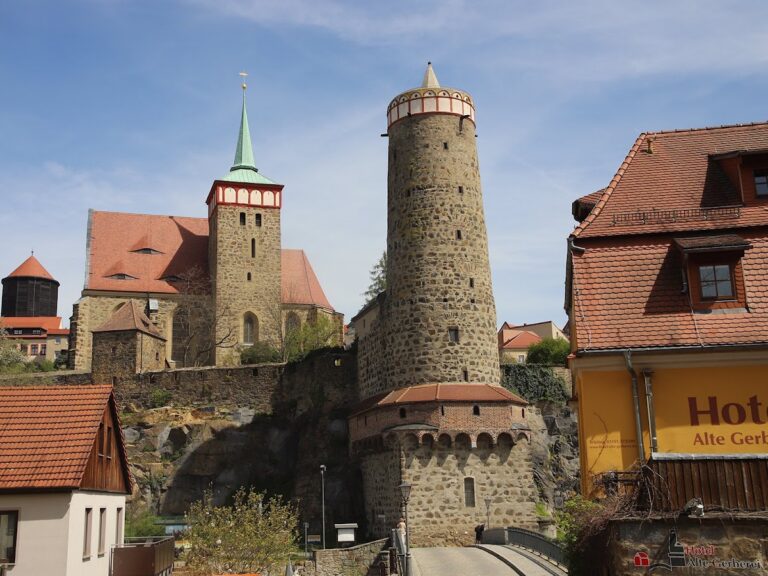
The western part of the ruin contains the water tower installed in 1877. Its tank held approximately 1,000 cubic metres of water. Wooden cladding on the upper section has been in place since 1936. Later work secured and renovated the installation, including the insertion of a stair-accessible opening through part of the tank floor. This arrangement incorporates a nineteenth-century municipal utility into the surviving medieval church structure.
Monastery buildings and precinct
Refectory and study house
The monastery precinct included a refectory used for noble assemblies and court proceedings, as well as a house of studies for friars preparing to enter the order. These buildings belonged to the wider complex of structures and courtyards associated with the church.
Residential and agricultural facilities
Residential and agricultural facilities supported the Franciscan community. The friars used houses and woodland, received food payments including grain and herrings, and had use of the Monks’ Sheep Farm. Livestock kept for their needs included cattle, pigs, sheep, and chickens. The precinct also held burial areas and church furnishings connected with its religious role.