Church of St. Vincent: Greek Catholic Cathedral in Wrocław


Site at a Glance
- Rating
- 4.8
- Popularity
- Low
- Country
- Poland
- Primary era
- Medieval
- External website
- Open
- Eras represented
- Medieval, Early Modern
- Civilizations
- Habsburg, Holy Roman Empire, Kingdom of Bohemia
- Site type
- Religious
- Remains
- Cathedral
On this page9 sections
History
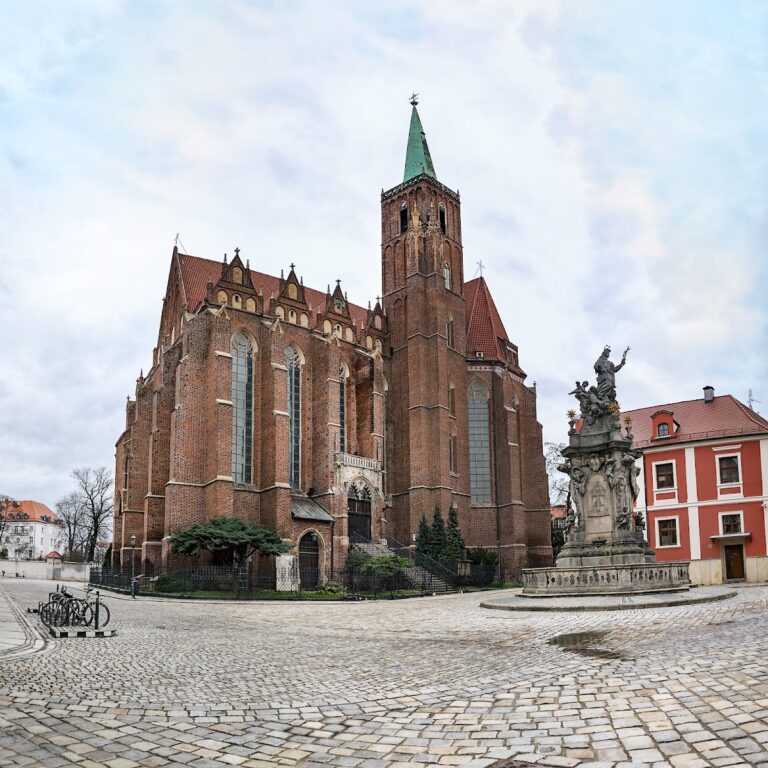
The Church of St. Vincent is a brick church in Wrocław, Poland, founded for Franciscans around 1240 in the predominantly Gothic form developed through later medieval rebuilding. The friars had been brought from Prague by Duke Henry II the Pious with the support of his family. Their presence in Wrocław is recorded by 1234, while a Franciscan provincial chapter met in the city in 1239.
Franciscan foundation and medieval development
The foundation may have taken place as early as 1232 or 1234. The first church was dedicated to St. James and built in the Romanesque style. It was described as completed by 1254, and its crypt became the burial place of Henry II, who was killed fighting the Mongols at the Battle of Legnica in 1241.
The church also witnessed an important event in the civic history of Wrocław. On 16 December 1261, the charter establishing the city’s New Town under Magdeburg Law was proclaimed there in the presence of Duchess Anna of Bohemia and her sons Henry III and Władysław of Silesia. Magdeburg Law was a system of municipal law used to organize towns across Central and Eastern Europe.
Major reconstruction and expansion continued during the fourteenth and fifteenth centuries. The work advanced slowly and intermittently because funds were limited, but these successive campaigns transformed the building from its Romanesque beginnings and gave it the predominantly Gothic character associated with the church today.
From the Franciscans to the Premonstratensians
At the beginning of the sixteenth century, most of the Franciscans either adopted Protestantism or departed from Wrocław. The remaining friars moved to St. Dorothy’s Church in 1529. The abandoned building was then taken over by Premonstratensians, also known as Norbertines, who had been transferred from their monastery at Ołbin after the city council ordered that monastery demolished.
On 3 June 1530, the new occupants rededicated the church to St. Vincent of Saragossa, a Christian deacon and martyr of the early fourth century who was venerated as a Catholic saint. The dedication recalled the patron of the Premonstratensians’ former monastery. Their period of occupation brought further changes to the building and its furnishings.
Between 1619 and 1625, the rood screen, the partition separating the nave from the chancel, and part of the Romanesque crypt were demolished. A rich Baroque interior was created between 1662 and 1674, including a new high altar made in 1667 by Franz Zeller and Georg Czermak. Baroque architecture and art are characterized by elaborate ornament, dramatic spatial effects, and richly furnished interiors. Abbot Andreas Gebel began the Baroque rebuilding of the monastery in 1673.
Secularization and wartime destruction
The Premonstratensian order was secularized in 1810. The church became a parish church, while the adjoining monastery buildings were converted into court offices. The building retained memorials to members of the Premonstratensian community and to prominent figures connected with the former duchy.
During the final days of the Second World War and the Siege of Breslau, the church suffered severe damage. Its tower collapsed, bringing down part of a side wall and sections of the vaults. Most of the interior furnishings were destroyed or looted, and the Hochberg Chapel was burned during a raid on Easter Sunday in 1945.
The church’s three-bell peal was also removed during the war and taken to Hamburg for metal production. The bells were not melted down. They are now used by St. Antonius Church in Lippstadt, while two smaller bells taken to Hamburg form part of the Memorial of the German East at Burg Castle in North Rhine-Westphalia.
Reconstruction and Greek Catholic cathedral
After the war, the Polish state took over the church and considered establishing a museum there. Reconstruction began in 1947 and continued for more than forty years. The restored church was reconsecrated in 1991 and temporarily served as a garrison church while St. Elizabeth’s Church was rebuilt after a fire.
In 1997, Pope John Paul II and Cardinal Henryk Gulbinowicz transferred the church to the Greek Catholic Church as the seat of the Wrocław-Gdańsk Eparchy. An eparchy is the equivalent of a diocese in several Eastern Christian churches. By the end of the 1990s, the church had become the cathedral of the Wrocław-Koszalin Eparchy. The Wrocław Greek Catholic parish itself had existed since 1956.
Final restoration work, including the relaying of the roof, took place between 1997 and 1999. Together with Wrocław’s Old Town, the church forms part of a Historic Monument of Poland designated in 1994.
Remains
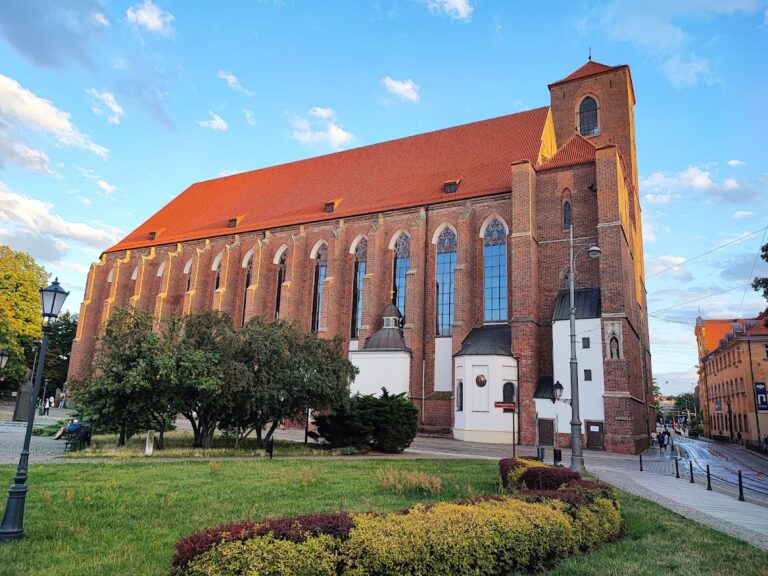
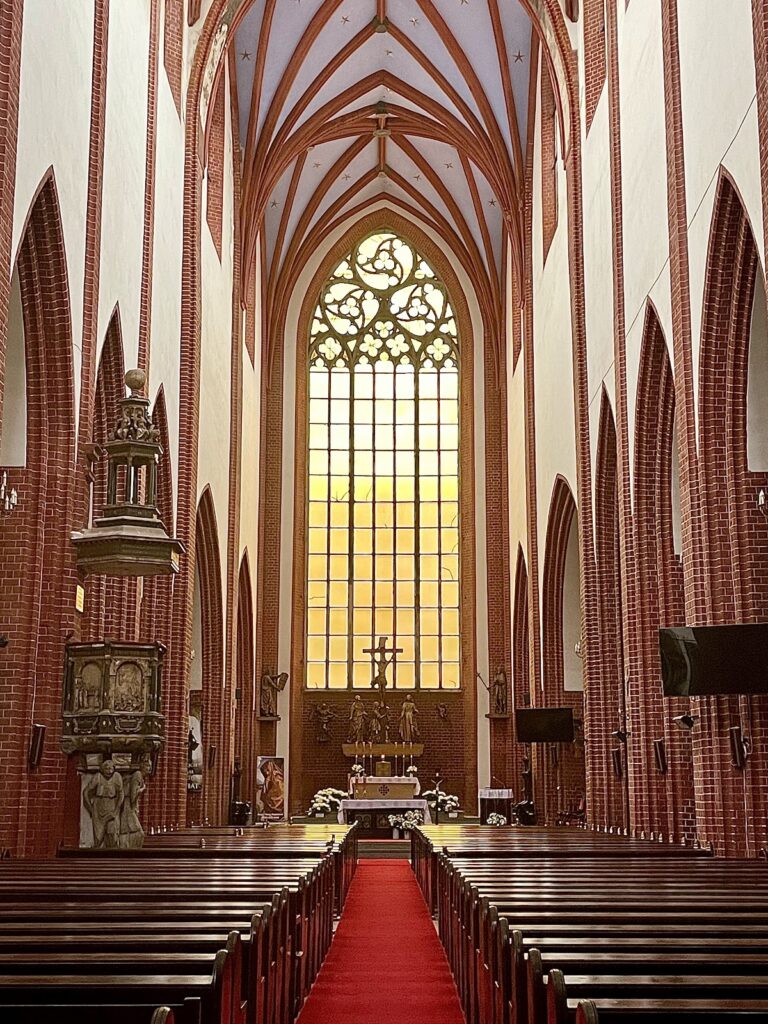
The surviving church is a brick structure whose long main nave measures 77.5 metres and rises 23 metres high. Its medieval plan developed from a three-aisled hall with a chancel of one or two bays. A quadrangular monastery complex adjoins the church on the north, an arrangement described as unusual in this part of Europe. The tower, sections of the side wall and vaults, and much of the interior were reconstructed after the wartime destruction; the tower’s lantern and cupola were rebuilt during the 1980s.
Church and monastery complex
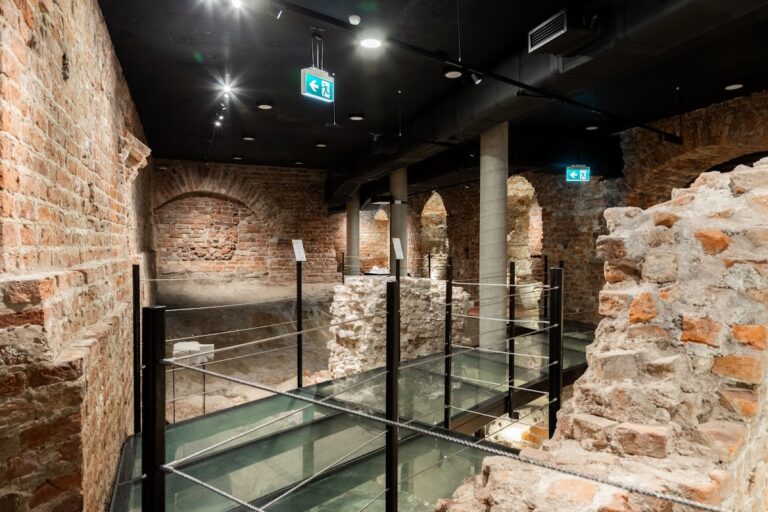
The church’s fabric preserves the result of several building phases. The original Romanesque foundation was enlarged and altered during the fourteenth and fifteenth centuries, producing the predominantly Gothic building. The northern monastery complex forms a quadrangular group against the church. Burial monuments and epitaphs commemorate Premonstratensian abbots, as well as Wilhelm Borek von Rostropitz, who died in 1641 after serving as governor of the Duchy of Wrocław, and Martin Maximilian von Wackerle, who died in 1705.
Hochberg Chapel
The late Baroque Hochberg Chapel stands against the southern side of the church. It was built between 1723 and 1727 on the foundations of an earlier Gothic chapel and designed by Christoph Hackner as a mausoleum for Count Ferdinand Hochberg, a Premonstratensian abbot. Hochberg was never buried there. The chapel’s decoration includes frescoes, stucco, sculptures, carved stone ornament, and an elaborate wrought-iron grille and gate made by the locksmith Jacob Meyer.
Scenes from the life of the Virgin Mary, including the Seven Sorrows of Mary, decorate the dome frescoes. Johann Georg Urbansky, Johann Adam Karinger, and other artists and craftsmen contributed to the sculptural and decorative work. A fifteenth-century Pietà, showing the Virgin Mary mourning the dead Christ, formerly stood on the altar. The original is now held by the National Museum in Wrocław, while the chapel contains an exact copy.
The chapel was heavily damaged in 1945. Part of its vault and dome structure collapsed or cracked, most of the fresco-covered plaster fell away, and the crypt beneath it also collapsed. More than 90 percent of the fresco surface and most of the wall decoration were destroyed. The interior was reconstructed between 2000 and 2013, including the stucco and painted decoration of the vaults. The reconstructed altar was assembled from 1,300 fragments recovered from the rubble.
In 2023, a statue head identified as the head of St. Anne from a sculpture formerly in the chapel was rediscovered in the collections of the Catholic University of Lublin. It had been incorrectly identified after the war, deposited in the Archdiocesan Museum, and transferred to Lublin in 1956.
Choir stalls and bells
The surviving choir stalls remained in good condition after the wartime destruction and were transferred to the cathedral choir. The church’s bells followed a different postwar history. The three-bell peal removed during the Second World War now serves at St. Antonius Church in Lippstadt, while two smaller bells are preserved at the Memorial of the German East at Burg Castle in North Rhine-Westphalia.
Nearby sites