Church of St. Mary of the Angels: A Camaldolese Monastery Complex in Florence
Site at a Glance
- Rating
- 4.7
- Popularity
- Very Low
- Country
- Italy
- Primary era
- Early Modern
- Eras represented
- Medieval, Early Modern, Modern
- Civilizations
- Grand Duchy of Tuscany, Republic of Florence
- Site type
- Religious
- Remains
- Monastery
On this page17 sections
History
The Church of St. Mary of the Angels is a former Roman Catholic Camaldolese church in Florence, Italy, founded as part of a monastery in 1295 by the poet Guittone d’Arezzo. The Camaldolese, a reformed branch of the Benedictine order, combined solitary life in individual cells with communal religious practice. The institution developed at Cafaggio, outside Florence’s second ring of walls and near the former Balla Gate, becoming an important religious, artistic, and intellectual center.
Foundation and monastic development
Guittone, a thirteenth-century poet and member of the Order of the Friars of the Blessed Virgin Mary, established the foundation after land had been acquired from the Alluodi family around 1294. Formal construction began on 14 January 1345 in the presence of the Florentine Signoria, civic magistrates, clergy, and the Camaldolese monk Orlando, who represented the order’s prior general, Fridiano. The institution was modeled on the Camaldolese Hermitage at Camaldoli. Its arrangement included separate monastic cells, each with a small garden, a roof window for light, and another opening through which food could be passed.
The hermitage and its adjoining oratory were dedicated to Saint Mary of the Angels. Houses formerly belonging to the Alfani and Adimari families were incorporated into the complex in 1348. By 1332, the monastery had a scriptorium, a monastic writing room where manuscripts were copied and decorated. It later became known for high-quality manuscripts and for a celebrated school of miniature painting, whose leading figures included Lorenzo Monaco. The monks also worked as scholars, calligraphers, painters, illuminators, metalworkers, goldsmiths, and embroiderers, copying ancient Greek and Latin texts and producing works that brought revenue to the monastery.
Conflict and cultural prominence
The monastery was looted during the Ciompi revolt of 1378, an uprising by Florence’s lower and working groups against the city’s governing elite. A crowd led by Cecco da Poggibonsi entered the complex, killing the vice-prior and two lay brothers. Manuscripts kept in the sacristy survived because Guido del Palagio and Vieri de’ Medici organized a defense. The monastery had also served as a repository for the wealth of many prosperous citizens.
During the first half of the fifteenth century, Santa Maria degli Angeli became an important setting for humanist Florence. Ambrose Traversari, a Camaldolese monk, theologian, humanist, and prior general of the order, hosted gatherings attended by Cosimo de’ Medici, Giovanni de’ Medici, the future Pope Leo X, Lorenzo de’ Medici, Luchino Visconti, Marsilio Ficino, Niccolò Niccoli, and Paolo Toscanelli dal Pozzo. Traversari also helped Niccolò de’ Niccoli acquire manuscripts that later entered the library at San Marco. The Codex Squarcialupi, probably written at the monastery between 1410 and 1415, remains an important source for the study of fourteenth-century Italian music.
Renaissance building projects and later changes
In 1434, the Medici family commissioned Filippo Brunelleschi, the Florentine architect and engineer central to the development of Renaissance architecture, to design an oratory for the monastery. Construction stopped in 1437 after the Florentine government seized funds intended for the church to help finance the war against Lucca. Archbishop Antoninus Pierozzi, also known as Saint Antoninus of Florence, consecrated the church on 14 September 1445.
The complex was enlarged toward the end of the sixteenth century while retaining much of its earlier appearance, especially its large cloisters. It was modernized during the seventeenth century by Gherardo Silvani and Bartolomeo Ammannati. Between 1654 and 1670, the Florence Monastery of the Angels meteorological station made observations and kept temperature records. The station is described as one of the oldest meteorological stations in the world. The adjoining street was called Via degli Angioli for four centuries before being renamed Via degli Alfani in 1865.
Francesco Franchi restored the church in 1676, and Giuseppe del Rosso frescoed its walls in 1820. The church and its annexes also hosted religious confraternities, including the Company of Saint Joseph of the Woodworkers.
Suppression, institutional reuse, and recovery
Napoleon suppressed the monastery and church in 1808, along with many other religious institutions. During the French occupation, Vivant Denon removed works of art from the Grand Duchy for shipment to France, including Taddeo Gaddi’s Triptych of the Life of Christ from Santa Maria degli Angeli.
After suppression, the complex was used by the Arcispedale of Santa Maria Nuova and was transferred to the University of Florence in 1940. University use began in 1964–1965, and the former church served as a lecture space for the Faculty of Letters and Philosophy. In the twenty-first century, the complex was progressively recovered for public use through the Florence branch of the National Association of Italian Mutilated and Disabled Veterans, which granted the Medici Museum use of long-unused historic rooms. The museum created a permanent museum route and carried out recovery and restoration work. The complex now forms part of the Medici Museum of Florence and includes a specialist library devoted to Medici history and the Renaissance, continuing the site’s long association with books and scholarship.
Remains
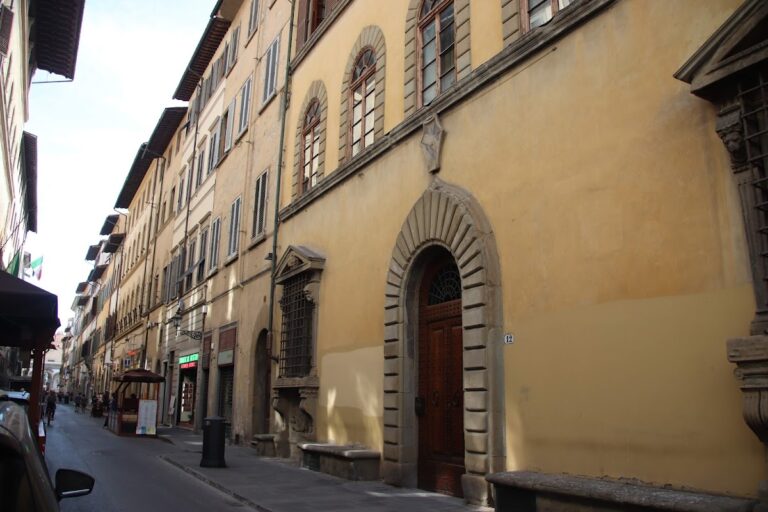
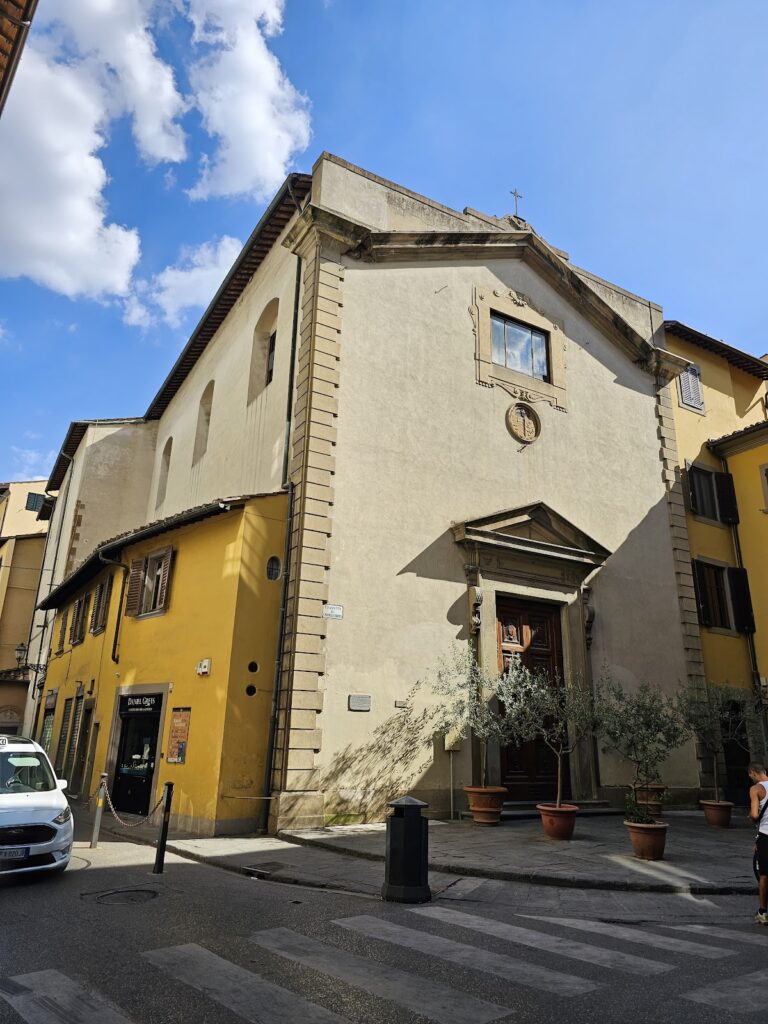
The former church is a small surviving part of the larger monastery complex and is entered from Via degli Alfani. Very little of the medieval church remains. The surviving spaces preserve later decoration, chapels, cloisters, tomb slabs, and architectural elements associated with the monastery’s long religious and scholarly history.
Church and chapels
Former church
The former church contained six altars. Its interior retains frescoes by Alessandro Gherardini dated 1700, illusionistic architectural painting by Giuseppe Tonelli, and several eighteenth-century paintings. The illusionistic decoration, known as quadratura, uses perspective to suggest three-dimensional architecture on a flat surface.
Ticci family chapel
The Ticci family chapel contains Giovanbattista di Bernardo Mossi’s The Resurrection of the Son of the Widow of Nain, an altar painting dated 1592. Its style combines features of early Florentine Mannerism with a Baroque manner influenced by Siena. The chapel also preserves frescoes by Bernardino Poccetti and paintings of Saint Matthew and Saint Francis attributed to Giovanni Balducci.
Chapel of the martyrs
A chapel beside the church formerly housed the relics of Saints Protus, Hyacinth, and Nemesius in a bronze urn cast by Lorenzo Ghiberti in 1428 at the expense of Cosimo de’ Medici and Lorenzo di Giovanni de’ Medici. The urn was later transferred to the National Museum of the Bargello.
Burial monuments
The church formerly contained the burials of the Spanish pseudocardinal Pedro Fernández de Frías, who died in Florence in 1420 while returning from the Council of Constance in the entourage of Pope Martin V, and the historian Benedetto Varchi, who died in 1566. Varchi’s tomb was found empty. Its tomb slab was moved to the Cloister of the Dead, where it remains visible beside the portal leading toward the Ammannati Cloister.
Monastic cloisters
Great Cloister
The Great Cloister, also called the Ammannati Cloister, occupies the former entrance area of the University of Florence’s Faculty of Letters on Piazza Brunelleschi. Traditionally associated with Bartolomeo Ammannati, it was actually designed by Matteo Nigetti. Its seventeenth-century portico has lowered arches. The cloister adjoins the Casa del Mutilato on its north side. On the right-hand wall, an entrance leads to the former church, which later became the Medici Library and held the original manuscripts of Scipione Ammirato’s Florentine Histories.
Cloister of the Angels
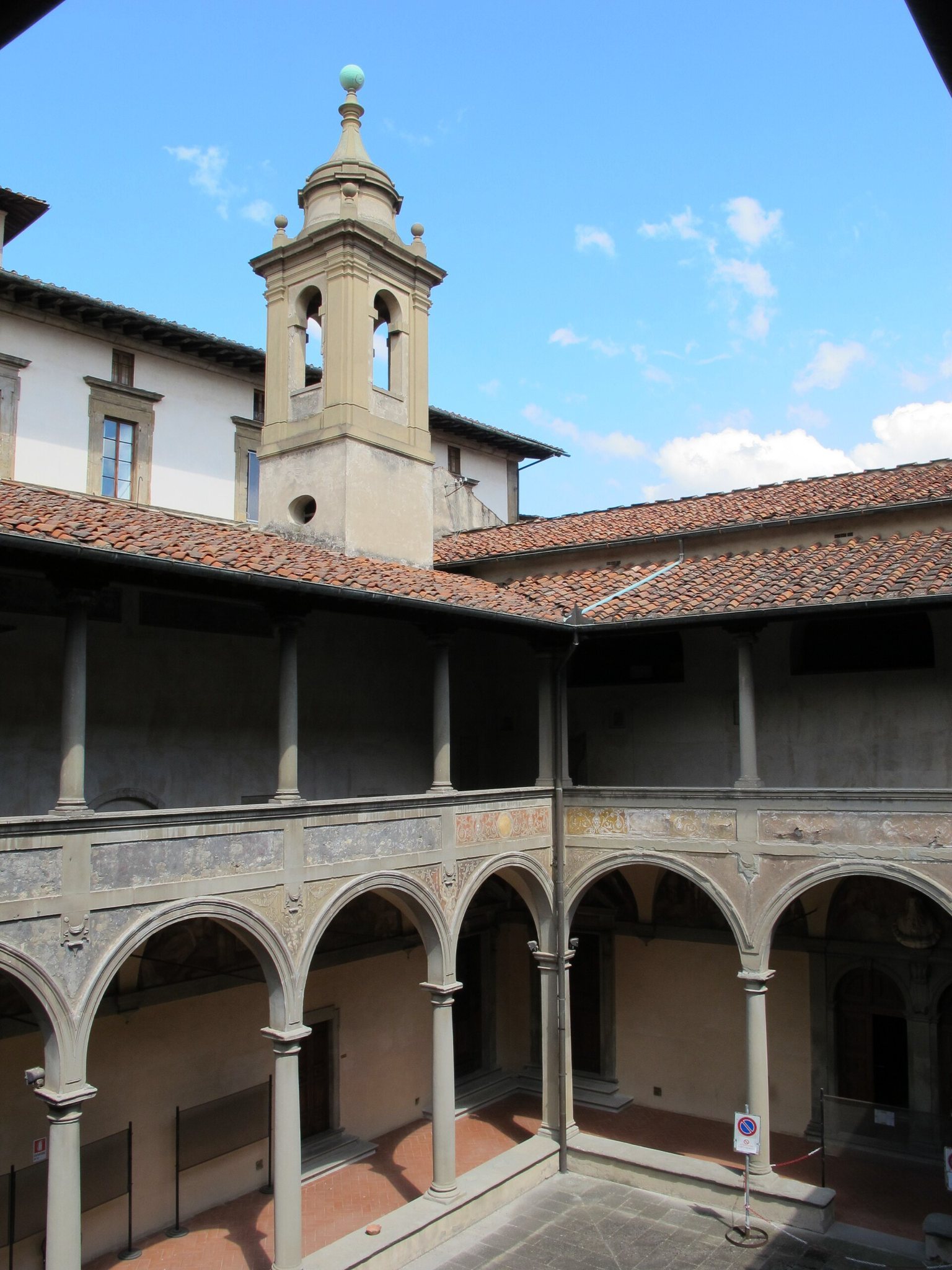
The Cloister of the Angels, also called the Sacristy Cloister, was built by Gherardo Silvani, probably from designs inspired by Brunelleschi. Round arches form a portico on all four sides, with an architraved loggia above. A loggia is an open-sided gallery or corridor, while an architrave is the horizontal member resting directly on columns or other supports.
The cloister retains well-preserved lunettes, many painted by Bernardino Poccetti around 1601 in vivid colors and with sharply defined drawing. Other lunettes were painted by Donato Arsenio Mascagni and Bernardino Monaldi. Marble busts of saints and protectors of the Camaldolese order above the portals were sculpted by Giovanni Caccini and Pietro Francavilla.
Cloister of the Dead
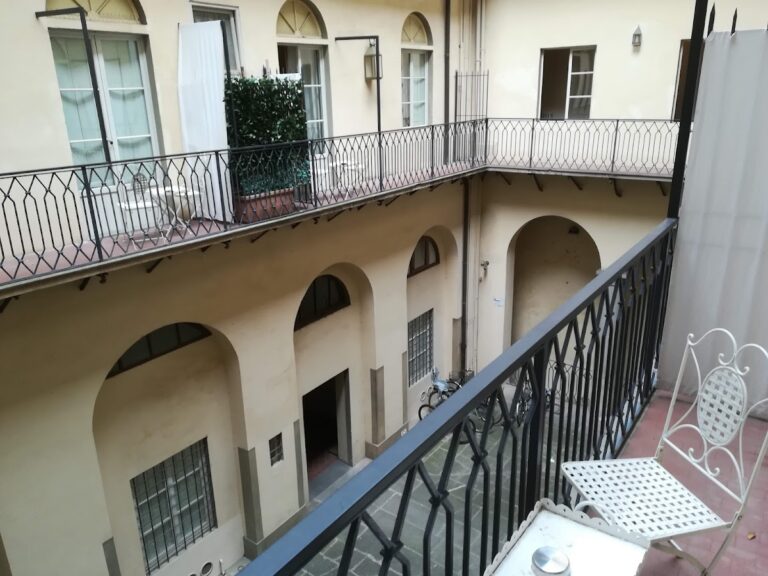
The Cloister of the Dead lies beside the present student entrance on Via Alfani. Its four-sided portico is formed by round arches, with a covered first-floor loggia above, and traces of graffiti remain on its exterior walls. Several tomb slabs are preserved there, including that of Benedetto Varchi. The rear wall of the former refectory bears The Last Supper, a fresco by Ridolfo del Ghirlandaio.
Rotonda degli Scolari
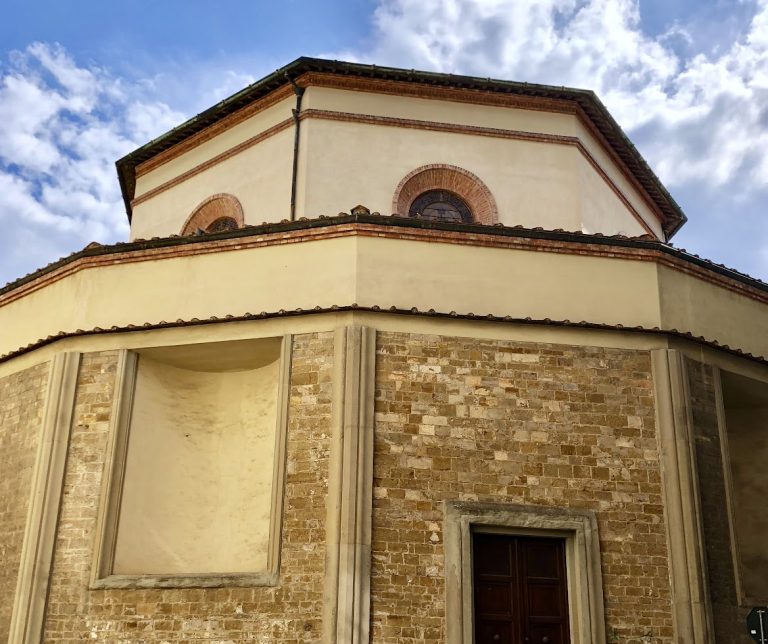
The Rotonda degli Scolari, or Scholars’ Rotunda, is part of the monastery complex and was partially built according to Brunelleschi’s design. It was planned as an octagonal domed space surrounded by eight ancillary rooms and stood at the corner of the property along the outer wall. An octagonal, centrally planned building organizes its main space around a geometric center rather than along a long axis. The unfinished shell received a simple wooden roof in 1503. That roof later deteriorated, and the structure was patched and given its modern exterior in the 1930s. The surviving interior preserves evidence of the intended arrangement of the ancillary spaces, although the restored exterior differs substantially from the original design.
Dispersed works of art
Works once housed at Santa Maria degli Angeli are now preserved in collections elsewhere. They include Nardo di Cione’s Triptych of the Throne of Grace of 1365 in Florence’s Accademia Gallery; Giovanni da Milano’s Christ Enthroned Adored by Angels of about 1371 in Milan’s Brera Gallery; Lorenzo Monaco’s Coronation of the Virgin of 1414 in the Uffizi, with three predella scenes in the Louvre; Lorenzo Ghiberti’s Ark of the Three Martyrs of about 1427–1428 in the Bargello Museum; Fra Angelico’s Last Judgment of about 1431 in Florence’s San Marco Museum; Andrea del Castagno’s Crucifixion of Santa Maria degli Angeli of about 1455 in the Cenacolo of Sant’Apollonia; Sandro Botticelli’s Madonna of the Pavilion of about 1493 in Milan’s Ambrosiana Gallery; and Taddeo Gaddi’s Triptych of the Life of Christ in Strasbourg.
Andrea del Castagno’s frescoes of the Crucifixion and saints, painted between 1440 and 1444, formerly decorated the smaller cloister. They are now preserved at the Santa Maria Nuova Hospital.