Palazzo di Sforza Almeni: A Sixteenth-Century Palace in Florence

Site at a Glance
- Rating
- 3.9
- Popularity
- Very Low
- Country
- Italy
- Primary era
- Early Modern
- Eras represented
- Early Modern, Modern
- Civilizations
- Grand Duchy of Tuscany, Italian
- Site type
- Domestic
- Remains
- Elite Residence
On this page11 sections
History
Palazzo di Sforza Almeni is a sixteenth-century palace in Florence, Italy, situated between Via de’ Servi and Via del Castellaccio. Formerly known as Palazzo Taddei, it was built during the Renaissance, in an area adjoining the Tiratoio dell’Aquila where houses owned by the Ghinetti and Mazzei families already stood. The building is often attributed to Bartolomeo Ammannati for Piero d’Antonio Taddei, although this attribution has not been confirmed by documentary evidence.
From the Taddei family to Sforza Almeni
Cosimo I de’ Medici, the sixteenth-century duke of Florence and founder of the Medici grand-ducal state, confiscated the palace from the Taddei family because of its opposition to Medici rule. He soon gave it to his cupbearer, Sforza Almeni, who came from Perugia and served the duke for twenty-four years.
After receiving the palace, Almeni commissioned further decoration, including an extensive painted program on the principal facade. Cristoforo Gherardi began this work around 1555 in collaboration with Giorgio Vasari, following Vasari’s project and drawings. Vasari later described the paintings as an iconographic program encompassing the whole course of human life, from birth to death. By the time of Giovanni Cinelli, a seventeenth-century Florentine writer and art historian, exposure had already badly damaged the facade paintings. Cinelli particularly recalled representations of the seven liberal arts, the traditional disciplines of grammar, rhetoric, logic, arithmetic, geometry, music, and astronomy.
Architectural historian Heinrich von Geymüller also attributed the design of the elaborate ground-floor windows to Giuliano di Baccio d’Agnolo. Howard Burns later proposed that Galeazzo Alessi was responsible for architectural alterations to the palace. Sforza Almeni’s connection with Cosimo I ended violently. The duke reportedly killed him personally after Almeni revealed to the heir Francesco that Francesco was involved with Eleonora degli Albizi.
Later ownership and conservation
The palace passed through several owners. It belonged to the Frosini Matteucci family in 1812 or 1816 and later came into the possession of the Cuccoli-Fieschi family. By 1902, ownership had passed to the Incontri family, and the building was restored that year. Further interventions included facade restoration in 1926, the opening of ground-floor shopfronts on Via del Castellaccio in 1933, and the demolition of masonry in the courtyard in 1955 to free its columns.
The building later underwent consolidation and underpinning. Its courtyard was covered and partly closed toward the entrance hall to accommodate a column for an elevator. Palazzo di Sforza Almeni appeared in the 1901 list of monumental buildings that Italy’s General Directorate of Antiquities and Fine Arts regarded as part of the national artistic heritage.
Remains
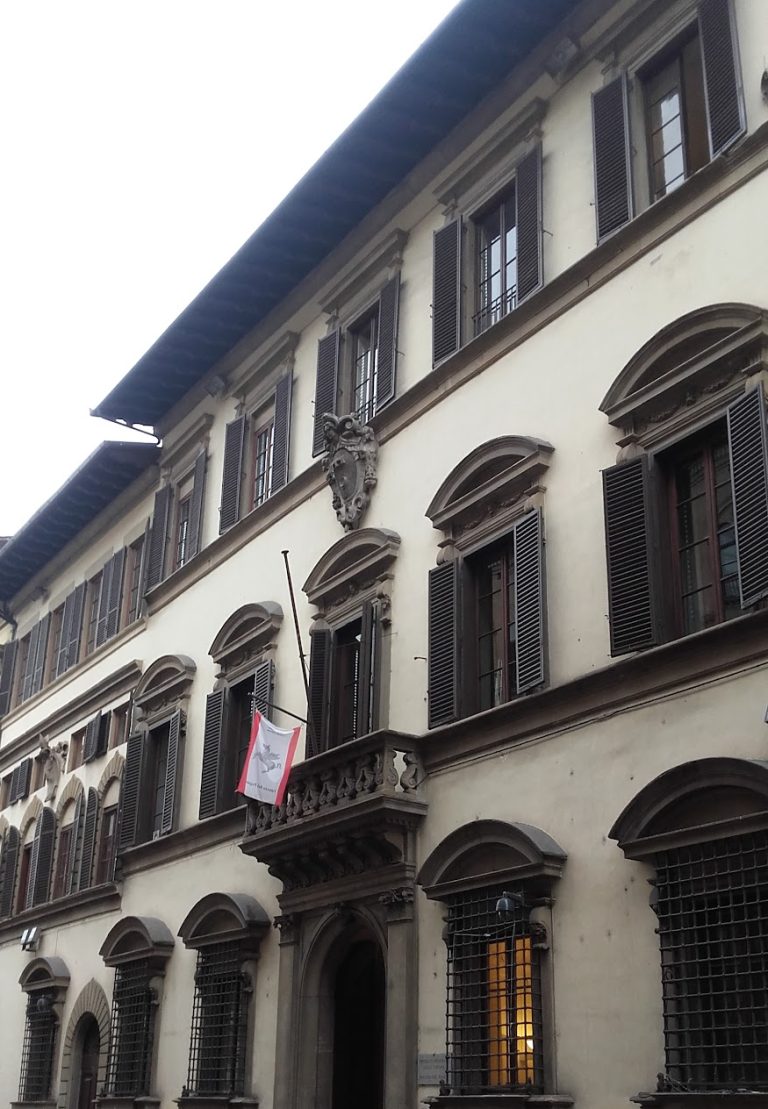
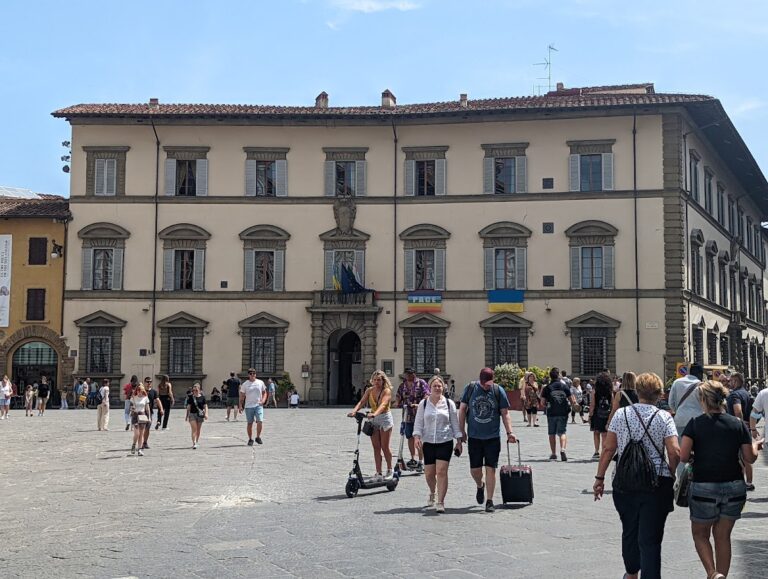
Facade and entrance
The principal facade extends over three floors and six axes along Via de’ Servi, where it forms an angled corner spur toward Via del Castellaccio. A small balcony was added later at the corner. On the ground floor, a large entrance portal is flanked by two elaborate kneeling windows set into a broad plastered surface. Their design is associated with Ammannati’s manner and has also been attributed to Giuliano di Baccio d’Agnolo.
The gray stonework is heavily abraded, while surviving decoration includes lion heads on the pediments and supports, a meander pattern along the window sills, and military trophies in the panels between the lower brackets. The trophy beside the right-hand window has disappeared, while the other remains partly legible. The windows retain notable iron grilles supported at the bottom by turtles. A shield bearing the arms of the Frosini Matteucci family is positioned above the entrance portal.
At the sharp corner of Via del Castellaccio is a commemorative shield bearing the Medici and Toledo arms. Installed during Sforza Almeni’s ownership, the original shield was removed in 1901 because it was unsafe. The Opificio delle Pietre Dure, Florence’s historic conservation institution for stonework, mosaics, and related artworks, restored it in 1955. The original is sheltered in the palace entrance hall, while the shield now visible on the corner is a copy.
Interior painted decoration
Frescoed vaulted room
One room contains a frescoed vault covered with allegorical figures framed by grotesques, ornamental designs combining fanciful human, animal, vegetal, and architectural forms. The program was probably conceived by Vincenzo Borghini, a Florentine humanist and art theorist, and executed by artists from Vasari’s circle. The same group worked on the facade and on interiors of the Palazzo Vecchio.
Entrance hall and heated room
The entrance hall retains an allegorical figure produced by the same artistic circle. The first-floor stufetta, a small heated room, has a small compartmented ceiling associated with this group of artists.
Painted room on the principal floor
The piano nobile, the principal residential floor of an Italian palace, contains another frescoed room. Its decoration combines painted ruins with a mythological composition involving Juno, Minerva, and Aphrodite, executed by the painter Mauro Soderini.
Later decorative fragments
Other rooms preserve fragments of decorative friezes with putti and festoons. These elements are attributable to the late seventeenth century, while many of the palace’s other interior decorations have been lost.
Courtyard sculpture
The courtyard formerly contained statues representing Honour and Deceit, described as works of exceptional quality by the sculptor Vincenzo Danti. Their hair was executed with particular artistry. The statues are now preserved in the Michelangelo Room of the Bargello National Museum, Florence’s major museum of sculpture, rather than in the palace.