Palazzo Galletti: A Nineteenth-Century Historic Building in Florence


Site at a Glance
- Rating
- 3.7
- Popularity
- Low
- Country
- Italy
- Primary era
- Modern
- External website
- Open
- Eras represented
- Modern
- Civilizations
- Grand Duchy of Tuscany
- Site type
- Domestic
- Remains
- Elite Residence
On this page8 sections
History
Palazzo Galletti is a historic building in Florence, Italy, built between 1831 and 1833 in the architectural culture of the first half of the nineteenth century. It rose from the foundations after several pre-existing houses were demolished. The architect was Vittorio Bellini, assisted by the engineer Antonio Catelani, and the patron was Vincenzo Batelli, an entrepreneur in the printing trade.
Construction and original purpose
Batelli intended the building to combine a private residence with premises for a calcography, an engraving-based printmaking business. Financial difficulties around the middle of the nineteenth century led to the division of the property, leaving only a few rooms for a small print shop. The change altered the building’s original combination of domestic and commercial functions.
Literary and educational associations
During the late nineteenth century, Palazzo Galletti housed the Nencioni Institute. The young Giosue Carducci, an Italian poet and literary scholar, taught there. The writer Bruno Cicognani was born in a first-floor apartment in the building in 1879. Palazzo Galletti now accommodates a lodging establishment, the Europass Italian-language school, and Europass’s teacher-training center.
Remains
Facade
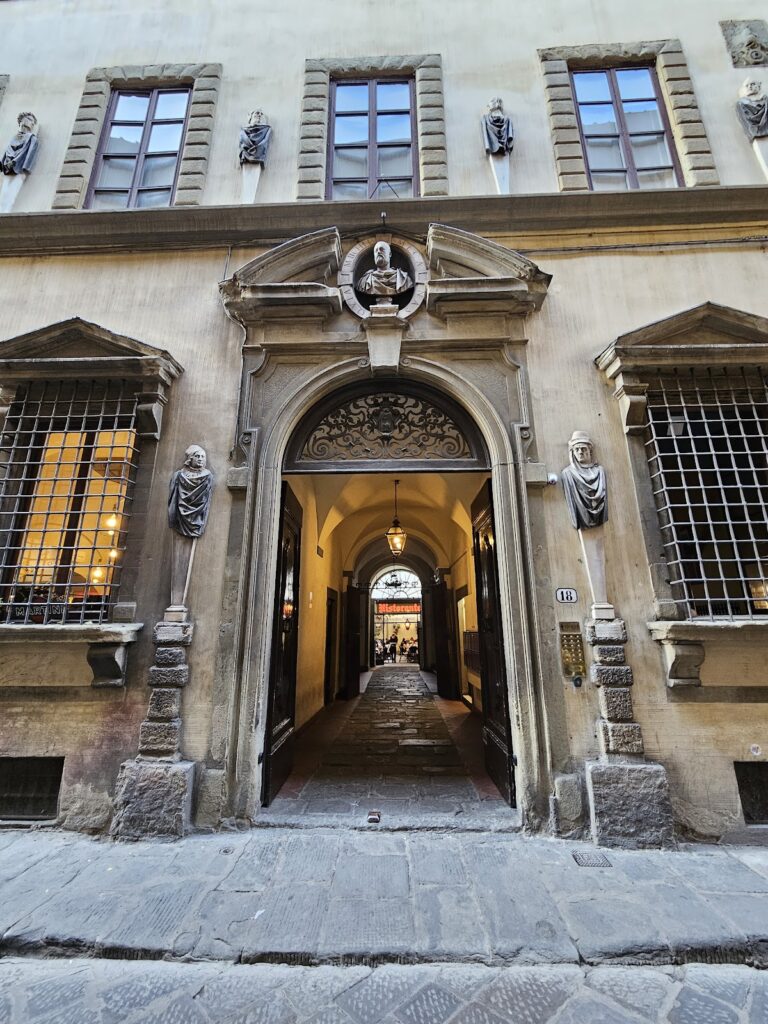
Palazzo Galletti rises over four floors. Stone rustication covers the full height of the ground floor, giving the base a strongly articulated surface. Four niches flank the first floor and hold statues representing the Four Seasons, installed around 1843. Lorenzo Nencini made Spring, Giovanni Insom modeled Summer, Francesco Orzalesi created Autumn, and Niccolo Bazzanti made Winter.
Three central arches open onto small terraces on the first floor. The second floor repeats the pattern of arches and terraces, while the third floor is comparatively plain. A clock display surmounts the center above the facade, completing the building’s vertical composition.
Entrance and interior decoration
Entrance atrium
The entrance atrium contains numerous Doric columns painted to imitate marble. Its vaulted ceiling carries frescoes of putti holding cartouches with mottoes. The entrance doorway has bronze bands made around 1843 by the Moreni Tognozzi workshop from designs by the engraver Luigi Finocchi. The date 1844 is inscribed on the threshold.
The atrium also contains busts of Dante Alighieri and Francesco Petrarch by Niccolo Bazzanti, Ludovico Ariosto by Girolamo Torrini, and Torquato Tasso by Tommaso Bandini. Its original sculptural program included Minerva, the Roman goddess associated with wisdom, strategy, and the arts, made by Bazzanti, and Harpocrates, a classical deity associated with silence and secrecy, made by Emilio Santarelli.
Principal floor
The piano nobile, the principal ceremonial floor of an Italian palace, contains numerous frescoes dating from the first half of the nineteenth century. Their style is contemporary with the building’s architecture and contributes to the decorated character of its principal interior spaces.