Church of St. Anthony of Padua in Warsaw: A Baroque Roman Catholic Church
Site at a Glance
- Popularity
- Medium
- Country
- Poland
- Primary era
- Early Modern
- Eras represented
- Early Modern, Modern
- Civilizations
- Polish–Lithuanian Commonwealth, Russian
- Site type
- Religious
- Remains
- Church
On this page14 sections
History
The Church of St. Anthony of Padua in Warsaw is a Baroque Roman Catholic church in Poland. Its first wooden building was begun in 1623, and a masonry church was built from 1668 to 1680. The church is described as Warsaw’s first Baroque church. It belongs to the Archdiocese of Warsaw and serves a parish dedicated to St. Anthony of Padua.
Foundation and first church
King Sigismund III Vasa funded the first church as a thanksgiving sanctuary for the capture of Smolensk on June 13, 1611. That date also fell on the liturgical commemoration of Anthony of Padua, leading to the choice of the saint as its patron. The Reformed Franciscans, a reform branch of the Franciscan order, arrived in Warsaw at the king’s invitation in 1623 and were entrusted with the church. Construction of its wooden building began in the king’s presence on October 4 that year, in what was then an undeveloped suburb. Bishop Jan Baltazar Liesch of Wrocław consecrated it on August 13, 1635.
Destruction and rebuilding
In 1657, during the Swedish invasion of the 1650s, often called the Deluge, troops led by George II Rákóczi, Prince of Transylvania, and allied with Sweden destroyed the church and monastery. A replacement in masonry was funded by Stanisław Leszczyc-Skarszewski, an official responsible for a castle district. The church was built from 1668 to 1680 and consecrated in 1679 by Stefan Wierzbowski, Bishop of Poznań.
Royal and Franciscan period
John III Sobieski was a frequent visitor. At the direction of Augustus III, a royal box for the king and his wife was installed in 1734–1735; the royal couple lived in a nearby palace. They also funded an altar to St. Joseph in 1756. In 1766, the Venetian writer and adventurer Giacomo Casanova hid in the Franciscan monastery while sought by the faction of Polish commander Franciszek Ksawery Branicki after a duel.
A chapel dedicated to the Virgin Mary was completed by 1781. A classical fence between the church and the street was erected in 1770, and two perpendicular wings were added to the cloister, a covered walkway around an open space, in 1792.
Nineteenth-century changes
A vault collapsed in 1813, damaging the church; repairs followed in 1872. A painting of the Virgin Mary was placed in the front gable panel in 1850, and a statue of the Immaculate Conception was set up outside the church the following year. The parish was established in 1866. In 1867, after the January Uprising, a Polish-led revolt against Russian rule in 1863–1864, the Franciscan order was suppressed as part of the reprisals, and diocesan priests took charge. The main altar was later moved against the chancel wall, while the choir and sacristy were removed.
The Chapel of the Holy Family was built in 1895 with an altar made by Wincenty Bogaczyk. A chapel dedicated to the Sacred Heart of Jesus followed in 1907.
War and reconstruction
German military operations badly damaged and burned the church during the Warsaw Uprising, the 1944 armed revolt against German occupation. A company from the Rudy unit of the Zośka Battalion, part of the Polish resistance, crossed the grounds while advancing from the Old Town toward central Warsaw. After German forces withdrew, 30 executed people and dozens of other bodies were found in the Sacred Heart chapel. The bodies had been doused with gasoline and partly burned.
The church and parish returned to the Reformed Franciscans in 1949. The church was rebuilt from 1950 to 1956, and Cardinal Stefan Wyszyński consecrated its main altar on January 18, 1969.
Remains
Exterior and plan
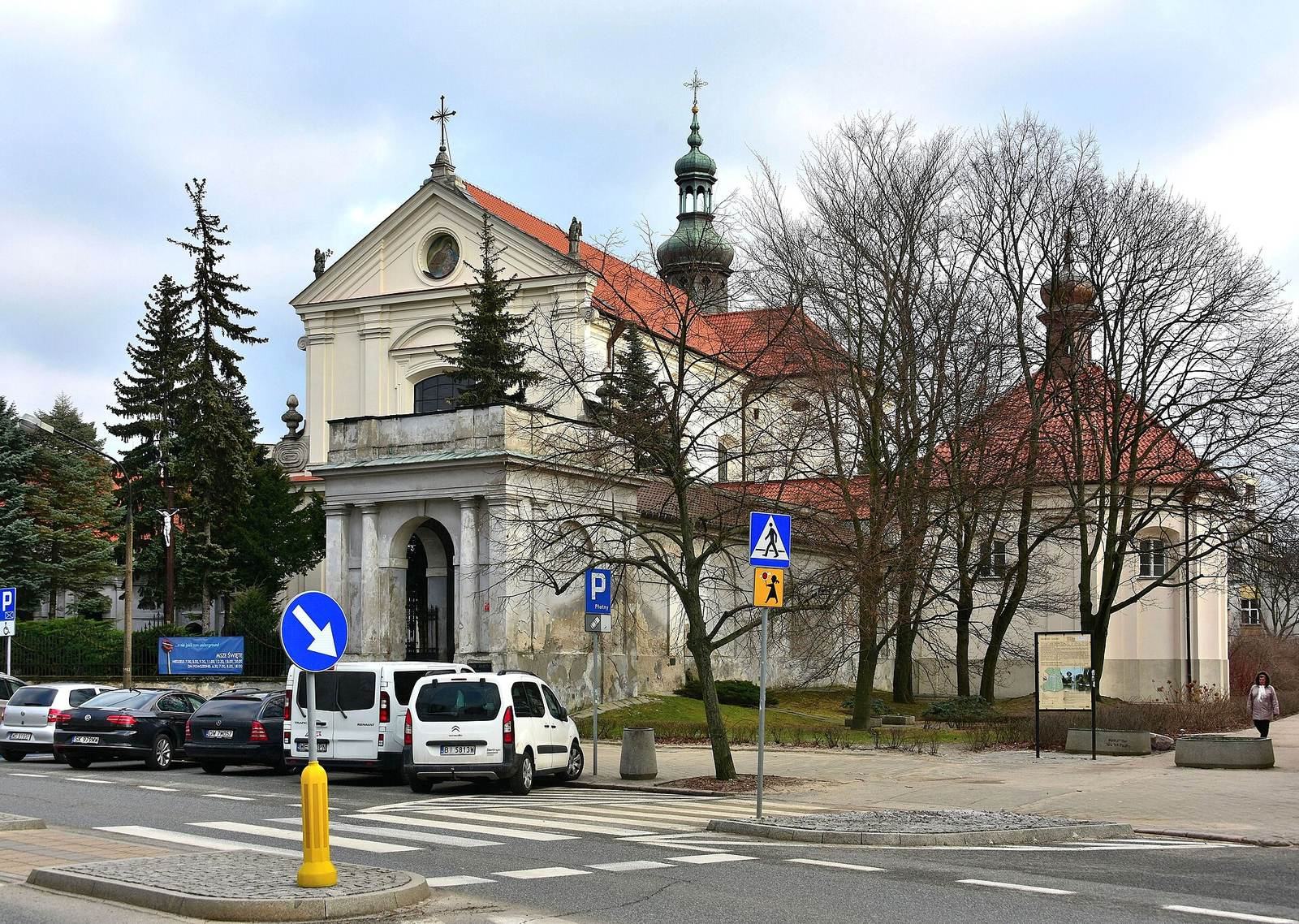
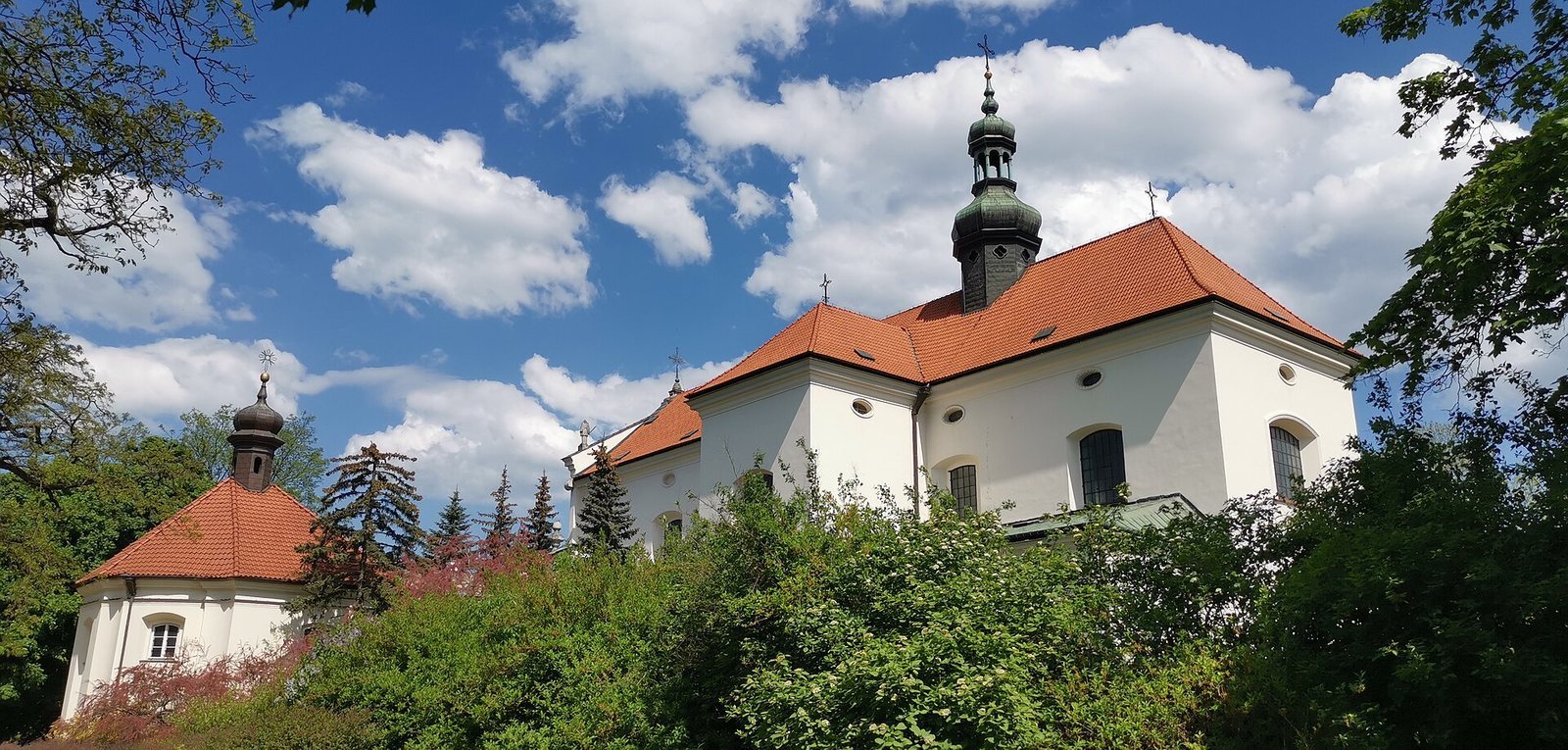
The surviving masonry church has a simple façade crowned by a triangular gable and a rectangular chancel. Its interior follows a rectangular plan, with a single main nave intersected by a transept, the crosswise part of the church. Rows of altar chapels line the nave, with two additional side chapels. An eighteenth-century grille separates the porch from the church interior. The royal box is positioned on the right side of the chancel, the area around the main altar.
Chapels and furnishings
Chapels and enclosure
The church contains chapels dedicated to the Virgin Mary, the Holy Family, and the Sacred Heart of Jesus, along with the altar to St. Joseph. The Holy Family Chapel and the eighteenth-century grille survived the 1944 destruction, as did some of the stucco around the chapel vaults.
Altars, sculpture, and paintings
Sculptures inside the church are attributed to Jan Jerzy Plersch. Paintings on the side altars include works of St. Francis and St. Anthony of Padua by Rafał Hadziewicz, as well as a Deposition of Christ by Annibale Vinici. The church’s image of St. Anthony is an object of miraculous veneration. A painting of the Virgin Mary occupies the central panel within the triangular front gable, while a statue of the Immaculate Conception by Antoni Messing stands outside.
The main and side altars, pulpit, and organ suffered particularly severe damage in 1944.
Memorials and devotional objects
Epitaphs and commemorations
Numerous epitaphs, or memorial inscriptions, include those for two wives of Marshal Józef Wandalin Mniszech, dated 1747 and 1772. Inscriptions in the cloisters commemorate, among others, writer Klementyna Hoffmanowa, painter Rafał Hadziewicz, poet Stanisław Jachowicz, actor Ludwik Panczykowski, Vilnius mayor Wiktor Malaszewski, writer Tadeusz Dołęga-Mostowicz, and Stanisław Englert. Traces of the former church cemetery remained visible in the interwar period.
A plaque at the church commemorates more than 100 people executed there. Other memorials honor people killed during the Second World War, those who died in German concentration camps, and Polish soldiers killed defending the country.
Relic
A first-class relic, a fragment of a person’s body, consisting here of a bone fragment of José Sánchez del Río, a Mexican Catholic youth venerated as a martyr, was installed in the church in December 2019.