Church of Sant’Afra: A Roman Catholic Church in Brescia


Site at a Glance
- Rating
- 4.4
- Popularity
- Low
- Country
- Italy
- Primary era
- Early Modern
- External website
- Open
- Eras represented
- Medieval, Early Modern
- Civilizations
- Venetian
- Site type
- Religious
- Remains
- Church
On this page13 sections
History
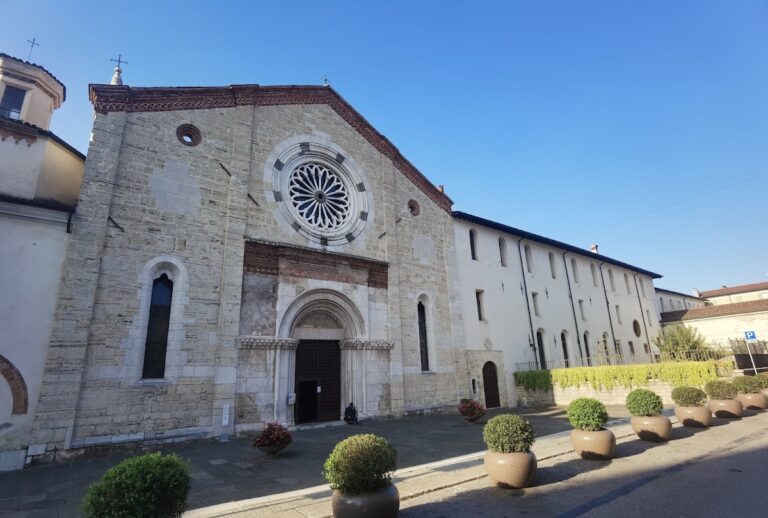
The Church of Sant’Afra is a Roman Catholic church in Brescia, Italy, built for the Benedictine monastery of Sant’Eufemia in the late fifteenth century. It stands at the eastern end of Corso Magenta, at the southeast corner of Piazzale Arnaldo. The church began as the monastery’s urban seat, a city establishment maintained by a monastic community whose principal house stood elsewhere.
From Sant’Eufemia to Torrelunga
The monastery of Sant’Eufemia della Fonte stood east of Brescia’s medieval walls. Founded around 1022, it was occupied and partly destroyed twice during its first three centuries as a result of attacks and invasions. In 1321, the abbot acquired an Umiliati building at Torrelunga, in the area now occupied by Piazzale Arnaldo, giving the monastery a base within the city.
The outer monastery suffered a decisive blow during the siege of Brescia in 1438. Filippo Maria Visconti, the duke of Milan, sent an army under the military commander Nicolò Piccinino, who occupied Sant’Eufemia della Fonte and used it as his headquarters for several months. The monastery was left almost completely destroyed, and much of its community moved to the Torrelunga property.
Construction and later changes
The Torrelunga complex was enlarged to house the relocated monastery of Sant’Eufemia. Pope Eugene IV authorized a new convent in a papal bull of 1444, and construction of the church and convent began in 1462. The church was completed in 1479. In the same year, the relics of Saint Paterio, an early bishop of Brescia, were transferred there and placed in a new ark in the crypt beneath the presbytery.
The building underwent a complete renovation during the seventeenth century, when its interior was altered and the church was restored to street level. Further work followed in the eighteenth century, including changes to the façade. The Moretto, the established name of the Brescia painter Alessandro Bonvicino, painted the Altarpiece of Sant’Eufemia between 1526 and 1530. In 1867, it was replaced in the church by an altarpiece by Enea Salmeggia and transferred to the Pinacoteca Tosio Martinengo.
Suppression and continued use
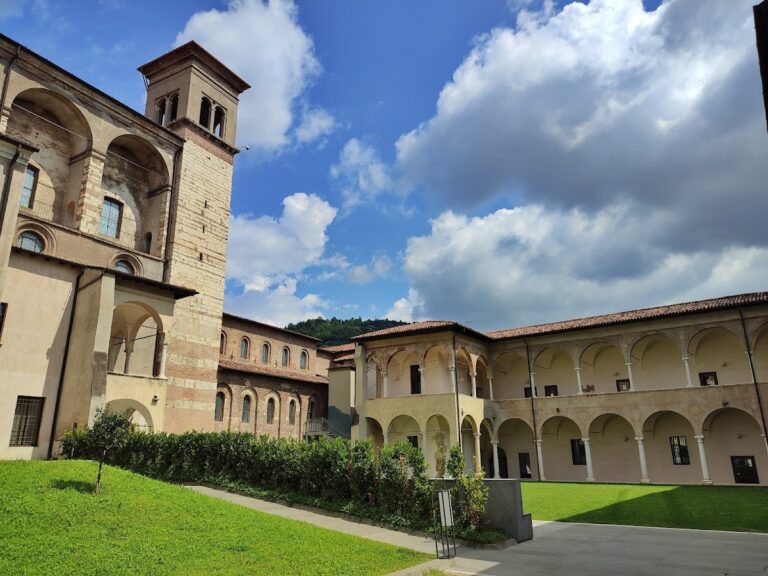
The monastery was suppressed in 1797, but the church remained open for worship and has continued in use. In 1859, the former monastic complex became the headquarters of the national military command and later formed part of the Goito barracks. The barracks incorporated the nearby Church of Saints Peter and Marcellinus in 1889. This conversion resulted in the loss of Lattanzio Gambara’s sixteenth-century cloister frescoes, which depicted Stories of the Old and New Testaments.
The additional name “in Sant’Eufemia” was used mainly until the first half of the twentieth century to distinguish this church from another Church of Sant’Afra on Via Francesco Crispi. That building was destroyed by bombing during the Second World War and rebuilt as the Church of Sant’Angela Merici, so the older distinguishing name is now generally obsolete. The church also preserves works by local artists, including Sante Cattaneo, alongside paintings by Paolo Veronese and Enea Salmeggia. Several objects came from Sant’Angela Merici, including the baptismal font and Veronese’s altarpiece. The adjacent rooms contain a treasury of liturgical furnishings and instruments, including a gilded-silver reliquary of Saint Afra made in 1591 by a Venetian silversmith.
Remains
Façade and entrance spaces
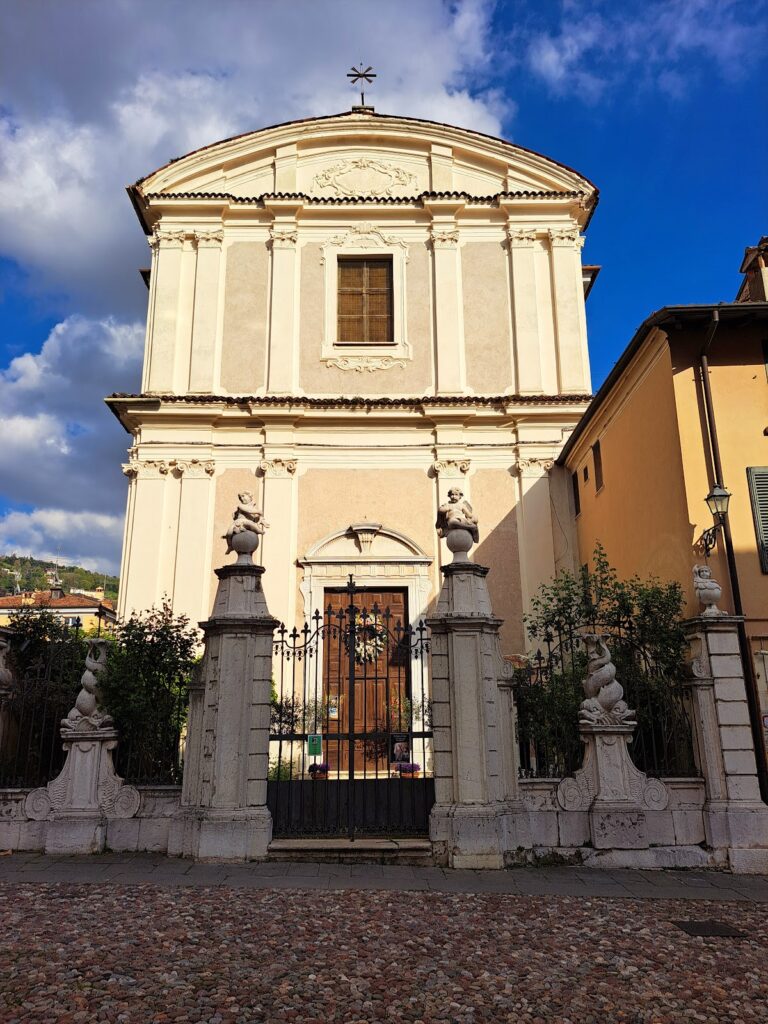
The exterior is largely the product of eighteenth-century work. Its imposing marble façade is arranged in two levels, separated by a high entablature, the horizontal structure above the supporting pilasters. Pilasters on tall bases articulate both orders. Three entrances occupy the lower level. The larger central doorway has a curved crowning element with a dedicatory plaque at its centre. Volutes connect the two levels, while the upper order contains a large window beneath a coat of arms and ends in a triangular pediment.
The left doorway opens into a small chapel that has no connection with the church interior. Dedicated to the Crucifixion of Jesus, it has modest wall decoration and a crucifix at the rear. The right doorway leads into a corridor alongside the nave, with access first to the crypt and then to the sacristy.
Nave and chapels
The interior is tall, broad, and deep, with a single nave. Three chapels on each side are framed by arches and Corinthian-order pilasters supporting an entablature. On the right side of the inner entrance wall is a small baptistery containing an octagonal baptismal font of modest dimensions, transferred from the Church of Sant’Angela Merici.
Right-hand chapels
The right-hand chapels contain three paintings arranged from the first chapel to the last. Camillo Rama painted the Consecration of Saint Paterio, Pietro Moro painted the Adoration of the Magi in 1790, and Pompeo Ghitti painted Saint Mauro Healing the Sick.
Left-hand chapels
The first chapel on the left contains Paolo Veronese’s altarpiece The Martyrdom of Saint Afra, transferred from the Church of Sant’Angela Merici. Sante Cattaneo’s Jesus Distributing Communion occupies the second chapel, while his Saints Benedict and Scholastica is in the third.
Presbytery and choir
Three successive sail vaults cover the nave. A sail vault is formed by curved, sail-like surfaces. The unusually long presbytery has a dome above the high altar and a barrel vault over the rectangular choir, which is raised above the main floor.
High altar
The high altar stands against the rear wall of the choir between two large windows. Its large altarpiece by Enea Salmeggia shows Saints Catherine, Barbara, Agnes, Lucy, Cecilia, and Euphemia. Antonio Calegari sculpted the altar, which contains Saint Paterio’s relics in an elegant urn.
Vault paintings
Around 1776, Pietro Ferrari and Antonio Grassi created the monochrome ornament and strong light-and-dark framing around the vault decorations. The three large oval paintings in the principal vault’s sails are by Sante Cattaneo. They depict Saint Paterio Offering His Writings to Saint John the Baptist, the Coronation of the Virgin, and Saints Benedict and Scholastica.
Cattaneo also painted four monochrome prophets on the presbytery walls. Antonio Mazza created the dome’s illusionistic architectural framework, a painted structure intended to extend the real architecture, while Carlo Innocenzo Carloni painted its figures. These include the Descent of the Holy Spirit upon Mary and the Apostles and four full-length Evangelists seated on clouds. The dome decoration is badly deteriorated.
Mazza and Carloni decorated the choir’s entire barrel vault with the Glory of Saint Euphemia and allegorical figures of Faith and Charity. Saint Euphemia is shown ascending to heaven before Christ, who holds the cross of martyrdom, accompanied by angels and supported by clouds. The composition uses pastel colours, soft tonal transitions, warm light, and heavily draped figures.
Camillo Rama painted four episodes from the Martyrdom of Saint Euphemia on the walls beside the altar. The organ shutters, by Jacopo Palma the Younger, show Saints Faustinus and Jovita, figures traditionally associated with Brescia’s Christian history.
Crypt
The original late fifteenth-century crypt survives beneath the church. A staircase to the right of the presbytery leads down to it, and the wall beside the staircase bears a round painting of the Madonna attributed to Vincenzo Civerchio.
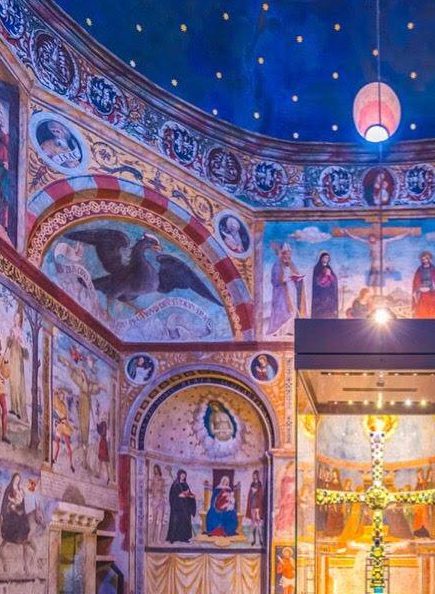
The crypt belongs to the primitive church and is divided into three small aisles by squat columns with Gothic capitals decorated with broad leaves. Its walls contain paintings by Francesco Giugno transferred from the Church of Sant’Angela Merici: Saints Faustinus and Jovita, The Martyrdom of Saints Faustinus and Jovita, and Saint Afra. A fragmentary, almost entirely lost fifteenth-century fresco of a Deposition can be seen on the rear wall, while the altar bears a fifteenth-century Nativity.
Saint Paterio’s ark, made around 1478, remained in the crypt until the second half of the nineteenth century. It is now displayed at the Museo di Santa Giulia.