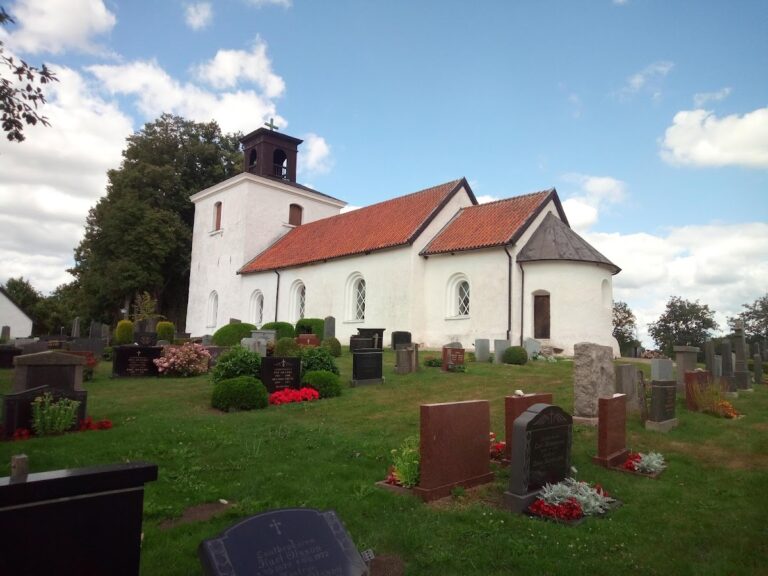
Bollerup Church: A Medieval Romanesque Lutheran Church in Sweden


Site at a Glance
- Rating
- 4.8
- Popularity
- Very Low
- Country
- Sweden
- Primary era
- Medieval
- External website
- Open
- Eras represented
- Medieval, Early Modern, Modern
- Civilizations
- Danish, Swedish
- Site type
- Religious
- Remains
- Church
On this page13 sections
History
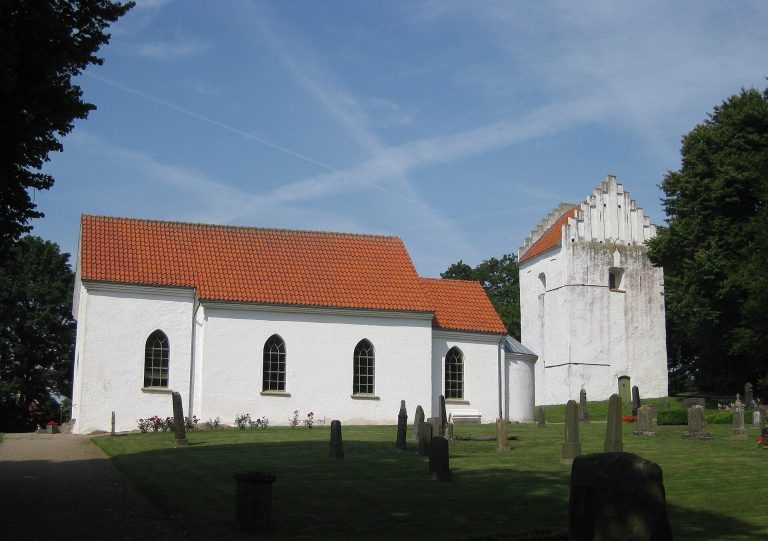
Bollerup Church is a medieval Lutheran church in Sweden, founded in the twelfth century in Bollerup near Tomelilla. Romanesque in character, it originally consisted of a nave, an altar area, and an apse. The round bell tower was added by the end of the twelfth century, probably during the same period as nearby Bollerup Castle. The church was originally dedicated to Saint Peter, one of Jesus’s twelve apostles and traditionally regarded as the first bishop of Rome.
Medieval foundation and rebuilding
The church’s western section and tower were built from locally quarried limestone, the same material used at Bollerup Castle. During the fifteenth century, brick vaults were inserted over the nave, changing the character of the medieval interior. In 1476, Barbara Brahe and her son Oluf Stigsen Krognos commissioned a restoration and a comprehensive programme of painted decoration.
Barbara probably brought an Italian painter to Bollerup after returning from a pilgrimage to Rome with King Christian I and Queen Dorothea. Christian I ruled Denmark, Norway, and Sweden in the fifteenth century, while Dorothea was his queen. The resulting murals differ from other wall paintings in the surrounding region. Barbara and Oluf appear as lay donors in full-length portraits on opposite sides of the nave vault. An inscription connected with the work states that they restored the church, hung bells in the tower, acquired a new Bible and prayer book, and asked for prayers.
Reformation and later patronage
During the Swedish Reformation of 1536, when Lutheran reforms reshaped church life in Sweden, the medieval wall paintings were covered with limewash. In 1649, Ida Skeel established an eastern burial chapel for the Rantzau family, a noble family connected with the church’s later history. The chapel was demolished in 1869, but its creation was associated with important seventeenth-century additions. An altar and altarpiece were installed in 1650, and a carved wooden pulpit, baptismal font, and altar candlesticks were added during the same century. The pulpit and altarpiece were probably donated by Ida Skeel.
Members of the Rantzau family supported repairs carried out in 1740 and 1741. Further enlargement took place between 1869 and 1874, including work on the choir and nave, the addition of a transept in 1869, and the construction of an apse-shaped sacristy.
Rediscovery and restoration
The wall paintings were rediscovered in 1955. Their restoration became a major part of a wider campaign carried out from 1955 to 1965, bringing the fifteenth-century decoration back into view. A new mechanical organ, built by Anders Persson, was installed in 1966. The church belongs to Smedstorp parish in the Church of Sweden and the Diocese of Lund.
Remains
Romanesque structure
Nave, choir, and tower
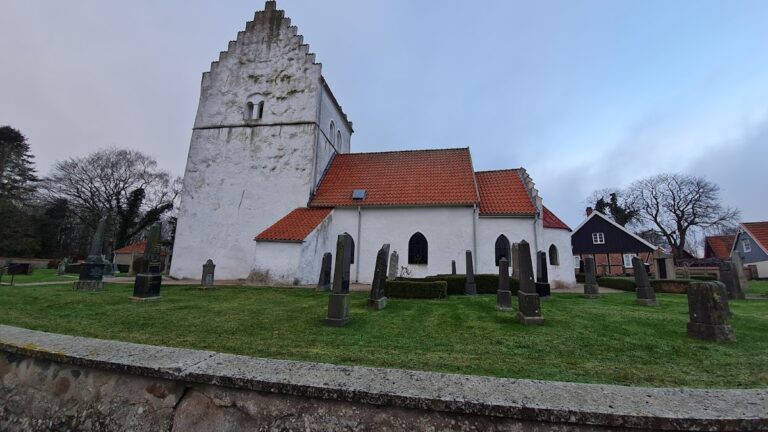
Bollerup Church retains a Romanesque arrangement centred on the nave, choir, and apse-related structures. The western part and the round bell tower are constructed from local limestone. The tower rises from a high socle, or plinth, that distinguishes it from the nave. Bollerup is one of four surviving churches with round towers in Scania, the historical province in southern Sweden, alongside Blentarp, Hammarlunda, and Hammarlöv.
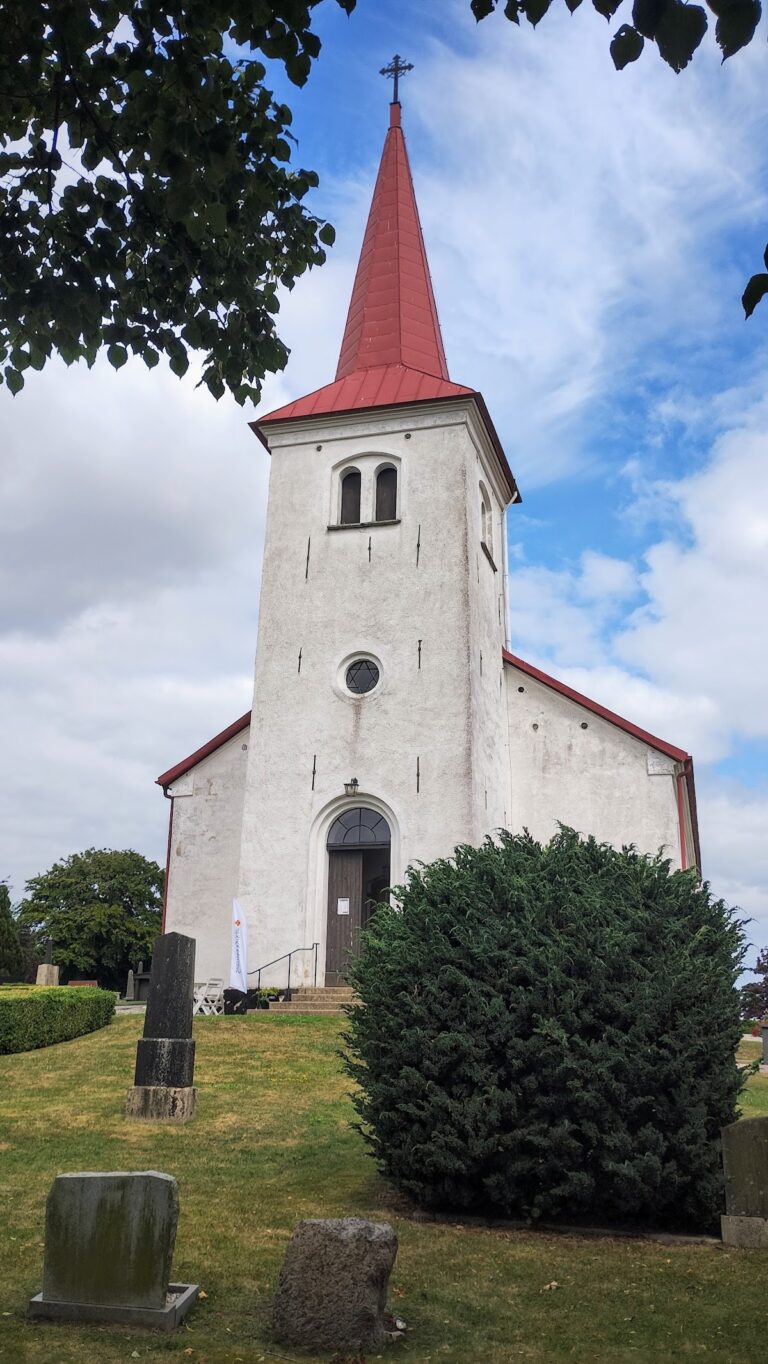
The original church had entrances on both its north and south sides. Brick vaulting was added to the nave during the first half of the fifteenth century. Later changes to the building include the choir and nave enlargement, the transept added in 1869, and the apse-shaped sacristy constructed between 1869 and 1874.
Baptismal font and furnishings
The Romanesque baptismal font dates from around 1200. Its bowl is decorated with arches and may have been made by the stonemason Mårten. The church also contains a carved wooden pulpit and an altarpiece in the auricular style, a seventeenth-century form of decoration using curling, lobed shapes resembling ears. Both were probably connected with Ida Skeel’s patronage when the Rantzau burial chapel was established. The altar and altarpiece were installed in 1650.
Fifteenth-century murals
Donor portraits and the Last Judgment
The 1476 murals cover the walls and vaults. Their painter may have been an Italian artist brought to Bollerup by Barbara Brahe. On the northeastern side of the vault, Barbara appears as a full-length donor figure, while her son Oluf Stigsen Krognos is shown on the southwestern side. Each holds a ribbon forming an arch around the waist, with part of the commemorative inscription written upon it.
A Last Judgment scene occupies another part of the painted programme. Christ sits on a rainbow within a mandorla, an almond-shaped frame used around sacred figures, with his feet resting on a globe. A lily and a sword emerge from his mouth. The Virgin Mary, John the Baptist, angels, and the dead rising from their graves appear before him.
Hell, Paradise, and Solomon’s judgment
The depiction of Hell shows chained sinners being dragged into fire and tormented by demons. The condemned include people from different social classes, as well as a fleeing monk and a fleeing king. In contrast, another scene shows the righteous travelling towards Paradise. The apostle Peter receives them at a stairway leading to the Heavenly City, where angels hover above saints entering the city. A devil climbs along its ribbed edge.
A separate painting presents the Judgment of Solomon. Solomon sits enthroned before a dead child while a soldier prepares to divide the living child with his sword. The living child’s mother kneels before the king, while the mother of the dead child stands with her head raised.
Saints and symbolic scenes
Other paintings show Saint Anne enthroned with the Virgin Mary and the infant Jesus on her lap, with two angels holding a mantle behind the throne. Additional scenes include a man with a goat, a wounded man, and a pelican feeding its young in a tree. The apostle Andrew appears with his characteristic cross, and John the Baptist is shown with a lamb resting on a book and a cross behind him.
The archangel Michael is represented weighing the souls of the dead. The Virgin Mary helps a soul by pressing a finger on the scales, while demons unsuccessfully try to tip them. Michael holds a spear and attacks the devil. These images draw on the Christian understanding of the Last Judgment, when Christ judges the dead, and on the common representation of Saint Michael as the measurer of souls.
Saint Christopher and the Nativity
A mural of Saint Christopher shows him looking in surprise at the unusual weight of the infant Jesus whom he carries. Christopher holds an oak staff, and a crab lies at his feet. Nearby, a hut contains a hermit with a lantern who is fishing, while a boat carries sacks of grain. The painted programme also includes scenes of the Nativity.