Church of San Cristoforo in Vercelli: A Renaissance Catholic Church
Site at a Glance
- Popularity
- Medium
- Country
- Italy
- Primary era
- Early Modern
- Eras represented
- Early Modern
- Civilizations
- Duchy of Savoy
- Site type
- Religious
- Remains
- Church
On this page14 sections
History
The Church of San Cristoforo in Vercelli is a Roman Catholic church in Italy, built in 1515 by the Humiliati, a Catholic religious order historically active in northern Italy. Dedicated to Saint Christopher, a Christian saint traditionally associated with carrying the Christ Child, it replaced a church dating to the twelfth century. The church’s paintings by Gaudenzio Ferrari are regarded as a major achievement in his work and an important part of its art-historical importance.
The Humiliati church and Ferrari’s commissions
Ferrari’s work at San Cristoforo began with a 1529 contract. It called for a wooden altarpiece at the rear of the apse, smaller panels, and paintings throughout the presbytery, the area around the main altar. Gerolamo Giovenone, an established painter with a Vercelli workshop, guaranteed the work. Ferrari moved to Vercelli and worked on the project intermittently for about five years. He did not complete every item in the contract, but the work he executed dates from 1529 to 1534.
Giovanni Angelo dei Corradi di Lignana commissioned Ferrari’s paintings for the Chapel of the Magdalene; an inscription marks their completion in 1533. In 1534, Frate Andrea dei Corradi di Lignana, the church’s provost and a Humiliati member, commissioned the Chapel of the Blessed Virgin.
Eighteenth-century changes and damage
In the eighteenth century, during the period when the Barnabites, a Catholic religious congregation, officiated at the church, it received a new decorative treatment. Cannon fire during conflicts in which Vercelli was besieged damaged the Magdalene chapel’s paintings. A cartouche dated 1704 refers to the damage, and the decision was made against undertaking ill-considered repairs.
Remains
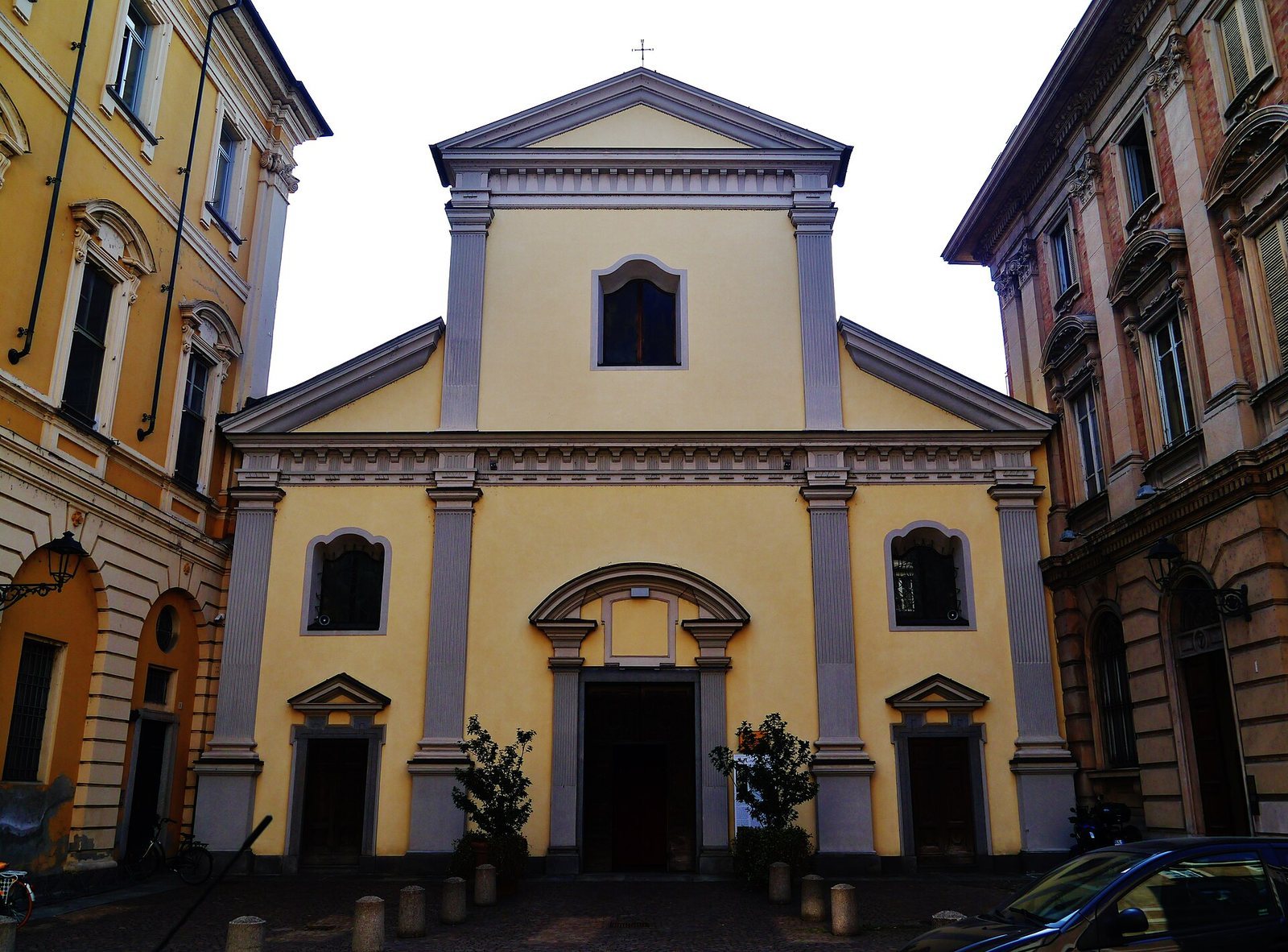
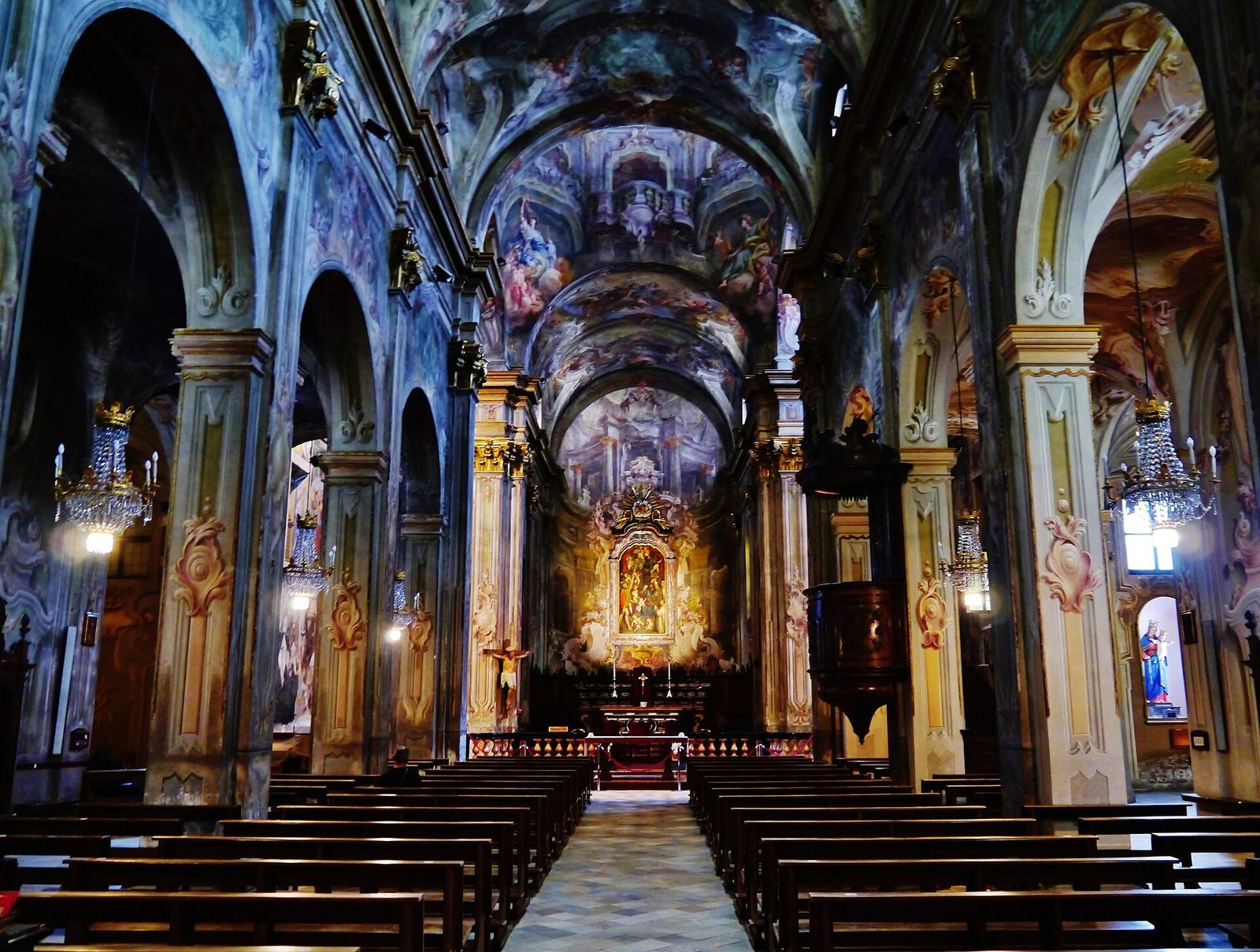
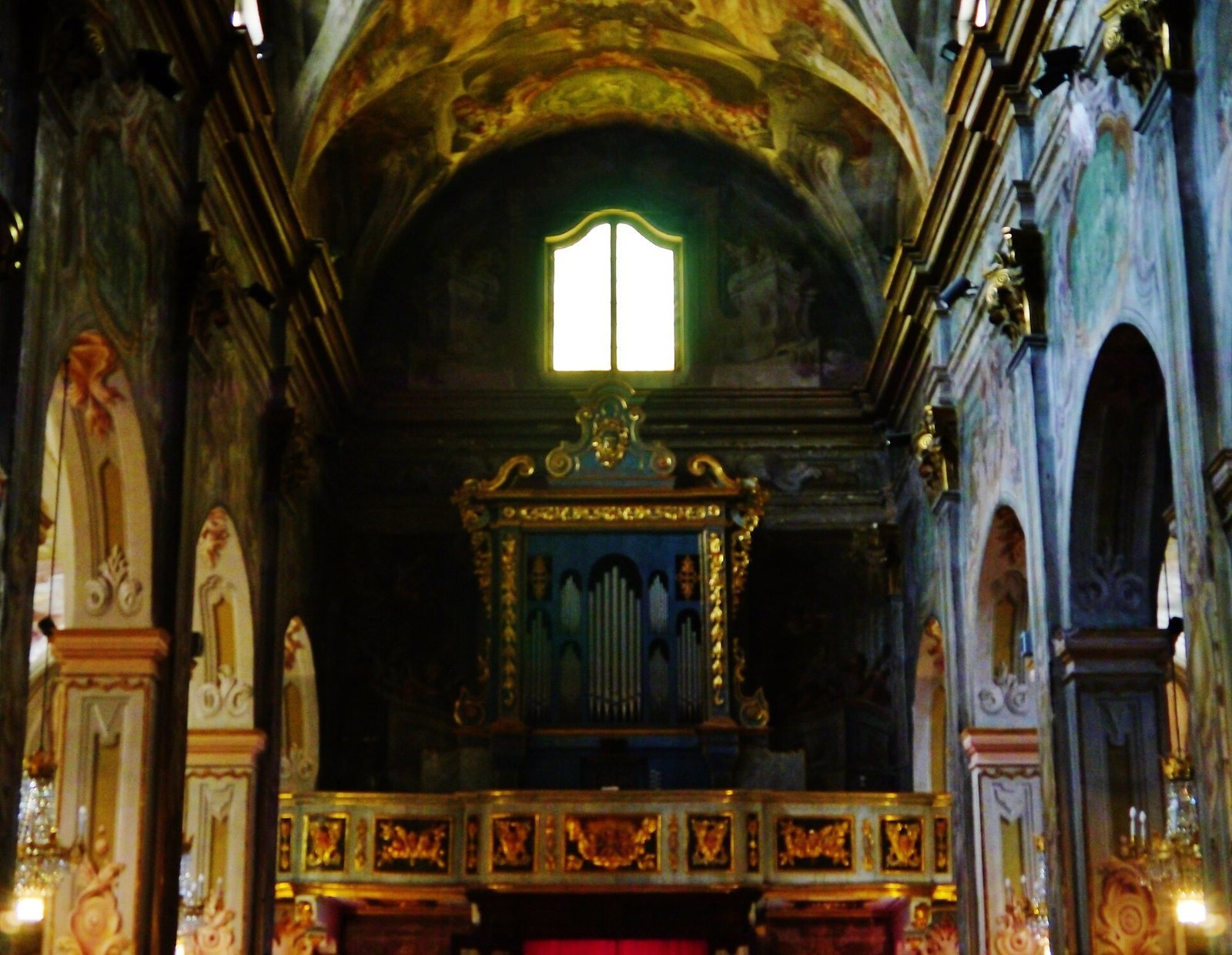
The church has three aisles leading to a transept, or crosswise arm, with a dome above it. The dome is enclosed by an octagonal structure visible from outside. Its Renaissance facade and later interior decoration frame this plan.
Exterior and interior architecture
Facade
The Renaissance facade is organized by Doric pilasters, shallow attached columns in a classical order, and projecting horizontal cornices. It was substantially altered in the eighteenth century.
Aisles, dome, and presbytery
Inside, a broad balustrade of colored marble, designed by Filippo Juvarra, separates the area for worshippers from the presbytery. The dome rises above the transept within the church’s externally visible octagonal structure.
Altarpiece and painted decoration
Madonna degli aranci
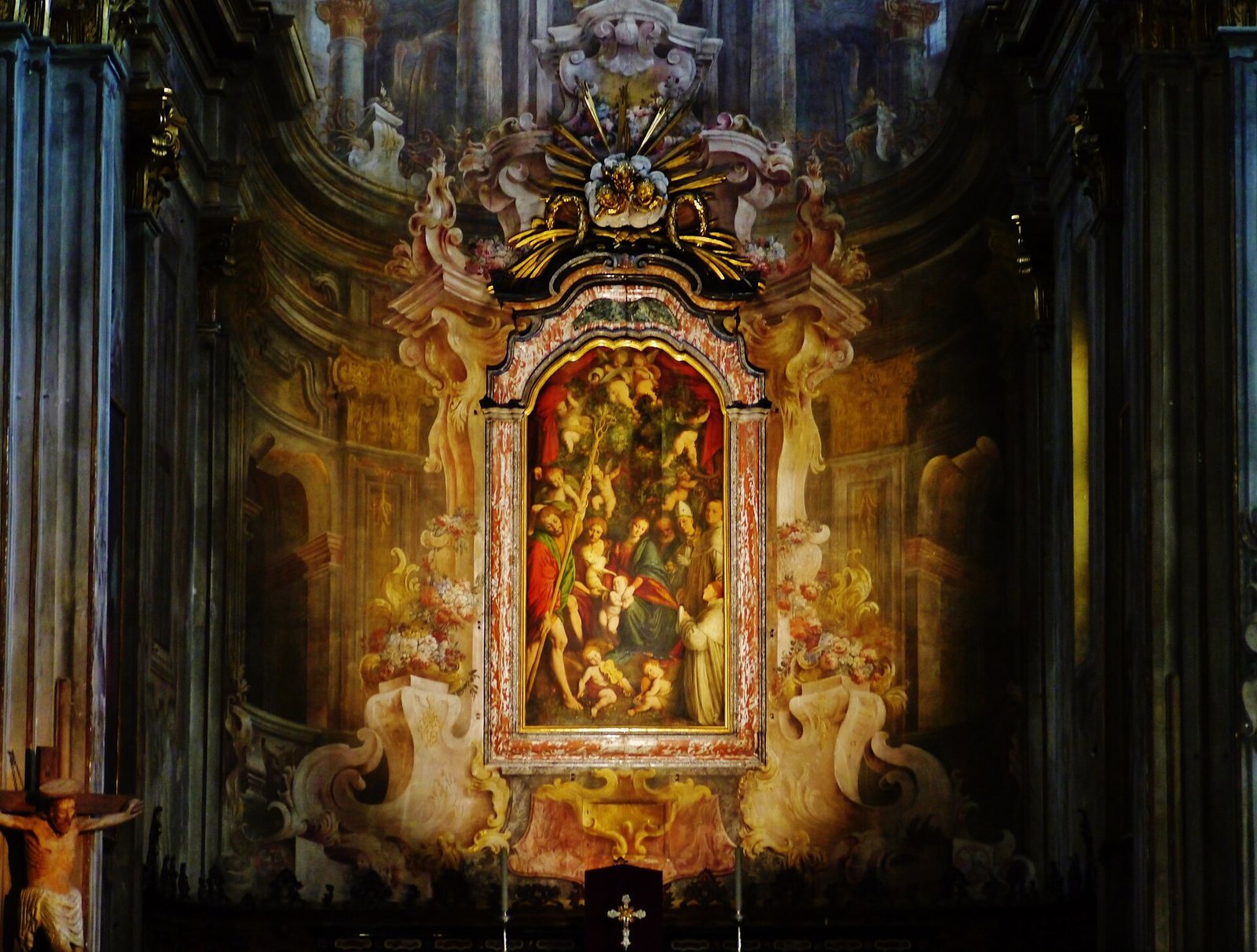
The large apse altarpiece, an oil painting on wood, is titled Madonna degli aranci, or Madonna of the Orange Trees. The Virgin and Child appear with Saint Joseph and Saints Christopher, John the Baptist, and Nicholas of Bari. Two white-robed Humiliati are thought to portray Blessed Orico and Nicolino Corradi di Lignana, who is identified with the church’s construction.
The Virgin’s pose and expression reflect the influence of Leonardo da Vinci, the Renaissance artist and writer on painting. At the group’s feet, two angels prepare to play a lute and a violin; the violin may be among the earliest instruments of its kind represented in a painting. Apple-tree branches weave across the background, bearing fruit of a variety grown in Valsesia despite the work’s title. A flowering palm branch supports the giant figure of Saint Christopher, while angels draw back a red curtain in the sky to reveal the sacred scene.
Vaults, dome, and decorative bands
Giacomo Antonio and Antonio Francesco Giovannini painted architectural scenes that create an illusion of built space. Francesco Maria Bianchi of Velate painted the Glory of Saint Christopher and the Glory of the Barnabite Order on the vaults, as well as Virtues on the dome’s pendentives, the curved triangular surfaces that help support a dome. Above the frescoes, broad monochrome bands feature grotesque ornament, a style combining foliage, figures, and fantastical forms, painted by Ferrari and his workshop.
Transept chapels
Chapel of the Magdalene
In the right transept, four large panels tell episodes from Mary Magdalene’s life, based on the Golden Legend, a medieval collection of saints’ lives compiled by Jacopo da Varagine. The scenes are read from left to right and top to bottom, but each panel combines episodes from different points in the story rather than presenting only one isolated event. In the first, Christ preaches to the Apostles and a group of listeners that includes Magdalene and other women. They are shown in a Renaissance church recalling San Cristoforo’s earlier form, in a scene related to Luke 8:2–5.
In the meal at Simon’s house, Magdalene kneels beneath the table and dries Jesus’ feet with her hair. Two small background scenes show the discovery of Christ’s empty tomb and his meeting with Magdalene after the resurrection. Another panel depicts Lazarus baptizing the princes of Marseille, drawing on the traditional belief that Magdalene preached in Provence with her sister Martha and brother Lazarus. Two figures behind the princes have been conjectured to portray Ferrari and his young pupil Bernardino Lanino. The cycle also includes Magdalene’s Ascension, in which her long blond hair is her only clothing. The meal scene has been compared with a similar treatment by Romanino in Brescia.
Crucifixion
A large Crucifixion on an adjacent wall completes the chapel’s painted cycle. The restricted vertical space places the holy women, Longinus and other Roman horsemen, and soldiers casting lots for Jesus’ tunic below Christ and the two thieves. Angels appear around the crosses. Magdalene kneels at the foot of the cross, her grief directing attention upward. The grouping of the holy women recalls a scene at Varallo. The paintings are substantially damaged, including the Ascension.
Chapel of the Blessed Virgin
Opposite the Magdalene chapel, the Chapel of the Blessed Virgin follows a similar arrangement. Four large panels surround a window topped by a sibyl, a female prophetic figure, holding a long and intricate scroll. Below the window, two kneeling women donors take the place of the explanatory angel found in the other chapel. They wear mourning dress and appear with Saints Catherine and Nicholas; they are identified as noblewomen of the Corradi di Lignana family.
The panels include the Virgin’s birth in a domestic interior, where attendants care for Saint Anne, bring her a fresh egg, and test the newborn’s bathwater. In the Marriage of the Virgin, a priest joins the couple’s hands as they exchange rings, while disappointed suitors break their unflowered rods. A view of the Presentation at the Temple appears within the scene’s architectural background; the composition has been compared with works by Perugino and Raphael.
The Adoration of the Shepherds includes smaller scenes of the Annunciation and Visitation, and its sculptural figures recall Ferrari’s work at the Sacro Monte of Varallo. The Adoration of the Magi shows a richly dressed procession with white horses and numerous attendants, including a sorrowful-looking dwarf beside Melchior. The two donor women also appear outside the panel, kneeling toward the Child.
A large fresco of the Assumption occupies another wall. Below, the astonished Apostles gather around Saint Thomas as an angel offers him the Virgin’s girdle. Above them, angels carry the Virgin heavenward, where God the Father crowns her.