Church of Saints Faustinus and Jovita: Brescia’s Patronal Church
Site at a Glance
- Rating
- 4.7
- Popularity
- Low
- Country
- Italy
- Primary era
- Early Modern
- External website
- Open
- Eras represented
- Medieval, Early Modern, Modern
- Civilizations
- Austrian Empire, Carolingian, Habsburg, Holy Roman Empire, Italian, Venetian
- Site type
- Religious
- Remains
- Church
On this page21 sections
History
The Church of Saints Faustinus and Jovita, also known as San Faustino Maggiore, is a Roman Catholic church in Brescia, Italy, built and repeatedly transformed by the Christian communities of the city. Its origins lie in an eighth-century church, while its present appearance is principally the result of a Baroque reconstruction carried out during the first half of the seventeenth century. As Brescia’s patronal church, and after the Old and New Cathedrals the city’s most important religious building, it remains closely associated with the cult of Saints Faustinus and Jovita and with the former Benedictine monastery beside it.
Origins and the ninth-century relic cult
The church began as Santa Maria in Silva, probably built in the eighth century near the Garza stream in the northern part of Brescia’s walled city. On May 9, 806, the relics of Saints Faustinus and Jovita were brought there from San Faustino ad Sanguinem. The transfer made the church a principal centre of devotion to the two martyrs, who became the traditional patron saints of Brescia.
A tradition connected with the procession says that the saints’ relics exuded blood near Porta Bruciata. Duke Naimon of Bavaria was said to have witnessed the event, converted to Catholicism, and given Brescia a fragment of the True Cross. The church of San Faustino in Riposo was later built at the supposed location of the miracle. The historical reasons for moving the relics, however, are unknown.
By the middle of the ninth century the church was poorly maintained and devotion to the relics had weakened. Bishop Ramperto, elected in 815, renewed the saints’ cult and in 841 endowed a monastic community beside the church, probably giving formal structure to an existing religious group. His measures were intended to manage donations, safeguard the relics, and strengthen religious life. He probably also initiated an early rebuilding of the church and bell tower.
In 843, Ramperto replaced the earlier burial container with a marble ark bearing a lead dedicatory tablet. The monastery subsequently developed around the relics and the public veneration of Faustinus and Jovita. A weathercock commissioned by Ramperto around 820 or 830 was placed on the bell tower. Removed in 1891 after more than a thousand years, it is now preserved in the Santa Giulia Museum, while a copy occupies the tower. Soldiers damaged its tail feathers when the monastery was being used as barracks, and the inscription once written on the feathers was lost.
Medieval reconstruction and monastic decline
During the early twelfth century, the monastery sought confirmation of its properties and privileges from Pope Callixtus II in 1123 and Pope Innocent II in 1133. These requests came during a period of political and social tension, intensified in Brescia by Arnold of Brescia’s criticism of clerical power. The church was rebuilt or substantially reconstructed, probably with an enlargement, and was consecrated in 1142.
The monastery later entered a long period of financial and administrative decline. By 1314 its considerable properties were badly managed and produced little income. In 1341 administration was placed under external abbots in commendam, a system in which an office and its revenues were assigned to a holder who did not necessarily reside with the community. In 1422 the municipality unsuccessfully asked the Holy See to transfer the monastery to the Friars Minor, citing misconduct by the commendatory abbots.
Political changes did not weaken local devotion to the patron saints. During the transition from Visconti rule to the government of Pandolfo III Malatesta and later the Republic of Venice, the saints continued to be invoked as protectors of Brescia. In 1438, when Milanese forces commanded by Niccolò Piccinino besieged the city, Faustinus and Jovita were traditionally believed to have appeared on the Roverotto terraces and driven the besieging army away. Whether understood as a historical apparition or a miracle, the story intensified civic devotion and brought renewed donations to the church and monastery.
Abbot Bernardo Marcello took control in 1444 and promoted repairs in the crypt, a partly underground space used for burials, relics, or altars. On December 11, 1455, Ramperto’s marble ark was found behind the crypt’s high altar. When it was opened, the remains of Faustinus and Jovita were identified along with Ramperto’s dedicatory inscription. Tonino of Lumezzane renewed the setting and placed the ark on six marble columns.
Benedictine reform and Renaissance transformation
On March 24, 1490, Pope Innocent VIII united the monastery with the Congregation of Saint Justina of Padua, a Benedictine reform congregation. Benedictine monks took possession the following month and began an extensive program of repair and modernization. A new cloister and a broader monastic rebuilding followed, but the work was interrupted by the French sack of Brescia in 1512. Construction resumed vigorously from 1520, and the cloisters and new dormitory were substantially completed as the monastery acquired its Renaissance form.
The church also received important artistic alterations. Gian Giacomo Antegnati’s organ was installed in 1532. During the second half of the sixteenth century, Lattanzio Gambara painted frescoes in the presbytery, while Geronimo Tobanello introduced Renaissance changes based on designs by Giovanni Maria Piantavigna. During Saint Charles Borromeo’s visit in October 1580, these alterations were recorded and he ordered the northern wall to be opened for three further chapels.
Seventeenth-century rebuilding
A radical reconstruction began with the presbytery in 1604. The earlier crypt was destroyed, and its relics and altars were moved. The municipality decided in 1609 to finance a new ark for the patron saints, and a contract with Giovanni Antonio Carra was signed in 1618. Antonio Comino received the commission for the complete interior reconstruction on September 26, 1620. Abbot Faustino Gioia supported the work by assigning his family’s merchant revenues to the project.
The foundation stone of the present church was laid on March 9, 1621. Construction was briefly suspended because of doubts about funding and concern that Comino’s columns, especially those in the serlian colonnades, appeared too low for the intended proportions. A serlian arrangement combines a central arch with lower openings at the sides. The difficulty was resolved by raising the columns on pedestals. The vaults were finished in 1622, and the main rebuilding was largely complete by early 1623. Carra’s new ark was installed that year, and the saints’ remains were transferred to it during a solemn ceremony.
Decoration continued throughout the century. Antonio and Bernardino Gandino began work in the central nave in 1625, and Tommaso Sandrino painted the remaining vaults between 1626 and 1629. The plague of 1630 delayed further work for about ten years. The chapel of Saint Honorius was rebuilt from 1643, the altar of Saint Benedict was begun in 1649, and the altar of the Nativity was completed late in the century.
Facade, fire, and eighteenth-century completion
The new facade was begun on December 22, 1699, using Botticino marble supplied through a bequest from Orazio Fenaroli. Giuseppe Cantone directed the project, and Santo Calegari the Elder carved the portal relief. Most of the facade was installed between 1701 and 1704, with final completion in 1711.
The altar of Santa Maria in Silva replaced an earlier wooden altar and was completed in 1726. Two wooden choir lofts were rebuilt and installed in 1735. On December 2, 1743, fire in the choir destroyed Antegnati’s organ, the seventeenth-century canvases on the walls, the choir stalls, and Gambara’s presbytery fresco cycle. The building remained standing, although its roof and some masonry had to be rebuilt, and the saints’ ark suffered minor heat damage. Giovanni Battista Carboni made new choir stalls, a new organ and wooden organ altarpiece were installed, and Giandomenico Tiepolo and Girolamo Mengozzi supplied replacement decoration over approximately the next two decades.
Suppression, parish renewal, and modern conservation
After the fall of the Venetian Republic in 1797, the monastery was suppressed, transferred to state property, and converted into military barracks. The church stayed open under Franciscan care. In 1808 Bishop Gabrio Maria Nava appointed Faustino Rossini provost and assigned part of the former monastery for clergy accommodation. A proposal to raise the eleventh-century bell tower in 1811 received approval but was not carried out.
Giovanni Battista Lurani Cernuschi led the parish from 1819 until his death in 1884 and undertook extensive maintenance and embellishment. In 1826 he secured the transfer of a fragment of the True Cross and arranged a new altar, installed in 1828. A memorial to him was inaugurated in 1889.
Urban change affected the church in the twentieth century. The former Discipline building south of the church was demolished in 1927 to widen Via San Faustino and make room for a tram line. In 1937 the bell tower was raised during the five-hundredth-anniversary commemorations of the 1438 miracle. In 1949 the former chapel of Saint Honorius became a baptistery, and a new font was installed in 1952.
Excavations beneath the sacristy in 1957 revealed portions of the Romanesque church, part of a crypt apse, earlier frescoes, and first-century Roman funerary stelae. One of the stelae was transferred to the Santa Giulia Museum. The former monastery was restored after its military use and adapted for the University of Brescia between 1983 and 1997. The presbytery and choir frescoes were conserved in 1998 and 1999, while a major campaign completed in September 2010 cleaned the altars, columns, stone pilasters, and frescoes, including Sandrino’s work, and restored various canvases and liturgical furnishings.
At the end of 2010, the Confraternity of Saints Faustinus and Jovita was re-established after lapsing following 1923. It supports religious initiatives connected with the martyrs’ cult and revived the Ab omni malo ceremony, a civic and religious protection ritual that originated in the tenth century and was abolished in 1798. The ceremony returned in February 2011 through an exchange of a civic request for protection and a red cardinal-style hat presented by the parish priest to the mayor.
Remains
The surviving church is a tall, broad Baroque building with three aisles and no transept. The central nave rises above the two side aisles and leads to a raised presbytery, high altar, and choir ending in a flat apse. The present structure preserves the principal form of the seventeenth-century rebuilding, while later paintings, altars, furnishings, and repairs reflect the fire of 1743 and subsequent changes.
Exterior and bell tower
Marble facade
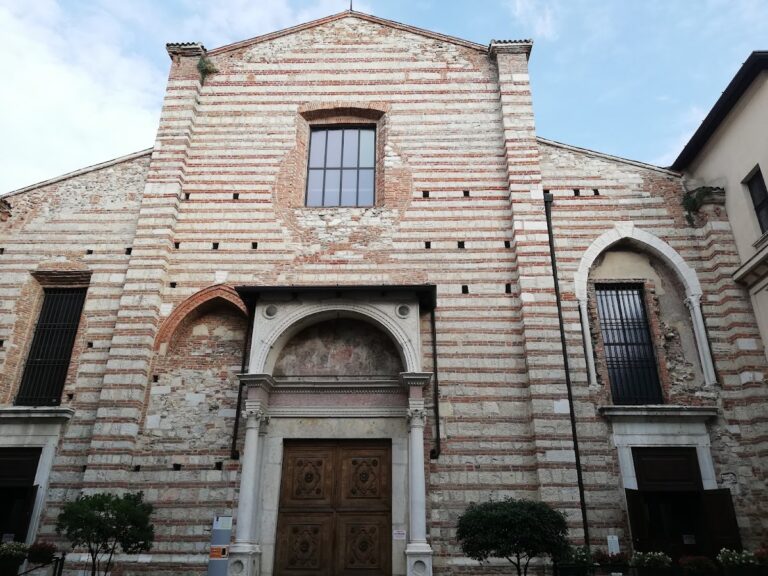
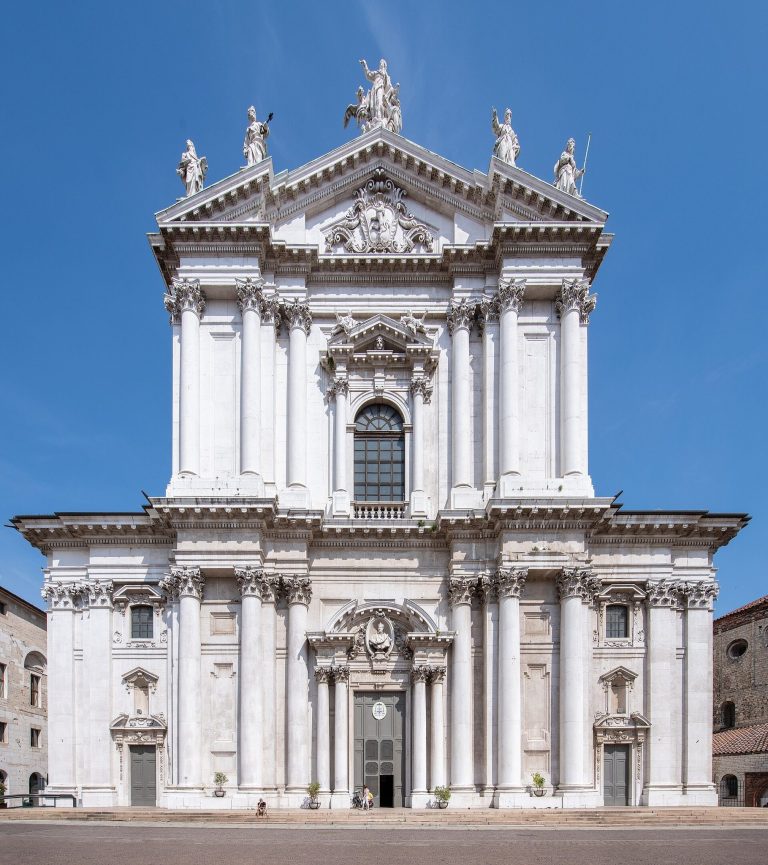
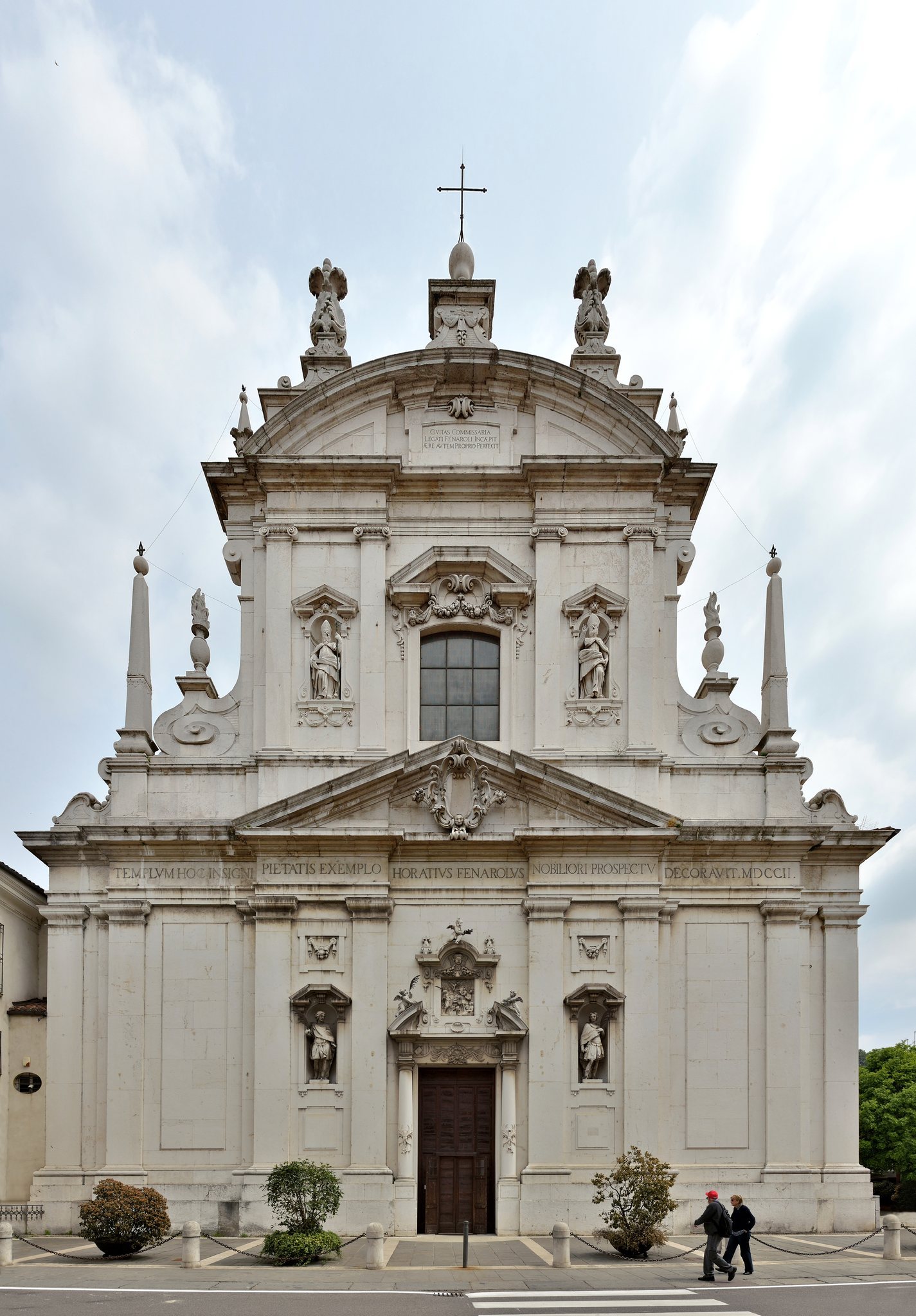
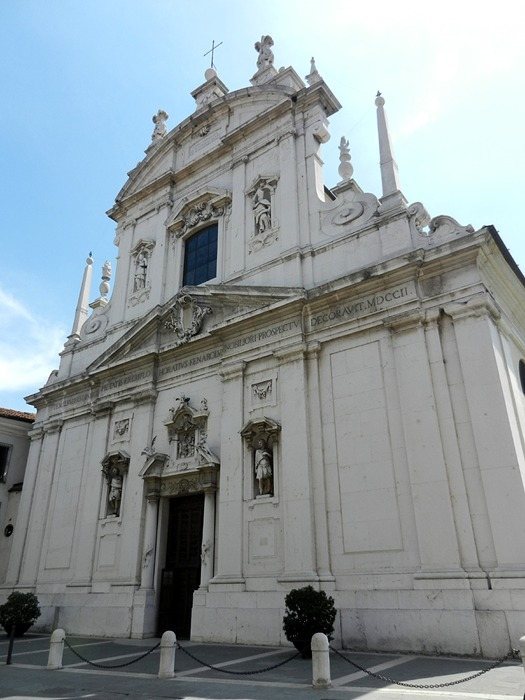
Giuseppe Cantone’s facade, built mainly between 1699 and 1705 and completed in 1711, is faced entirely with Botticino marble. Its lower level is broader and uses Tuscan wall strips, while the narrower upper level uses Ionic wall strips. Flattened volutes join the two levels, which are crowned by pinnacles and an iron cross.
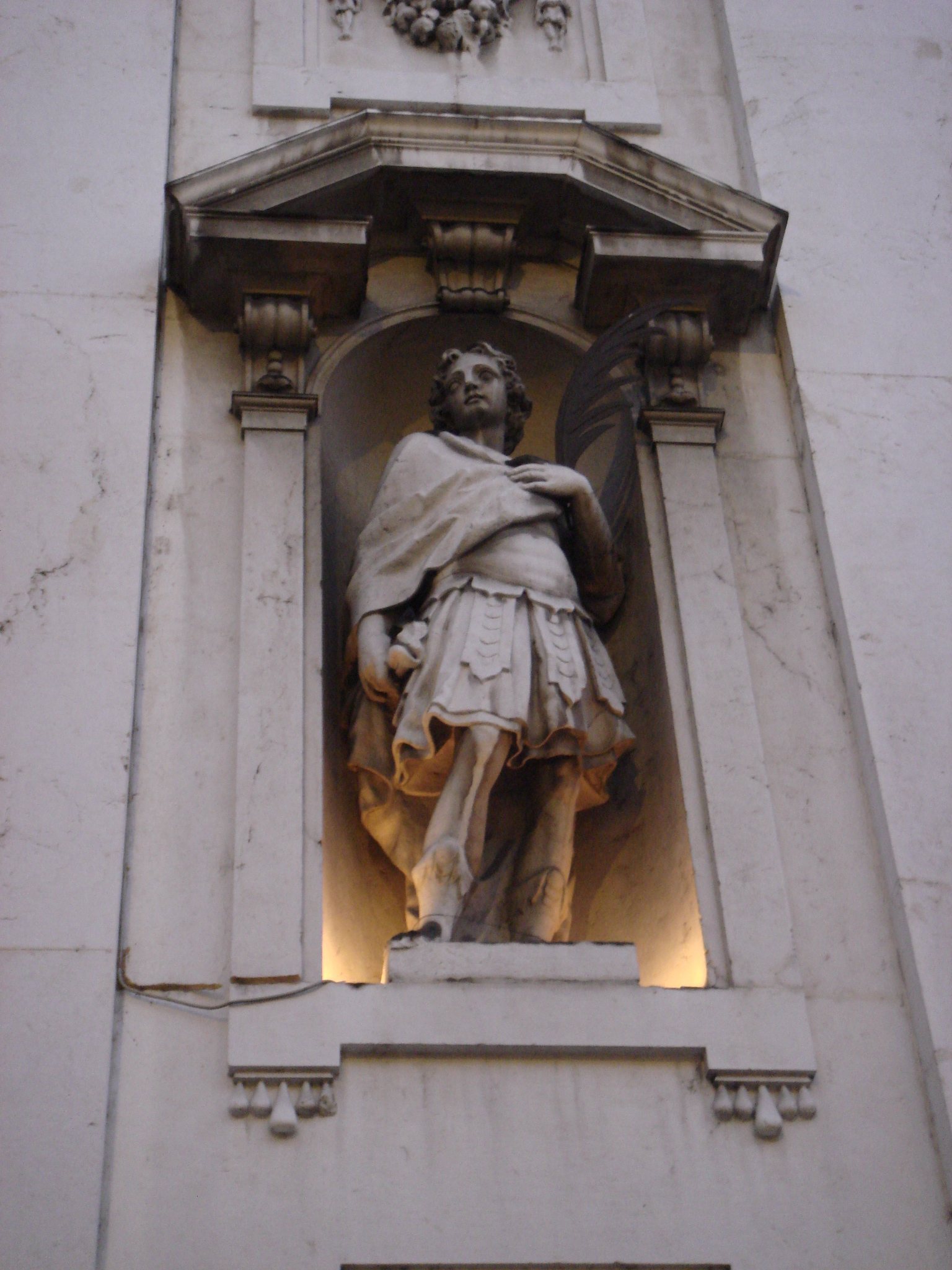
The central portal is framed by free-standing Tuscan columns, plant ornament, and a broken arched pediment. Above it is a crest with putti, volutes, and floral decoration. Santo Calegari the Elder’s marble high relief of the Martyrdom of Saints Faustinus and Jovita occupies the centre and incorporates iron inserts. Niches on either side hold statues of the two titular saints. The upper level contains a large central window and statues of Saint Antigius and Saint Honorius, attributed to the Calegari workshop. A dedicatory inscription recalls Fenaroli’s bequest, while a Baroque cartouche is attributed to Cantone.
Bell tower and south side
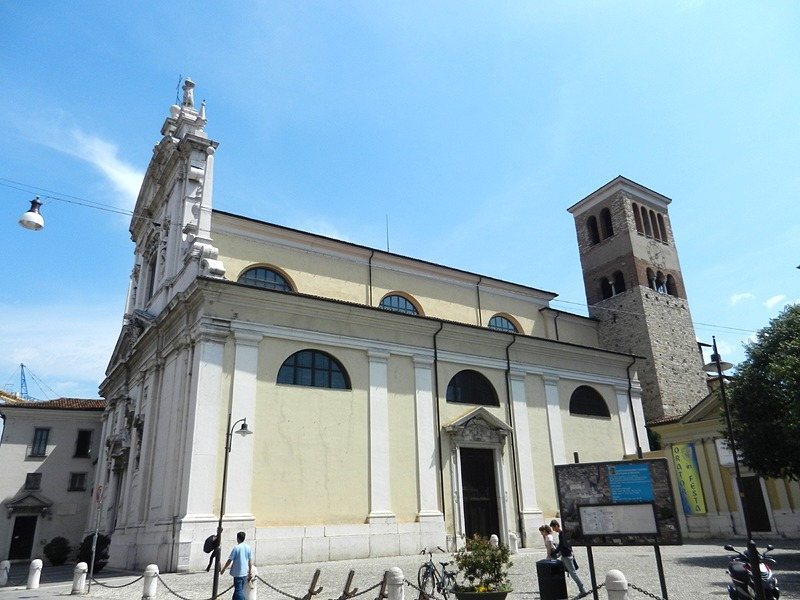
The bell tower is the oldest in Brescia and survived both the seventeenth-century reconstruction and the 1743 fire with much of its fabric intact. Its earliest layer dates from the ninth century and is built of local whitish medolo stone. The rectangular tower’s brick belfry belongs to a twelfth-century rebuilding. Its short sides retain two-light windows, while openings on the long sides were changed from two lights to three during the 1937 elevation. The upper belfry has two-light openings on the short sides and four-light openings on the long sides.
The tower holds nine bells and a call bell and is topped by a copy of Ramperto’s rooster. The church is most visible from outside through the facade and south side. The south wall became exposed along its full length after the Discipline building was demolished in 1927. Large lunette windows open the wall, and an intermediate pitched roof indicates the three-aisled interior. Near the apse stands the former Oratory of Saint James, once the baptistery, with a low Neoclassical facade.
Interior structure and painted decoration
Nave, aisles, and vaults
Two Tuscan-order colonnades divide the nave from the aisles. Each side has six free-standing columns, continued against the walls by shallow strips resembling pilasters. The columns stand on raised pedestals introduced during construction to resolve concerns about the proportions of Comino’s design. The related wall strips had been made roughly fifty years earlier from Piantavigna’s designs.
The nave is covered by a large barrel vault that changes into cloister vaults at its ends. The aisles have a sequence of light rib vaults, while the presbytery and apse have two successive sail vaults. Metopes and triglyphs decorate the entablature above the colonnades.
Fresco cycles
Tommaso Sandrino’s extensive illusionistic frescoes cover the nave and aisle ceilings. The central nave creates painted architectural depth through a balustrade, Solomonic columns, stairways, and other fictive structures. Its central panel, by Antonio and Bernardino Gandino, shows the Glory of the Martyred Saints Faustinus and Jovita. Four gray monochrome panels by Camillo Rama above the colonnades depict episodes from the saints’ legendary journey associated with Brescia, Milan, Naples, and Rome.
The right aisle contains scenes of angels, the saints’ martyrdom, and musician angels. The left aisle includes the Assumption of Mary, the Ascension of Jesus, and Saint Benedict in Glory. Ottavio Amigoni painted Saint Gregory the Great and Saint Honorius on the counterfacade.
Giandomenico Tiepolo decorated the presbytery and choir after the 1743 fire. His Apotheosis of Saints Faustinus, Jovita, Benedict, and Scholastica opens into an illusionistic space filled with angels, clouds, and painted architecture. Monochrome figures around it represent the four Latin Church Fathers, Gregory the Great, Augustine, Ambrose, and Jerome. Tiepolo also painted the Martyrdom of Saints Faustinus and Jovita and the saints’ intervention during the 1438 siege. Girolamo Mengozzi probably decorated the choir in 1754 and 1755 with an illusionistic dome, medallions of the evangelists, painted tribunes, clouds, angels, and fictive marble cartouches showing Saint Benedict and Saint Scholastica.
Altars and chapels
High altar and saints’ ark
The high altar is formed by Giovanni Antonio Carra’s burial ark, made between 1617 and 1622. Built chiefly from Carrara marble with black and multicolored stone inlay, it contains the remains of Saints Faustinus and Jovita. Bronze figures of the saints and a double cross rise above it. Allegorical female figures probably represent Fortitude and Faith, while four lateral statues represent Faith, Hope, and two Victories.
Crucifix chapel and baptistery
The chapel at the head of the left aisle is dedicated to the Crucifix. Its seventeenth-century altar contains a wooden crucifix, an urn with the relics of unidentified martyrs, and the remains of Saint Honorius, transferred there in 1949. A 1925 reliquary in a wall niche contains relics of Faustinus and Jovita and is moved to the centre of the nave on their feast day, February 15.
The chapel’s walls include a nineteenth-century golden-tile mosaic of Saints Roch and Anthony of Padua. Other fresco panels show episodes from the life of Jesus. Their architectural frames are attributed to Sandrino and the scenes to Antonio Gandino and Camillo Rama; Vittorio Trainini and Giuseppe Trainini restored and completed the work between 1923 and 1930.
The former chapel of Saint Honorius at the head of the right aisle became the baptistery in 1949. Claudio Botta’s cylindrical baptismal font, made in 1952, has a continuous high-relief frieze centred on Christ rising from the tomb. The chapel also contains Amedeo Bocchi’s Baptism of Jesus in the Jordan and Bernardino Gandino’s Saint Honorius among Angels and Members of the Calini Family.
Side altars
The church’s six side altars belong to different periods. Those dedicated to Saint Benedict and the Crucifix date from the first half of the seventeenth century, while the Nativity and Blessed Sacrament altars belong to the second half. Santa Maria in Silva was completed in the eighteenth century, and the Holy Cross altar was installed in the nineteenth century.
Giovanni Carra built the altar of Saint Benedict in 1649. It was intended for an arm relic from Montecassino but instead holds relics of other Benedictine saints, including the jawbone of Saint Placidus. Its central statue shows Benedict with pastoral staff, mitre, and a raven carrying bread. Sante Cattaneo’s image of angels and Montecassino Abbey forms the niche backdrop.
The Blessed Sacrament altar was completed in 1696 after nearly eighty years of work. It combines multicolored marble inlay with a jeweled tabernacle and antependium, and includes statuettes of the patron saints by Giovanni and Carlo Carra. Agostino Avanzo and Giuseppe Cantone were involved in its design. The associated chapel also contains Sante Cattaneo’s Deposition of Christ, commissioned in 1808 to replace Romanino’s Lamentation over the Dead Christ, which was confiscated in 1797 and destroyed in 1945. Two octagonal paintings show Abraham meeting Melchizedek and the Gathering of the Manna.
The altar of the Nativity is a large Baroque composition by Santo Calegari the Elder. Its antependium incorporates Saint Antigius’s funerary urn, while Lattanzio Gambara’s Nativity of Jesus forms the altarpiece. Santa Maria in Silva, completed in 1726, is made of red breccia, white marble, gilding, and inlay. Its central image is Paolo Amatore’s gilded and painted wooden Madonna and Child with the young John the Baptist. The prophets Isaiah and Hosea on the antependium are modern copies of works whose originals were stolen in 1975 and later recovered.
The Neoclassical Holy Cross altar, installed in 1828, combines pinkish breccia, white marble, and gilded details. A cruciform reliquary containing a fragment of the True Cross stands within it, beneath Gaetano Matteo Monti’s group of the risen Christ and two kneeling angels. The original late fifteenth-century reliquary is kept in the treasury.
Furnishings, paintings, and archaeological remains
Choir, organ, and devotional furnishings
The two choir lofts installed in 1735 are gilded and richly carved. Each contains seven seventeenth-century paintings, probably by Antonio Gandino, and both survived the 1743 fire. Behind the high altar is Serassi organ opus 567, built in 1843 and restored in 1860 and 1986. It has mechanical transmission, one 66-note keyboard, and a 27-note concave pedalboard.
Four original confessionals from the early seventeenth century are recessed into the aisle walls. Carved from walnut, they have separate compartments for penitents and confessor, shallow wall strips, entablatures, triangular pediments, carved grilles, allegorical figures, and an angel. Near the main entrance are two early seventeenth-century stoups made from red Verona marble with yellow and pink veining. Each rests on four lion paws and has an amphora-shaped shaft with a broad, shallow basin.
Romanino’s processional standard of the Blessed Sacrament, painted between 1535 and 1540, bears the Resurrection on one side and the Mass of Saint Apollonius on the other. It was carried in the Corpus Christi procession and has been displayed between two columns in the left aisle since 1965 so that both paintings can be seen. Grazio Cossali’s 1603 canvas of the saints’ apparition during Piccinino’s siege hangs on the right counterfacade. It was formerly displayed outside during the February 15 feast, while a copy now represents it outdoors.
A late fifteenth-century wooden Crucifix by an unknown carver stands beside the presbytery entrance. Other works include Giuseppe Teosa’s painted lunette on the wooden side-entry screen, four early seventeenth-century paintings above the confessionals, and Giovanni Carobio’s Saint John of Matha Ransoming Slaves. Marco Richiedei’s Incredulity of Saint Thomas hangs on the left counterfacade after being transferred from the former church of Saint Thomas when it was decommissioned in 1836.
The former baptistery in the church of Saint James contains further transferred works, including an anonymous fifteenth-century Crucifixion, a sixteenth-century Madonna and Child with Saints James the Greater and Anne, Pietro Scalvini’s Saint Louis Gonzaga Adoring the Crucifix, and Liberale Cozza’s Saint Philip Neri Inviting Children to Venerate the Madonna.
Excavated remains and treasury
Excavation beneath the sacristy in 1957 exposed the northern wall of the Romanesque church, a section of a crypt apse roughly one metre high, and two layers of decoration. The later layer contained fifteenth-century frescoes commissioned by Bernardo Marcello, while the earlier layer consisted of votive panels with saints. The foundations also contained a first-century Roman funerary stele showing three men and a woman beneath a triangular pediment, as well as a second reused stele consisting only of an inscription. The figural stele was transferred to the Santa Giulia Museum.
The treasury contains reliquaries, liturgical vessels, vestments, processional objects, and altar furnishings, chiefly from the seventeenth to nineteenth centuries. Among them are the Cross of Saint Faustinus, a reliquary associated with the True Cross fragment, Eugenio Brusa’s 1823 chalice of the Eucharistic Mystery, and the 1925 Patron Saints’ Urn, which contains two femurs removed from the principal ark in 1923.