Church of Saint John the Evangelist: A Historic Roman Catholic Church in Brescia


Site at a Glance
- Rating
- 4.6
- Popularity
- Low
- Country
- Italy
- Primary era
- Medieval
- External website
- Open
- Eras represented
- Medieval, Early Modern
- Civilizations
- Holy Roman Empire, Venetian
- Site type
- Religious
- Remains
- Church
On this page15 sections
History
The Church of Saint John the Evangelist is a Roman Catholic church in Brescia, Italy, whose earliest traces date to the fourth century. Its exterior is predominantly Gothic, while its interior reflects major Baroque alterations. Located in the historic center and belonging to the Diocese of Brescia, it is among the city’s oldest churches and is especially known for its paintings and the Renaissance decoration of the Chapel of the Blessed Sacrament.
Early Christian foundations
Saint Gaudentius became bishop of Brescia in 390. After returning from the Holy Land with numerous relics, he founded the city’s third basilica on this site under the title Concilium Sanctorum, meaning “Assembly of the Saints.” The basilica was consecrated in 400 or 402 in the presence of numerous bishops and dignitaries. It was probably a very large building with either three or five aisles.
The earliest architectural nucleus of the present complex is traditionally or hypothetically placed at the beginning of the fifth century. Both the Concilium Sanctorum and a nearby church already dedicated to Saint John were destroyed by invading barbarians. A new church dedicated to Saint John the Baptist and Saint John the Evangelist was built shortly afterward on the ruins.
Medieval rebuilding and religious administration
Fires in 1096 and 1144 caused further damage and led to a rebuilding campaign that began in 1151. The church became a parish in 1173, the same year that a hospital was established alongside its religious functions. From the eleventh through the fourteenth century, canons served the church under a provost, the head of the chapter, and followed the Augustinian rule, a system of religious discipline based on teachings traditionally associated with Saint Augustine.
In 1237 the church was incorporated into Brescia’s new circuit of city walls. Another rebuilding took place from 1440 to 1447, when two cloisters were also added. Administration was then entrusted to the Canons Regular of San Salvatore in Venice, clergy who lived in community under a religious rule. This change began a prosperous period for the church and its community, accompanied by extensive artistic enrichment.
Renaissance patronage and Baroque transformation
The Confraternity of the Blessed Sacrament commissioned Romanino and Moretto on 21 March 1521 to decorate its chapel. Their work created the Renaissance cycle for which the church is particularly noted. The chapel’s paintings combine scenes from the Old and New Testaments with images of prophets and Evangelists, forming a program centered on the Eucharistic mystery and the relationship between divine revelation and humanity.
From 1651, the interior underwent major alterations lasting approximately twenty-five or thirty years. The work followed designs by the Milanese architect Girolamo Quadri and largely obscured the earlier Gothic interior beneath a Baroque arrangement. The chapter was suppressed in 1771, after which the church passed to the diocesan clergy.
Later conservation
Conservation restoration of the facade and the Chapel of the Blessed Sacrament took place in 2008 and 2009. The church also preserves a Marian image associated with processions intended to avert drought. It is venerated on 2 February, the Feast of the Purification of Mary, also known as Candlemas. According to the tradition connected with the image, rain began before one procession returned to the church, requiring participants to wear the long mantles called tabarri.
Remains
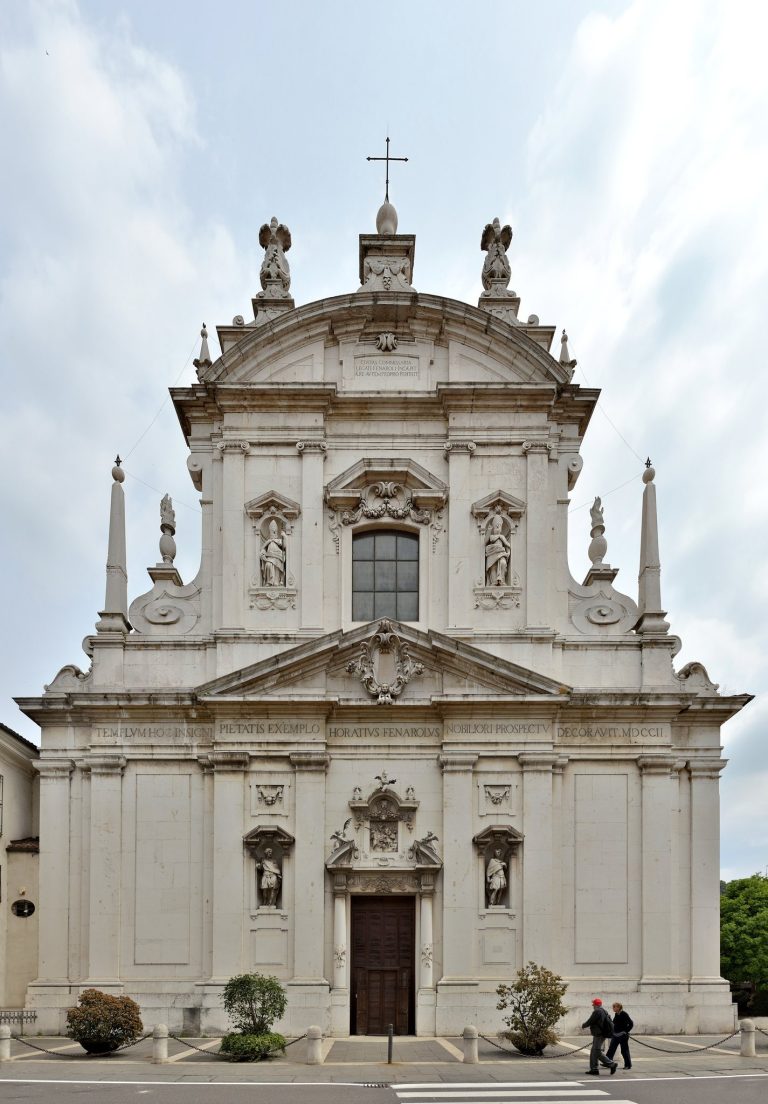
The surviving church combines a Gothic exterior with a predominantly Baroque interior. Its facade is organized around a broad fifteenth-century surface of regularly laid red brick and white stone, while the Romanesque bell tower includes alternating courses of stone and brick on one side. Inside, the building follows a Latin-cross plan with one central nave and two narrower side aisles. Five substantial pillars on each side separate the aisles from the nave.
Facade, tower, and church plan
The facade preserves evidence of several construction phases. The original rose window was replaced by a rectangular Renaissance window, although the outline of the earlier opening remains visible. A stone portal added at the beginning of the sixteenth century has an arch resting on columns and is attributed to Filippo Grassi of Milan. Beside it are remnants of noble tombs, including a terracotta arch from a Maggi tomb and a marble arch from a Paitone family tomb.
The present stone pillars incorporate the original Gothic brick pillars. The transept is short and is only weakly expressed in the plan, ending before the presbytery beneath the central dome. The Chapel of the Blessed Sacrament occupies the left side of this area, while the Chapel of the Madonna del Tabarrino occupies the right. The current barrel vault replaced the original exposed pitched roof, and the polygonal apse is the principal major structural element to have remained intact through the successive rebuildings.
Most chapels and side altars belong to the original structure. The Chapel of the Blessed Sacrament replaced the former Chapel of the Crucifix in 1509. The Chapel of the Madonna del Tabarrino was substituted for the Chapel of Saint Gaudentius by Agostino Avanzo. Outside the church, the late-fifteenth-century cloister survives with a harmonious double loggia.
Chapels and Marian images
Chapel of the Blessed Sacrament
Built in 1509, the Chapel of the Blessed Sacrament consists of three niches, one at the rear and two at the sides. Each niche is surmounted by a lunette, a curved area above a painting or opening, beneath the vault. The rear altar contains Bernardo Zenale’s pre-existing Deposition in a wooden frame by Stefano Lamberti, while Moretto’s Coronation of the Virgin occupies the lunette above it.
Moretto’s paintings cover the right wall with The Gathering of the Manna, Elijah Comforted by the Angel, Saints Luke and Mark, and The Last Supper in the lunette. Six prophets fill the arch soffit. On the left wall, Romanino painted The Resurrection of Lazarus, The Supper in the House of the Pharisee, Saints Matthew and John, and The Mass of Saint Gregory in the lunette, accompanied by another six prophets.
The two artists’ contributions create a unified catechetical program. Moretto’s scenes draw on the Old Testament, while Romanino’s represent episodes from the New Testament. The prophets present a dialogue between God and humanity, the Evangelists offer testimony to divine existence, and the central scenes focus on the Eucharistic mystery.
Chapel of the Madonna del Tabarrino
Agostino Avanzo built the Chapel of the Madonna del Tabarrino at the beginning of the seventeenth century to house a painting of the Madonna nursing the Child. The image is a faithful copy of the miraculous Marian fresco in the Chapel of Saint Mary. It was once attributed to Moretto, but the art historian Simone Facchinetti has identified it as an early work by Moroni, from the period when Moroni was Moretto’s pupil.
Antonio Calegari remodeled the chapel in the eighteenth century. He frescoed the vault and created a theatrical altar with angels and clouds resting on elaborate yellow-marble drapery. A dove representing the Holy Spirit appears above the altar, while a bas-relief of the Flight into Egypt is set below the painting. Antonio’s brother Alessandro Calegari made the putti and the bas-relief. Francesco Paglia painted the Nativity of Mary in the left lunette, and Giuseppe Nuvolone painted the Presentation of Jesus at the Temple in the right lunette.
Chapel of Saint Mary
The Chapel of Saint Mary lies north of the Chapel of the Blessed Sacrament. Its present structure dates from the fifteenth century and may stand partly over the earlier Concilium Sanctorum. Its uses and names changed over the centuries. The chapel contains the Marian image copied by Moretto for the Chapel of the Madonna del Tabarrino. The artist of the original fresco is uncertain; after it was considered lost, the image was rediscovered during restoration in the 1960s.
The oldest paintings in the chapel are two enthroned Madonnas and two groups of saints with devotees, dated 1486 and attributed to Paolo da Caylina the Elder. Paolo da Caylina the Younger painted two-tiered panels showing scenes from the life of Mary and probably created the two apse lunettes during the first half of the sixteenth century. At the beginning of that century, Floriano Ferramola painted the vault with the four Evangelists, their symbols, and the Fathers of the Latin Church, Gregory the Great, Ambrose, Jerome, and Augustine.
Altars, choir, and furnishings
Paintings and altars
Several other works are distributed among the church’s altars and chapels. Francesco Paglia’s Assumption occupies the first altar on the right. At the third altar on the right is Moretto’s Massacre of the Innocents, with an architectural surround attributed to Stefano Lamberti. Gaspare Bianchi’s large Altar of the Relics stands at the fourth altar on the same side, while Grazio Cossali’s Birth of John the Baptist is at the rear altar of the right aisle.
Other works include Moretto’s Mary with the Child, Angels, and Saints, with a frame attributed to Stefano Lamberti; four original organ shutters painted by Moretto and now hung on the presbytery walls; Cossali’s Giving of the Name to John the Baptist at the rear altar of the left aisle; and Romanino’s Sacred Conversation at the fourth altar on the left. Giuseppe Nuvolone’s Saints Cecilia, Catherine, and Lucy is at the third altar on the left, and Romanino’s Marriage of the Virgin, commissioned by the Martinengo family, hangs on the left wall of the baptistery. Salloni painted the lunettes above the altars, including those above the stele of Paul VI, in the mid-seventeenth century.
Choir, lectern, and organ
The choir dates from the early sixteenth century. Its simple stalls are separated by elegant sculptures. The wooden lectern, or ambon, a raised stand used for reading or proclamation, is decorated with a black eagle, the symbol of the Evangelist John. This fifteenth-century sculpture formerly stood on the entrance portal of the convent.
The pipe organ was originally built by Facchinetti in 1517 and has been rebuilt approximately ten times. Armando Maccarinelli constructed the present instrument in 1940, and Inzoli-Bonizzi enlarged it in 1994. It replaced a succession of instruments, the oldest of which dated to 1571. The present organ has electric transmission, two 61-key keyboards, and a concave-radial pedalboard with 32 pedals. It is housed in a Baroque case painted to imitate marble on the left wall of the presbytery, while its console stands in the right transept.
Later devotional features
A statue of the Sacred Heart of Jesus, made by the Poisa brothers in 1955, stands at the second altar on the left. The Sacred Heart is a Catholic devotional symbol representing Christ’s heart as an expression of his love and sacrifice. At the beginning of the right aisle, a modern marble stele dedicated to Paul VI was made by the Pistoian artist Enrico Savelli.