Duomo Nuovo: Brescia’s Cathedral of Santa Maria Assunta
Site at a Glance
- Rating
- 4.6
- Popularity
- Medium
- Country
- Italy
- Primary era
- Early Modern
- External website
- Open
- Eras represented
- Early Modern, Modern
- Civilizations
- Austrian Empire, Habsburg, Venetian
- Site type
- Religious
- Remains
- Cathedral
On this page24 sections
History
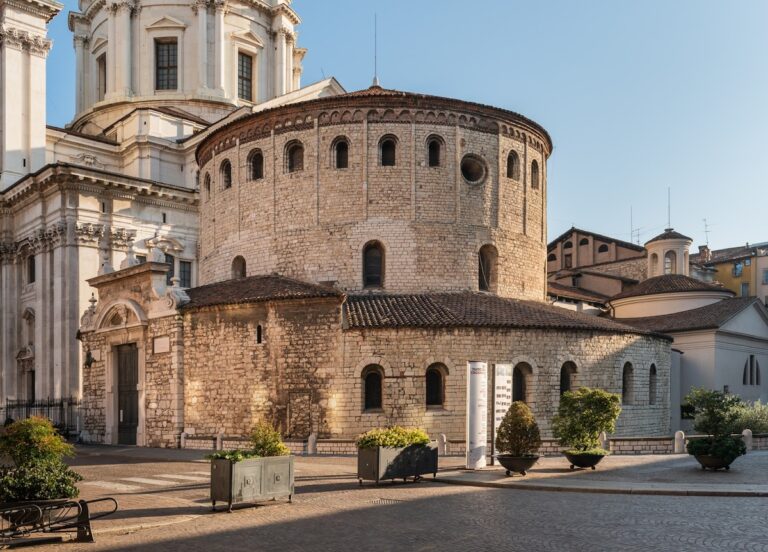
Duomo Nuovo, formally the Cathedral of Santa Maria Assunta, is the principal church of Brescia, Italy, and the mother church of the Diocese of Brescia. Built in a Baroque and later Neoclassical architectural context, it was begun in 1604, consecrated in 1914, and occupies the site of the early Christian Basilica of San Pietro de Dom, which dated from the fifth or sixth century. The cathedral stands beside the Old Cathedral in Piazza Paolo VI, also known as Piazza del Duomo, and is recognized as an Italian national monument.
Replacing the early Christian basilica
Plans to replace the deteriorating Basilica of San Pietro de Dom began in 1603. The project reflected both changing architectural expectations and the Counter-Reformation, the Catholic Church’s institutional response to the Protestant Reformation. Its architectural directives favored clear liturgical organization and forms suited to Catholic worship. Agostino Avanzo prepared the first design, a Latin-cross church with three aisles, a transept, projecting side altars, and a large central dome. It combined Mannerist and Classical elements, but the proposal was rejected.
Giovanni Battista Lantana then developed a related but more structurally ambitious scheme. His later design placed a Greek cross, whose four arms are approximately equal, within a square. A large central dome was surrounded by four smaller domes, and a projecting apse established the principal axis. The plan was accepted despite continued debate and comparisons with Bramante’s project for Saint Peter’s Basilica. The existing basilica was eventually demolished because this solution was less costly than the alternatives under consideration.
Early construction and changing designs
The first stone was laid in 1604. The square in front of the building became a temporary settlement for stonemasons and a working school for sculpture and architectural production in Brescia. The Genoese Orsolini were among the first masons employed on the cathedral. Lantana’s plan soon encountered opposition from Pier Maria Bagnadore, who wanted to add a western bay and turn the Greek-cross arrangement into a Latin cross. Bagnadore became director of the works, while Lantana retained responsibility for financial administration.
Bagnadore later restored the Greek-cross arrangement, but rivalry and disagreements between the two architects led to repeated and lengthy interruptions. Lantana ultimately left the project, apparently after his pupil Tommaso Lorando was brought in to assist with the accounts. In 1611, Bishop Marino Giorgi removed Bagnadore and appointed Lorenzo Binago of Milan. Antonio Comino directed construction, while Binago remained the designer and chief supervisor, beginning a second major phase.
The building continued to change during this period. Two service buildings, including one used as a rectory, were erected beside the apse. They enclosed it, so that it no longer projected externally, and removed the need for outside buttresses supporting the dome. The five external niches originally planned for the building were reduced to two, which contain statues of Brescia’s patron saints, Faustino and Giovita.
Interruption and eighteenth-century progress
Binago proposed a Baroque facade flanked by two bell towers, but the design was considered too innovative for Brescia and the towers were never built. Their construction would have given the square four towers, counting the tower of the Broletto and the bell tower of the Old Cathedral, which collapsed in 1708.
The plague epidemic that affected northern Italy around 1630 brought a severe economic and demographic crisis, halting work for almost forty years. Construction resumed intermittently during the second half of the seventeenth century and was substantially restarted toward its close. Inheritances transferred to the Church by plague victims strengthened the finances of the Diocese of Brescia and helped the project continue.
The renewed phase included Luca Serena’s completion project of 1698 and Giuseppe Antonio Torri’s 1711 proposal for a ship-hull-shaped covering over the apse, which was never carried out. Antonio Biasio became director of the works, redesigned the facade in 1719, and changed its semicircular pediment into a lowered arch in 1748. Cardinal Angelo Maria Querini, Bishop of Brescia from 1727 to 1755, gave strong impetus to the building campaign. Andrea Pozzo, Giorgio Massari, and Filippo Juvarra were consulted, and Juvarra visited the construction site in 1729.
After Biasio’s death in 1758, Giovanni Battista Marchetti directed the works with his son Antonio. They gave the facade a Neoclassical character and its definitive triangular pediment, while the springing of the dome was raised slightly. The dome was designed by Luigi Cagnola and built by Rodolfo Vantini. Its completion in 1825 brought to an end a construction process that had lasted approximately 230 years, although the intended balustrade along the roofline was never added.
Damage, restoration, and later memory
The cathedral suffered serious damage during the aerial bombardment of 13 July 1944. Fire caught the lead covering of the dome, while the tympanum and the windows of the drum, lantern, and apse were badly affected. The rear walls also retain abrasions caused by Austrian bombardment during the Ten Days of Brescia in 1849, an uprising and military conflict in which Brescia resisted Austrian rule.
Postwar restoration returned the building largely to its earlier appearance. Scarring remains visible on the apse walls, and some damaged marble rosettes in the dome were reproduced in cement. The cathedral’s final character combines the Baroque setting in which construction began with the Neoclassical approach that shaped its completion. It received national-monument status, and a monument to Pope Paul VI, the twentieth-century pope, was installed inside in 1984.
The cathedral also contains burials associated with the bishops of Brescia. They include Anatalone, Apollonius, Philastrius, Marino Zorzi or Giorgi, Marino Giovanni Zorzi or Giorgi, Bartolomeo Gradenigo, Giovanni Alberto Badoer, Angelo Maria Querini, Giovanni Molin, Giovanni Nani, Gabrio Maria Nava, Carlo Domenico Ferrari, Girolamo Verzeri, Giacinto Gaggia, Giacinto Tredici, Luigi Morstabilini, and Bruno Foresti. Their episcopates extend from the third century to 1998.
Remains
Duomo Nuovo has a Greek-cross plan organized around a broad central space beneath the dome. A single nave surrounds this central area, while a deep apse provides the main axis without changing the building’s Greek-cross arrangement. Four large piers and eight tall free-standing Corinthian columns support the interior. The extensive use of marble, white stucco, and carved decoration gives the cathedral its characteristic white and blue luminosity.
Facade and external sculpture
Facade
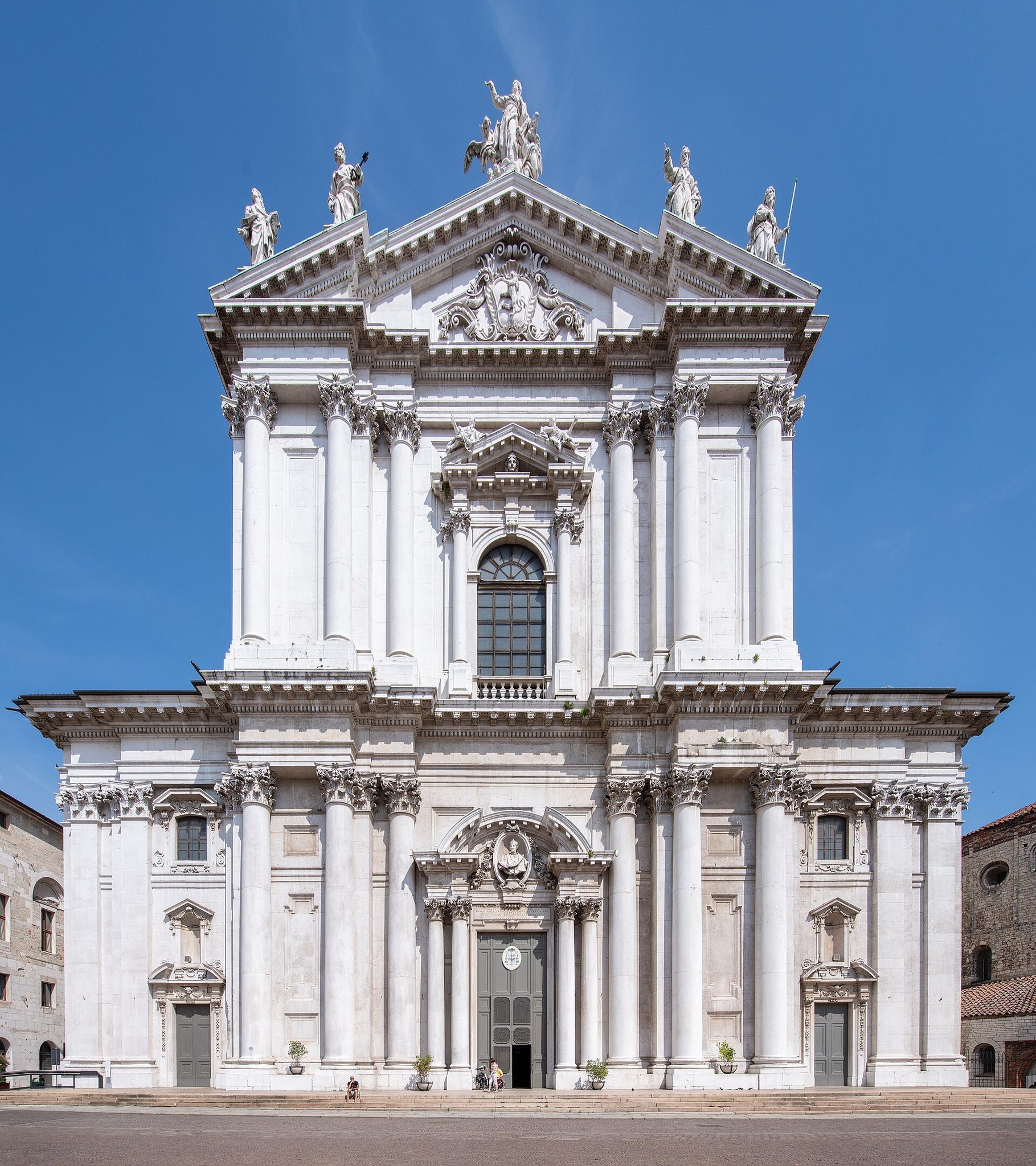
The facade facing Piazza Paolo VI is symmetrical and built of Botticino marble. It is arranged in two orders, with a wider lower level containing two side entrances and a narrower upper level that is chiefly decorative. Corinthian details and Attic column bases shape the composition. The central portal has an arched pediment containing Antonio Calegari’s bust of Cardinal Angelo Maria Querini, made in 1750. Above it is a tall window with a triangular pediment.
Pediment and statues
The main triangular pediment bears Brescia’s coat of arms and statues of the Assumed Virgin, Saints Peter, Paul, James, and John. Giovanni Battista Carboni, Stefano Citerio, and Pier Giuseppe Possenti made these statues in 1792. The niches in the apse contain statues of Saints Faustino and Giovita by Antonio and Carlo Carra. A statue of Saint John the Baptist by the same sculptors stands above the side entrance toward Via Querini and the Broletto.
Dome and central space
Dome structure
A high drum, the structural zone supporting the dome, contains large rectangular windows. The dome measures approximately 21 metres across internally and 26 metres externally. Its internal height is 64.20 metres, while the height to the top of the external lantern, the raised structure at the crown, is 72.60 metres. A corrected external measurement is approximately 80 metres. At its completion, the dome was described as the third-largest in Italy.
Dome decoration
The interior of the dome is decorated with stucco and carved marble executed by Giovanni Battista Carboni. Its coffering contains marble rosettes, some of which were reproduced in cement during postwar restoration. Marble also appears in the columns, pilasters, frieze, window frames, lunettes above the side altars, and the evangelists in the pendentives. These curved triangular surfaces transfer the dome’s weight onto the four supporting piers. The four pendentives contain marble busts of the evangelists. Santo Calegari the Younger made Saint John and Saint Luke, while Giovanni Battista Carboni made Saint Mark and Saint Matthew.
Chapels and altars
Right-side chapels
The cathedral contains eight side chapels. The first altar on the right is dedicated to the Holy Cross and contains Francesco Giolfino’s Crucifix, made in 1502. Its lunette contains Alessandro Bonvicino’s Sacrifice of Isaac. The second chapel, dedicated to the Blessed Sacrament, occupies the end of the horizontal arm of the Greek cross. Its Neoclassical altar was designed by Rodolfo Vantini. The chapel also contains Michelangelo Grigoletti’s Jesus Preaching to the Crowds, Giovanni Seleroni’s Faith, and Giovanni Antonio Emanueli’s Hope. A 1990 painting of the Venerable Annunciata Cocchetti by Gabriele Saleri hangs above the confessional.
Ark of Saint Apollonius
The third altar on the right contains a perspectival wall fresco and the monumental Ark of Saint Apollonius. Decorated with refined reliefs, the ark is attributed to Gasparo Cairano and is generally dated to 1508 to 1510. It was first kept in the Basilica of San Pietro de Dom, moved to the Old Cathedral while Duomo Nuovo was being built, and later transferred to the New Cathedral. A decorated glass urn designed by Graziano Ferriani, containing relics of Saint Benedict of Nursia, stands before it. This chapel is described as the only one completed and fully decorated according to the cathedral’s original design.
Transferred altar
The terminal altar of the right aisle contains Antonio Calegari’s Faith and Humility and Luigi Basiletti’s nineteenth-century Guardian Angel. The altar came from the Church of Santa Maria degli Angeli and was installed in 1808 after its donation by Eugene de Beauharnais, viceroy of Italy.
Left-side chapels
The terminal altar of the left aisle contains Jacopo Palma the Younger’s Assumption Venerated by Saints Charles and Francis and Bishop Marino Giorgi. It also serves as Giorgi’s tomb. Lorenzo Binago designed the altar in the early seventeenth century, and it became a model for Lombard side altars and for later examples in Brescia and northern Italy. The third altar on the left is dedicated to Saint Nicholas of Tolentino. Its trompe-l’oeil decoration, a painted illusion of three-dimensional architectural forms, surrounds Giuseppe Nuvolone’s 1679 painting of Saints Nicholas of Tolentino, Faustino, and Giovita at prayer, made in thanksgiving for the end of the plague of 1630.
Paul VI monument and baptistery
Raffaele Scorzelli’s 1984 monument to Pope Paul VI stands on the left wall of the central arm. A reliquary beside it contains a relic of Saint Andrew the Apostle, described as a gift from the pope to his native city. The monument is near the grave marker of Bishop Luigi Morstabilini. Paintings by Romanino depicting the Marriage of the Virgin, the Birth of the Virgin, and the Visitation were formerly displayed above the monument. After restoration of the Antegnati organ, they were returned to the Old Cathedral in 2023. The first chapel on the left contains the baptistery and a bronze statue of Saint John the Baptist by Claudio Botta.
Presbytery and associated works
High altar
The presbytery contains statues of Saints Gaudentius and Philastrius by Antonio Calegari. Its high altarpiece is Giacomo Zoboli’s Assumption, commissioned by Cardinal Angelo Maria Querini in 1732, painted in Rome, completed and installed in 1735, and placed above a high altar completed and inaugurated in 1737.
Sacristy entrance and adjoining room
A painting of Saint Anthony of Padua by Giuseppe Nuvolone stands before the sacristy entrance on the right side of the presbytery. The entrance pillars bear the tombs of Bishop Carlo Domenico Ferrari, by Giovanni Antonio Emanueli, and Bishop Gabrio Maria Nava, by Gaetano Matteo Monti. An adjoining room preserves a valuable Christ Blessing, attributed to a member of the Piazza family and dated to the first half of the sixteenth century. The cathedral also contains monuments to Ferrari, Nava, and Girolamo Verzeri.
Pipe organs
Tonoli-Porro organ
Two monumental pipe organs stand in Neoclassical cases. The Tonoli-Porro organ of 1855 occupies the choir on the Epistle side and replaced an earlier instrument made in 1750. It originally had one manual, a second was added in 1880, and Diego Porro reformed it in 1906. Gianluca Chiminelli carried out extensive cleaning and partial restoration in 2005 and 2006.
Mascioni organ
The Mascioni Opus 898, made in 1968, stands in the choir on the Gospel side and has electric transmission. Its pipes are divided between the choir case, which contains the Positive, Swell, Pedal, and Great Organ sections, and an expressive case behind the former Baroque high altar. The console is in the presbytery and has three keyboards of 61 notes each and a concave-radial pedalboard of 32 notes. Mascioni restored the instrument in 2005.
Other recorded works in the cathedral include paintings and frescoes representing the Life of the Virgin, the Mystic Marriage of Saint Catherine of Alexandria, Saint Martin by Pietro Rosa, Saint Anthony of Padua with the Virgin and Child, Brescia Pleading to the Madonna of Health, the Martyrdom of Saint Apollonia, Saint Anthony with the Madonna and Child, the Guardian Angel and a Bishop, and Saint Gaudentius with the Trinity.