Church of Saint Nicholas: A Medieval Wayside Church in Czechia


Site at a Glance
- Rating
- 4.8
- Popularity
- Low
- Country
- Czechia
- Primary era
- Medieval
- Eras represented
- Medieval
- Civilizations
- Holy Roman Empire, Kingdom of Bohemia
- Site type
- Religious
- Remains
- Church
On this page9 sections
History
The former Church of Saint Nicholas was a medieval Roman Catholic church in Czechia, near Horní Slavkov in the Slavkov Forest. Built in the late Romanesque period with Early Gothic elements, it stood at a crossroads of old strategic and trading routes near the northern foot of Krudum. Its first documentary reference dates from the mid-thirteenth century, although its foundation and original purpose remain uncertain.
Medieval foundation and purpose
The dedication to Saint Nicholas, a Christian saint associated with generosity and the protection of merchants and travellers, has encouraged the interpretation that the church may have served people using the route as a wayside church. Its position was also connected with medieval mining in an area containing iron ore and gemstones. These associations help explain why a church was established in this otherwise wooded upland landscape, but they do not establish its precise original function.
In the mid-thirteenth century, King Wenceslaus I transferred the parish Church of Saint Wenceslaus in Loket, together with the affiliated Church of Saint Nicholas and other churches in the surrounding area, to the Order of the Knights of the Cross with the Red Star. This Catholic religious and charitable order administered churches and charitable institutions in the medieval Bohemian lands. The medieval record confirms the church’s institutional connection with Loket, but it does not identify its exact location.
Disappearance and legend
The church probably disappeared around the turn of the sixteenth century. It was already absent from the Loket land register of 1525, although coins found at the site show that the nearby trading route continued in use at least until the Thirty Years’ War, the seventeenth-century conflict that reshaped much of Central Europe.
Over the following centuries, the ruins became associated with the tradition of Saint Nicholas of Krudum. According to the local legend, Saint Nicholas lived inside the mountain and distributed gifts to children on the eve of his feast day, 6 December. The tradition circulated in the former Loket region from the fifteenth century until the displacement of the German population after the Second World War.
Rediscovery and archaeological investigation
The location was surveyed in 1989, and windbreaks created during the 1980s and 1990s exposed sections of the buried walls. Archaeological investigation by the Karlovy Vary Regional Museum began in 2002 and continued through 2006. The work identified the remains as those of a church rather than fortifications and brought back into view a site that had been difficult to locate for roughly five centuries.
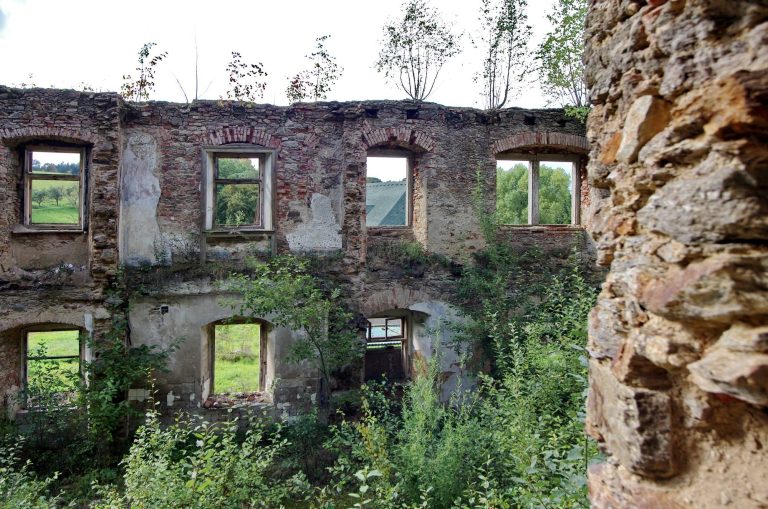
The investigation examined the church, its possible cemetery and settlement, and nearby mining remains. The surviving walls were conserved after the excavations, and some sections were rebuilt. Renewed archaeological interest also revived the Saint Nicholas of Krudum tradition. In 2005, the research team brought back the story of Saint Nicholas travelling through the region, and the ruined church area has since been used for performances connected with the legend.
Remains
The church stood on the crest of a granite outcrop in woodland between Hrušková and Třídomí, near the boundary of the Třídomí, Hrušková, and Nadlesí cadastral areas. Its surviving structure was built from granite ashlar, or carefully shaped stone blocks, in a late Romanesque form modified by Early Gothic features. The rectangular nave, eastern presbytery, thick masonry, and surviving fragments together define the plan of the former building.
Church plan and construction
The nave measured approximately 14.8 metres in length and 12.6 to 12.8 metres in width. An eastern presbytery, the part reserved for the clergy and altar, extended for about 10.5 metres and was approximately 12 metres wide. A triumphal arch separated the nave from the presbytery. The walls were generally 1.10 to 1.15 metres thick, reaching about 1.20 metres in some places. In the western part of the nave, the granite outcrop rose above the surrounding paving.
Approximately 360 cubic metres of stone went into the walls. About half of the dressed granite came from a quarry roughly 100 metres west of the church, while the remainder was taken from shallow extraction sites and loose boulders nearby. The mortar contained Karlovy Vary sinter. The building reached approximately 11 metres in height, with the masonry itself rising about 5 metres. Its roof was probably gabled over the nave and hipped over the presbytery.
Openings and roof features
Large quantities of slate pierced by nail holes point to a small sanctus-bell turret, a roof structure that housed a church bell. Fragments of the entrance portal and windows show tall, slender Early Gothic openings with pointed upper arches and side hollows. The Early Gothic portals had surrounds shaped with a hollow moulding. Fragments of original plaster, floor tiles, and flooring also survived among the archaeological remains.
Burials and small finds
Human skeletal remains were found during excavation. In 2004, the remains of a man lay 45 centimetres below the floor, while the remains of children, probably newborns, were discovered close to the surface beside the southern wall of the presbytery.
Numerous fragments of ordinary pottery came from deposits beneath the floor. Excavators also recovered 82 coins inside or immediately around the church. The earliest was a small German merchant coin, a heller, dating from around the turn of the fourteenth century. Twenty coins belonged to the fourteenth century, chiefly Cheb hollow hellers, and 42 came from the fifteenth century, including Austrian, Bavarian, Znojmo, and Palatinate pfennigs.
Nearby mining remains and the route
Mining features near the church include the mouth of an old adit, collapsed workings, spoil heaps, drainage channels, and previously unknown underground workings. Geological and archaeological investigations indicate that iron ore was mined around the church. The surrounding area contains hematite in quartz veins, as well as amethyst and jasper. Tin-bearing greisen occurs nearby, but analysed samples contained only 0.01 percent tin, making a major tin-mining connection unlikely.
In the mid-nineteenth century, the route leading around the church toward Třídomí was paved with material from old mining dumps. Its iron-oxide and jasper content gave the road the name “Red Little Road.”