Sokolov Chateau: Castle and Regional Museum in Czechia


Site at a Glance
- Rating
- 4.5
- Popularity
- Low
- Country
- Czechia
- Primary era
- Modern
- External website
- Open
- Eras represented
- Medieval, Early Modern, Modern
- Civilizations
- Habsburg, Holy Roman Empire, Kingdom of Bohemia
- Site type
- Domestic
- Remains
- Castle
On this page16 sections
History
Sokolov Chateau is a historic castle in Sokolov, Czechia, whose predecessor was a medieval fortified complex first mentioned in writing on 13 April 1279. The site developed through medieval, Renaissance, late Renaissance, and Neoclassical phases, and now houses the Sokolov Museum of the Karlovy Vary Region. Its history reflects the changing ownership of the Sokolov, also known as Falkenau, estate and the military conflicts that repeatedly affected the castle.
Medieval origins and the Schlick rebuilding
The first fortress was probably held by the Nothafft family, a medieval service nobility whose members carried out administrative and military duties for territorial rulers. The family also contributed to the cultivation of the surrounding area. The estate passed to the Winklere family in 1339 and to the Royal Chamber, the central royal administration for crown estates, in 1366.
The Hussite Wars caused no reported damage to the buildings. In 1434, Sigismund of Luxembourg granted the Falkenau estate to Kaspar Schlick. Around 1480, the Schlick family rebuilt the fortress as an approximately square castle with four corner towers. Under Wolf Schlick and his nephew Albín, further work introduced Renaissance forms.
Confiscation and wartime destruction
Jan Albín Schlick was the last Schlick lord to reside at Sokolov. From 1618, he and his brother Jáchym Ondřej joined the Bohemian Estates’ revolt against Habsburg rule. The revolt ended with the rebels’ defeat at the Battle of White Mountain on 8 November 1620. Jan Albín fled abroad, while Jáchym Ondřej was executed in Prague on 21 June 1621.
The castle and the wider estate were confiscated from the Schlick family in 1621 and sold to the Nostitz family in 1622. The Nostitzes were an important aristocratic family loyal to the Habsburgs, the ruling dynasty to which the family remained attached. They retained the estate until its expropriation under the Beneš Decrees, postwar Czechoslovak decrees, in 1945.
During the Thirty Years’ War, the conflict that lasted from 1618 to 1648 and involved major powers across central Europe, the castle had an important defensive role for the town. Imperial and local feudal forces used the estate, while Saxon, Bavarian, and Swedish troops were stationed there. Swedish troops burned the town and damaged the castle in 1648, leaving the complex almost completely destroyed.
Rebuilding and Neoclassical transformation
Johann Hartwig von Nostitz-Rieneck rebuilt the heavily damaged castle between 1659 and 1663, giving it late Renaissance forms. Around 1730, the grounds were redesigned as a formal French-style garden with extensive sculptural decoration. French forces occupied the castle in 1742 during the War of the Austrian Succession, and Prussian troops plundered it in 1762 during the Seven Years’ War.
Count Friedrich Nostitz-Rieneck thoroughly renovated the residence between 1800 and 1805. The work transformed it into a Neoclassical building, using forms and proportions inspired by classical Greek and Roman architecture. Minor structural changes followed in 1870, and the historic roofs were replaced around 1880.
Twentieth-century use and museum history
Immediately after the Second World War, the United States Army used the castle as the seat of its command post. The Soviet Army later occupied it. Extensive damage occurred during the later Soviet use, and much of the inventory was damaged or destroyed. The furnishings of the castle chapel were burned.
During the 1960s, the castle was gradually renovated and adapted for civil use. The complex accommodated a library, a museum, and rooms for the registry office. It became a museum in 1960, initially housing the Sokolov mining museum. The institution was reorganized in 1982 and received a new permanent exhibition in 1986. A major renovation in 1993 and 1994 included repainting the facades in their characteristic brick-red color.
The castle now houses the Sokolov Museum of the Karlovy Vary Region. Its displays cover mining, regional industries, local history, and the history of the castle’s owners, particularly the Nostitz family. The museum’s historical material includes mining for metals and lignite in the Czech Ore Mountains, the Eger Graben, and the Kaiser Forest; early industrial glassmaking; regional porcelain production; historical art; Second World War military uniforms; and clothing from prisoners of the Falkenau subcamp of Flossenbürg concentration camp. The Sokolov Chateau complex is protected as a national cultural monument of the Czech Republic.
Remains
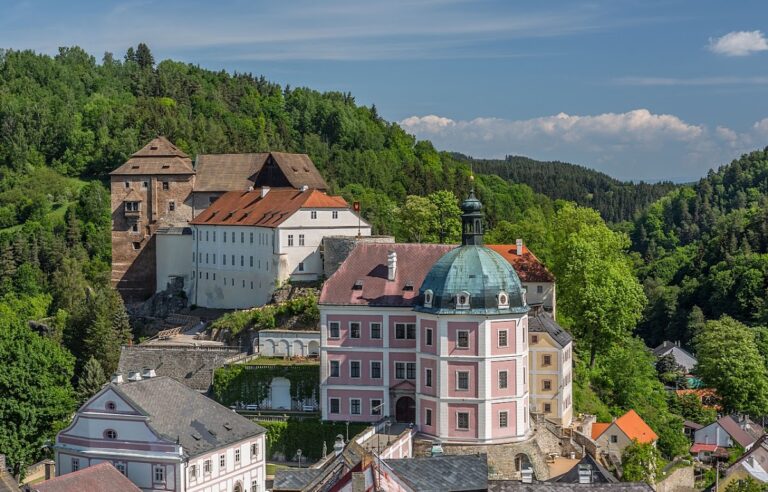
The castle stands near Sokolov’s main square at the edge of the historic town. Its present form consists of four wings and four corner towers arranged around a large internal courtyard. The complex combines the defensive arrangement of the earlier castle with later Renaissance, late Renaissance, and Neoclassical alterations.
Fortified castle and courtyard
Medieval defenses
The medieval predecessor was a circular fortified enclosure around a rectangular residential palace. Built predominantly of stone, it was protected by a defensive wall and a water-filled moat. In the Gothic period, the complex became a water castle, a fortified residence partly protected by a moat, with four corner towers. The moat was crossed by several stone bridges and reportedly still existed in the seventeenth century.
Corner towers and wings
The current castle retains four wings and four corner towers. The northern towers are cylindrical, while the southern towers are square. This arrangement gives the building an architecturally distinctive form within the region. The large courtyard contains a central fountain and is partly lined with arcades or covered porticoes. The main portal carries the aristocratic coat of arms.
Castle chapel
The castle chapel retains Baroque furnishings. Its stucco ceilings date from the Neoclassical rebuilding of 1805, linking the surviving interior decoration to the major transformation carried out under Count Friedrich Nostitz-Rieneck.
Park and associated buildings
Former park
A large former park is enclosed by walls and has several entrances. It includes a silver maple with a trunk circumference of almost four metres, a surviving feature of the grounds that were redesigned as a formal French-style garden around 1730.
Market, stables, and hunting lodge
The historic complex also included a municipal market and an agricultural building used as stables. An eighteenth-century hunting lodge survives and now houses the Sokolov Library.
Museum collections
Archaeology and regional history
The museum presents archaeological finds from the region’s prehistoric and early history. These include bones and mammoth tusks, early human artworks such as Venus figurines, and fragments of an early wooden figure. Other displays document the castle’s former owners and its historical development.
Industry, art, and wartime material
Additional collections include regional paintings, wooden sculptures and figures, industrial and mining-related objects, and material connected with porcelain and glassmaking. Military uniforms from the Second World War and prisoner clothing associated with the Falkenau subcamp of Flossenbürg concentration camp form part of the museum’s historical displays. An associated art gallery occasionally presents contemporary art.