Church of Saint George in Pskov Hill, Moscow: A Seventeenth-Century Orthodox Church
Site at a Glance
- Popularity
- Medium
- Country
- Russia
- Primary era
- Early Modern
- Eras represented
- Medieval, Early Modern, Modern
- Civilizations
- Russian
- Site type
- Religious
- Remains
- Church
On this page7 sections
History
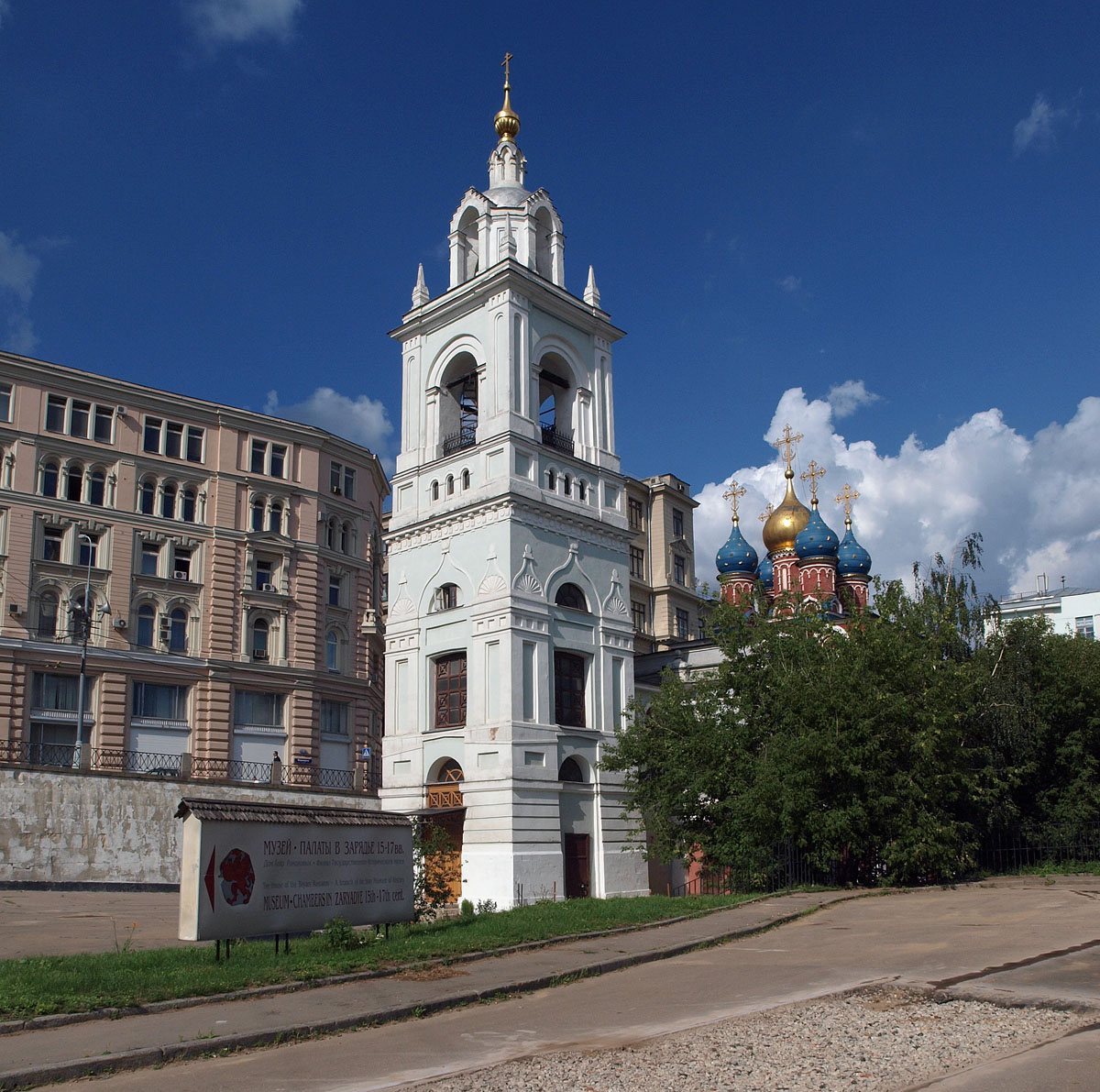
The Church of Saint George in Pskov Hill is a Russian Orthodox church on Varvarka Street in Moscow, Russia. Its present building was erected in 1657–1658.
Pskov Hill and the earlier church
Pskov Hill was once a settlement of people from Pskov brought to Moscow by Grand Prince Vasily III, who ruled from 1505 to 1533. An earlier Church of the Intercession of the Virgin, dedicated to a feast honoring the Virgin Mary’s protective intercession, was founded here in the fifteenth century and stood by 1462. After a fire in 1639, the present church was built over the earlier church’s foundations.
Nineteenth-century rebuilding
The 1812 Moscow fire badly damaged the church. It was rebuilt and enlarged in 1818.
Closure and return to worship
The church closed after the 1917 Revolution and was taken from its Orthodox parish in the 1920s. It stood empty, was later used as a warehouse, and fell into disrepair. Exterior repairs took place from 1965 to 1972. In 1979, the building passed to a society for the protection of historical and cultural monuments and was subsequently used for exhibitions.
The Russian Orthodox Church recovered the building in 1991, and services resumed in 1995. The church belongs to the Moscow Diocese, a bishop’s administrative territory, and the Iveron Deanery, a grouping of parishes. It also forms part of the Patriarchal Metochion, a church compound affiliated with a patriarch, in Zaryadye. The compound includes nearby churches dedicated to the Sign of the Mother of God, Saint Maximus the Blessed, Saint Barbara, the Nativity of Saint John the Baptist, and the Conception of Saint Anne. The church is a cultural heritage monument of federal significance in Russia.
Remains
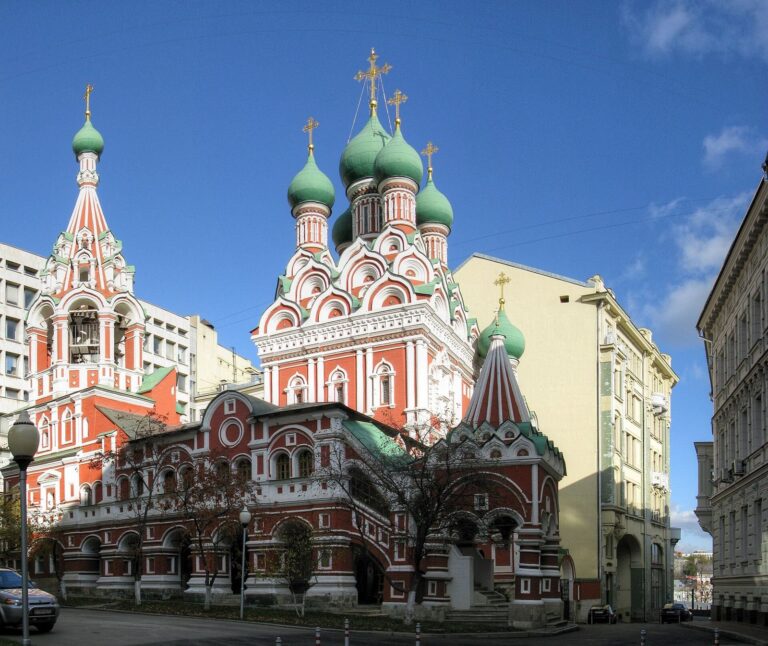
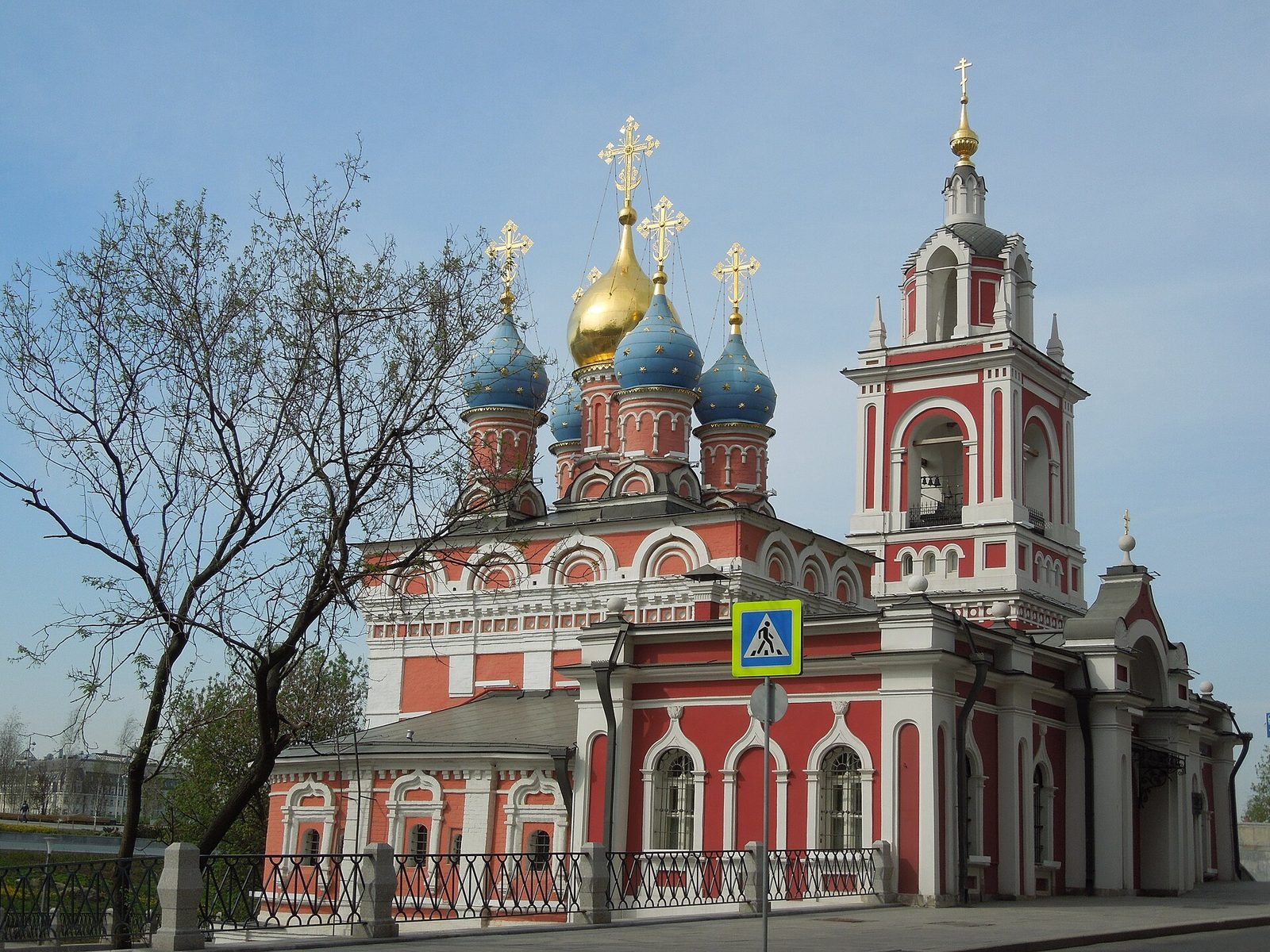
The brick church has a rectangular plan, one main worship space, five domes, a bell tower, and a single icon screen. Some walls from the earlier church were incorporated into the building. Seventeenth-century frescoes, paintings made on plaster, survived the 1812 fire.
Additions and exterior finish
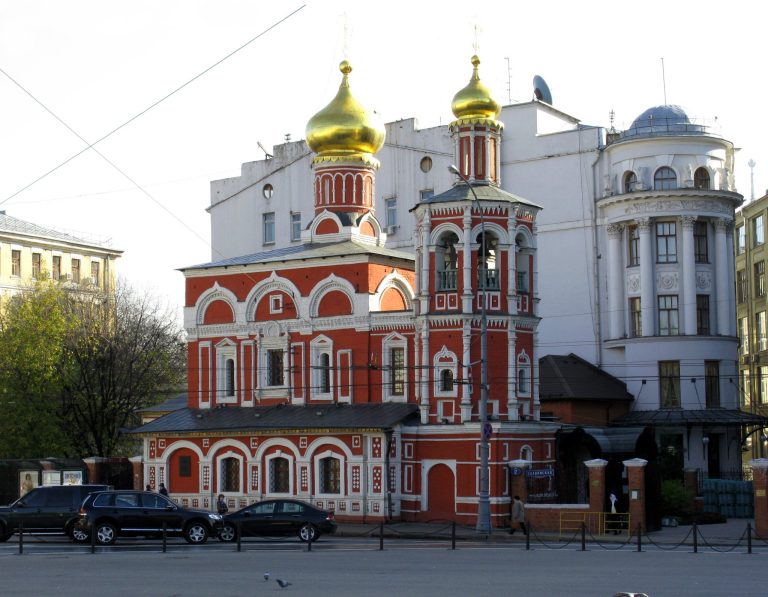
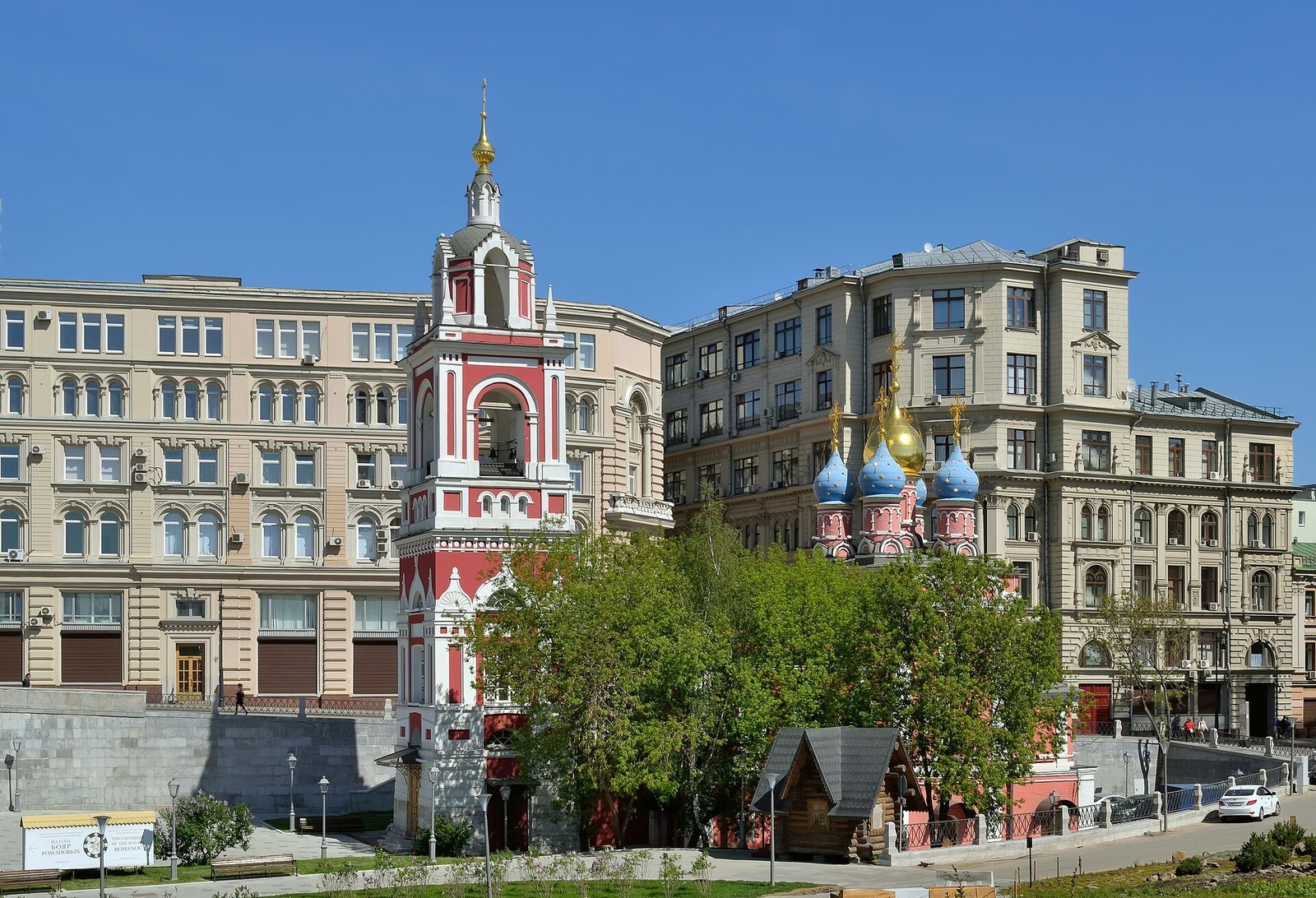
The enlargement added a dining hall, known as a refectory, and a spacious entrance hall. The refectory and bell tower contrast with the main church in style: they use pseudo-Gothic forms, a later style borrowing from Gothic architecture, while the tower’s upper part has Empire-style details, a monumental style associated with the Napoleonic era. Since 2005, the church, refectory, and bell tower have been painted red with white decorative details. The central dome is gold-colored; the four smaller domes are blue and decorated with stars.
Altars and sacred objects
The main altar is dedicated to the Intercession of the Virgin. The two side altars honor Saint George the Victorious, a Christian martyr venerated as a warrior saint, and Peter, Metropolitan of Moscow, a medieval Russian Orthodox church leader. Sacred objects associated with the church include a copy of the Kazan Icon of the Mother of God; icons of Saint Spyridon of Trimythous and righteous warrior Theodore Ushakov; an icon of Saint Ludmila of Bohemia with relics of saints; and a container holding relics of Saint George the Victorious.