Church of All Saints, Moscow: History and Orthodox Heritage
Site at a Glance
- Rating
- 4.8
- Popularity
- Low
- Country
- Russia
- Primary era
- Early Modern
- External website
- Open
- Eras represented
- Medieval, Early Modern, Modern
- Civilizations
- Russian
- Site type
- Religious
- Remains
- Church
On this page10 sections
History
The Church of All Saints at Kulishki is an Orthodox church in Moscow, Russia, whose history reaches back to the fourteenth century. A wooden church stood here by 1364, and the site is traditionally connected with Grand Prince Dmitry Donskoy, the Moscow ruler associated with victory over Mamai at the Battle of Kulikovo in 1380. Its exact foundation date remains uncertain. One interpretation places it before the battle, around 1367, while a later tradition links its dedication to All Saints with prayers for warriors who died at Kulikovo.
Medieval origins and rebuilding
The church’s early history was shaped by repeated fires and periods of destruction. The wooden building was damaged in the Moscow fires of 1493 and 1547, and it was seriously affected during the fighting for Moscow in 1612. A stone church was built in 1488, although the present structure is also associated with the sixteenth century and may preserve parts of an earlier masonry building. The tradition that some Kulikovo warriors were buried near the church became an enduring part of its historical identity.
By the first half of the seventeenth century, All Saints was a parish church with a single nave, a square plan, an apse, and a gallery around the vestibule and nave. A second altar dedicated to Saint Nicholas was added in 1662. These changes reflect the church’s continuing role as a working parish rather than solely as a commemorative foundation.
The Moscow Baroque transformation
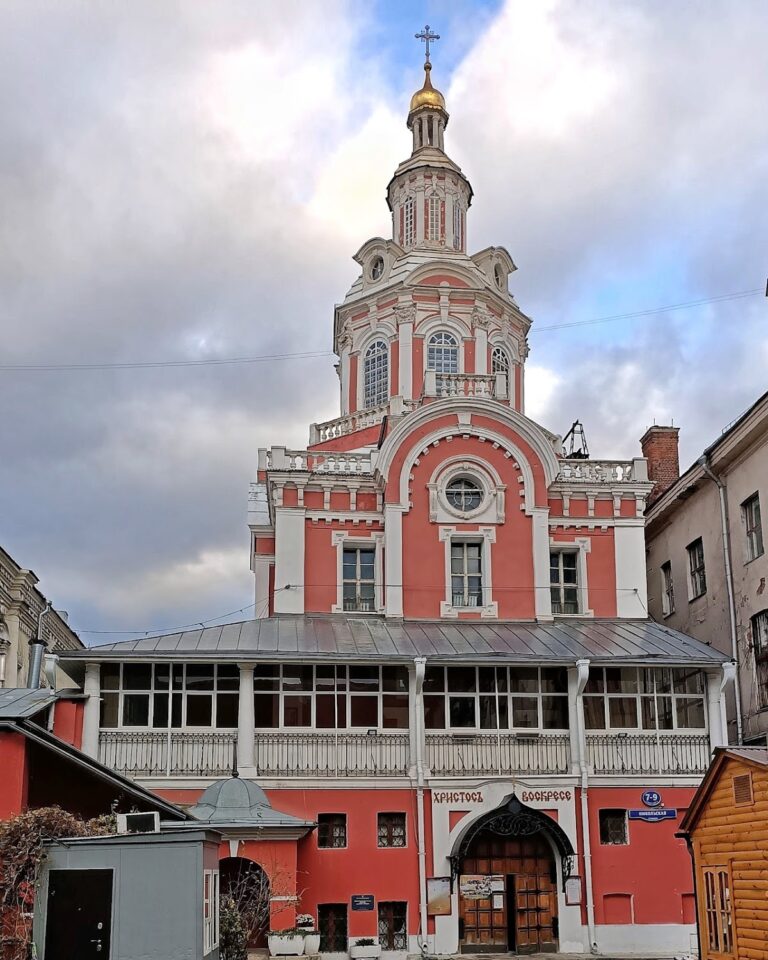
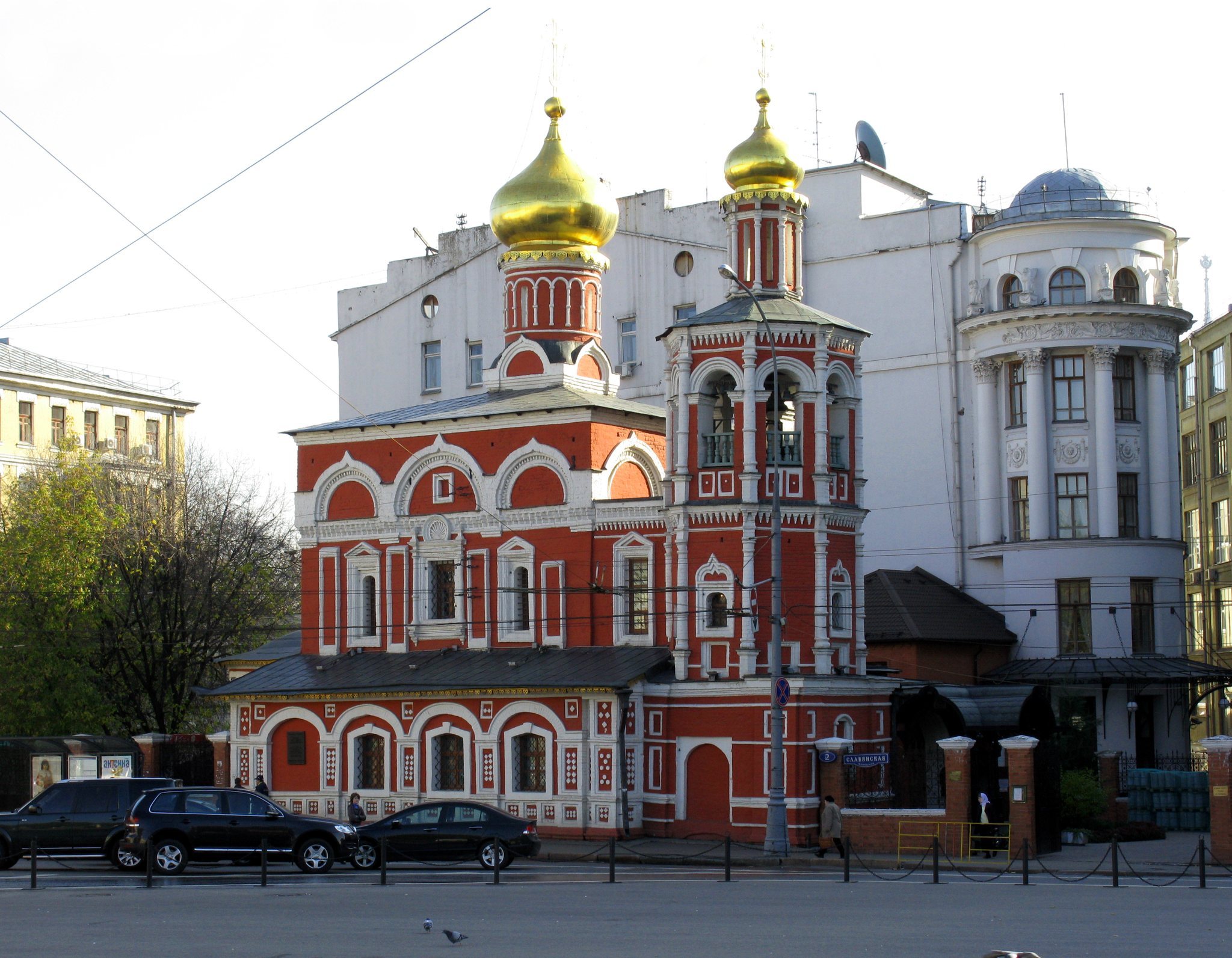
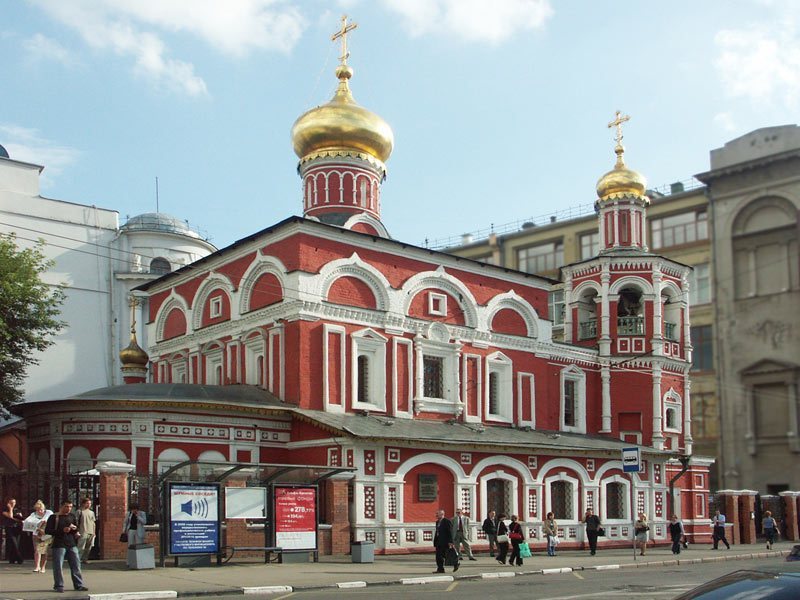
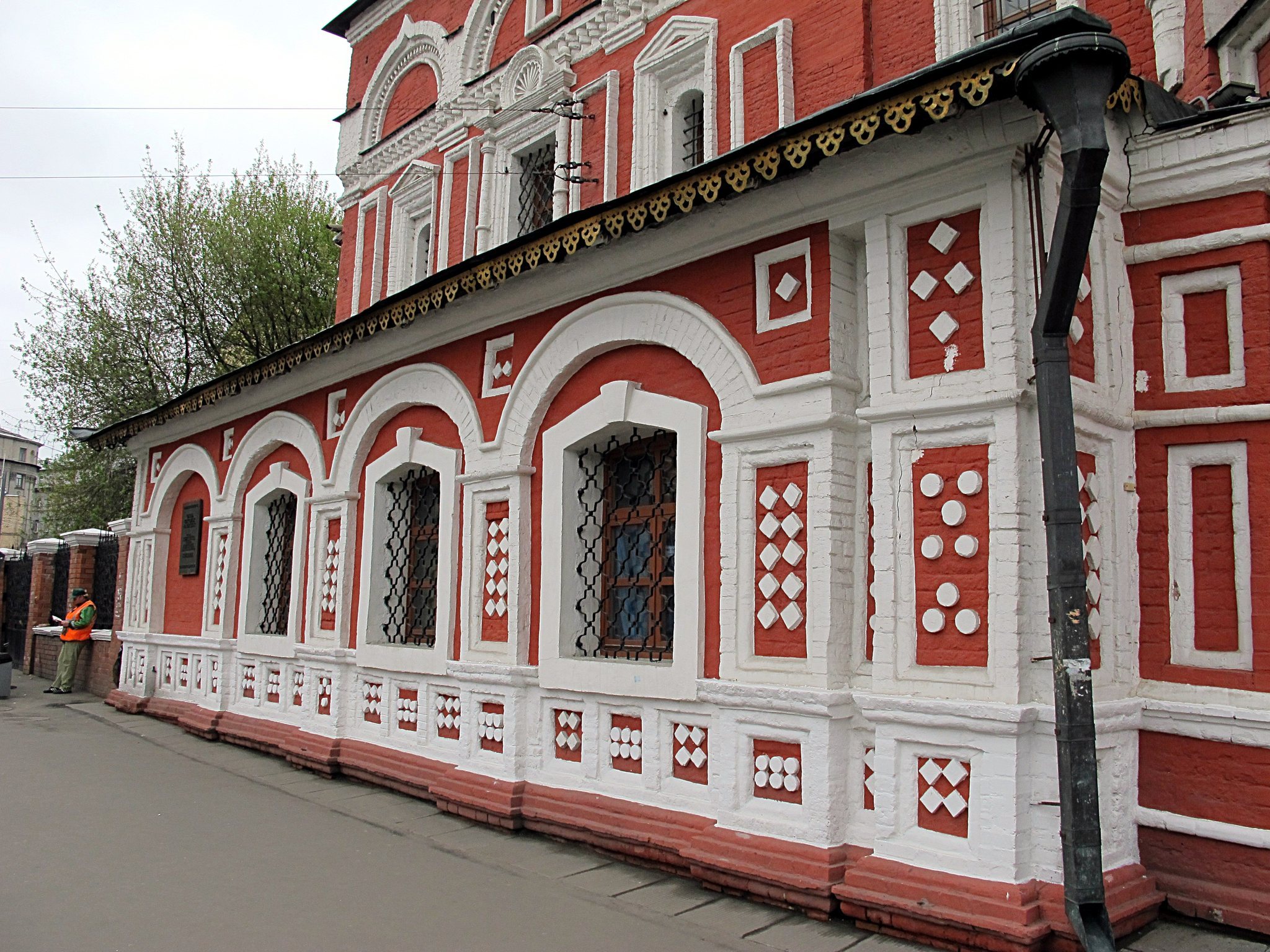
The church was rebuilt or substantially remodeled in 1687–1689 in the Moscow Baroque style, a late-seventeenth-century form known for richly decorated facades, elaborate window surrounds, and ornamental gable-like shapes called kokoshniki. Following another fire, a vestibule and bell tower were added in 1688, while part of the earlier gallery was dismantled. The remaining gallery was removed during further rebuilding in 1737. Repairs continued at intervals between the seventeenth and nineteenth centuries, while the church retained its parish status.
The church also became involved in one of Moscow’s most violent eighteenth-century religious disturbances. During the 1771 epidemic, Archbishop Ambrose ordered the Bogolyubsk Icon of the Mother of God to be removed from a public chapel in the Varvarskaya Tower, which was subordinate to All Saints. He sought to prevent large gatherings of worshippers. The decision provoked a riot in which the archbishop was killed, and the uprising was suppressed two days later.
Revolution, closure, and archaeological investigation
After the October Revolution, the church was looted. Soviet authorities closed it in 1930 or 1931 and adapted the building for use by state-security organs instead of demolishing it. Human remains believed to belong to executed people were found in the basement in 1994, adding a further layer to the building’s twentieth-century history.
The building was transferred to the Museum of the History of Moscow in 1975. Restoration work carried out from 1970 to 1982 was accompanied by archaeological investigations in 1978–1979, which exposed foundations belonging to the original fourteenth-century church. The building returned to the Russian Orthodox Church in 1991. In 1994, a cross bearing images of the New Martyrs was erected beside the basement in memory of the people whose remains had been found there.
Contemporary ecclesiastical role
On 31 March 1999, the church became the Moscow metochion of the Patriarchate of Alexandria. A metochion is an Orthodox church or institutional representation of a larger jurisdiction outside its principal seat. The arrangement ended after the Moscow Patriarchate suspended the metochion’s activity in November 2019, with the suspension formally confirmed in December following the Patriarchate of Alexandria’s recognition of the Orthodox Church of Ukraine.
From November 2019 to October 2021, the church was administered by Archpriest Sergius Zvonaryov. Archbishop Leonid of Yerevan and Armenia, later Metropolitan Leonid of Klin, became rector in October 2021 and was relieved of the post in September 2023. Archpriest Vadim Leonov became rector on 27 October 2023. In December 2021, the church was designated for the administrative needs of the newly established Patriarchal Exarchate of Africa, an administrative jurisdiction of the Russian Orthodox Church covering its ecclesiastical organization in Africa. It remains an active Orthodox church and a federally protected cultural-heritage object of the Russian Federation.
Remains
Church building and exterior
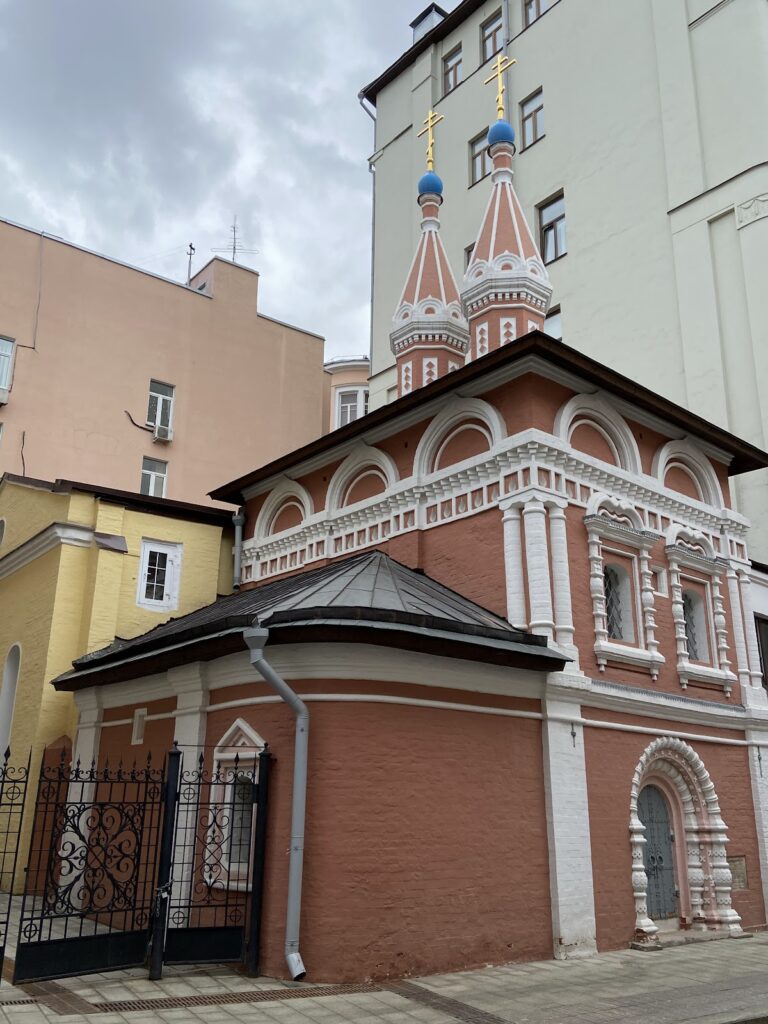
The surviving church is a two-tiered, single-domed building with one semicircular apse. A gallery surrounds the apse on three sides, and a vestibule joins the gallery at the western facade. The building’s architectural chronology remains complex. Elaborate window decoration and a false belt of kokoshniki point toward the 1680s, while the two-apse side chapel and refectory may represent additions on the southern side of an earlier four-sided structure, possibly dating to the period of Boris Godunov, who ruled as tsar from 1598 to 1605.
Bell tower and surviving medieval fabric
A three-tiered, octagonal bell tower rises from the northwestern corner. Its Baroque detailing accompanies a pronounced inclination, making it one of Moscow’s notable leaning bell towers. The lower tier of the church is partly concealed by the accumulated cultural layer, the archaeological deposit formed through successive occupation, building, demolition, and soil buildup. Fifteenth- and sixteenth-century tombstones survive within this lower area. The northern portal contains white-stone details, and wall paintings from the period following the reign of Peter the Great have been restored.
Interior, altars, and sacred objects
The interior has a single iconostasis and three altars. The principal altar is dedicated to All Saints, while the documented side altars honor Saint Nicholas and Saint Naum. The church also preserves two reliquaries brought from Kykkos Monastery in Cyprus by Metropolitan Athanasius of the Patriarchate of Alexandria.
The larger, elongated reliquary contains particles associated with Paraskeva of Rome, Tryphon of Apamea, Mamant of Gangra in Paphlagonia, Menas of Egypt, Antipas of Pergamon, the Apostle Philemon, Onesiphorus, Artemius, Charalambus of Magnesia in Thessaly, Polycarp of Smyrna, the Apostle Philip, and Sabbas Stratelates. A smaller round reliquary, topped by a high lid and cross, contains a relic particle of Saint Nicholas the Wonderworker.
Other sacred objects include an icon of Seraphim of Sarov, a copy of the Kykkos Icon of the Mother of God, the Tikhvin Icon of the Mother of God, the Sign Icon of the Mother of God, the Hodegetria-Sumela Icon, the Merciful Icon of the Mother of God, an icon of the Apostle and Evangelist John the Theologian, and an icon of the Martyr Andrew Stratelates. The church also preserves a crucifix described as an exceptional work of art.
Basement memorial and urban setting
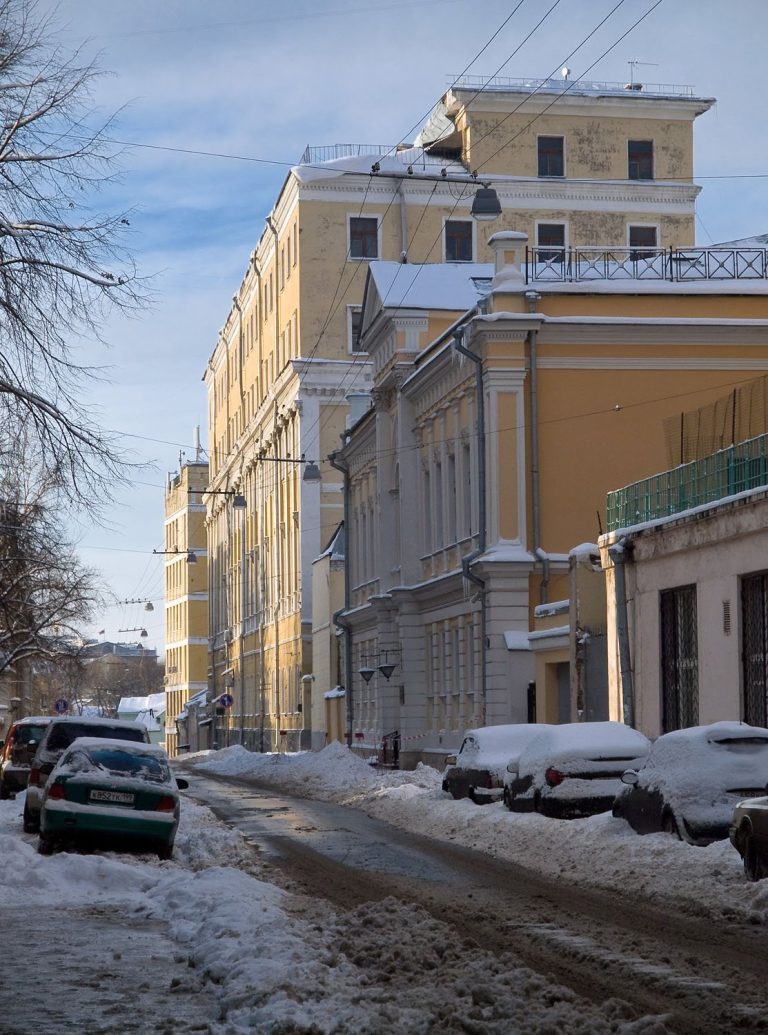
A memorial cross showing the New Martyrs stands beside the basement and commemorates the people whose remains were discovered there in 1994. Despite the depth of the surrounding cultural layer, including material removed to the northeast, the church continues to shape the architectural appearance of Slavyanskaya Square. An entrance to the Kitay-Gorod Metro station stands a few metres from the altar area.