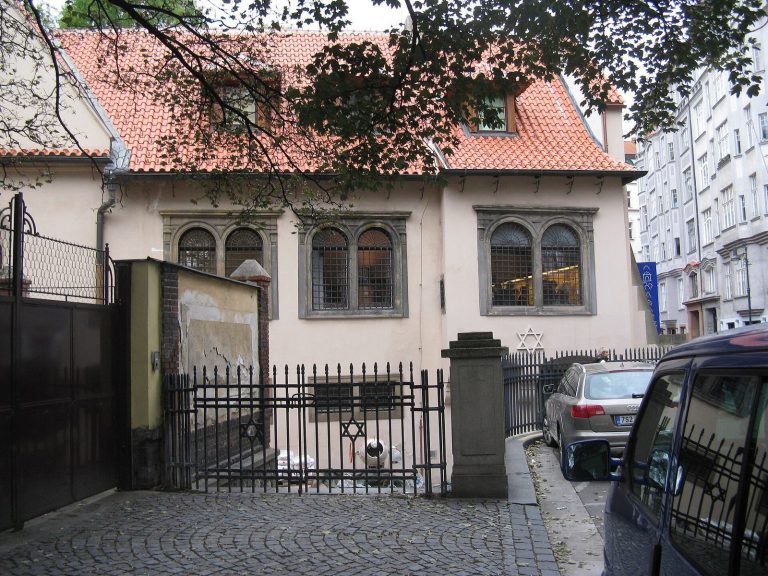
Church of Saint Simon and Saint Jude, Prague: A Historic Concert Church


Site at a Glance
- Rating
- 4.7
- Popularity
- Low
- Country
- Czechia
- Primary era
- Early Modern
- External website
- Open
- Eras represented
- Medieval, Early Modern
- Civilizations
- Holy Roman Empire, Kingdom of Bohemia
- Site type
- Religious
- Remains
- Church
On this page17 sections
History
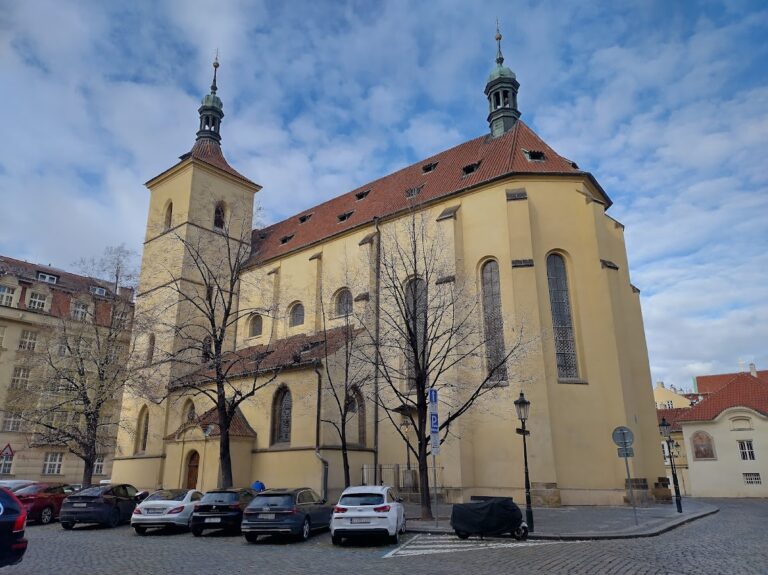
The Church of Saint Simon and Saint Jude is a Roman Catholic church in Prague, Czechia, built and transformed by successive religious communities between the medieval period and the eighteenth century. Its history began with a hospital founded on the site in 1354, and it later became part of the monastery and hospital complex of the Brothers Hospitallers of Saint John of God.
Medieval hospital and chapel
A chapel associated with the hospital was consecrated by Arnošt of Pardubice, the first archbishop of Prague and a close associate of Charles IV, the fourteenth-century King of Bohemia and Holy Roman Emperor. A Gothic chapel or church stood on the site before the present building, providing the medieval foundation for the later church.
Gothic-Renaissance rebuilding
Between 1615 and 1620, the Bohemian Brethren, a Protestant religious movement originating in the Bohemian lands, substantially enlarged the church. The rebuilt structure combined Gothic and Renaissance features and was dedicated to Saint Simon the Cananaean and the Apostle Jude, traditionally counted among the Twelve Apostles. The earlier Gothic building was incorporated into the new church, with its northern side aisle surviving during the rebuilding.
Construction was troubled by technical difficulties. The vault collapsed in 1617, and the church was adapted for German Lutherans in 1618. Their congregation was solemnly consecrated there on 14 June 1620. The political and religious situation changed soon afterward, when the Bohemian Protestant forces were defeated at the Battle of White Mountain, a victory that strengthened Habsburg Catholic rule in Bohemia.
The Hospitallers and the Baroque transformation
After the Battle of White Mountain, Emperor Ferdinand II entrusted the church and the adjoining Saint Francis Hospital at Na Františku to the Brothers Hospitallers of Saint John of God. This Catholic order was historically devoted to hospital care. The church consequently became part of the Hospitallers’ monastery and hospital complex, a role that connected its religious function with the order’s medical work.
Extensive High Baroque alterations took place in 1720 and 1721, reshaping the façades and interior. The building’s present character reflects this work as well as its earlier Gothic and Renaissance phases. Its organ and acoustics later became associated with visits by Joseph Haydn and Wolfgang Amadeus Mozart. A commemorative plaque records that both musicians played the organ during visits to Prague.
Secularization and renewed use
In 1950, communist authorities expelled the Hospitallers and nationalized the hospital. The church was deconsecrated and used as a warehouse for approximately four decades. After the fall of communism, it underwent restoration in the late twentieth century. It was not reconsecrated, and responsibility for its maintenance was transferred to the Prague Symphony Orchestra in exchange for its use as a concert hall.
During the reconstruction of Prague’s Municipal House from 1994 to 1997, the church served as a rehearsal space and concert hall for the Prague Symphony Orchestra FOK. It now functions as a venue for chamber, choral, and organ performances. The building remains owned by the Czech-Moravian Province of the Brothers Hospitallers of Saint John of God and forms part of their protected monastery complex. In June 2020, Prague announced plans to purchase the church, but the purchase was not completed according to the available information.
Remains
The surviving church is a single-nave building whose Gothic, Renaissance, and High Baroque elements remain integrated in one structure. The earlier enlargement created a hall-like interior with galleries and shallow chapels, while Late Gothic-style windows were added to the building. The nave is covered by a barrel vault and ends in a semicircular termination. On the north side, a narrower former brethren’s choir survives as a distinct adjoining space.
Structure and underground spaces
Nave and former brethren’s choir
The nave provides the main interior volume of the church, with galleries and side chapels contributing to its hall-like arrangement. Its barrel vault leads toward the semicircular end of the building. The narrower former brethren’s choir on the north side preserves part of the arrangement associated with the church’s early seventeenth-century rebuilding.
Crypt
A crypt, meaning a chamber beneath a church, lies below the presbytery. Its groin vault, formed by the intersection of two barrel vaults, is supported by central pillars. The crypt was deepened in 1747, an alteration that belongs to the church’s later Baroque history.
Baroque and Rococo furnishings
Main altar
The main altar includes an illusionistic painted retable on the wall. This trompe-l’oeil retable, a painted architectural altarpiece designed to suggest a three-dimensional structure, was signed and dated 1773 by the fresco painter Josef Hager. Its central painting shows Saint Augustine handing the rule of the order to Saint John of God, the sixteenth-century Catholic saint who founded the hospital-care order. Saints Simon and Jude appear interceding with the Holy Trinity. The oil painting is attributed to the workshop of Václav Vavřinec Reiner and dates to around 1731.
South-side Rococo altar
A Rococo altar on the south side bears Josef Štern’s painting of the Glorification of Saint Leopold. Its mensa, or altar table, carries an image of Saint John of Nepomuk, while the upper section contains a painting of Saint Florian. Angels, the Archangel Michael, angel heads, and vases were produced in the workshop of Richard J. Prachner between 1773 and 1775.
Portal altars
The shallow side chapels contain several portal altars. One is dedicated to Our Lady of Perpetual Help and the plague patrons, with a 1772 oil painting by J. J. Redelmayer and statuettes by Matěj Václav Jäckel from 1688. The altar of the Holy Cross combines an anonymous Calvary painting with sculptures by Ferdinand Geiger from 1706. Another altar is dedicated to Saint Barbara and includes a painting by Josef Jáchym Redelmayer from 1772 to 1775, together with sculptures of Saints Sebastian and Roch. The altar of Saint Anne contains Redelmayer’s image of Saint Anne Selbdritt, showing Saint Anne with the Virgin Mary and the Christ Child, accompanied by sculptures of Saints Cosmas and Damian.
Former altar of Saint John of God
The former altar of Saint John of God has been abolished, but its statue of the saint survives. Matěj Václav Jäckel made the statue in 1691 and 1692, adding an earlier sculptural work to the church’s later Baroque interior.
Pulpit and organ
Rococo pulpit
The Rococo pulpit is decorated with sculptures of the Western Fathers of the Church, major Latin Christian theologians whose teachings shaped Western Christianity. The figures represent Saints Ambrose, Augustine, Jerome, and Gregory the Great, and were made by František Ignác Weiss.
Pipe organ
A pipe organ made by Andreas Wambetsser of northern Bohemia was installed in the gallery. Organ builders Jaroslav Tůma and Vladimír Šlajch overhauled the instrument in 2000 and restored it with new old-fashioned bellows. Michal Novenko presented its revised sound at an inaugural concert, continuing the association between the church’s interior and organ performance.