Antoniterkirche: A Gothic Monastery Church and Protestant Church in Cologne


Site at a Glance
- Rating
- 4.6
- Popularity
- Low
- Country
- Germany
- Primary era
- Medieval
- External website
- Open
- Eras represented
- Classical, Medieval, Modern
- Civilizations
- Holy Roman Empire, Roman
- Site type
- Religious
- Remains
- Church
On this page19 sections
History
Antoniterkirche is a fourteenth-century Gothic church in Cologne, Germany, built by the Antonite Order as a monastery church dedicated to Saint Anthony the Great. Construction is dated to 1350 and 1370–1378. The Antonites were a Christian religious order devoted especially to caring for the sick, and their community followed the Rule of Saint Augustine, a framework for communal religious life associated with Augustine of Hippo.
The Antonite monastery
The Antonite community established its monastery on the site during the fourteenth century. The church served the order as a Catholic monastery church until the upheavals of the French occupation and the dissolution of Cologne’s monasteries in 1794. These changes also altered the position of Protestant communities in the city. Protestants had previously worshipped secretly or travelled to Mülheim in the Duchy of Berg and Frechen in the Duchy of Jülich. After public Protestant worship was permitted, Antoniterkirche and parts of the former monastery buildings became the first church premises made available to Protestants in Cologne.
Conversion to Protestant worship
On 6 August 1802, the church was transferred to Cologne’s Protestant communities. Ferdinand Franz Wallraf, a Cologne scholar, collector, and cultural official, directed its conversion for Protestant worship between 1802 and 1805. Inter-nave pillars were removed, galleries were installed in the side aisles and at the west end, and a pulpit altar was added. When the church reopened on Rogation Sunday in 1805, it could accommodate about 800 worshippers.
From 1805, Reformed and Lutheran congregations worshipped together at Antoniterkirche, alternating between Reformed and Lutheran ministers. This arrangement anticipated the Protestant church union proclaimed by King Frederick William III of Prussia in 1817, a movement that brought Lutheran and Reformed congregations into united church structures in several German territories. Antoniterkirche continues to represent Reformed, United, and Lutheran traditions.
Nineteenth-century changes
During the late nineteenth century, the galleries and pulpit altar were removed. Larger Protestant churches had reduced the pressure on the smaller building, while the changes also made the Gothic choir visible again. The side-aisle windows received Neo-Gothic tracery in 1896, adding a nineteenth-century treatment to the medieval structure.
War damage and reconstruction
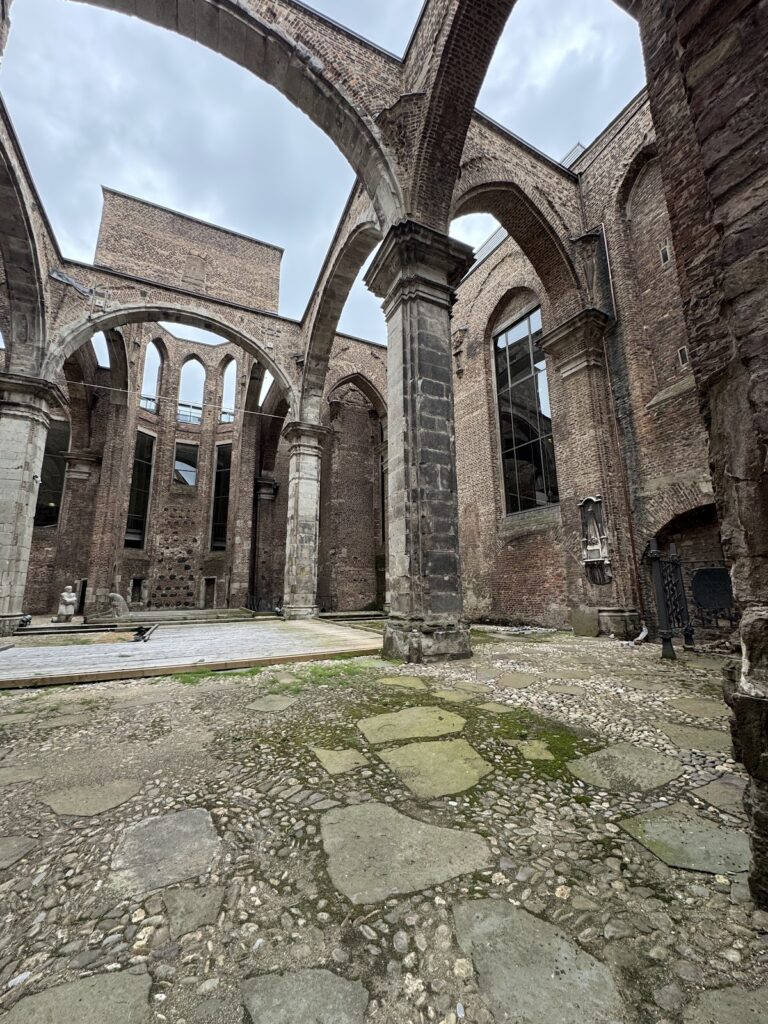
An air raid on 31 May 1942 largely destroyed Antoniterkirche. Reconstruction took place from 1946 to 1952 under Georg Eberlein, using Wallraf’s earlier plans together with surviving sections of the building. The first postwar service was held on 18 May 1952, and Federal President Theodor Heuss attended the rededication. The roof turret was rebuilt in 1954.
The west facade was reconstructed between 1961 and 1964 during the construction of the neighboring north–south traffic route. Later conservation included restoration of the medieval interior color scheme in 1979–1980, renewal of the longitudinal-facade masonry in 1994–1996, repairs to the westwork in 2006, and extensive work on lighting and electrical systems in 2011. The church belongs to the Evangelical Church in the Rhineland and the Cologne-Left Bank church district. Since 2016, it has also belonged to the Coventry Cross of Nails Community, an international network connected with remembrance and reconciliation after the destruction of Coventry Cathedral during the Second World War.
Religious and civic life
Antoniterkirche has hosted Protestant worship, ecumenical services, concerts, exhibitions, discussions, and church-music activities. From 1968, it hosted the Political Night Prayer, associated especially with the Protestant theologian and political activist Dorothee Sölle. The later City Sermons series invited prominent figures from cultural and political life to preach. Freya von Moltke, a member of the German resistance, was baptized at the church.
The church’s city-ministry work developed through an evangelical information center, a church-entry office, Café Stanton, and the AntoniterCityTours program. A City Pavilion built in 2002 was replaced by the AntoniterQuartier, which opened in 2020. The six-storey complex provides congregational rooms, gastronomy, services, housing, and retail space. Archaeological work connected with its construction also revealed Roman remains associated with the church complex.
The church’s musical institutions include a choir founded in 1948, an amateur orchestra added in 2005, the Ecumenical Gregorian Schola Cologne founded in 2005, and the chamber choir Constant, formed in 2006.
Remains
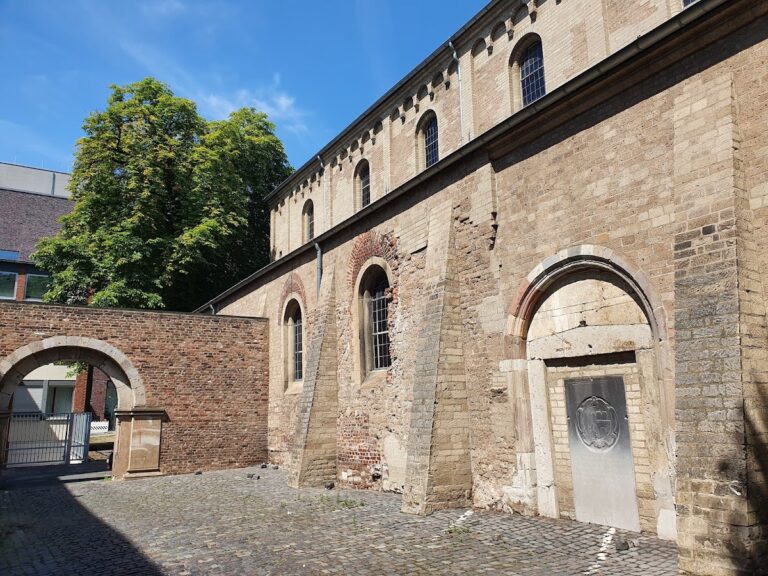
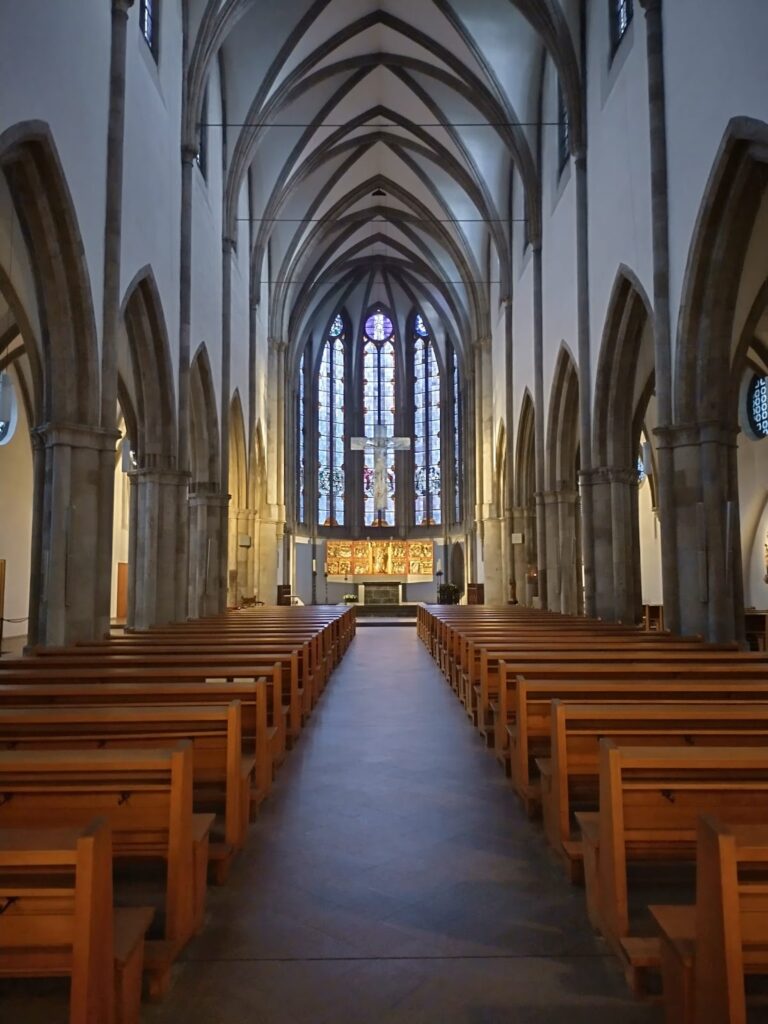
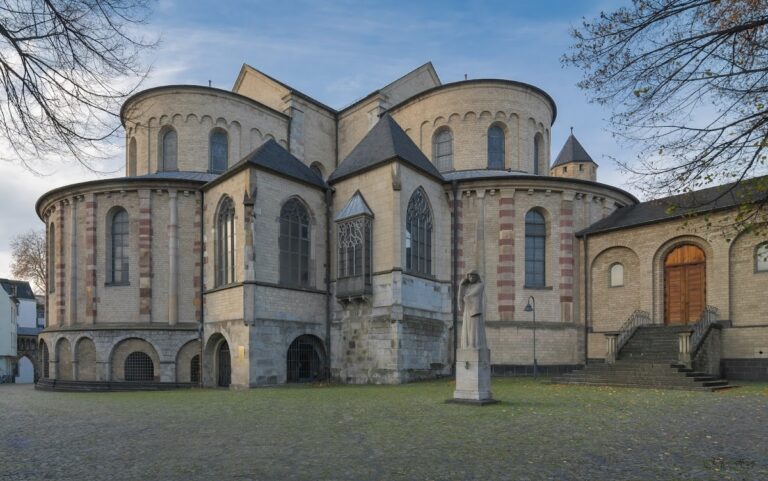
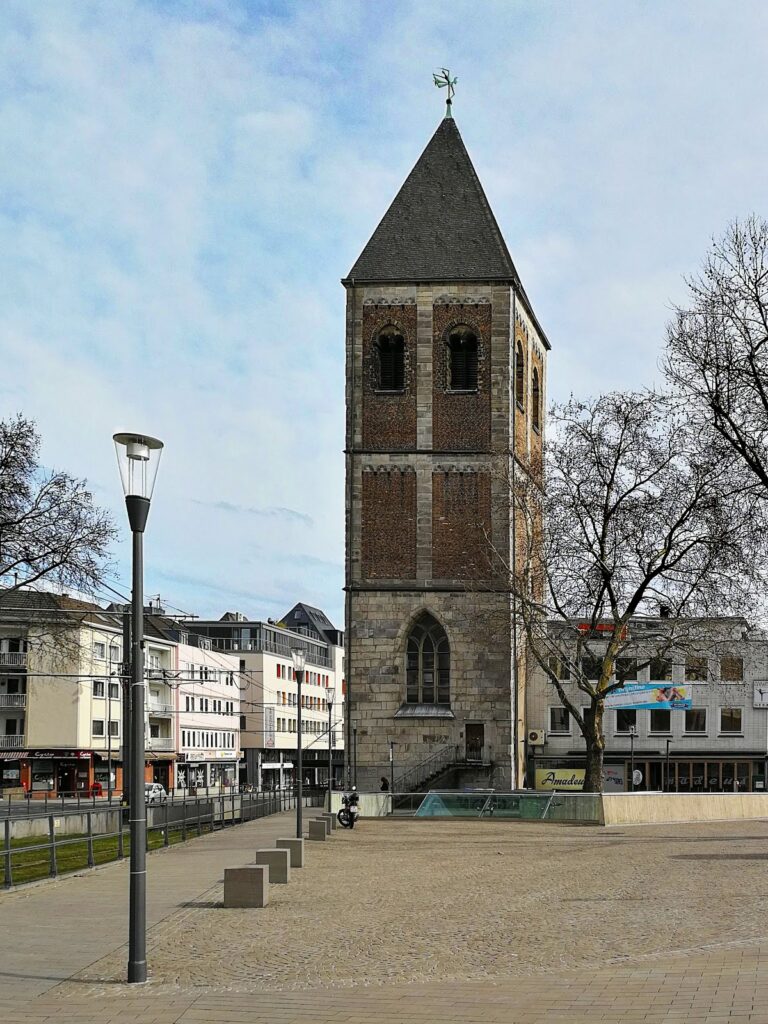
Antoniterkirche is a short but relatively tall Gothic basilica with three vaulted naves, a polygonal choir, and a northern side aisle that terminates in its own choir. Its restrained form reflects the character of a mendicant-order church, designed for a religious community dependent on preaching and charitable support rather than extensive landed resources. The building is approximately 28 meters long. The central nave rises 15.5 meters, while the side aisles reach about half that height. A roof turret rises above the church, and the postwar reconstruction created a new western entrance area with an organ gallery.
Church fabric and interior
Basilica and choir
The surviving masonry provided the basis for the postwar rebuilding, which followed Wallraf’s earlier plans while creating the new western entrance area. The three vaulted naves lead toward the polygonal choir, and the northern side aisle has its own terminating choir. The medieval interior color scheme was restored in 1979–1980 on a historically based model, allowing the reconstructed interior to reflect the appearance associated with the church’s medieval phase.
Windows and medieval furnishings
Most of the historic stained-glass windows were destroyed during the Second World War. A Crucifixion scene dated 1520–1530 survives. For the 1952 rededication, Georg Eberlein created seal windows for the chancel. They show the seals of Cologne’s Reformed, Lutheran, and United congregations, the Reformed congregation of Frechen, the Old Cologne church seal, and the Walloon-Reformed Protestant congregation of Cologne. Alois Plum made the ground-floor side-aisle windows in 1966–1967.
Nearly all medieval furnishings were removed before or during the French occupation. The Boisserée brothers saved and sold several works, including Legend of the Holy Hermit Anthony with Donor, attributed to the Younger Master of the Holy Kinship. Dated 1501/1509, the painting is now in the Alte Pinakothek in Munich.
Sculpture and memorials
Ernst Barlach’s works
Three works by Ernst Barlach are held in the church. Barlach was a German sculptor, draughtsman, and writer associated with Expressionism. His Der Schwebende is the second cast of a sculpture created in 1927. It hangs in the northern side chapel above a stone slab bearing the years of the First World War and of National Socialist rule from 1933 to 1945. The figure has the facial features of Käthe Kollwitz, a German artist known for socially engaged prints and sculptures.
The original Der Schwebende in Güstrow Cathedral was confiscated and melted down by the National Socialists as “degenerate art.” The Cologne cast was installed in 1952, and a third cast was presented to the Güstrow cathedral congregation in 1953. During the church’s 2011 renovation, Kruzifix II was mounted in the southern aisle above the baptismal font, while Der Lehrende Christus, a bronze figure, was positioned opposite it.
Holocaust memorial plaque
A memorial plaque for victims of the Holocaust, made by Dieter Boers in 1995, stands near the Barlach works. Its position places the memorial within the church’s group of twentieth-century sculptures and commemorative features.
Baptismal font and musical equipment
Romanesque baptismal font
A Romanesque baptismal font now stands in the southern side aisle. Made in the twelfth century in the Lower Rhine–Meuse region, it is carved from Namur blue stone and has four corner heads representing mythical creatures. The Evangelical congregation holds the font on loan from the Schnütgen Museum. Its original provenance remains uncertain.
Organ
The organ was built in 1969 by the Willi Peter organ-building firm. It has three manuals, a pedal, electrically operated action, and 45 stops on slider chests. Extensive restoration included replacement of the console, the addition of eight stops, and the installation of a Zimbelstern. The instrument was rededicated on 3 March 2013.
Bells and roof turret
Two bells cast in 1771 by Martin Legros hung in the roof turret until the Second World War, when they burned together with the turret. Three replacement bells made by the Rincker foundry in Sinn were installed in 1956. They weigh 357 kilograms and sound the notes D, E, and G, or d″, e″, and g″.
A six-bell peal was later planned. Two smaller bells were cast in October 2015 and hung in January 2016. The Mary and Michael Bell bears reliefs of the Stalingrad Madonna and Saint Michael of Coventry, while the Anthony Bell bears a relief of Saint Anthony the Great. Four larger bells were cast in July 2017, requiring a new bell frame in the westwork.
Roman archaeological remains
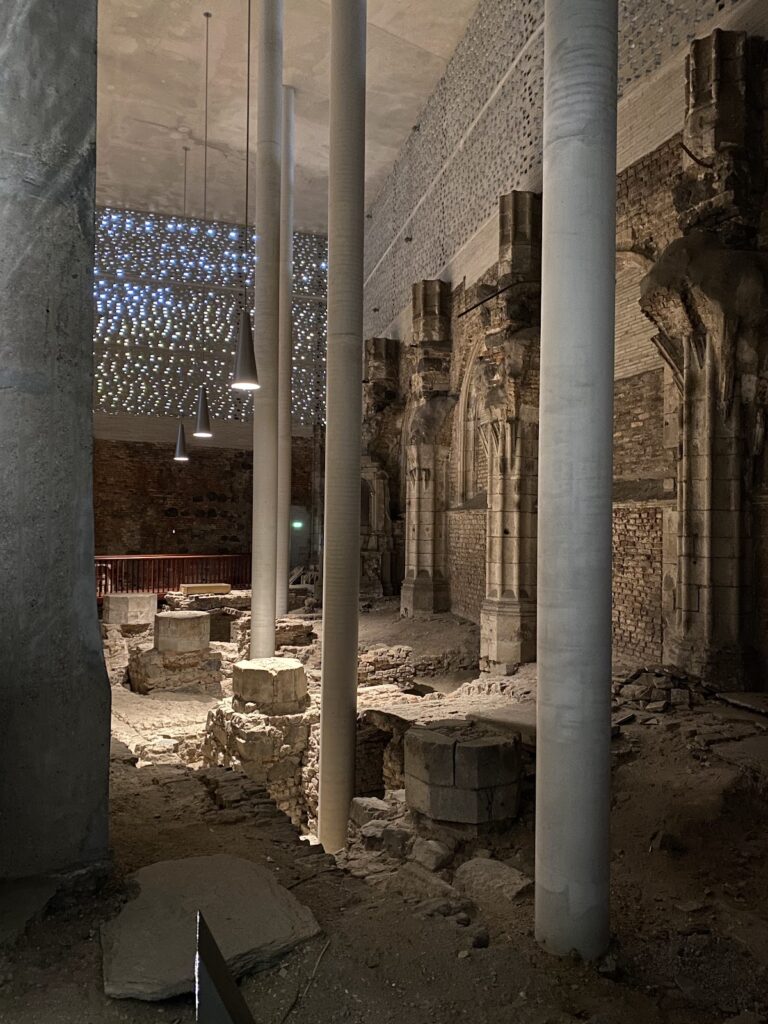
Roman building
Archaeological excavations during construction of the AntoniterQuartier exposed a Roman building measuring approximately 20 by 9 meters, together with an annex. The structure was probably two storeys high and probably dates from the second century AD. It has been interpreted as Germany’s oldest library. Changes to the construction plans allowed large parts of this archaeologically important monument to remain permanently preserved beneath or beside the modern church complex.