Church of Our Lady of Victories: A Carmelite Church and Shrine in Czechia
Site at a Glance
- Popularity
- High
- Country
- Czechia
- Primary era
- Early Modern
- Eras represented
- Early Modern, Modern
- Civilizations
- Habsburg, Holy Roman Empire, Kingdom of Bohemia
- Site type
- Religious
- Remains
- Church
On this page25 sections
History
The Church of Our Lady of Victories in Czechia began as a late-Renaissance church built for German Lutherans in 1611–13 and was reshaped for the Discalced Carmelites, a reformed branch of the Carmelite order, as an early-Baroque church. Its history became closely linked to Marian devotion and to the venerated statue known as the Infant Jesus of Prague.
From Lutheran church to Carmelite foundation
A chapel dedicated to the Holy Trinity stood on the site by 1584. The larger church was built in 1611–13. Before its Carmelite adaptation, it faced east, with its altar toward the street and its entrance toward the Petřín slope.
The church closed after the Battle of White Mountain in 1620, a Catholic victory associated with a devotional image of the Adoration of the Lord from Štěnovice. In 1624, Emperor Ferdinand II transferred the church to the Discalced Carmelites. Their formal installation took place on 7 September, and the following day Jan Savonanti, an apostolic visitor to the Minorites, dedicated it to Our Lady of Victories and Saint Anthony of Padua. Pope Gregory XV also sent a venerated Marian altarpiece from Rome.
Carmelite adaptation and the Infant Jesus
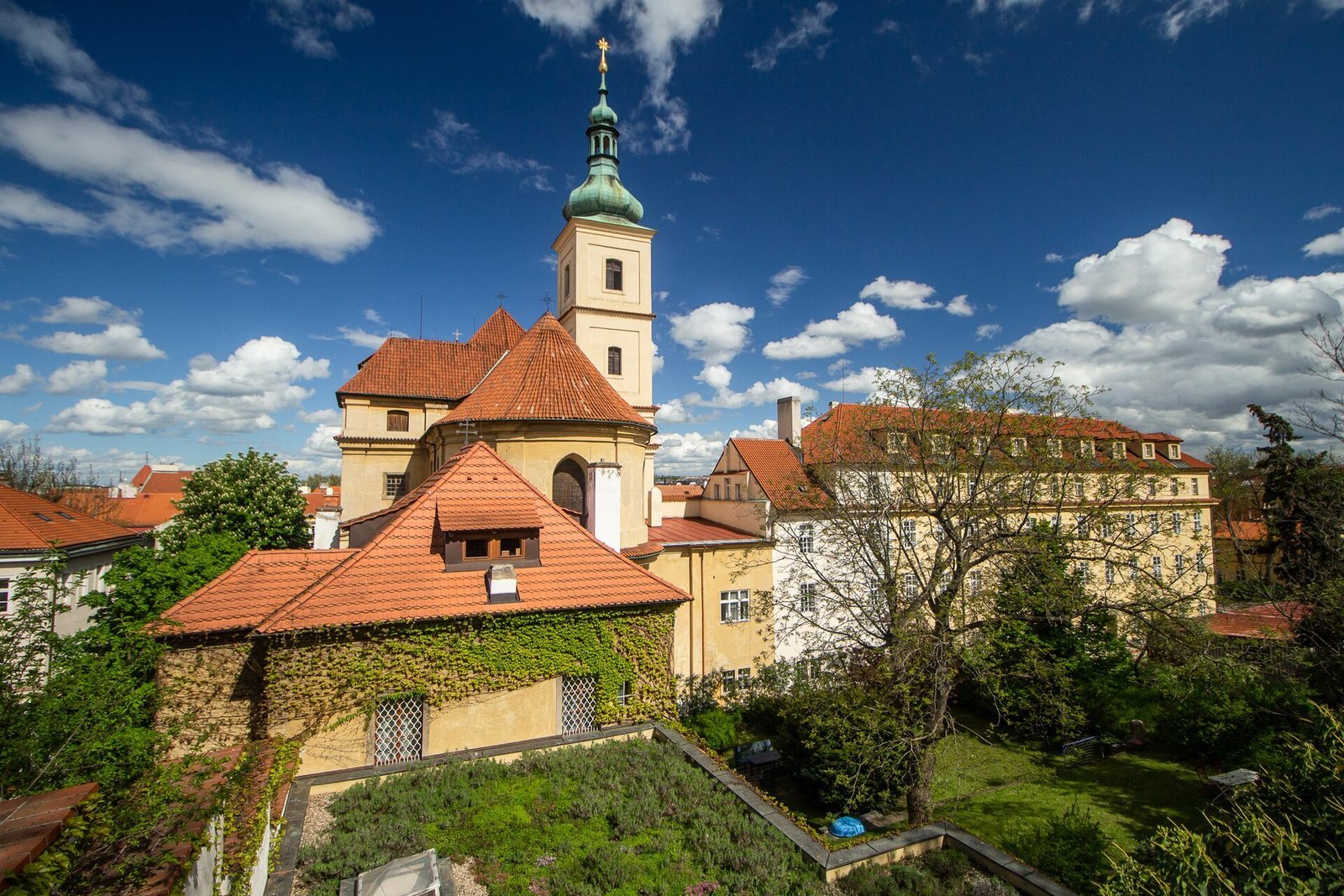
Carmelite monks arrived from Vienna in October 1624. They tried to establish a novitiate, where candidates prepared for religious vows, but financial difficulties led them to move it to Munich in 1630. Between 1625 and 1644, they adapted the church for Carmelite use, reversing its orientation and adding a semicircular altar end and monastic choir. A monastery was established beside the church.
The statue of the Infant Jesus was brought from Spain by Maria Manrique de Lara. Her daughter, Polyxena of Lobkowicz, gave it to the Carmelites. Swedish troops under King Gustavus Adolphus plundered Prague in 1631, during the Thirty Years’ War, and the statue was lost. When the Carmelites returned in 1637, they found it discarded. It was installed in the church by 1641 and solemnly crowned by the bishop of Prague in 1655. Devotion spread beyond the region, especially in Spain.
Baltasar de Marradas paid for the rebuilding of the façade in the mid-17th century, but died before the work was complete. An inscription records his payment for the portal in 1644. Baron and colonel Husmann paid for the doors and a stone statue of the Virgin and Child. The Infant Jesus statue was placed in the church choir and moved to the Chapel of the Holy Cross in 1656. In 1776, a new shrine altar of red and grey marble was built for it.
Suppression and changing use
On 3 June 1784, Emperor Joseph II suppressed the monastery as part of his reforms of religious houses. Its buildings went to a financial office and a gymnasium, later used as a primary school. The terraced garden, adjoining vineyard, and garden house were assigned to the general seminary. The former monastery garden had artificial ponds for raising fish. A hermitage behind the monastery, founded in 1659, is now a private residence.
The church became a parish church administered by the Knights of Malta, who took it over from the nearby Church of Our Lady beneath the Chain. After the monastery’s suppression, the church and its shrine fell into decline. Pope Leo XII granted the Infant Jesus image a decree of canonical coronation in 1824, and Pope Pius X authorized a confraternity devoted to the Infant Jesus of Prague in 1913.
Return of the Carmelites and modern history
Devotion at the shrine was discouraged during the Nazi occupation and the subsequent communist period, though pilgrims from Spanish-speaking countries continued to come. At the request of Archbishop Miloslav Vlk, the Carmelites returned on 2 July 1993, after more than two centuries away. The parish of Saint Thomas administered the church until 2004, when it became a monastic church again. The former monastery now houses offices of the Ministry of Education, Youth, and Sports.
Pope Benedict XVI chose the church and the Infant Jesus as the first station of his 2009 apostolic visit to the Czech Republic and gave the statue a gold crown decorated with eight shells, pearls, and garnets. The main altar underwent restoration from 2006 to 2023, and the choir stalls were restored in 2022. The church forms part of the UNESCO World Heritage Site of Prague’s Historic Center and is protected within the Carmelite monastery complex.
Remains
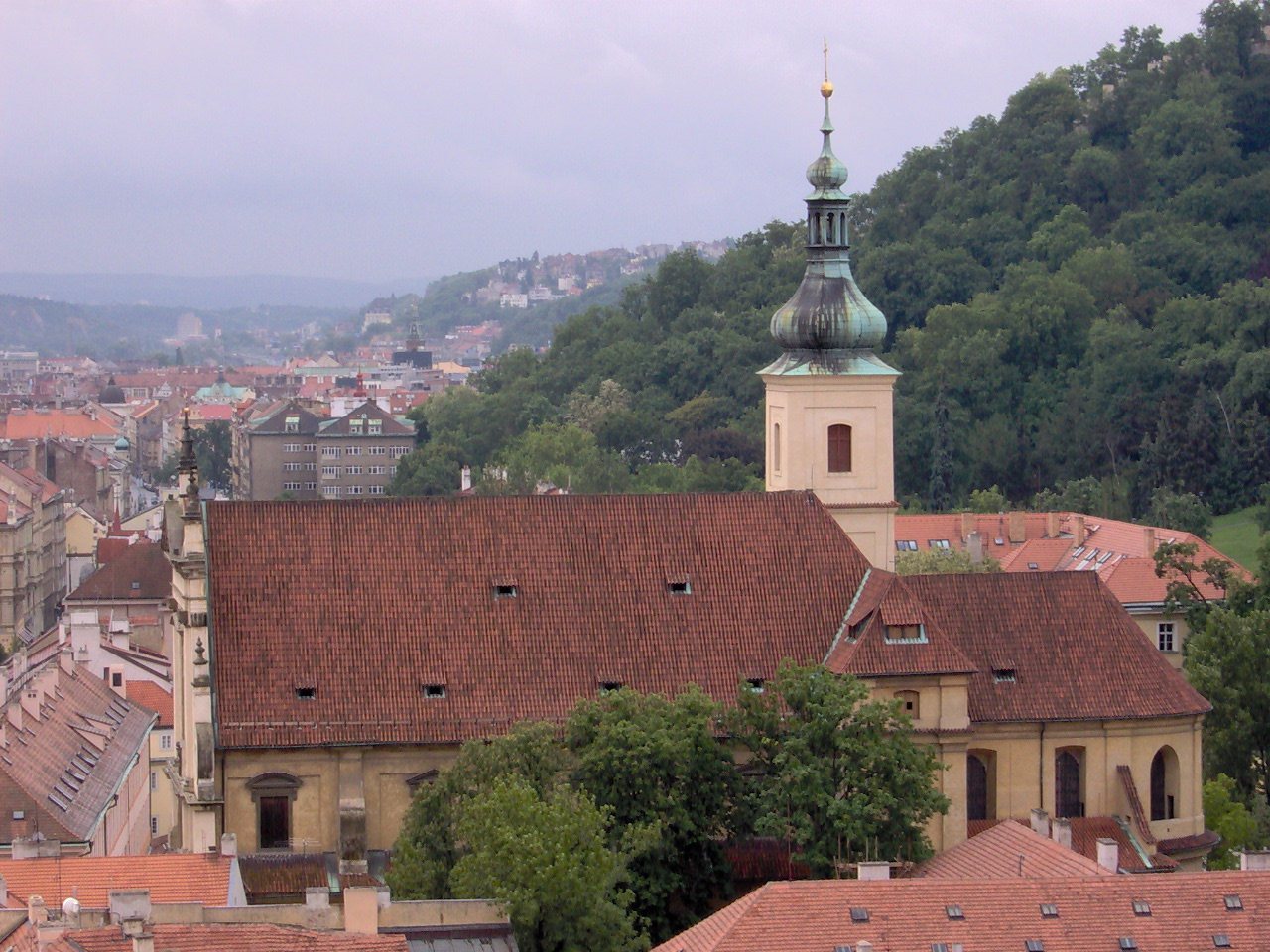
The church is a rectangular hall with a single main space, built with marl stone, brick, and stucco. Its ceiling is a barrel-shaped vault crossed by transverse arches, and the eastern end has a semicircular area around the main altar. The original east-facing altar and west entrance were reversed during the Carmelite adaptation. Eight niche chapels occupy the church: two closed chapels in the tower bay by the entrance, and six side chapels in three pairs. The side chapels stand above the main floor on steps and connect to one another through passages. A wooden structure around the main altar separates the monastic choir from the church’s eastern end. A spiral staircase beside the altar end leads to the Infant Jesus museum.
Principal façade
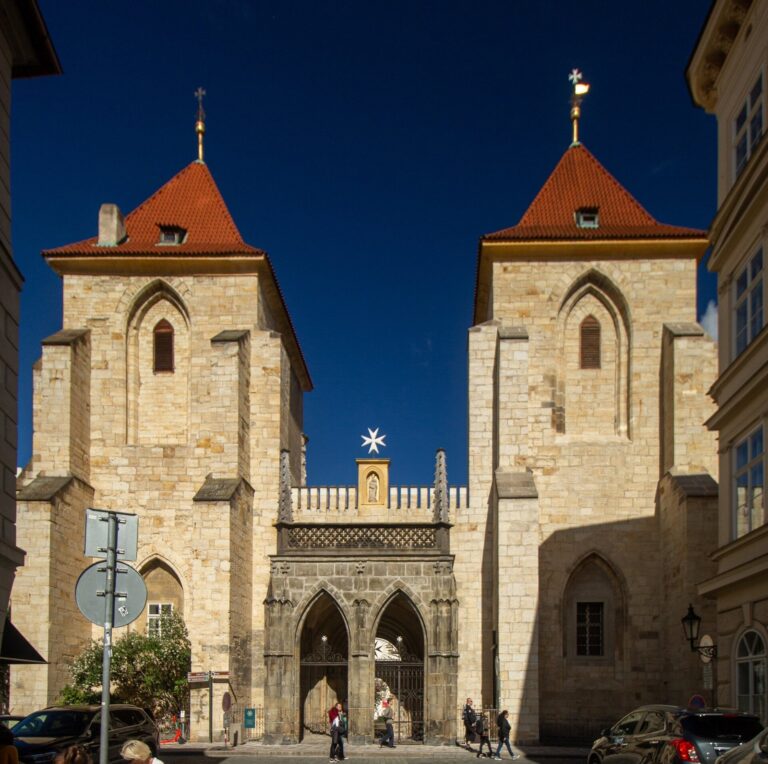
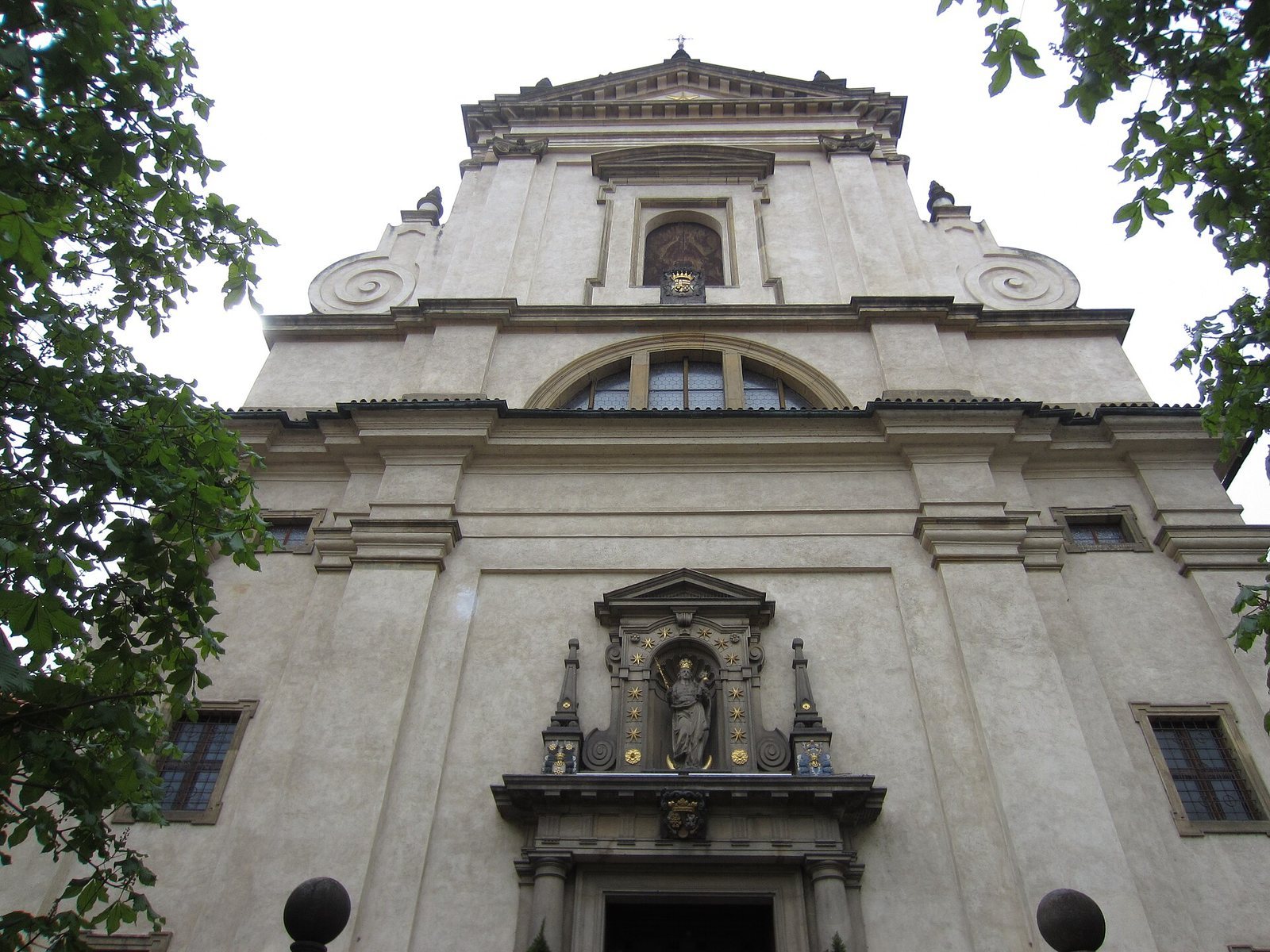
The façade draws on Carmelite churches in Rome, including Santa Maria della Scala and Santa Maria della Vittoria, as well as the Church of Saint Susanna. Above the portal, a niche holds a statue of the Virgin and Child; the present figure is a 1944 copy. The Carmelite emblem also appears on the façade. A sculpted donor’s shield sits below a count’s crown in a Baroque cartouche bordered by white Maltese crosses. Its quartered panels combine devices of the Marradas and Vique families, the Pallás double-headed imperial eagle, and the arms of Manrique de Lara, with motifs associated with Castile and León.
A Latin inscription beneath the shield commemorates Marradas’s payment for the portal and his devotion to Saint Teresa and her order. It also lists his titles, including count of the Holy Roman Empire, knight of the Hospitaller order, castellan of Amposta, imperial chamberlain, and military commander in Bohemia. In 2024, removal of plaster on the church’s north side exposed foundations made of marl blocks and brick infill belonging to two windows.
Altars and chapels
Main altar
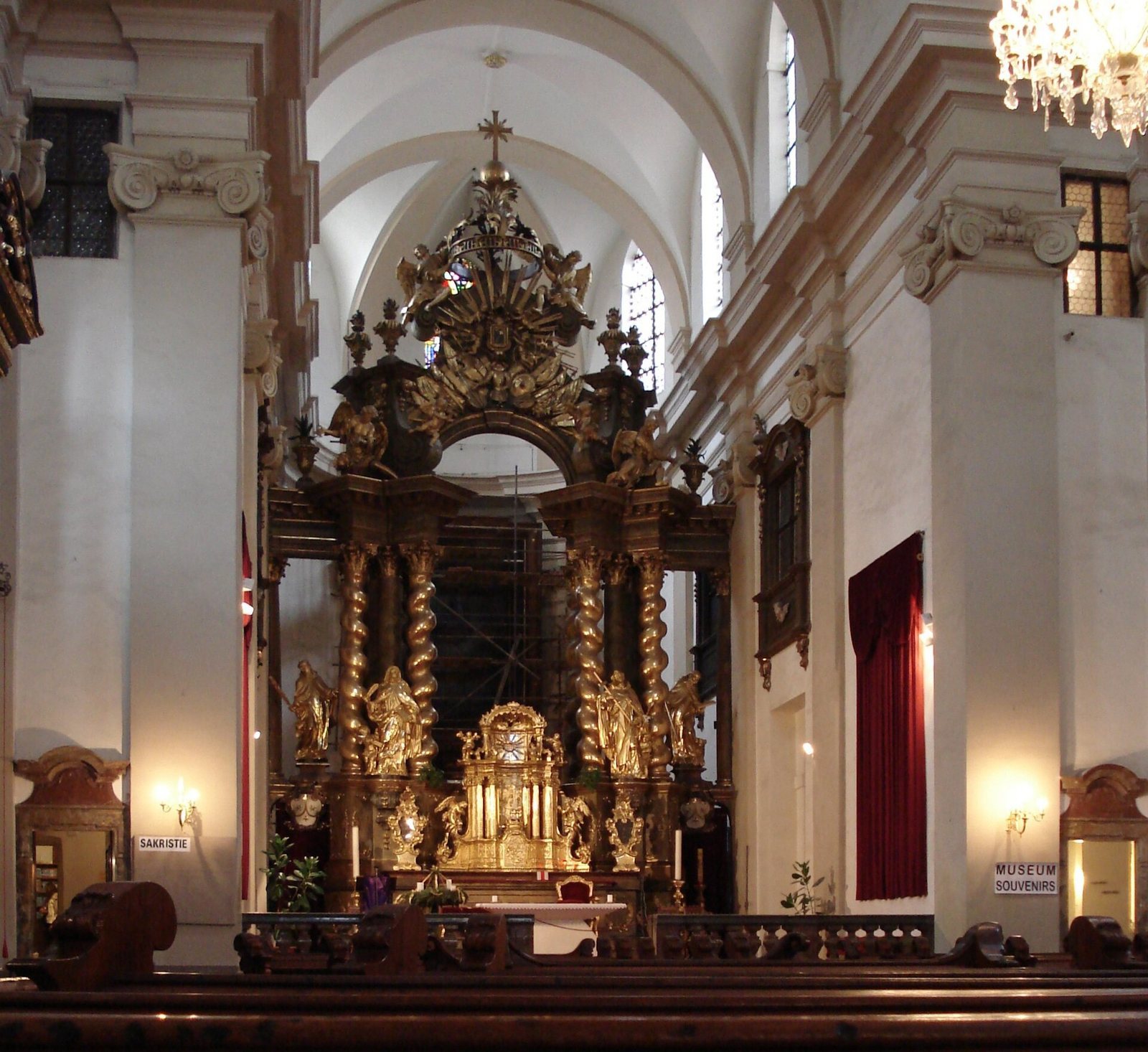
The high-Baroque main altar has twisted columns supporting a horizontal upper structure and an openwork, moulded cornice. Jan Ferdinand Schor designed it in 1715 and contributed to its painted finish; it was built in 1716–17. Sculptures of Saints Elijah and Elisha came from the workshop of Matěj Václav Jäckel. The figures of Teresa of Ávila and John of the Cross are later and probably the work of Petr Prachner. At the top, a copy of the Adoration of the Lord image appears within a radiant halo, beneath a royal crown and among angels and war trophies.
Painting behind the main altar
Behind the altar is Antonín Stevens’s large painting of Ferdinand II and his son Ferdinand III praying for Catholic victory at White Mountain. The Carmelite friar Dominic à Jesu Maria kneels opposite them, holding the Adoration of the Lord image. Above, the Virgin and saints intercede with God. Stevens painted the work for the church’s original altar structure in 1641.
Chapel of the Crucifixion
The closed Chapel of the Crucifixion is the first chapel on the left. Its Baroque group shows Mary Magdalene kneeling at the foot of the cross, with the Sorrowful Virgin and Saint John the Evangelist on either side. God the Father appears above them.
Chapel of Our Lady of the Scapular
The closed chapel to the right of the entrance serves as a confessional. Its altar holds a statue of the Virgin dated 1626, flanked by figures of Saints Joachim and Anne, with God the Father above.
Chapel of Teresa of Ávila
One side altar features Johann Georg Wilhelm Dietrich’s 1752 painting of the Ecstasy of Teresa of Ávila, with an image of her Apotheosis by Jan Bedřich Hess above it. A statue of Teresa of Lisieux by Jiří Kobra, made in 2019, stands on the altar table. The upper section also includes figures of John the Baptist and Jerome by a sculptor from the circle of Jan J. Bendl.
Chapel of John of the Cross
Another side chapel contains Matěj Zimprecht’s Apotheosis of John of the Cross, set within an architectural frame by Marek Nonnenmacher dated 1679. The altar table bears an image of the Madonna of Mantua with a silver crown, while a second image by Zimprecht shows the Virgin in the clouds. Jan L. Scheiermann carved figures of Saints Ulrich, Susanna, and Judith.
Chapel of Saint Simon Stock
The chapel nearest the sacristy and the altar end contains Petr Brandl’s painting of the Mystical Vision of Saint Simon Stock, made before 1720, and another Brandl painting of Saint John Nepomuk at prayer. Figures of Carmelite saints and Saint Dionysius in the upper section were made by artists from the circles of Jan Antonín Quitainer and Matěj Václav Jäckel.
Chapel of Saints Joachim and Anne
At the entrance on the right, a chapel contains Brandl’s signed 1716 painting of the Vision of Saints Joachim and Anne. Its upper section includes figures of Pope Telesphorus and Bishops Andrew and Cyril from Jäckel’s workshop, together with a painting of God the Father by Brandl.
Infant Jesus altar
A marble altar in a side chapel holds the Infant Jesus between gilded wooden figures of the Virgin and Saint Joseph, with God the Father above. František Lauermann made the altar in 1775–76, and Petr Prachner made its statues. The wooden Infant Jesus figure is a Spanish work probably dating to the 16th century. It stands 47 centimetres high, with its right hand raised in blessing and a globe topped by a cross in its left hand. Wax coats the wood, and the statue stands in a glazed silver case made by a goldsmith.
Chapel by the monastery museum entrance
The altar beside the entrance to the monastery museum has Brandl’s 1720 painting of the Death of Saint Joseph in the presence of Christ. Its altar table holds a miniature copy of the Brazilian statue of Our Lady of Aparecida. Jan Antonín Quitainer made the upper figures of Carmelite saints and Saint Gregory, while Brandl painted Saint Anthony of Padua with the Child Jesus.
Other side-chapel sculpture
Sculptural decoration in two chapels associated with the Talmbers was probably made by Jan Antonín Geiger in the mid-1730s.
Other furnishings and burial spaces
Pulpit
The early-Baroque pulpit is finished in black and gold. On its canopy, Jan L. Scheiermann depicted Elijah on a fiery chariot as Elisha catches his cloak. Matěj Zimprecht’s oval images of Teresa of Ávila, John of the Cross, and Denis Perronet date to 1679.
Organ and choir stalls
Franz Karetzer of Králíky made the Rococo organ case in 1754. The original Baroque choir stalls were later altered in a Neo-Gothic style, then restored to their early-Baroque appearance.
Crypt
The crypt extends beneath the entire church. It contains coffins holding mummified members of religious orders and supporters of the church. More than 200 Carmelites were buried there during the 17th and 18th centuries. Water damage has left the crypt and cellar rooms in poor condition.
Later furnishings
Since 2015, the church interior has also included a new altar, a raised lectern for readings, a cross, and a cover for the baptismal font, all made by sculptor Otmar Oliva.
The Infant Jesus and its devotional clothing
The statue is dressed and crowned during the church year in garments of different colors. The church preserves more than 100 outfits donated by worshippers. Among the most valued are garments said to have been sewn by Maria Theresa and given to the church by Ferdinand III.