Kuntsevo Settlement: An Ancient Fortified Site in Moscow
Site at a Glance
- Popularity
- Medium
- Country
- Russia
- Primary era
- Iron Age
- Eras represented
- Iron Age, Classical, Medieval
- Civilizations
- Unclassified
- Site type
- Military
- Remains
- Fortified Town
On this page9 sections
History
Early settlement and the Vyatichi
The Kuntsevo settlement preserves the remains of a former fortified settlement in the Kuntsevo district of Moscow, Russia. Its cultural layers extend from the sixth and fifth centuries BCE through the seventh and eighth centuries CE and are associated with the Dyakovo culture, an archaeological culture of central Russia’s forest zone. The settlement’s social organization during this early period has been described as patriarchal. Kuntsevo is considered one of the oldest settlements within present-day Moscow.
From the eleventh to the thirteenth century, the Vyatichi, an East Slavic people, lived at the site. They practiced plough agriculture and raised livestock.
Church, destruction, and local traditions
A Church of the Protection of the Mother of God stood at Kuntsevo from the thirteenth through the sixteenth century. In 1611–1612, during the Time of Troubles, a period of political and dynastic upheaval in Russia, troops of the Polish hetman Stanisław Żółkiewski were stationed in the nearby Khoroshyovo and Setun meadows. In the early seventeenth century, the settlement and church were looted and destroyed. The former town then became a ruined settlement site.
In the nineteenth century and earlier, people sometimes called the place the Slavic, Polish, or Tatar cemetery. It was also known as the Cursed Place because of a belief that it had once been a pagan sanctuary. A local legend held that the Church of the Protection of the Mother of God sank underground in a single night, carrying its cross with it.
In the 1840s, historian Ivan Zabelin described a custom among residents of Terekhovo, whose village lay upstream along the Moskva River. On Trinity Day, the Christian feast of Pentecost, they cast green wreaths into the river from the opposite bank near the settlement. Since Terekhovo was already upstream, they did not need to approach Kuntsevo merely to throw wreaths into the water. Zabelin suggested that the custom might preserve an older reverence for a pagan place of ritual offerings.
Research and cultural memory
The earliest recorded mention of the settlement appears in a 1649 boundary survey of Kuntsevo village. Nineteenth-century investigations involved the antiquarian Z. Ya. Dolenga-Khodakovsky and the historian and archaeologist Ivan Yegorovich Zabelin. Archaeologist V. A. Gorodtsov led excavations from 1919 to 1923. Further investigations took place from 1960 to 1973 under A. G. Veksler and the Museum of History and Reconstruction of Moscow. Kuntsevo is a cultural heritage site of federal significance in Russia.
The hill also became a setting for later cultural works. M. I. Voskresensky’s novel The Cursed Place is set chiefly there, and Marina Tsvetaeva referred to Kuntsevo’s oaks in a poem. A. K. Savrasov’s 1872 painting Autumn Forest. Kuntsevo (Cursed Place) depicts the settlement among old oaks.
Remains
Settlement platform and defenses
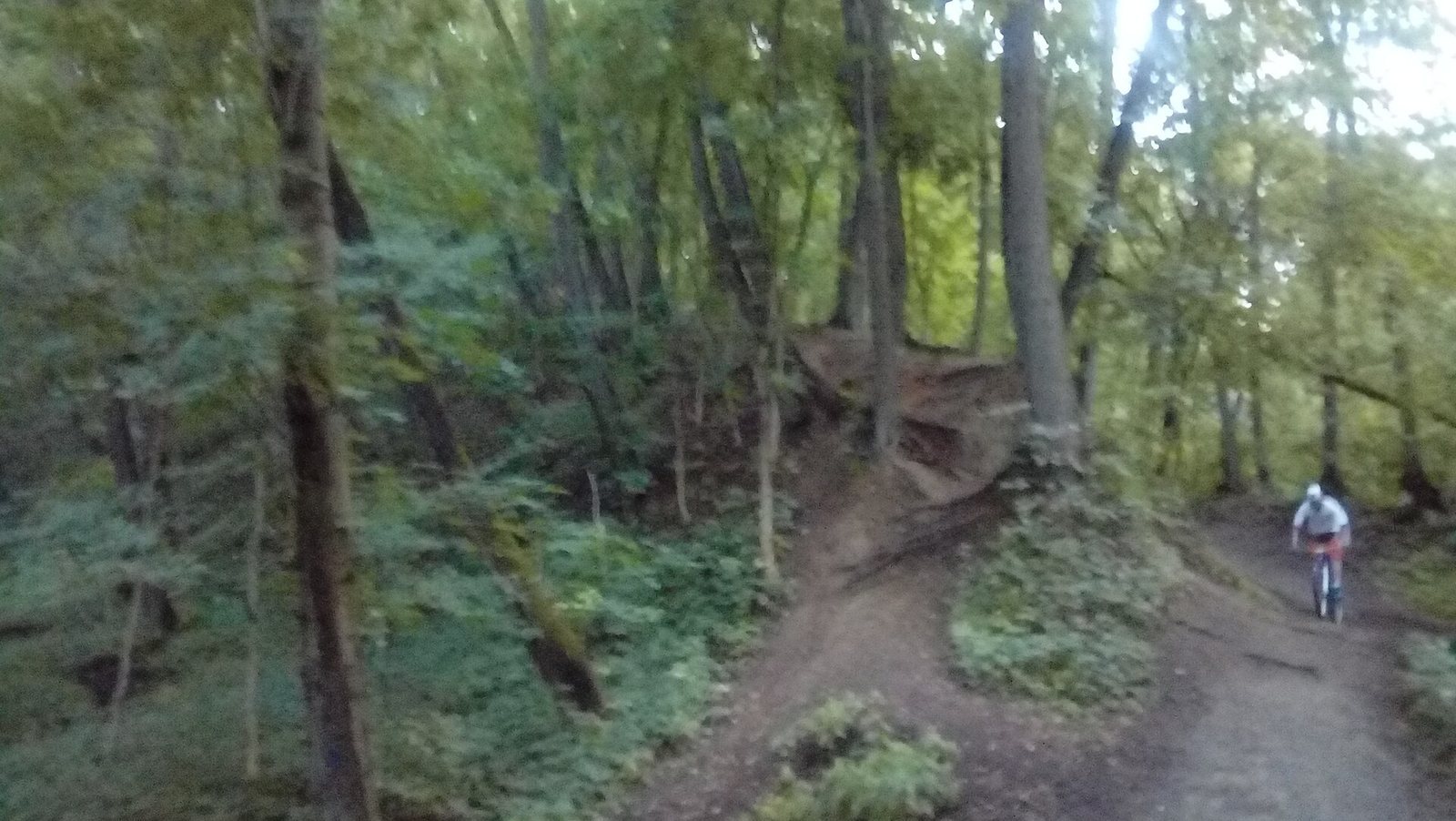
The settlement occupies a cape formed by converging ravines on the right bank of the Moskva River, at the western edge of Kuntsevo-Fili Park, also called Suvorovsky Park. Its oval-rectangular platform measures about 72 metres from southeast to northwest and is 20 to 27 metres wide, reaching about 30 metres across at the north. The surface slopes downward by about 1.5 metres toward the north. Earth ramparts and ditches remain, and excavations revealed defensive palisades as well as remains of residential and utility buildings.
Buildings and occupation finds
Objects associated with the earliest settlement phase include items made of bone, clay, and iron, equipment for casting non-ferrous metal, and metal ornaments. Finds from the Vyatichi period include tools, household goods, craft objects, and ornaments. Together with the building and palisade remains, these materials represent different phases of life at the fortified site.
Church and cemetery
The Church of the Protection of the Mother of God stood on the site’s higher ground. It was first built of wood and later replaced by a stone church. The associated cemetery yielded carved white-stone tombstones, coins, and crosses. In the 1840s, Zabelin found a grave slab bearing an inscription with a date corresponding to 1557.
Landscape and associated objects
A stone figure resembling statues associated with the Polovtsians, a Turkic people of the Eurasian steppe, was linked to the settlement. Zabelin argued that a local landowner had brought it there in the late eighteenth century to decorate a park pavilion. It first stood inside a hollow elm near the middle of the peninsula and was later moved to a garden closer to the estate. Streams near the settlement contain fossils popularly known as devil’s fingers.
Oaks more than 300 years old grow in the surrounding park. One especially large oak near the settlement had a trunk measuring four arm-spans around and was described in botanist K. A. Timiryazev’s The Life of Plants.