Church of the Purification of the Virgin Mary: An Early Gothic Church in Slovakia
Site at a Glance
- Popularity
- Very Low
- Country
- Slovakia
- Primary era
- Medieval
- Eras represented
- Medieval, Early Modern
- Civilizations
- Hungarian
- Site type
- Religious
- Remains
- Church
On this page12 sections
History
Medieval foundation
The Church of the Purification of the Virgin Mary is an early Gothic Roman Catholic church in Slovakia, founded in 1349 on the site of an older sacred building and completed in the early 15th century. Gothic is a medieval European architectural style. A parish school stood near the church by 1348.
The church is a branch church, attached to a parish but not serving as its principal church. It belongs to the Roman Catholic parish of Okoličné, within the Liptovský Mikuláš Deanery and the Diocese of Spiš in the Eastern Province.
Rebuilding and liturgical dedication
The church underwent rebuilding in 1517 and again in 1664. These works, described as Baroque, altered its tower and nave ceiling. Baroque is an early modern European artistic and architectural style.
For centuries, the church’s dedication reflected the February 2 feast of the Purification of the Virgin Mary. In the older liturgical calendar, the feast recalled Mary bringing Jesus to the Jerusalem Temple forty days after his birth and undergoing a purification rite, as described in the Gospel of Luke. The Second Vatican Council, a major council of the Roman Catholic Church held from 1962 to 1965, revised the liturgical calendar. Its reform shifted the feast’s emphasis to Jesus’s presentation in the Temple and took effect in 1969. February 2 then became the Feast of the Presentation of the Lord. The church has since also been called the Church of the Presentation of the Lord, sometimes retaining its earlier dedication to the Purification of the Virgin Mary.
The school and modern preservation
The parish school closed in 1941 because it had too few pupils. Its building now houses a local museum with a permanent exhibition on the village’s history.
A heritage restoration of the church took place in 1954–1956, and the roof of the enclosing wall underwent extensive reconstruction in 2017. On November 28, 2015, the church, entrance gate, enclosing wall and adjacent cemetery were entered together in Slovakia’s register of immovable cultural monuments. The Baroque organ, bell, late Gothic altars, frescoes and ceiling paintings are also designated national cultural monuments.
Remains
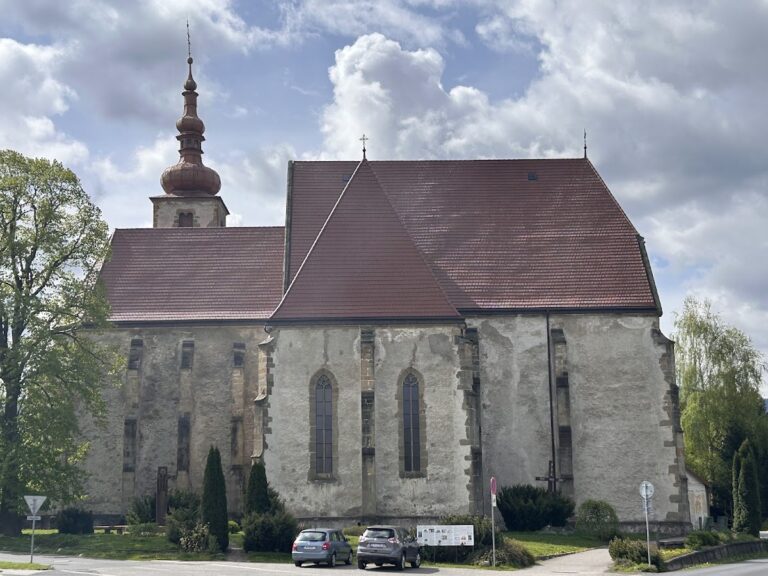
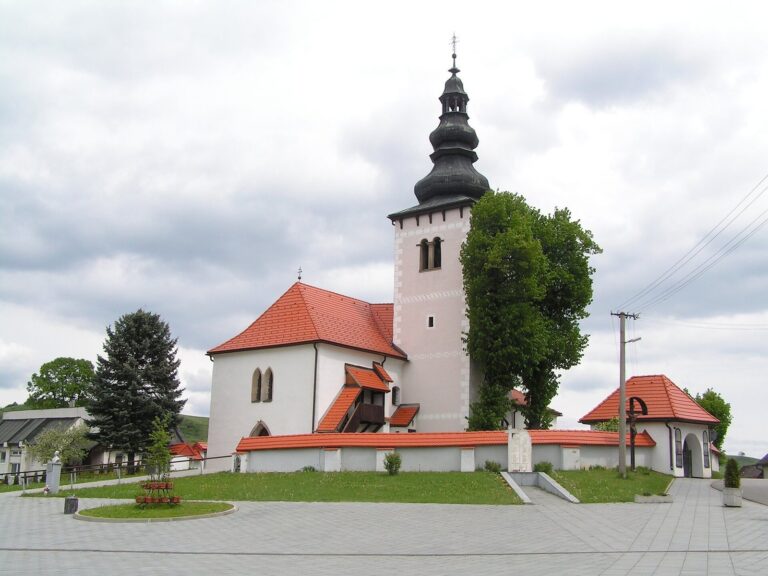
West of the village center, the church stands in an enclosed compound, with a cemetery on one side and the former parish school on the other. The well-preserved building has a single main worship space and a square-ended chancel, the area around the altar.
The church
Exterior and interior
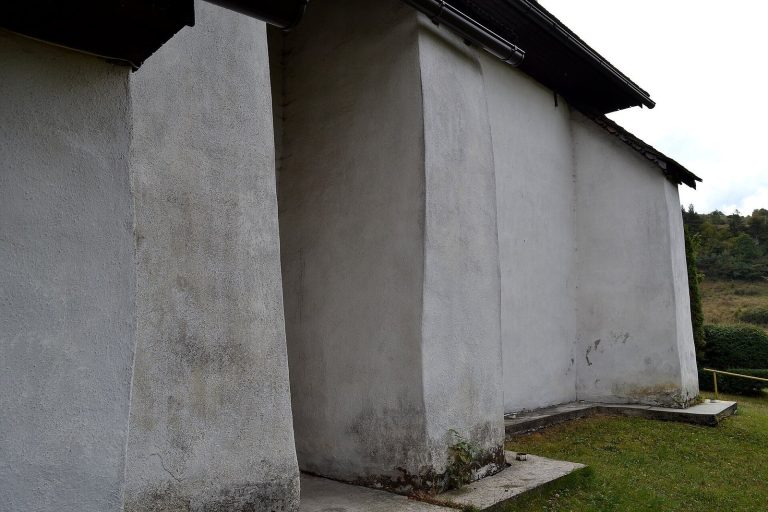
Smooth façades are divided by projecting buttresses and pointed-arch windows. The tower has a Baroque onion-shaped roof and a gallery. Inside, the nave has a painted plank ceiling, and the church contains frescoes and ceiling paintings.
Altars and paintings
The main Gothic panel altarpiece, an altar artwork made up of panels, dates to 1480 and depicts the Virgin Mary with Saints Barbara and Catherine. Two side altars date to around 1510. All three are attributed to the Master of Okoličné, a conventional name for an artist identified through associated works rather than a personal name.
Organ and bell
The church contains a Baroque organ dating to 1750. Its tower holds a Gothic bell cast in 1509, the oldest bell in the church.
Enclosure and neighboring buildings
Wall and entrance gate
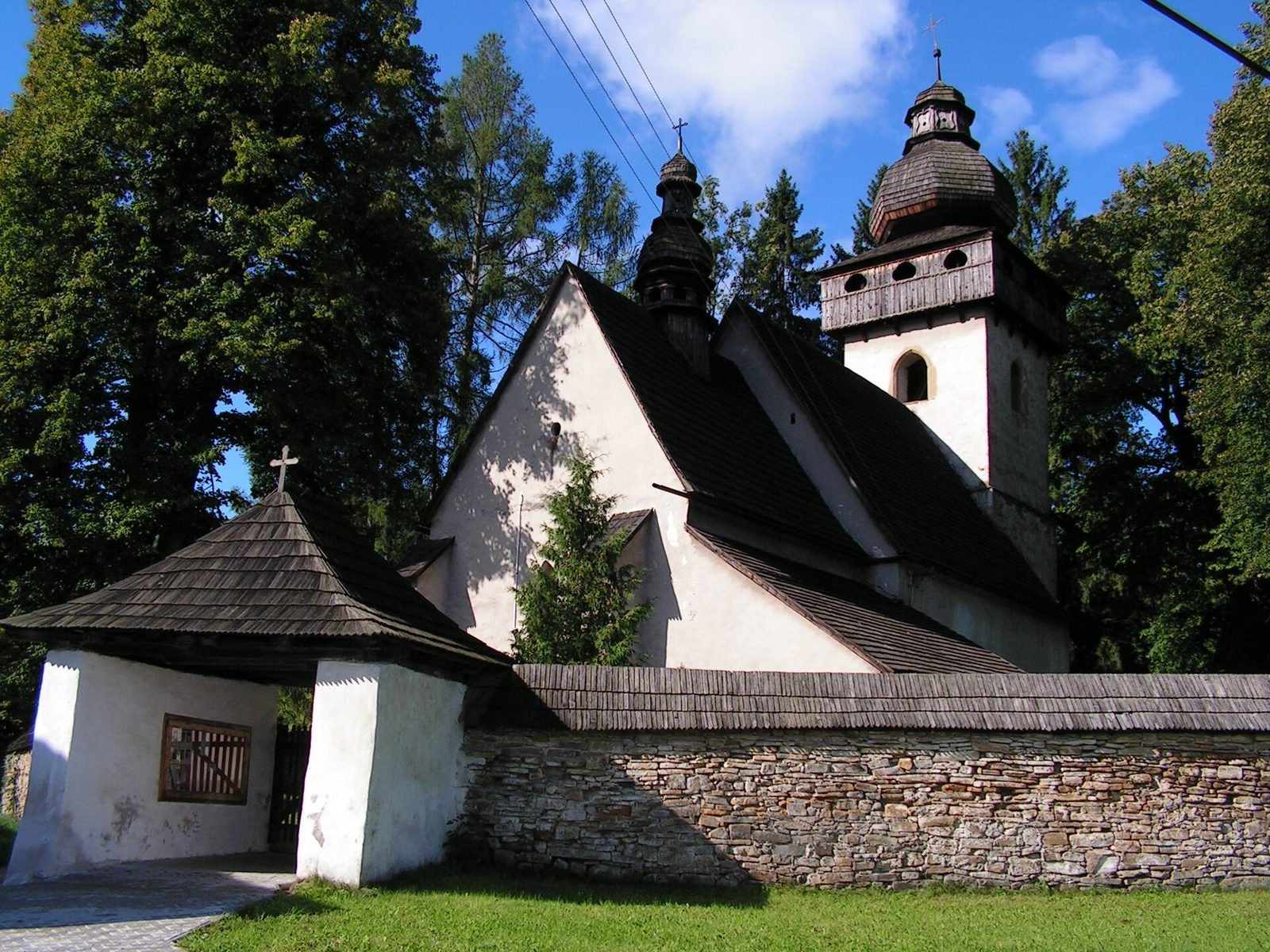
A stone entrance gate opens through the compound’s enclosing wall, which is about 2.2 metres high and built of rubble stone. The wall probably dates from the same period as the church and survives in almost its original medieval condition. A shingled gabled roof caps it around its perimeter.
Cemetery and former school
The adjacent cemetery and former parish school are positioned on opposite sides of the church. The school building remains near the church compound.