Chiesa Santa Maria Assunta: A Roman Catholic Church in Bientina
Site at a Glance
- Popularity
- Low
- Country
- Italy
- Primary era
- Early Modern
- Eras represented
- Early Modern
- Civilizations
- Grand Duchy of Tuscany
- Site type
- Religious
- Remains
- Church
On this page16 sections
History
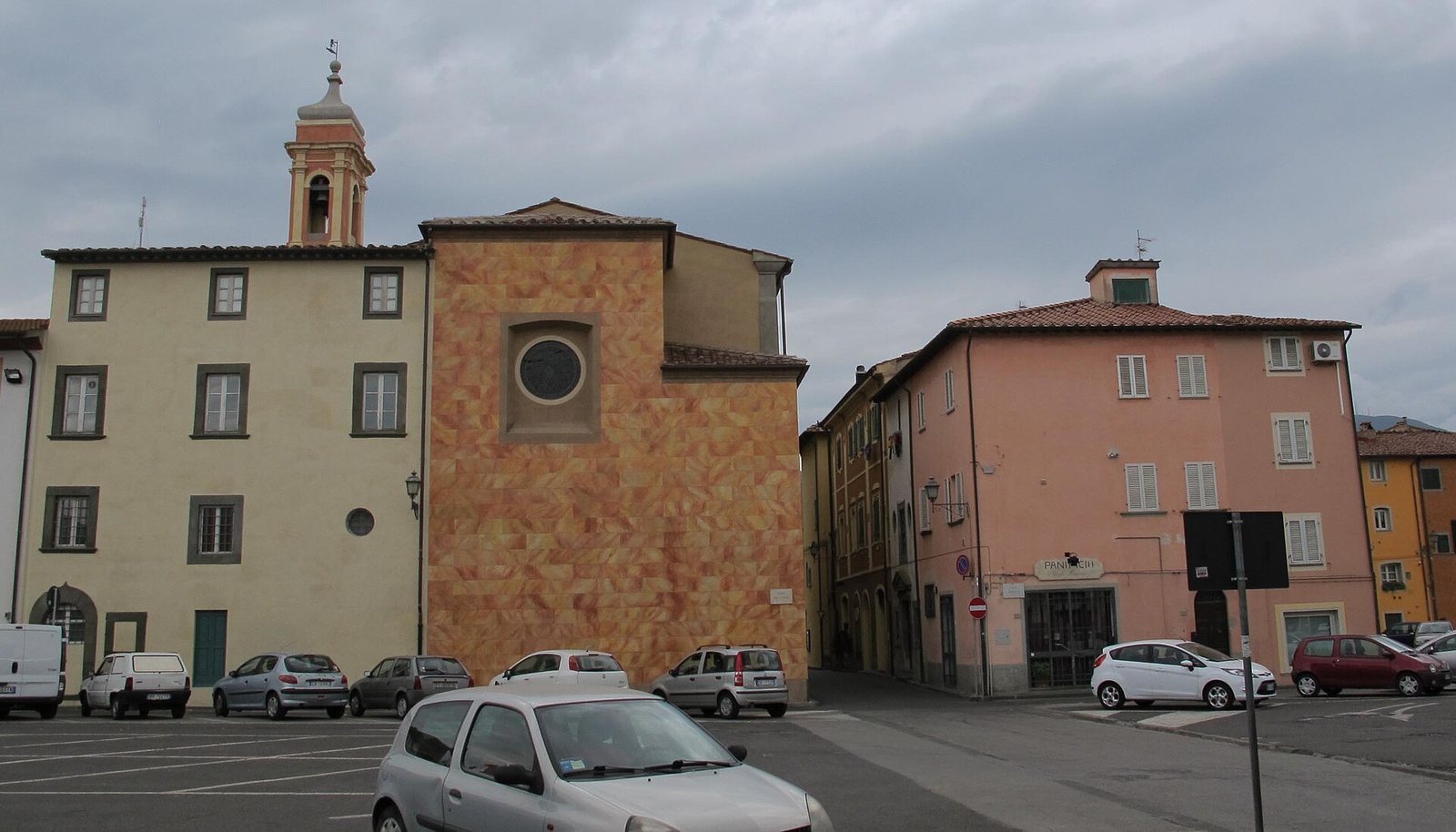
Chiesa Santa Maria Assunta is a Roman Catholic church in Bientina, Tuscany, Italy. Dedicated to the Assumption of the Virgin Mary, the Christian belief that Mary was taken into heaven, it belongs to the Archdiocese of Pisa and is documented from 1326.
Medieval parish church and early dedications
By the fifteenth century, the church held the status of a pieve, a parish church serving a wider district. In 1332, Archbishop Simone Saltarelli granted it a baptismal font. A plaque inside the church recalls its early relics: those of Barnabas, an early Christian apostle, Blaise, a bishop and martyr, and Catherine, a martyr.
Consecration and seventeenth-century rebuilding
The church was consecrated to the Assumption on 27 September 1509. Between 1628 and 1639, it was enlarged and renovated to a design by Florentine architect Gherardo Silvani. The work included demolishing the bell tower. The renovated church was consecrated again on 10 April 1644.
Saint Valentine and pilgrimage
In 1695, Bientina’s civic authorities sought relics of a martyr for the town’s principal church. They turned to Giovanni Maria Maestrini, a regional superior of the Observant Franciscans, a branch of the Franciscan order. Maestrini secured the relics of Saint Valentine, a Christian martyr. They had been exhumed in 1681 from Rome’s Catacombs of Saint Callixtus, an ancient underground Christian burial complex, and reached Bientina on 6 June 1699.
The relics’ arrival led to the church being refitted and embellished. It became a pilgrimage destination for people seeking Valentine’s aid, and the saint is the patron of Bientina.
Later embellishment and restoration
The church received extensive decoration during the eighteenth century. A major refurbishment began in 1750, followed by another substantial one in 1829. Later interventions included a restoration in 1986 and major structural and conservation work from 2006 to 2011.
Remains
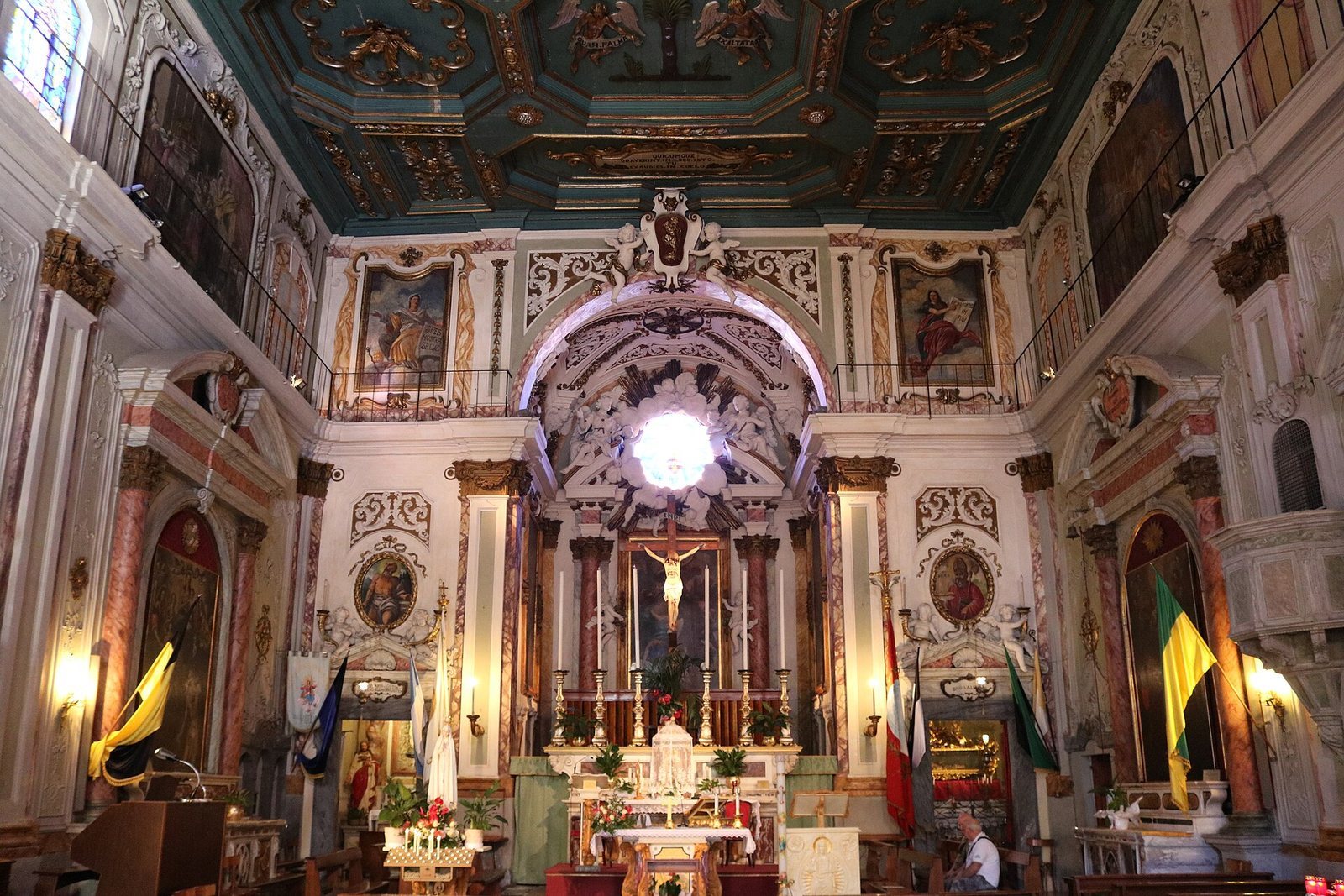
The church is arranged around a single nave with side altars, a presbytery, and chapels beside it. Its surviving interior combines painted wood, stucco, stone, marble, and gilded decoration.
Façade and nave
Façade
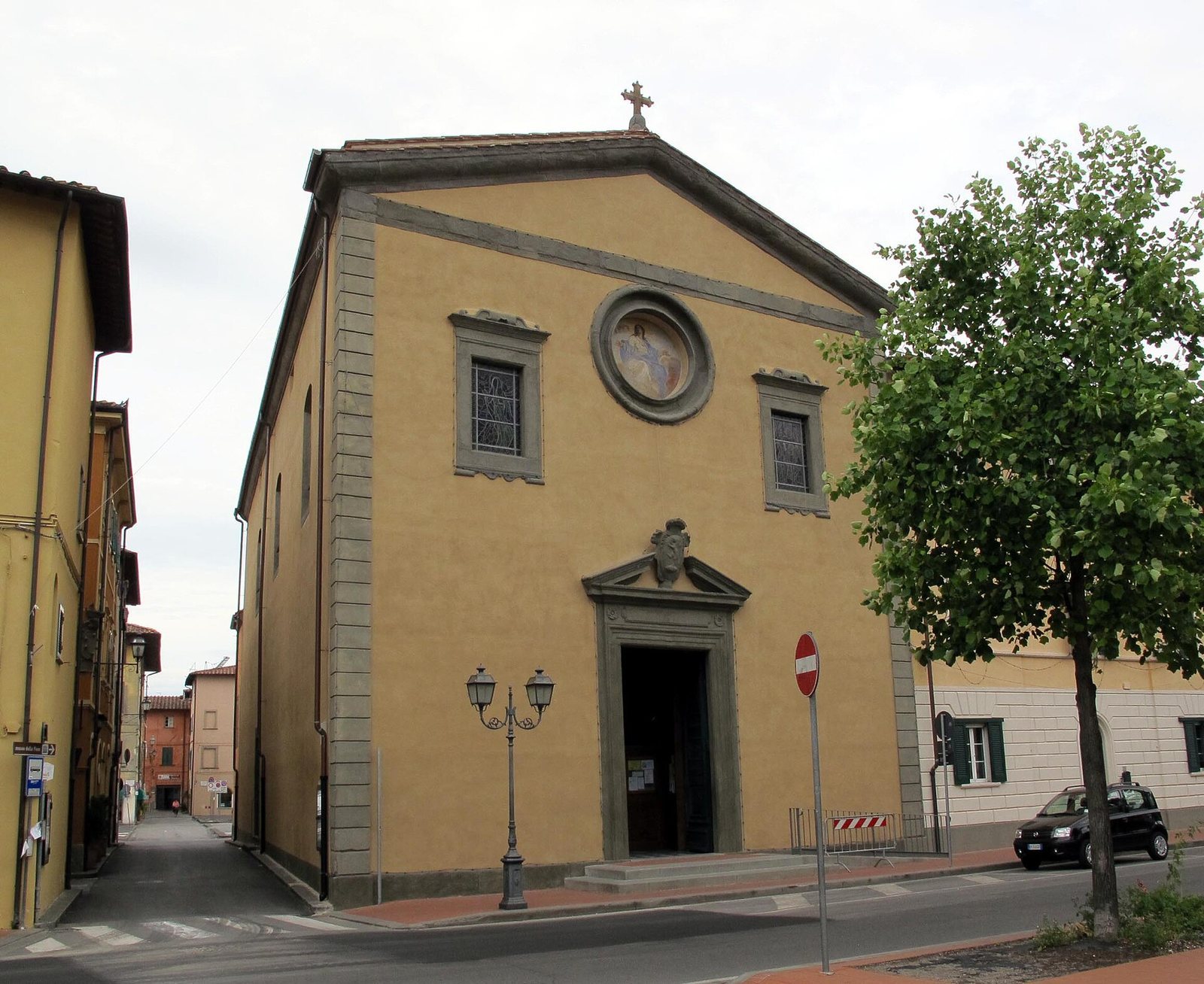
The façade has a stone portal, with two windows above it and an oculus containing a fresco of the Assumption.
Ceiling and wall decoration
A large painted wooden coffered ceiling, divided into recessed panels, was made in 1749 by Pisa woodcarver Andrea Mattei. Its carved central image shows the Assumption among angels. Paolo and Domenico Bolani decorated the side walls and the wall before the presbytery in stucco in 1777–1778. Above the altars, a continuous gallery stands in front of six fresco panels by Giuseppe Romei, painted in 1782–1783. They depict episodes from Saint Valentine’s story, including the arrival of his relics and his first miracles.
Marble and scagliola altar frontals, made with a decorative material that imitates marble, and eighteenth-century altarpieces also contribute to the nave’s decoration.
Organ
The pipe organ stands on the wall above the entrance. Bartolomeo Ravani of Lucca built it in 1640, and Silvani designed its carved wooden case, which is gilded with pure gold. The organ was restored in 2002.
Altars on the right
The first altar on the right is dedicated to Saint Andrew and was patronized by the Del Grande family. Its marble frontal accompanies a late-seventeenth-century canvas of the Annunciation with Saints Luke, possibly, Lawrence, Andrew, and Peter. The artist is unidentified; the painting was once attributed to Carlo Cignani. The Del Rosso family erected the second altar in 1616. It holds Alessandro Bardelli’s painting of the Immaculate Conception with Saints, and a sixteenth-century stone pulpit stands beside it. The Cosci family’s third altar dates to 1735, with a frontal by Giovan Battista Vaccà and a painting of the Madonna of Carmel with Saints by Giovanni Antonio Pucci, also from 1735. Bientina’s community commissioned the final altar in 1636. Cesare Dandini’s altarpiece shows Saints Francis, Dominic, Giusto, and Carlo Borromeo adoring the name of Christ.
Presbytery and adjoining chapels
High altar and presbytery
The presbytery, the area around the main altar traditionally reserved for clergy, follows an arrangement devised by Antonio Ferri. Its central high altar is made of polychrome marble and was created in 1701 by Carrara sculptor Giovanni Baratta. Behind it, an early-eighteenth-century altarpiece by Pier Dandini depicts the Glory of Saint Valentine. Paintings on either side show the Martyrdom of Saint Valentine, by Antonio Puglieschi, and the Condemnation to Death of Saint Valentine, by Tommaso Redi. Giovanni Martino Portogalli executed the stucco work above them between 1702 and 1706.
Saint Valentine chapel
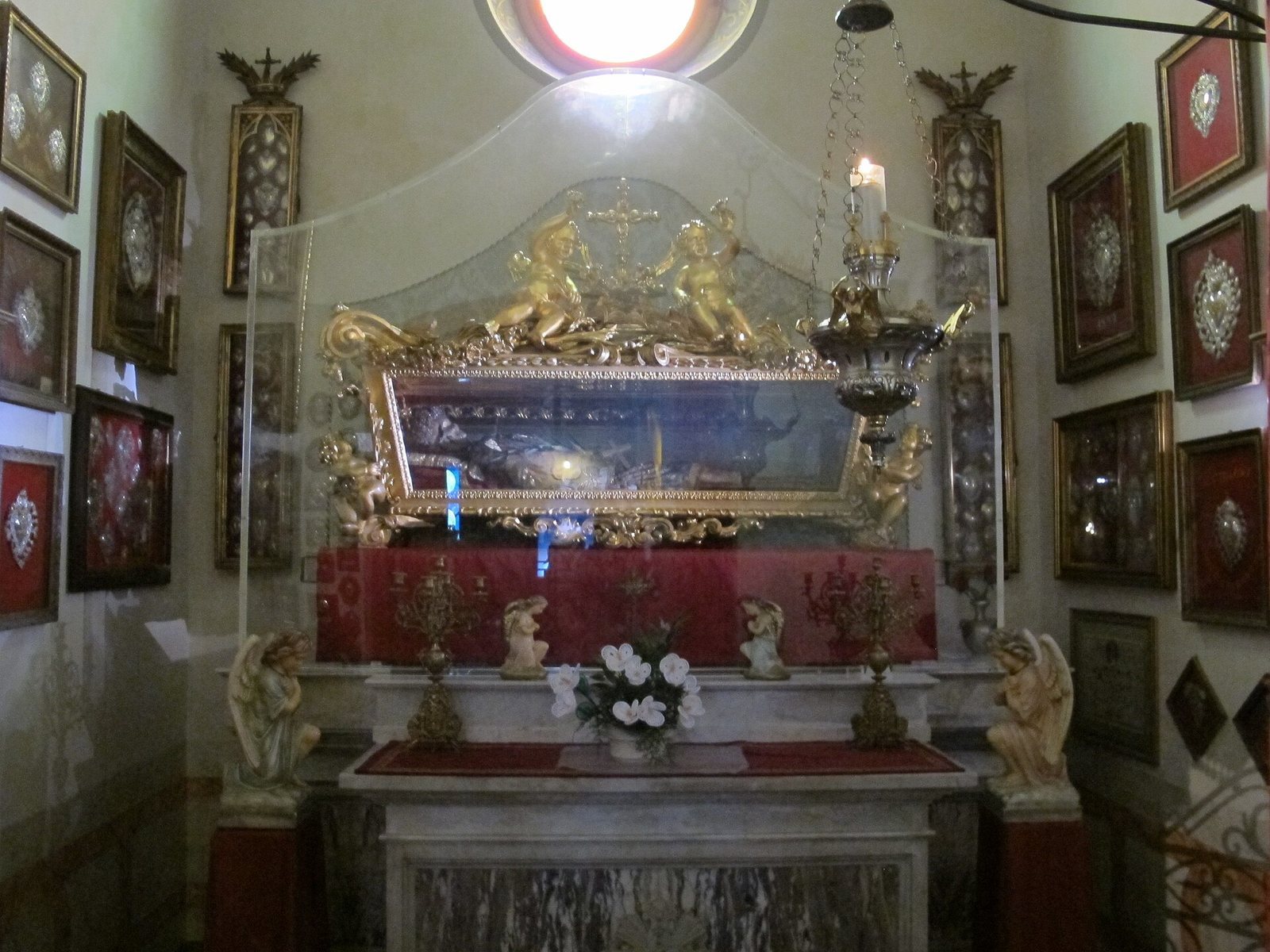
The chapel to the right of the presbytery is dedicated to Saint Valentine. It contains a carved and gilded wooden urn holding the saint’s relics. Made in the early eighteenth century and first placed on the high altar, the urn received further carving from Andrea Andrei in 1730–1731. A silver, partly gilded reliquary bust of Valentine, modeled in 1710 by Giuseppe Giacobbi, is preserved in the church museum.
Saint Anthony and the Blessed Sacrament chapel
The chapel to the left of the presbytery is dedicated to Saint Anthony of Padua and the Blessed Sacrament. Its final altar, dedicated to the Eucharist, the Catholic sacrament of Communion understood as Christ’s body and blood, once held Aurelio Lomi’s Last Supper, painted in 1603–1604 and now in the church of San Domenico. The altar’s present painting was made in 1642–1643 for the deconsecrated church of San Girolamo. By an unidentified artist, it depicts the Madonna and Child, souls in purgatory, Saint John the Baptist, and Girolamo.
The chapel’s central altar, dedicated to the Assumption, was built in 1605 and contains a modern statue. The first altar, known as the community’s Crucifix altar, holds a late-sixteenth-century wooden crucifix that may have been transferred from the vanished church of San Giusto. It was restored in 1995.
Church museum
A small museum attached to the church preserves furnishings, vestments, and sacred objects. Among its holdings is the silver and partly gilded bust-shaped reliquary of Saint Valentine, a container for the saint’s relics.