Santo Stefano: Catholic Parish Church in Terenzo, Italy
Site at a Glance
- Rating
- 4.8
- Popularity
- Very Low
- Country
- Italy
- Primary era
- Early Modern
- Eras represented
- Medieval, Early Modern
- Civilizations
- Holy Roman Empire
- Site type
- Religious
- Remains
- Church
On this page13 sections
History
Santo Stefano is a Catholic church of the Roman rite in Terenzo, Italy, and the seat of a parish in the Diocese of Parma. Its origins reach back to a medieval chapel first listed on 11 November 1141, when a papal bull of Pope Innocent II placed the chapel of Terenzo among the possessions of the Chapter of Parma Cathedral.
Medieval Chapel and Rebuilding
In 1230, the church was recorded among the chapels belonging to the Cathedral Chapter, although it stood within territory dependent on the parish church of Bardone. A catastrophic landslide in 1294 almost completely destroyed Terenzo and also swept away the medieval church. The settlement and its chapel were rebuilt during the following century, and the chapel appears in records again by the second half of the fourteenth century.
The church’s dedication to Saint Stephen the Protomartyr, regarded in Christian tradition as the first martyr, was first recorded in 1494. Santo Stefano became an autonomous parish in 1564, establishing the ecclesiastical status it retains as a parish church.
Associated Chapel and Parish Development
A nearby chapel dedicated to Santa Maria degli Angeli was built in 1355 by Charles IV of Luxembourg, the Holy Roman Emperor and King of Bohemia. He commissioned it to commemorate a frightening prophetic dream experienced while stopping at Terenzo on the night of 15 August 1333. The chapel fell into ruin in the early seventeenth century. In 1622, Pompeo Cornazzano, Bishop of Parma, transferred its benefice, an endowed ecclesiastical institution whose revenues supported religious functions, to Santo Stefano.
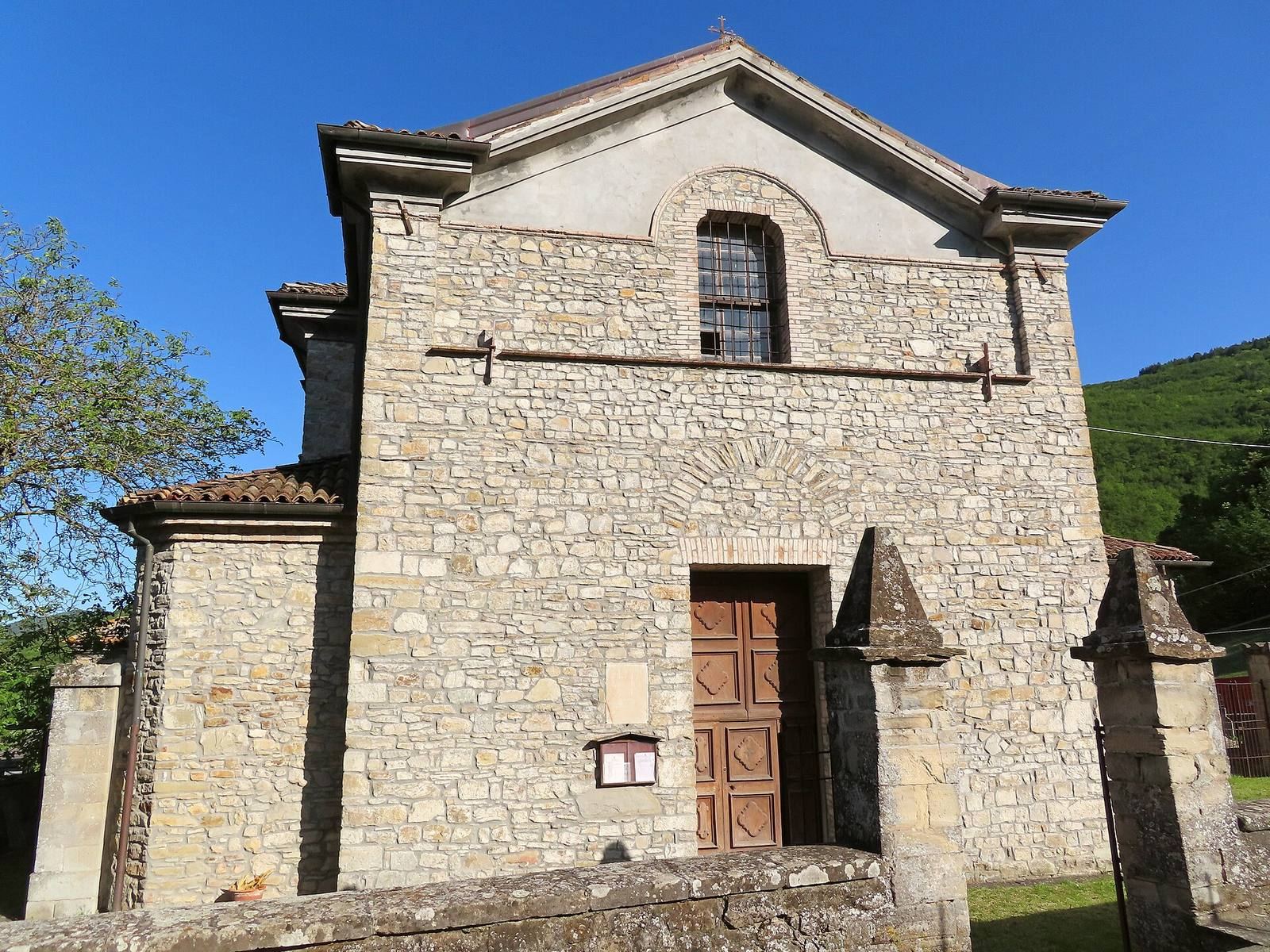
By the eighteenth century, the parish church had deteriorated and was demolished. A new building rose between 1767 and 1789, while the fourteenth-century bell tower was retained. The facade and right side were presumably altered during the final years of the nineteenth century, when their lower sections received a stone facing.
Modern Restoration and Ecclesiastical Heritage
Restoration after 1950 included work on the medieval bell tower, and the interior floor was replaced in 1960. An earthquake struck the area on 23 December 2008. Structural consolidation and restoration began in 2010 and were completed in 2011.
Santo Stefano also inherited a Romanesque processional cross associated with Charles IV. A processional cross is mounted on a staff and carried during Christian liturgical processions. Charles IV had donated the cross to the imperial chapel, and it was transferred to Santo Stefano in the seventeenth century before later entering the Diocesan Museum of Parma.
Remains
Exterior and Medieval Structures
Church Facade
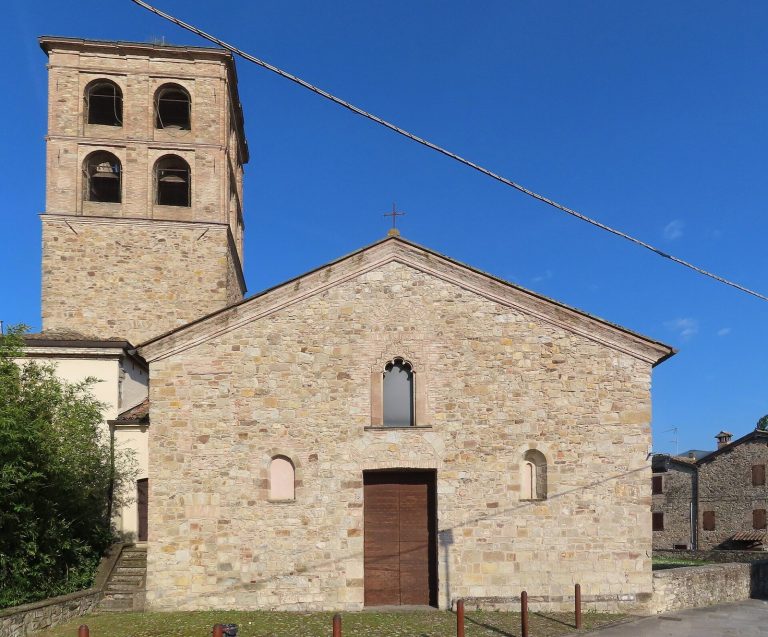
The church has a single-nave plan with a western entrance and an eastern presbytery, or area surrounding the main altar. Its symmetrical gabled facade is almost entirely faced with stone, as is the rest of the building. A thin brick cornice divides the facade into two horizontal sections. The lower section contains a simple central portal. Above it, a shallow recess is framed by two pilasters and contains a broad central window. The window’s round-arched crown interrupts a slight horizontal brick band, while a projecting moulded cornice follows the upper gabled outline.
Bell Tower
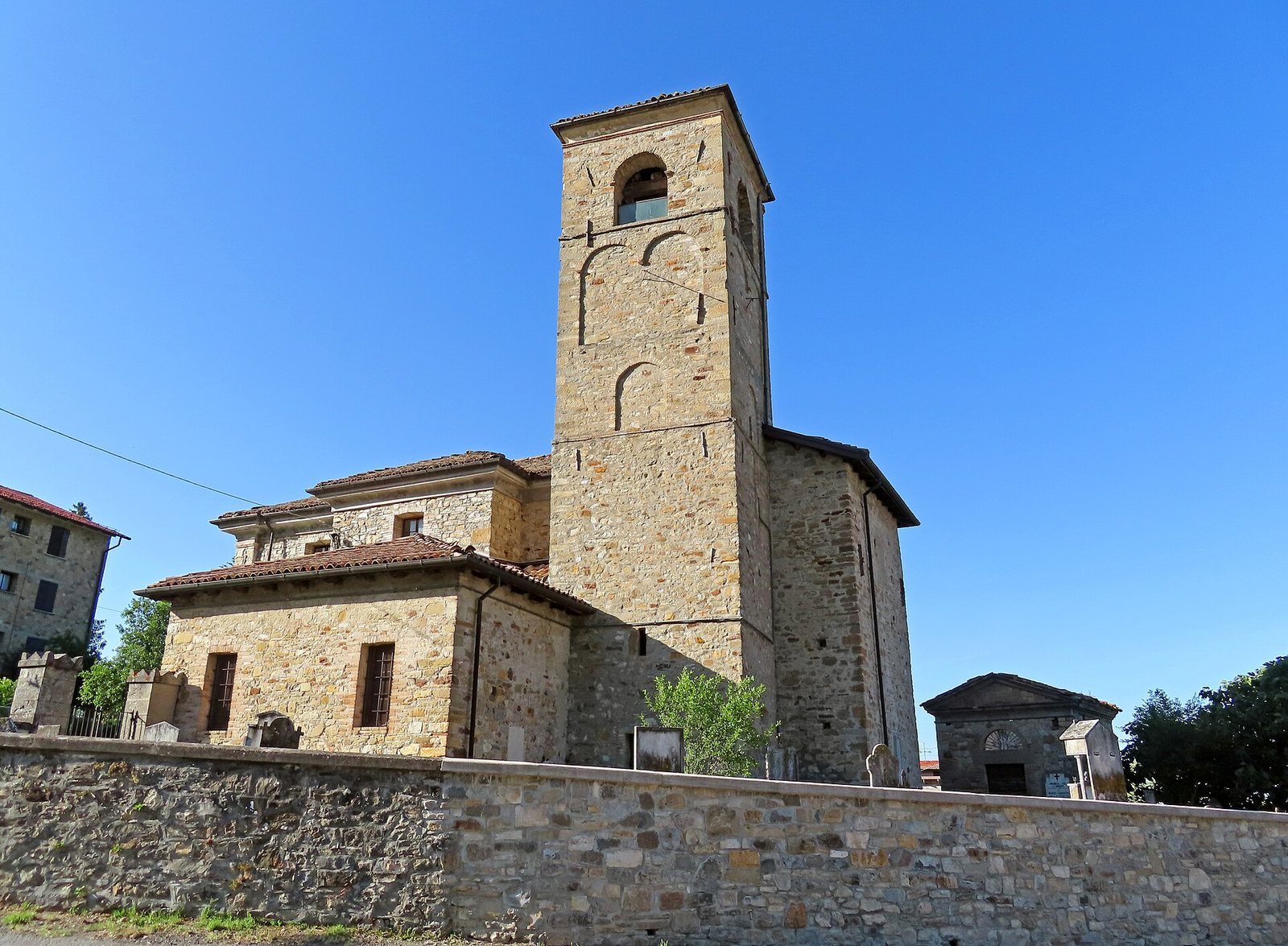
At the rear of the right side, beside the rectangular-ended apsidal area, stands the tall fourteenth-century stone bell tower. Built in the Romanesque style, its upper part has two levels of blocked single-light and twin-light openings. One of these openings contains the iron gnomon of a former sundial. Above them, the bell chamber opens through broad round-arched apertures on all four sides. The tower is the surviving medieval element retained when the eighteenth-century church was rebuilt.
Forecourt and Cemetery
A small forecourt lies before the facade and contains a stone and wrought-iron monument dedicated to the Passion of Christ. Behind the church is an old cemetery with a small Neoclassical chapel. The side chapels project from the lateral walls, forming part of the building’s external arrangement.
Interior and Furnishings
Nave and Side Chapels
The plastered nave is covered by a barrel vault with lunettes, curved openings or recesses that interrupt the vault. Doric pilasters divide the lateral walls and support a projecting continuous cornice. Broad round arches open into the side chapels, each of which contains a side altar decorated with an eighteenth-century painted brocade altar frontal.
The left chapel preserves a bell dated 1365. It came from a now-disappeared hospice founded at Terenzo by Gerardo, or Gherardo, Zily. The institution provided hospitality and assistance to pilgrims and people with physical impairments.
Presbytery and Main Altarpiece
The slightly raised presbytery is set back toward the nave behind the round triumphal arch. Its marble table-shaped altar was added between 1970 and 1980. At the rear stands a seventeenth-century Baroque altarpiece, an artwork or decorated structure placed behind or above an altar. Two Corinthian columns support its broken pediment, and the structure contains a painting of the Martyrdom of Saint Stephen made toward the end of the seventeenth century.
Beside the presbytery is a painting of the Sacred Heart of Jesus with putti and the Eucharist, made by Giuseppe Peroni between 1767 and 1776. Putti are winged or childlike figures used as decorative motifs in European religious art. Other furnishings include an eighteenth-century oval painting of the Madonna and Child with Saint Bernardino of Siena, a fifteenth-century Franciscan preacher and theologian, and an embroidered set of seventeenth-century liturgical vestments.
Processional Cross
The processional cross now held by the Diocesan Museum of Parma dates from the first half of the twelfth century. It is made from copper and gilded bronze and consists of a flat cross and a separate Crucifix joined with hammered nails. Both faces of the cross carry burin engravings, incised designs made with a sharp engraving tool, arranged as a jagged border.
On the front, Adam appears at the base, while the Virgin Mary and Saint John the Evangelist occupy the arms of the cross. The reverse has a large central medallion containing the victorious Lamb, with the symbols of the four Evangelists at the ends. The engraved Crucifix has a monstrous, probably serpent-like face at its base, beneath the feet of Jesus. Its original gilded spike survives and was used to attach the cross to its processional staff.