Matka Monastery: A Fourteenth-Century Orthodox Monastery in North Macedonia
Site at a Glance
- Rating
- 4.8
- Popularity
- Very Low
- Country
- North Macedonia
- Primary era
- Medieval
- External website
- Open
- Eras represented
- Medieval
- Civilizations
- Ottoman, Serbian
- Site type
- Religious
- Remains
- Monastery
On this page8 sections
History
Matka Monastery is an active Orthodox monastery in North Macedonia, located near Skopje in the Matka canyon. Established in the mid-fourteenth century, probably around 1370, it was built within the Byzantine architectural tradition of the period and remains a functioning religious site in the Skopje Diocese of the Macedonian Orthodox Church–Ohrid Archbishopric. The monastery has a women’s monastic sisterhood and is dedicated to the Dormition of the Most Holy Mother of God, the Eastern Orthodox feast commemorating Mary’s death and assumption into heaven.
Foundation in the Fourteenth Century
The monastery was founded on an older cult site, although its exact construction date and first patron are uncertain. It has been attributed to the nobleman Boyko during the reign of Serbian Emperor Stefan Dušan. Boyko is also identified as the son of Danica, a patron of the Monastery of Saint Nicholas at Ljuboten. The church’s design belongs to the aristocratic sacred architecture of fourteenth-century Byzantium.
Matka became a central institution for churches, monasteries, and monastic hermitages in this part of the Treska River gorge. Records connected with its monastic life indicate a particularly strong devotion to the Mother of God. The monastery also received prominent visitors, including Arsenije IV, a patriarch of the Peć Patriarchate, the Serbian Orthodox ecclesiastical institution that held authority over Serbian Orthodox communities in parts of the Balkans.
Damage and Restoration in 1497
The original church suffered damage to its roof and painted decoration, probably during the establishment of Ottoman rule in Macedonia. By 1497, it stood without a roof. Milica of Skopje financed the replacement of the roof, the repainting of the church, and the construction of a narthex, the entrance or vestibule area of an Orthodox church. The commemorative inscription also names Tosinko, his son Nikola, and Athanasius, Metropolitan of Skopje.
Milica and her son Nikola were represented inside the church as ktitors, founders or patrons who financed restoration or decoration. Their carefully painted portraits provide an uncommon image of Christian elites in the fifteenth century. A memorial book preserved at the monastery lists many donors from the wider Skopje region, including inhabitants of villages now populated by Muslim Albanian communities. The book is an important source for the history of the Skopje area.
Later Monastic History
The monastery’s later history includes several violent deaths. In 1897, an abbot was killed in the courtyard, and his student was also killed. In mid-October 1929, the Russian monk Gelasius, a member of the community and a hermit of the cell of Saint Andrew, was found murdered near his hermitage after receiving eleven knife wounds. He had lived an ascetic, solitary life and was locally respected as a holy man. Nearby Muslims were suspected because they had previously seen that he possessed money.
In mid-October 1930, the elderly Kocha Jovanovic died at the monastery and was buried there. He was a prominent Serbian national activist, one of the founders of Serbian chetnik activity in Old Serbia and Macedonia, and from 1895 operated the first Serbian bookshop in Skopje, where Serbian revolutionaries secretly gathered. In 1934, the monastery’s superior was the hieromonk Trifun, a hieromonk being a monk who has also been ordained as a priest.
The patronal feast is celebrated on 28 August and is locally known as the Great Feast of the Mother of God. It includes a large communal celebration and a monastery meal. The name Matka may derive from the monastery’s dedication to the Mother of God, through the Church Slavonic word for “mother.” The monastery is recognized as a cultural monument.
Remains
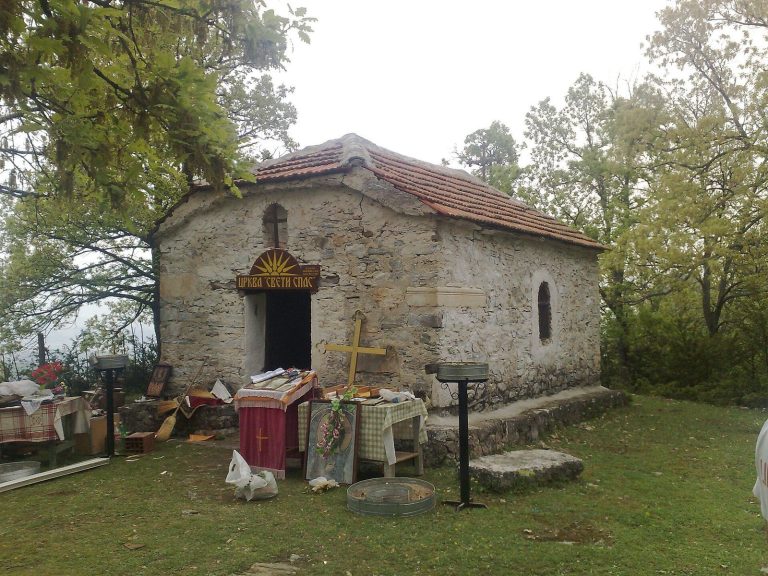
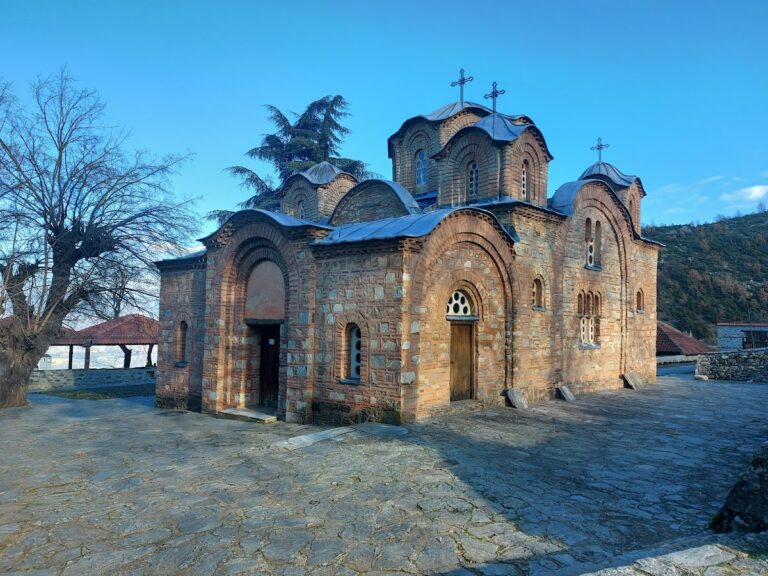
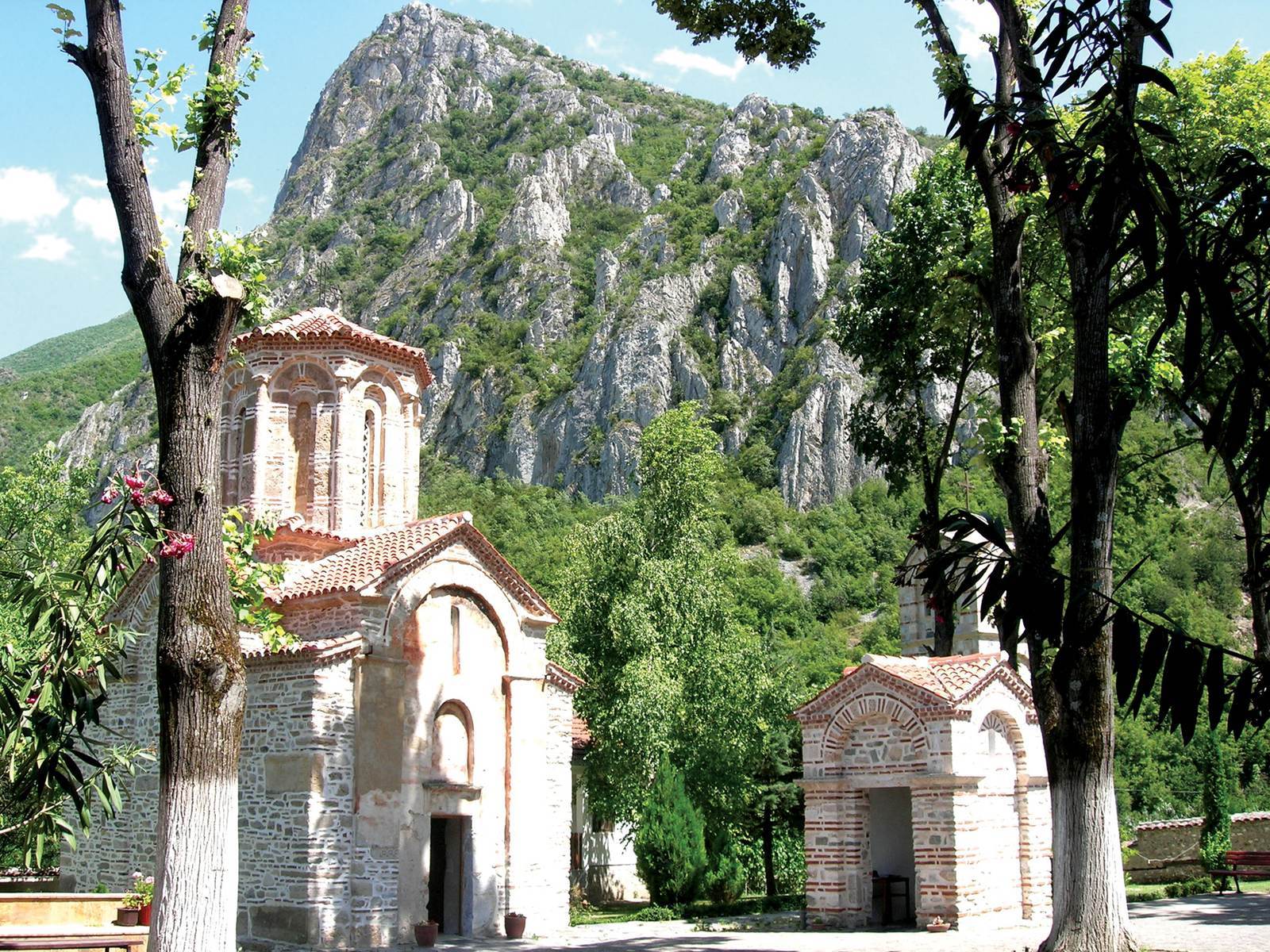
The monastery stands on the left bank of the Treska River in the Matka canyon, near the dam and Lake Matka, about 17 kilometres from central Skopje and approximately 400 metres from the lake. Its principal surviving building is a small stone-and-brick church, whose compact plan, single dome, high-set windows, and painted interior preserve the remains of its medieval foundation and late fifteenth-century renewal.
Church Structure
The church is approximately 9.5 metres long and has a contracted cross inscribed within a square. A single dome rises above the building on an octagonal drum, the polygonal structure supporting a dome. The drum rests on substantial masonry pilasters, engaged vertical supports built against the walls, and consoles. The exterior is plastered, while the building itself is made of stone and brick.
On the exterior, the sanctuary ends in a three-sided central apse, a projecting polygonal end of the church. The small windows are positioned high in the walls. Geometric patterns made from laid brick and stone were visible on the building when the church was freshly whitewashed in 1925. These features belong to the church’s physical fabric and help distinguish its masonry treatment from the later painted decoration inside.
Frescoes and Interior Features
The narthex, roof, and fresco decoration belong to the late fifteenth-century restoration rather than the original construction. The frescoes are poorly preserved and were probably painted by a single artist whose work has been associated with Ohrid. Their scenes have uncertain compositions, uneven coloring, imprecise drawing, and figures that vary in size and proportion. Many faces have thick, rounded heads and small eyes. Their modeling uses vivid green and ruddy areas, a treatment linked with older Ohrid artistic practices.
A fresco of Saint Clement of Ohrid in the second zone of the north wall has been interpreted as evidence of an artist from Ohrid. Saint Clement was a medieval Slavic Christian missionary, bishop, and educator associated with the Ohrid literary and ecclesiastical tradition. The image of the Mother of God Eleusa with Christ and the Archangel Gabriel is comparatively well executed. Eleusa is an iconographic type in which the Virgin embraces or tenderly inclines toward the Christ Child.
The carefully painted ktitor portraits of Milica and Nikola remain among the church’s notable images. The best-preserved early Slavic fresco is an image of the Mother of God of the Three Hands. Above the entrance door, on the interior side, stands the inscription commemorating the 1497 restoration and recording the roof replacement, fresco painting, and construction of the narthex.
A tombstone belonging to a Christian woman named Maria was found inside the church in front of the altar. It forms part of the material evidence preserved within the building and adds a funerary element to the surviving interior remains.
Monastery Landscape
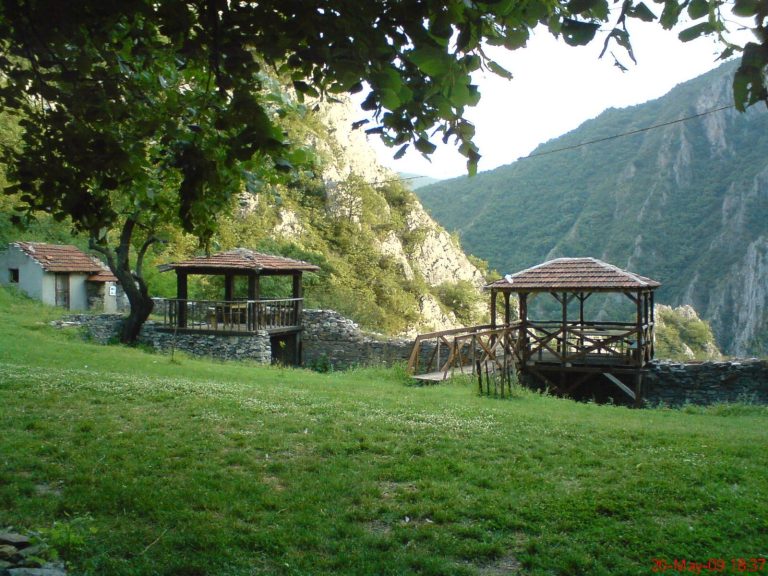
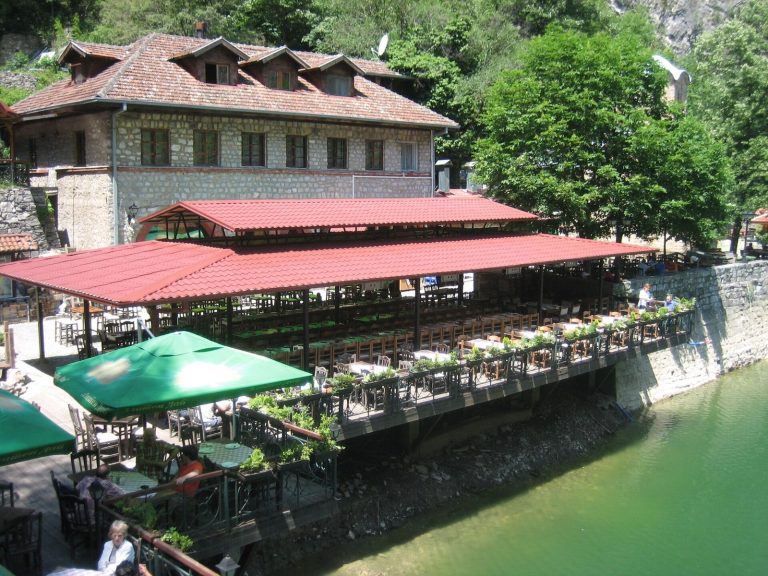
The canyon around the monastery formerly contained rows of planted boxwood and fig trees. Together with the church’s position beside the Treska River and near Lake Matka, this landscape forms the physical setting of the surviving monastic complex.