San Martino Vescovo: The Archpresbyteral Parish Church of Nembro, Italy


Site at a Glance
- Rating
- 4.5
- Popularity
- Very Low
- Country
- Italy
- Primary era
- Early Modern
- External website
- Open
- Eras represented
- Medieval, Early Modern, Modern
- Civilizations
- Duchy of Milan, Habsburg, Venetian
- Site type
- Religious
- Remains
- Church
On this page21 sections
History
San Martino Vescovo is the principal Roman Catholic church of Nembro, Italy, and an archpresbyteral parish church dedicated to Saint Martin of Tours. It occupies the site of one of the oldest and largest pleban churches in the Diocese of Bergamo. A pleban church was the principal parish church of a district, supervising dependent parishes and often holding special liturgical and administrative privileges. The present building was begun in 1752 and completed in 1777, replacing an earlier church that had served as the leading religious center of the lower Seriana Valley.
Early Christian and Medieval Origins
The pleban church of Nembro is traditionally dated to around the fifth or sixth century. Its earliest center was associated with a church dedicated to Saint Donatus, an early Christian bishop and martyr linked with Arezzo. That building stood near the fifteenth-century church of Saint Nicholas of Tolentino and was demolished in 1907.
A church dedicated to Saint Martin of Tours, a fourth-century bishop of Tours widely venerated in western Europe, existed at Nembro by the eighth century. A document dated 1 August 830 names an Ecclesia Sancti Martini sita Nembro, while a document from 909 refers to the pleban church of Saint Martin at Nembro. Its position gave it an important role among the churches of the lower Seriana Valley.
The church took part in the Bergamo synod of 17 March 1304. It was also included in the ecclesiastical register commissioned in 1360 by Bernabò Visconti, the ruler of Milan, to assess clerical taxes and tithes. These references reflect the church’s administrative importance within the local ecclesiastical structure.
Rebuilding and Ecclesiastical Role
The medieval church was modified and rebuilt several times. Work on a fifteenth-century rebuilding began on 19 May 1424, and a surviving keystone bearing that date is associated with the campaign. In 1468, a papal bull issued by Pope Paul II granted the church benefices together with those of San Bernardino at Lallio.
Cristoforo Magnanini served as archpriest of Nembro from 1510 to 1520. He had been bishop of Polignano in Apulia, but remained at Nembro after resigning that see in 1517. During the period when the Bishops of Bergamo were in exile, priestly ordinations, confirmations, and other episcopal functions took place at the Nembro pleban church.
Bishop Pietro Lippomano’s pastoral visit of 30 May 1520 described the church as a parish. Further episcopal visits followed in 1546, 1564, and 1575. The last of these was conducted by Cardinal Carlo Borromeo, the archbishop of Milan and a leading Catholic reformer whose visitations regulated churches after the Council of Trent. His inspection provided a detailed account of the church and ordered work on some of its furnishings and decoration.
The Eighteenth-Century Church
Population growth led to the construction of the present large church. The design is probably attributable to Luca Lucchini, an architect from Lugano. Its first stone was laid on either 23 or 25 April 1752. The former parish church was demolished in 1760, and the new building occupied the area of the rectory, part of a wood, and the old church. Because of this expansion, the exact position of the earliest church can no longer be identified.
Construction lasted twenty-five years, not counting the later work on the facade and bell tower, and involved much of the local community. Stone came from a quarry about 800 metres away. It was first taken to the temporary parish church at Santa Maria in Borgo and then moved to the building site along an inclined plane. A nearby kiln produced bricks from clay extracted in the Viana area.
The new church was completed, opened for worship, and blessed on 16 November 1777 by Antonio Ambiveri, bishop of Aureliopolis. Bishop Giovanni Paolo Dolfin of Bergamo consecrated it on 16 May 1790 and dedicated it to Saint Martin of Tours. Its minor patrons are Blessed Alberto of Villa d’Ogna, Saint Roch, and Saint Bernard of Clairvaux. Devotion to Saint Roch and Saint Bernard has largely disappeared, although the feast of Saint Roch continues at the church dedicated to him.
Nineteenth- and Twentieth-Century Religious Life
The bell tower was built in 1806 to a design by Francesco Antonio Caniana. The original plan called for two symmetrical towers on the facade, but only the tower on the left was constructed. Giuseppe Ronchetti, archpriest from 1805 until his death in 1838, wrote histories of the archpriests of Nembro and of Bergamo and its church. He declined appointment as bishop of Ceneda.
On 11 October 1806, the body of Saint Boniface was ceremonially transferred from Nembro’s church of Saint Nicholas to San Martino Vescovo. The relic had been removed from the Roman catacombs and kept in the house of Giovanni Tommaso Coffetti of Alzano Lombardo from 1792. It has since been preserved and displayed in the church.
Devotion to Saint Boniface included appeals for protection against epidemics and natural disasters and for help for the dying through the exposure of the relic. That rite is no longer celebrated. A major centenary observance took place in August 1906, with a novena beginning on 3 August and solemn celebrations from 11 to 13 August. Cardinal Felice Cavagnis and Giacomo Radini-Tedeschi, bishop of Bergamo, attended the ceremonies.
The church’s former archpresbyteral privileges were discussed in a detailed petition prepared by Andrea Gavazzeni around the centenary of its blessing. The petition was not submitted after Bishop Gaetano Camillo Guindani judged it inappropriate, although he accepted that the title was legitimate and well founded. The requested privileges included first place in ancient lists of pleban churches, precedence during pastoral visits, and an archdeacon who later became known as the chief sacristan and then the vice-archpriest.
The archpriest was also entitled to sit on the left side of the presbytery, the area around the main altar reserved for the clergy. Until 1630, he could wear a mitre during solemn services throughout the pleban district and wear a ring daily. He could also be accompanied by two acolytes during solemn functions. Until 1904, a deacon, subdeacon, and ceremonial master wearing a rochet and violet vestment assisted him at solemn Mass. Giosuè Signori, then vicar general, ended this practice amid local complaints.
From 31 July to 11 August 1920, Nembro celebrated the coronation of the image of the Blessed Virgin Mary of Zuccarello. The image was carried from its sanctuary through Saint Nicholas to the pleban church, drawing pilgrims from the valley, Bergamo, the surrounding province, and farther afield. Cardinal Giorgio Gusmini, archbishop of Bologna, performed the coronation in the presence of Luigi Maria Marelli, bishop of Bergamo, and other bishops and clergy.
The church’s bells were affected by wartime requisitioning. Four bells from the 1938 bronze peal, with a combined weight of 3,710 kilograms, were removed for military purposes. The present eight bells were cast in 1952 by the Angelo Ottolina foundry of Bergamo and restored in 2019.
Remains
Exterior and Bell Tower
San Martino Vescovo stands before a large churchyard paved with porphyry and follows a traditional eastward orientation. Its scale has given it the local dialect name Ol Cesù, meaning “the big church.” The facade has a single main entrance with jambs supporting a Zandobbio marble architrave. Above it, a porch with two columns on tall bases and Ionic capitals, the scroll-shaped capitals of the classical Ionic order, supports a triangular pediment. Two angels hold the coat of arms of the Diocese of Bergamo.
Two cornices divide the facade into three horizontal orders. Five vertical sections are separated by pilasters and counter-pilasters set on high bases of ceppo stone, with the central sections projecting beyond the lateral ones. Niches contain statues made by Nicola Pirovano in 1820. The lower level presents the bishop saints Fulgentius, Augustine, Simplicianus, and Thomas of Villanova. The second order has a large central window with a curved pediment, together with niches containing Saints Nicholas of Tolentino and Julian. Statues of Saints Monica and Clare stand on the lateral parts of the cornice. The upper pediment bears the inscription “D.O.M. ET DIVO MARTINO EPISCOPO” and is topped by an iron cross.
The bell tower rises 45 metres to the roof. Its eight bells occupy the belfry. The largest measures 169 centimetres in diameter and weighs 2,647 kilograms, while the complete peal weighs 8,641 kilograms. The earlier 1938 peal was tuned to C natural. The replacement bells were selected in B-flat after the wartime losses.
Central Space and Major Paintings
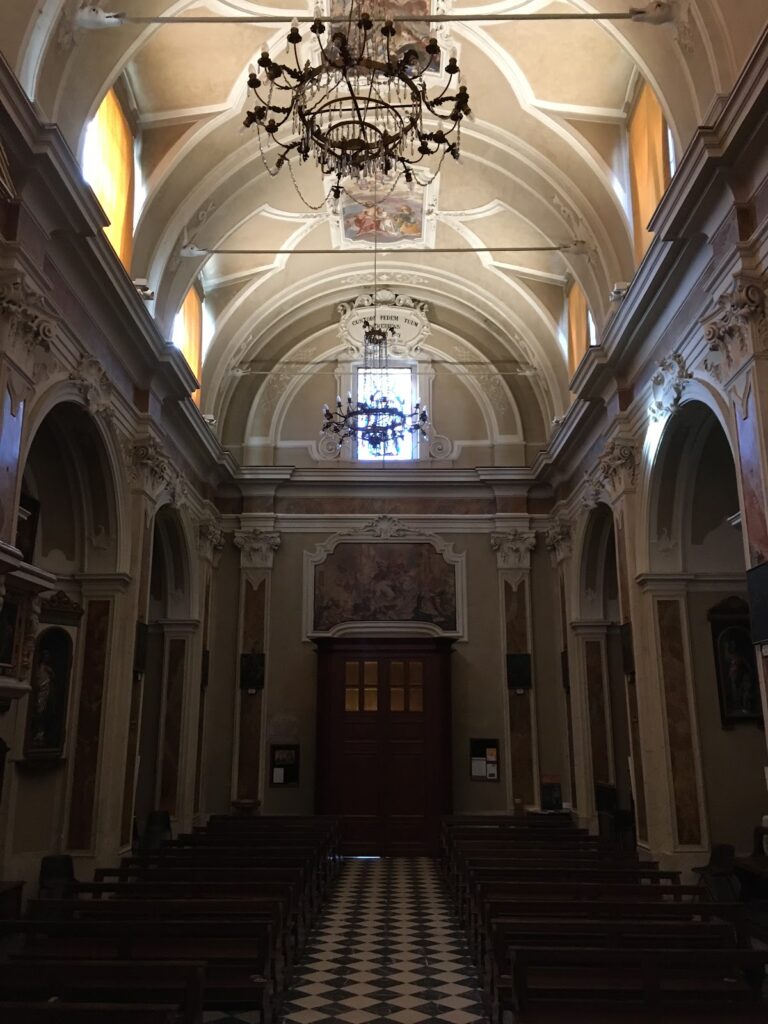
The interior has a single nave arranged as a Greek cross, a plan with four arms of equal length. A large dome over the crossing rises to an internal height of 34.60 metres. The smaller dome over the presbytery reaches 32 metres. A seven-step staircase leads to the raised presbytery, beneath which lies a scurolo, a chapel or crypt-like space often used for relics or devotional purposes.
A large canvas of Saint Martin hangs above the wooden entrance vestibule and was probably donated by Giuseppe Zambelli in 1812. Nicola Savoldi made the organ curtains and painted the Apotheosis of Saint Boniface the Martyr in 1906.
Left Chapels and Altars
Baptismal Chapel
The first chapel on the left contains a seventeenth-century baptismal font enclosed by a marble balustrade and a two-leaf iron gate. The side walls carry the names of former parishes belonging to the Nembro pleban district, including Selvino, Albino, Alzano Maggiore, Villa di Serio, Gazzaniga, Vertova, Scanzo, Casnigo, and Pradalunga.
Holy Family Altar
An altar made in 1830 by Antonio Oldelli of Bergamo contains a central canvas of the Holy Family, painted by Ponziano Loverini in 1898. The painting replaced a planned representation of the death of Saint Joseph after Loverini’s Holy Family had been exhibited in Turin and received an honorary diploma.
Rosary Chapel
The large chapel in the left transept occupies a recess in the wall and has a white-and-red marble altar. Two columns support its triangular pediment, which bears statues of Gentleness and Truth and the inscription “IN ME SPES VITAE.” Enea Salmeggia painted the central canvas, the Madonna of the Rosary, and the fifteen Rosary mysteries in 1611. His other paintings in the chapel include the Adoration of the Magi, Descent from the Cross, Flight into Egypt, Visitation, Eternal Father, Nativity of the Virgin, Death of the Virgin, Holy Family, and Marriage of the Virgin.
Crucifix Altar
The marble Crucifix altar, completed with onyx panels, was made by Pietro Giacomo Manni in 1790. Its central altarpiece was painted by Enea Salmeggia in 1615 for the former pleban church. It depicts the crucified Christ with Saints Bernardino of Siena and Francis of Assisi and a donor.
The former altar of Saints Bernardino and Francis had been ordered to be restored during Carlo Borromeo’s 1575 visitation. At that time it contained frescoes and statues of the two saints, while its vault also required restoration and a new window was to be installed. The chapel was under the patronage of the Confraternity of the Blessed Sacrament. Its approximately 350 members funded a chaplain, five weekly Masses, altar furnishings, and burials for people in need.
Presbytery and Choir
High Altar
The square presbytery is raised by seven marble steps. Its monumental high altar was made between 1824 and 1827 by Antonio Oldelli, assisted by his father Gerolamo, to a design by the Milanese architect Francesco Peverelli. The altar uses white Carrara marble, green marble from Varallo, and Piedmontese alabaster, and was consecrated in 1831.
The high altar includes a large tribune for exposition of the Blessed Sacrament, a white Carrara marble tabernacle, and two angel-shaped caryatids. A caryatid is a sculpted human figure used as an architectural support. Claudio Monti made the statues of Saints Peter and Paul beside the tribune. A canopy suspended above the altar was made by Francesco Antonio Caniana in 1772.
Apsidal Choir
The presbytery ends in a semicircular apsidal choir. Beneath the choir galleries are Antonio Cifrondi’s Moses Making Water Spring from the Rock and Belshazzar’s Feast, produced between 1701 and 1712 for the Lateran canons and transferred from the church of Santo Spirito. The choir also contains Giovanni Raggi’s Virgin and Child with Saints Martin the Pope, Roch, Bernardino, and Alberto of Villa d’Ogna, together with Mazzoleni’s Death of Saint Martin and a Baptism of Saint Martin.
Right-Side Altars and Relics
Suffrage Altar
The altar of Suffrage for the Dead, also called the Suffrage altar, was made by Pier Giacomo Manni in 1790. Its central canvas depicts the Madonna of Mount Carmel. The altar was under the patronage of the confraternity dedicated to the dead.
All Saints Altar
An altar originally dedicated to All Saints was made by Giuseppe Fossati of Bergamo and consecrated on 1 September 1872 by Bishop Pietro Luigi Speranza. It contains an urn with the relic of Saint Boniface and a large panel of All Saints. The panel, once attributed to Antonio and Mattia Zamasin and dated 1490, is now attributed to Antonio Marinoni of the Marinoni family of Albino.
An urn beneath the altar contains the bones of Blessed Daniele Tiraboschi, a Franciscan from Nembro who followed Saint Bernardino of Siena. His remains had previously been kept in a wooden box after being removed from the church of the Grazie.
Altar of the Titular Saint
Another altar probably dates from 1795. Its central painting shows its titular saint with Saint Mary Magdalene de’ Pazzi, in a work made by Vincenzo Angelo Orelli in 1793.
Chapel of the Sorrowful Virgin
The small final chapel on the right is dedicated to the Sorrowful Virgin. It contains a statue listed in eighteenth-century inventories and apparently purchased in 1782. Paintings of the Descent from the Cross and Christ Scourged at the Column complete the chapel’s decoration.