Vysoký Hrádek: A Renaissance Castle in Czechia


Site at a Glance
- Rating
- 4.8
- Popularity
- Low
- Country
- Czechia
- Primary era
- Early Modern
- External website
- Open
- Eras represented
- Medieval, Early Modern, Modern
- Civilizations
- Holy Roman Empire
- Site type
- Domestic
- Remains
- Castle
On this page11 sections
History
Vysoký Hrádek is a Renaissance castle in Czechia, in the Temelín municipality of South Bohemia. Its early-seventeenth-century rebuilding transformed a medieval fortress into a Renaissance residence, and the castle now houses the Temelín Nuclear Power Station Information Centre. It stands at the northeastern edge of the power station complex, in the southern foothills of the Písecké Mountains and within the cadastral area of Březí u Týna nad Vltavou.
Medieval fortress and noble ownership
The Lords of Březí held the Hrádek, Knín, and Býšov estates during the fourteenth century and expanded the Hrádek court into a fortress. The first written reference dates from 1367, after the death of Albert of Březí. His inheritance was divided among his sons Svatomír, Smil, and Bušek, with Svatomír receiving the Hrádek fortress.
After the Lords of Březí died out following the Hussite Wars, fifteenth-century religious and political conflicts that reshaped power in the Kingdom of Bohemia, the estate passed to their relatives, the Lords of Býšov. Oldřich of Býšov owned it in 1440, while Jindřich of Býšov is recorded as its owner between 1507 and 1517. Members of the Býšov family sometimes used the territorial designation “of Březí.”
From fortress to Renaissance castle
Johann and Nikolaus Rendl of Uschau acquired the Hrádek estate in 1520 and sold it to Jan Nebřehovský of Nebřehovice in 1526. Zikmund Malovec of Malovice purchased it from Ondřej Nebřehovský of Nebřehovice of Pyšely in 1556.
Under Václav Malovec Liběšický of Chvalešovice, the fortress was converted into a Renaissance castle at the beginning of the seventeenth century. The Renaissance was a European architectural and cultural period associated with classical forms, symmetry, and ornamental design. Václav Malovec, who inherited Vysoký Hrádek in 1790, later commissioned alterations in 1805.
The landed estate in the nineteenth century
Franz Malowetz of Cheynow and Winterberg sold the estate to Josef Hirsch and his wife Barbara, née Baroness Lipowsky, on 15 January 1825. Until the middle of the nineteenth century, Hohen-Hradek remained a landed estate recorded in the land registers. Such an estate was a legally recognized private territory that included land, settlements, agricultural operations, and administrative rights.
In 1840, the estate, also known as Hohen-Hradek, Hoch-Hradek, or Hradek-Březy, covered 1,570 yokes and 352 square fathoms of usable land. It had 759 predominantly Czech-speaking inhabitants, including three Jewish families. Its holdings included the Březy manor farm, the emphyteutically held Podhay court, the Great Forest and Zapowědey Forest forestry district, the villages of Březy, Křtěnow, and Podhay, and one house in Temelinetz. Emphyteusis was a long-term hereditary lease involving continuing obligations to the estate owner. The castle contained a household chapel dedicated to Saint Anne and the office of the estate administration. The villages belonged ecclesiastically to the branch church of Saint Procopius at Křtěnow.
Late ownership and nationalization
Josef Hirsch the Younger sold the estate to Václav and Anežka Wenzel in 1882 for 148,000 gulden. They sold the 328-hectare estate, which included a farm and distillery, to Josef Sailer in 1894. The Kovář family became owners in 1914. Ownership changed frequently from 1926 until Václav and Jindřiška Diviš acquired the estate in 1933.
Jindřiška Divišová was expropriated and the estate was nationalized during the 1948 land reform, the communist-era redistribution and nationalization of landed property in Czechoslovakia. Under communist rule, an agricultural cooperative, a collectivized farming institution, severely damaged the castle and park. The castle was eventually removed from the list of historic monuments.
Reuse and restoration
Following the dissolution of Temelínec, Březí, and Křtěnov for construction of the Temelín Nuclear Power Station, the agricultural cooperative left the area. From 1986, Vysoký Hrádek was used as a works kitchen, office, and kindergarten. Between 1987 and 1989, heritage-protection specialists reroofed the castle and carried out further repairs, intending to turn it into a depot for the Municipal Museum of Týn nad Vltavou. Frequent vandalism led to the abandonment of that plan.
After the Velvet Revolution, the castle was returned to the Diviš family through restitution, the legal return of confiscated property to former owners or their heirs. ČEZ purchased the ruined castle from the family in 1994 and renovated it. The Temelín Nuclear Power Station Information Centre had been established by ČEZ in 1991 to explain the power station, nuclear power, energy technology, and physics. It moved into Vysoký Hrádek in 1997 and has occupied the castle since then. Its displays include computer graphics and films about reactor operation, reactor physics, and safety, alongside a small exhibition on the history of the castle.
Remains
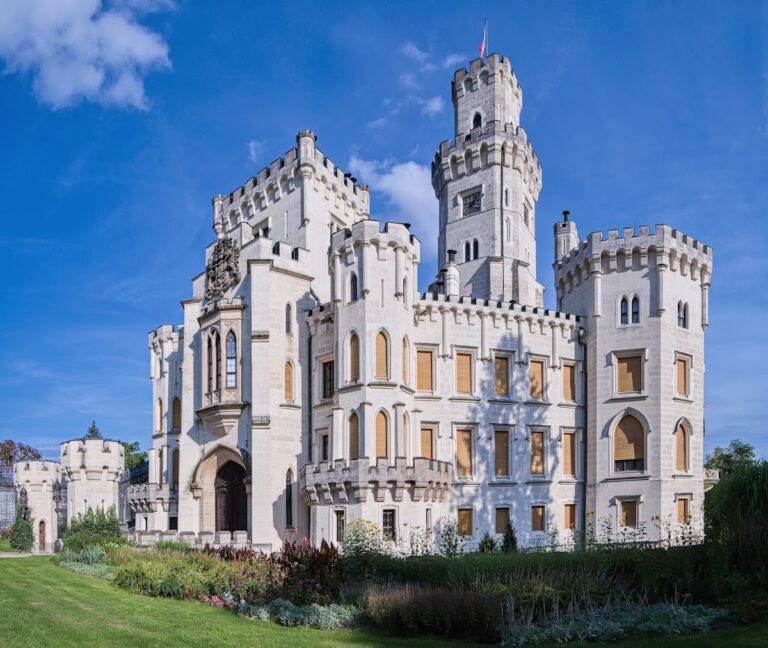
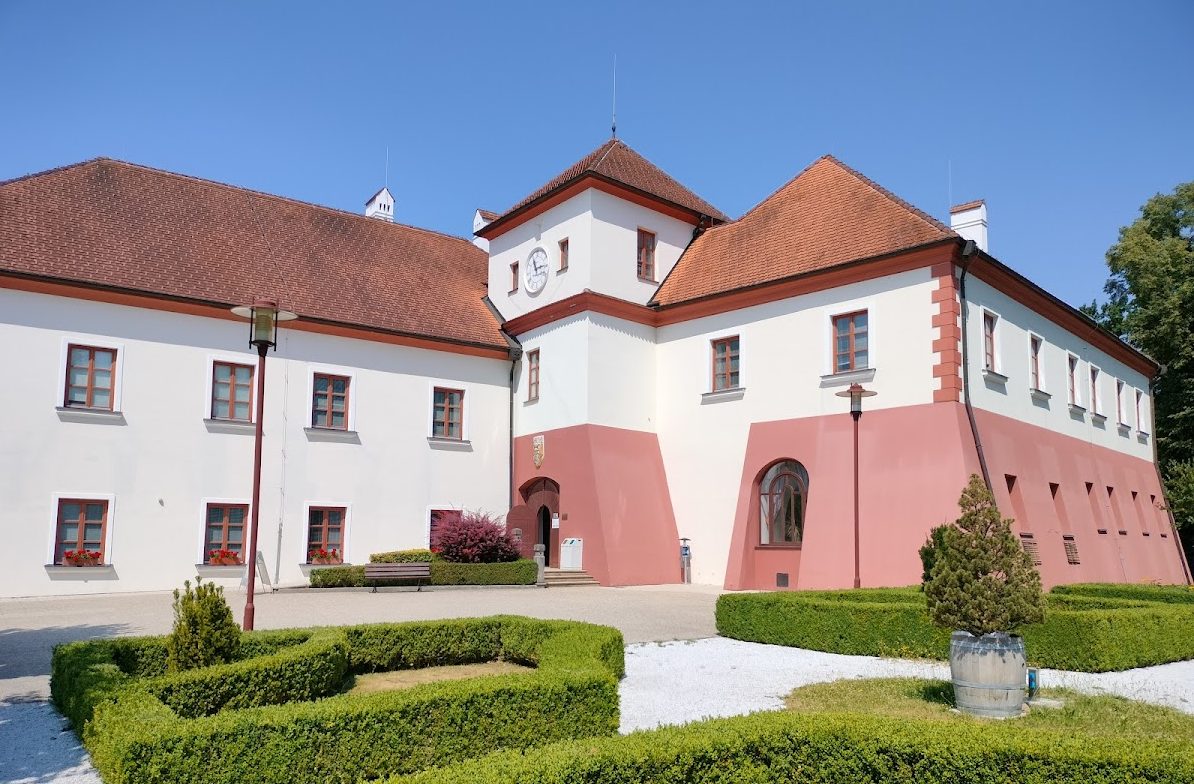
Vysoký Hrádek survives as a single-storey, two-winged castle with buttresses. The wings are joined by a compact two-storey gate tower, which forms the principal architectural focus of the building. A park with two ponds extends north of the castle, linking the residence to its surrounding grounds.
Castle building and grounds
Gate tower and entrance
The compact gate tower rises two storeys above the adjoining single-storey wings. Its gate portal bears the coat of arms of the Malovec of Malovice family, the initials “WM,” identified with Wenceslaus Malowetz, and the date 1805. These details connect the entrance with the alterations commissioned during the castle’s later history.
Interior and educational installations
The first floor contains a cinema and lecture hall used for educational films, as well as a cloud chamber, a scientific instrument that makes the tracks of ionizing particles visible. The building also contains a small exhibition devoted to Vysoký Hrádek’s history. The present interior therefore combines surviving castle fabric with facilities for explaining reactor operation, reactor physics, and safety.
Park and ponds
North of the castle, the park extends around two ponds. The grounds form part of the surviving physical setting of the building and remain associated with the castle’s layout.
Nearby sites