Château-Neuf d’Allinges: A Medieval Fortified Castle in France


Site at a Glance
- Rating
- 4.7
- Popularity
- Low
- Country
- France
- Primary era
- Medieval
- External website
- Open
- Eras represented
- Medieval
- Civilizations
- Duchy of Savoy
- Site type
- Military
- Remains
- Castle
On this page15 sections
History
Château-Neuf d’Allinges is a medieval fortified castle in France, founded under Rudolph II of Burgundy in the tenth century and restored by his successor, Rudolph III. Its keep is recorded by 1073. The castle later became a Savoyard stronghold and the seat of a châtellenie, a territorial and administrative district governed from a castle by a castellan who managed revenues and maintenance.
Early foundation and Savoyard administration
Morand appears as castellan for Thomas I, Count of Savoy, in 1203, and the castle is mentioned the following year. By the thirteenth century, it stood at the center of a comital châtellenie first known as Allinges-Neuf and later as Allinges-Thonon. Around the middle of that century, Pierre II of Savoy united Château-Neuf and Allinges-Vieux through his marriage to Agnes of Faucigny.
After Pierre II died in 1268, the two castles became contested positions in the succession struggle between the House of Savoy and the Dauphins of Viennois, the rulers and heirs of the Dauphiné. Their garrisons fought one another for almost seventy years. The châtellenie’s administrative center moved from Château-Neuf to Thonon in 1288, reflecting Thonon’s stronger economic activity. Thonon and its surrounding area had been included in the district from 1300, while the châtellenie of Ballaison was attached to it from 1285 to 1288. The former châtellenie of Allinges-Vieux was united with it in 1356.
The district belonged to the judicial authority and bailliage of Chablais, the historical region around the southern and eastern shores of Lake Geneva controlled by Savoy, and comprised about twenty parishes. A castellan collected the domain’s revenues and supervised the upkeep of the castle, sometimes with help from an accounts receiver. After the Bernese occupation, castellans mainly retained judicial duties, while military command passed to officials called captains, commanders, or governors.
Sieges and the end of the castle conflict
Château-Neuf was struck by siege engines in 1272. Repairs followed in 1282, when the fortress was also armed against a coalition formed by the Dauphins of Viennois and the Counts of Geneva. Engines placed at Allinges-Vieux damaged it again in 1291, 1292, and 1302.
In 1305, the two castles subjected each other to heavy bombardment. Château-Neuf received a strong garrison during the next two years, and at the start of 1308 its siege engines were brought behind the walls. The fortress then endured a twelve-day siege that ended in a Savoyard victory, followed by extensive repairs. Fighting resumed from 1321 to 1334 and again after 1350. In 1325, Guigues VIII, Dauphin of Viennois, besieged Château-Neuf with Hugues de Faucigny, Amadeus III of Geneva, and Hugues d’Anthon. The fortress held out until Count Edward of Savoy arrived and defeated the besieging army. Severe clashes between the two garrisons continued in 1353.
The conflict ended with the Treaty of Paris in 1355, which incorporated Faucigny into the territories of Savoy. The inhabitants of the fortified boroughs around both Allinges castles subsequently moved to the plain, ending the settlement’s earlier role as a defended urban community.
Bernese occupation and religious restoration
In 1536, Bernese forces captured Château-Neuf together with Allinges-Vieux and held them until 1567. In 1570, the Baron of Hermance took command of the stronghold and demolished the last houses of the borough to reinforce its defenses. On 3 June of that year, Emmanuel-Philibert of Savoy made Allinges a county. It included the parishes of Allinges, Anthy, Armoy, Cervens, Draillant, Le Lyaud, Margencel, Mésinges, Orcier, and Perrignier.
Francis de Sales stayed at Château-Neuf from September 1594 to March 1595 as the guest of the Baron of Hermance. A Catholic bishop and Counter-Reformation preacher, he descended the hill each day to preach in Thonon and the surrounding area, seeking to restore Catholic observance in the Chablais after the Reformation associated with the Bernese occupation.
Later military use and preservation
The castle capitulated during the Franco-Savoyard War of 1600–1601. French forces under Louis XIII occupied it for a year in 1630, and it was occupied again during the invasions of 1690 and 1703. In 1703, during the War of the Spanish Succession, Victor Amadeus II of Savoy ordered the fortresses dismantled when they were threatened by the forces of Louis XIV.
In 1832, Rey, Bishop of Annecy, purchased the ruins of both Allinges castles to establish a house of the Congregation of the Missionaries of Saint Francis de Sales. The congregation made Château-Neuf a center of Salesian pilgrimage and remains its owner. The castle and associated features were classified as French historical monuments in 2011. The protected group includes the enclosure, two southwestern barbicans, the chapel, adjoining lodgings, the barn and its vaulted cellars, the former borough, and parcels containing old and current approaches.
Remains
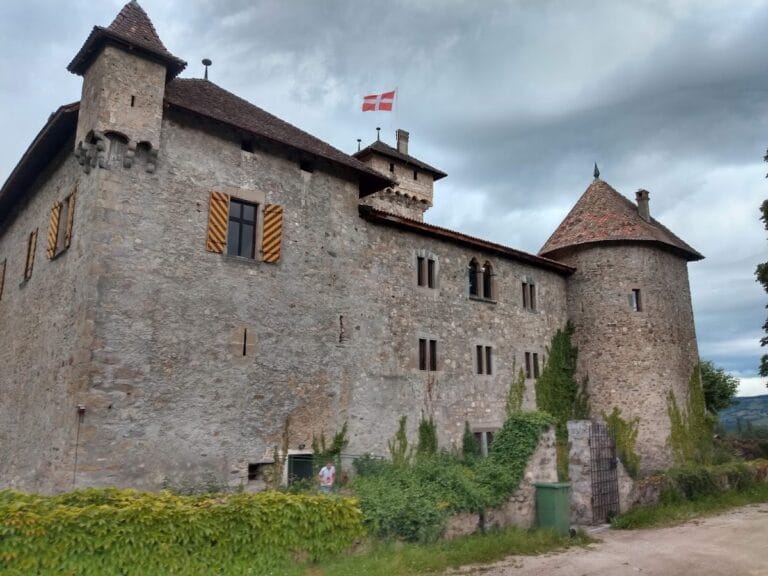
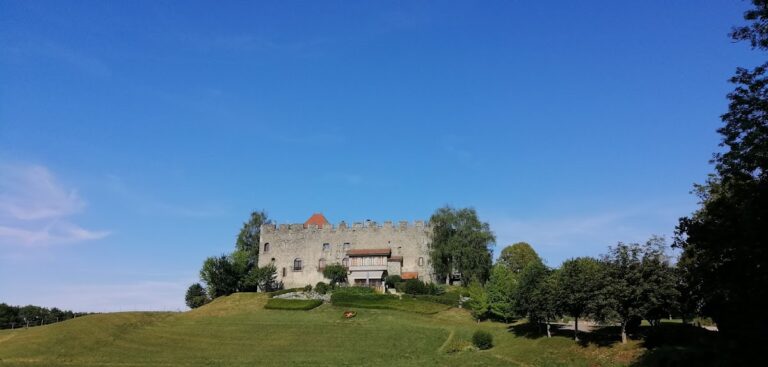
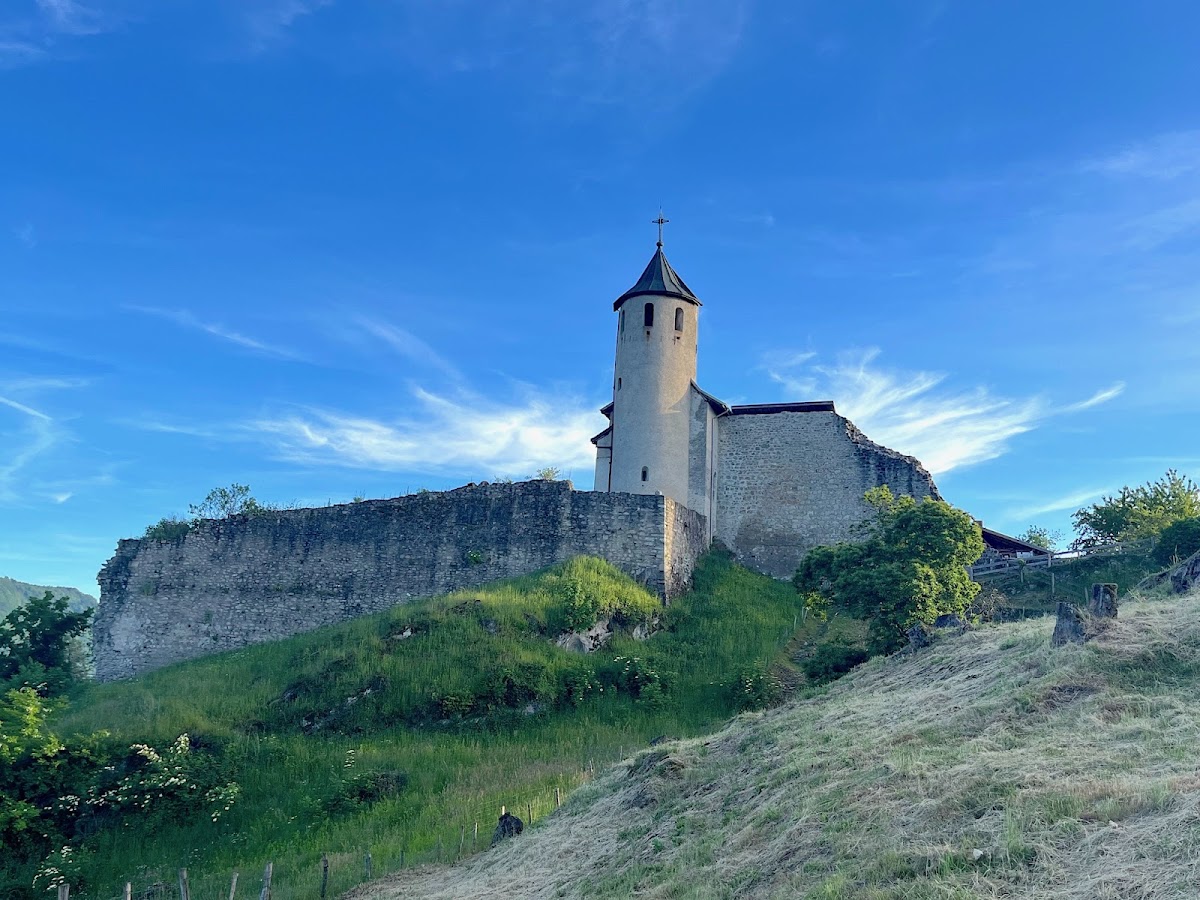
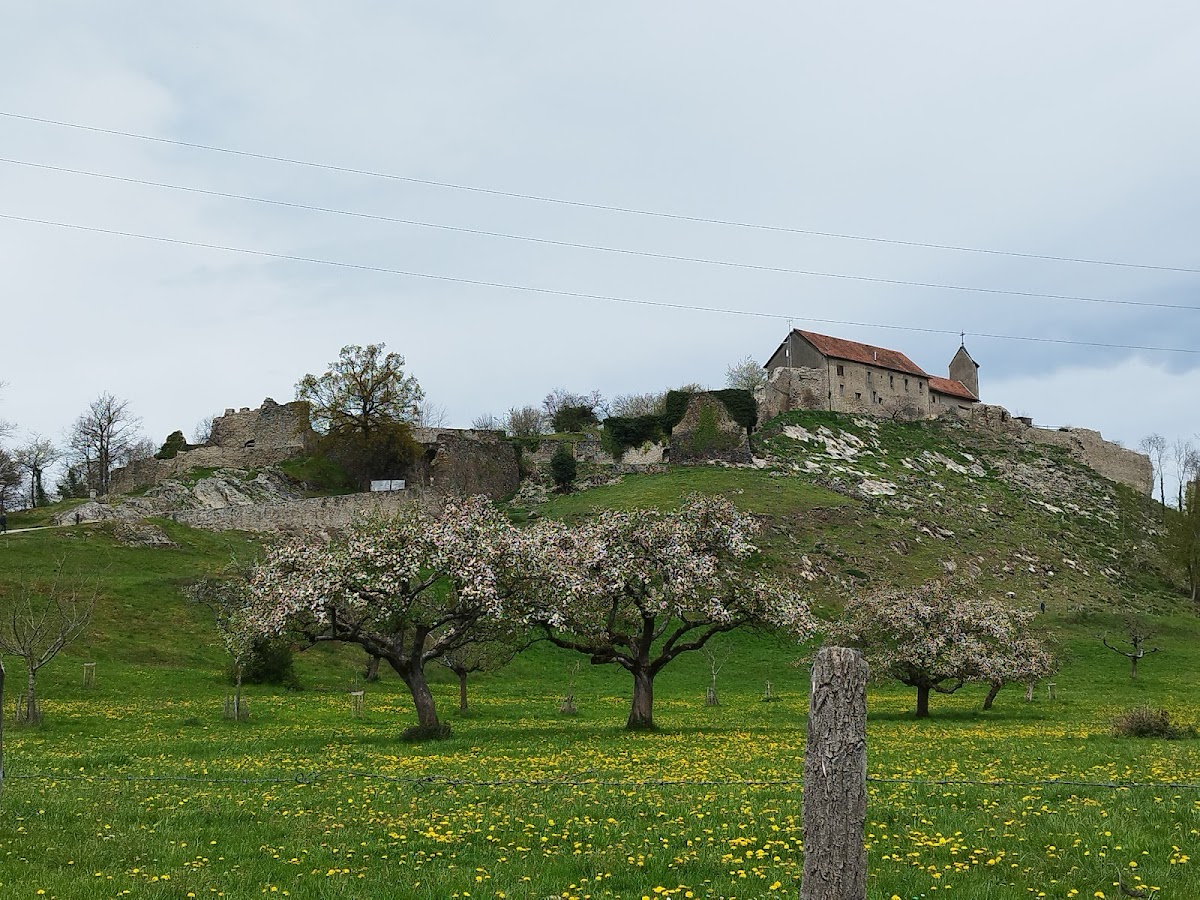
Château-Neuf occupies the western part of the hill known as the hill of the castles, at approximately 712 to 714 metres above sea level. Together with Allinges-Vieux, it stands about 200 metres above Allinges and overlooks Thonon-les-Bains and Lake Geneva. The two castles are about 150 metres apart, separated by a small saddle cut by two ditches. The surviving ruins of Château-Neuf share the hilltop with those of its former rival.
Enclosures and principal towers
Older northern enclosure
The castle is formed from two principal sections preceded by a common lower enclosure. The older northwestern part is an enclosure arranged around the keep of the lords of Allinges. That keep, known from 1073, has been demolished, while the enclosing space preserves the arrangement of the earlier stronghold.
Count’s Castle
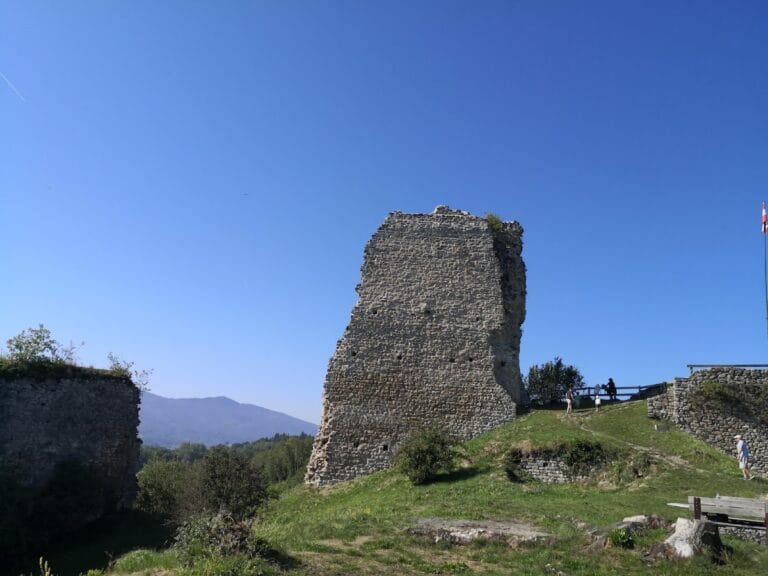
The later section, called the Count’s Castle, is an elongated polygonal enclosure created by the Counts of Savoy at the end of the twelfth or the beginning of the thirteenth century. Within it are the ruins of a square main tower measuring about 14 metres on each side. Its walls are approximately 2.24 metres thick. Residential buildings and the castle chapel also survive within this enclosure.
Chapel and residential buildings
Castle chapel
The chapel has a semicircular apse, the rounded termination of a chapel, set inside a flanking tower. Its surviving decoration includes part of an eleventh-century Romanesque fresco. The painting shows Christ in Majesty surrounded by the Evangelists and saints, along with busts of the four Virtues and a full-length image of Saint Martin, Bishop of Tours.
Adjoining lodgings
The current lodgings of the Missionaries of Saint Francis de Sales occupy the former residential buildings beside the chapel. These buildings form part of the surviving architectural complex and continue the use of the chapel-side structures established after the ruins were acquired in the nineteenth century.
Former borough and southwestern defenses
Former castle borough
The former borough occupied the southwestern half of the enclosure. Traces of its buildings preserve arrangements associated with habitation and agricultural work. The borough’s surviving remains are therefore distinct from the principal fortified enclosures and towers that occupy the other parts of the site.
Barbicans and service buildings
Two barbicans, fortified outer works placed before an entrance or approach, defended the southwestern side. A barn with vaulted cellars stands southwest of the chapel. The surviving castle complex also includes parcels associated with both former and current approaches to Château-Neuf.