Dublin Castle: A Norman Fortress and Seat of Government in Ireland


Site at a Glance
- Rating
- 4.3
- Popularity
- Very High
- Country
- Ireland
- Primary era
- Early Modern
- External website
- Open
- Eras represented
- Medieval, Early Modern, Modern
- Civilizations
- British, English, Irish, Norman
- Site type
- Civic
- Remains
- Palace
On this page22 sections
History
Dublin Castle is a Norman fortress and former seat of government in Ireland, located in central Dublin. Founded in 1204 on the orders of King John of England, it was built by Meiler Fitzhenry after the Norman invasion of Ireland, which began in 1169 and established English political and military control over much of the island. The castle was intended to defend Dublin, administer justice, and safeguard the king’s treasury. It was largely complete by 1230 and became the first major administrative centre of the English Crown in Ireland.
Foundation and medieval government
Dublin Castle stood at the southeastern edge of Norman Dublin, where the River Poddle helped protect the site. Its establishment followed King John’s unsuccessful expedition to Ireland in 1185. During that earlier visit, he had used Ardfinnan Castle for issuing royal charters. The new stronghold gave the Crown a permanent centre from which to exercise military, judicial, and financial authority in the city.
Over the medieval period, the castle developed into a centre of government as well as defence. The Great Hall served at different times as a parliament house, a court of law, and a banqueting hall. From about 1570, the Court of Castle Chamber met in a specially built room there. This royal court, modeled on England’s Star Chamber, handled selected judicial and administrative cases under the Tudor and Stuart monarchies.
Dublin Castle remained the seat of English government under the Lordship of Ireland from 1171 to 1541. It continued in that role under the Kingdom of Ireland from 1541 to 1800 and the United Kingdom of Great Britain and Ireland from 1801 to 1922. Parliament, courts, administrative departments, and military functions operated at the complex during different periods. The castle later became the residence of the Lord Lieutenant, or Viceroy, the monarch’s chief representative in Ireland, and housed the offices of the Chief Secretary for Ireland.
Fire and transformation into a palace
The medieval complex was altered dramatically in the seventeenth and eighteenth centuries. A fire damaged the Great Hall in 1673, and it was demolished soon afterwards. A much larger fire in 1684 prompted rebuilding on an extensive scale. This work transformed the fortified medieval centre into a Georgian palace, and most of the buildings visible today date from the eighteenth century.
The castle also witnessed episodes involving political prisoners and Gaelic resistance. In January 1592, Red Hugh O’Donnell and Art and Henry O’Neill escaped from imprisonment there. Art O’Neill died of exposure during the winter journey south, and the escape and journey have been commemorated since 2009 by the annual Art O’Neill Challenge. In 1798, Joseph Holt, a commander of the United Irishmen who took part in that year’s rebellion, was held in Bermingham Tower before being transported to New South Wales in 1799.
In 1884, officers at the castle became involved in a homosexual scandal publicised by William O’Brien, an Irish nationalist politician and editor of United Ireland. In 1907, the Irish Crown Jewels were stolen from the complex. Suspicion fell on Sir Arthur Vicars, the Officer of Arms responsible for heraldic affairs in Ireland, but the jewels were never recovered.
Revolution, independence, and the Irish state
Dublin Castle became a contested centre during the revolutionary period. At the beginning of the Easter Rising in 1916, twenty-five members of the Irish Citizen Army seized the castle entrance and guardroom before reinforcements reached its small garrison. During the Anglo-Irish War, the complex served as the centre of the British campaign against Irish separatism. On Bloody Sunday in 1920, Dick McKee, Conor Clune, and Peadar Clancy, members of the Irish Republican Army, were tortured and killed there.
Following the Anglo-Irish Treaty of December 1921, the complex was ceremonially handed over to the Provisional Government led by Michael Collins. When the Irish Free State was established in 1922, Dublin Castle ceased to be the administrative seat of British government in Ireland. The Four Courts, Ireland’s principal historic court complex, had been destroyed during the Civil War, so the castle temporarily accommodated court proceedings for about a decade. It then returned chiefly to ceremonial functions.
The castle became an important setting for the new state. In the 1930s, Éamon de Valera, then President of the Executive Council, received the credentials of newly arrived ambassadors there on behalf of King George V. Douglas Hyde was inaugurated as the first President of Ireland at Dublin Castle in 1938, and every subsequent presidential inauguration has taken place at the complex. Dublin Castle also hosted the lying-in-state of President Erskine Hamilton Childers in November 1974 and former President Éamon de Valera in September 1975.
Contemporary public and ceremonial role
Dublin Castle continues to accommodate parts of the Irish government administration, including offices of the Revenue Commissioners and the Electoral Commission, as well as Garda facilities. The Garda Síochána is Ireland’s national police service. The complex also contains the Garda Museum, the Revenue Museum, and the Chester Beatty Library, a public library and museum holding collections of manuscripts, books, and artworks from several regions.
State visits, foreign-affairs engagements, official banquets, government policy launches, and European Union events have taken place at the castle. It hosted a state banquet during Queen Elizabeth II’s visit to Ireland in 2011 and has served as a central venue during Ireland’s European Union presidencies. The Hibernia Conference Centre and the Printworks were installed for the presidencies of 1990 and 2013. The complex is maintained and managed by the Office of Public Works and functions as a conference centre, an accredited museum, and a venue for official government events.
The former dark pool beside the River Poddle was known as Dubh Linn, meaning dark pool, and gave Dublin its name. The area has continued to carry ceremonial and cultural associations. The crypt of the Chapel Royal has been adapted as an arts centre, while concerts are held there and occasionally elsewhere in the complex. Official Castle Season events continue to use the historic rooms.
Remains
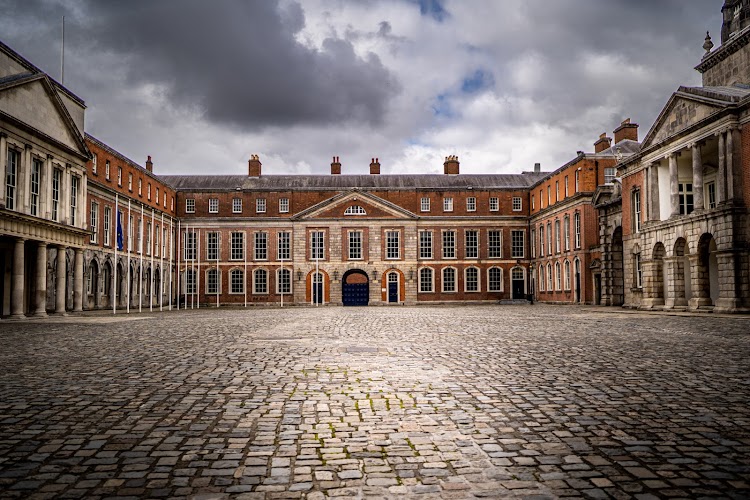
Dublin Castle occupies approximately 44,000 square metres on the south side of central Dublin, off Dame Street. Its physical form combines the remains of a Norman courtyard fortress with Georgian buildings erected during the rebuilding that followed the fires of the seventeenth century. The original defensive arrangement used high enclosing walls, four circular corner towers, a moat, and a drawbridge around a central courtyard. The River Poddle formed a natural defence along two sides, and it was diverted through arches at the junction of the castle and city walls to flood the moat.
Medieval fortress and surviving defenses
Record Tower
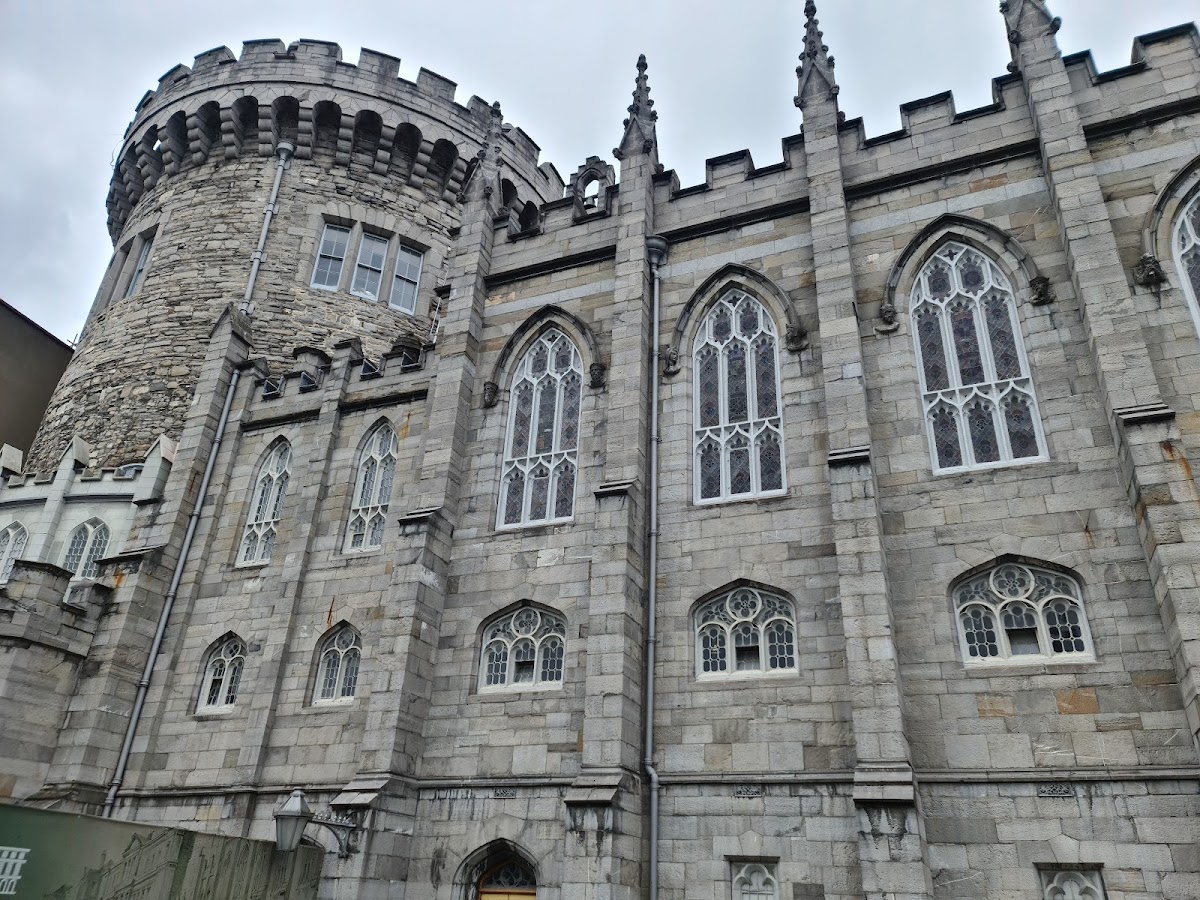
The Record Tower, built about 1228 to 1230, is the medieval tower preserved substantially above ground. Its battlements were added in the early nineteenth century. The tower forms the clearest surviving part of the original Norman castle, whose defensive architecture relied on enclosing walls and corner towers rather than a central keep.
Bermingham Tower
Bermingham Tower occupies the southwestern corner of the complex. Its original base survives, while the upper part was reconstructed in modern times. The tower’s name is associated with the De Bermingham family, although the origin of that association remains uncertain.
Walls, moat, and Poddle arches
The medieval city wall joined the castle at the northeastern Powder Tower, continued around Dublin, and returned at the southwestern Bermingham Tower. One former Poddle arch and part of the city wall survive beneath the eighteenth-century buildings and can be viewed within the complex. Excavations in 1986 exposed the base of one of the original towers, sections of the old city wall, and the former moat. The other medieval tower names preserved in the castle’s history include the Octagonal Tower, Bedford Tower, Powder Tower, and Cork Tower, with their remains surviving through demolished structures or foundations.
Georgian ranges and later buildings
The courtyard and surrounding ranges contain eighteenth-century Georgian buildings erected during the transformation from fortress to palace. Former stable buildings and twentieth-century office structures also form part of the complex. A four-storey modern office block designed by Frank du Berry, a senior Office of Public Works architect, began construction in 1970. Its design was criticised for disrupting the historic rectangular layout. The former Ship Street Barracks housed troops responsible for protecting the castle.
State Apartments
Saint Patrick’s Hall
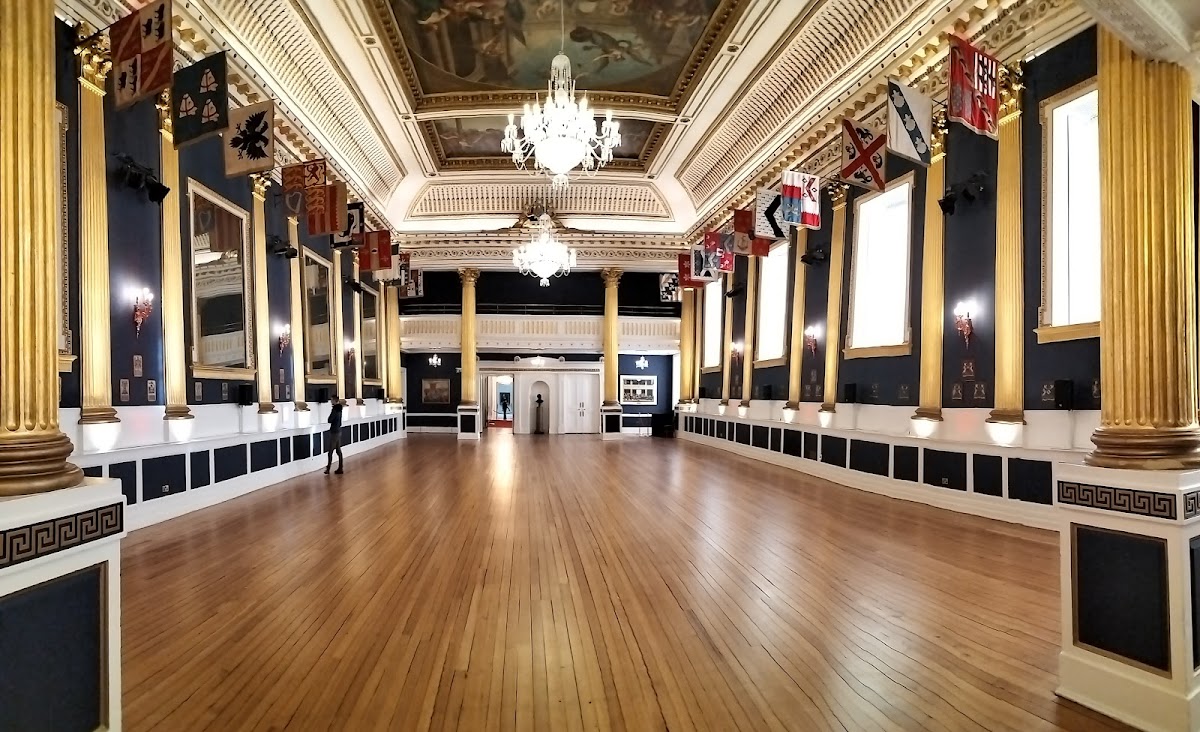
Saint Patrick’s Hall is the largest room in the State Apartments, which occupy the southern range of the Upper Yard. The hall contains a major decorative scheme dating chiefly from about 1790, with earlier elements from the 1740s. Vincenzo Valdrè painted its three-part ceiling with scenes showing the coronation of George III, Saint Patrick introducing Christianity to Ireland, and Henry II receiving Irish leaders. Saint Patrick, the traditional patron saint of Ireland, is also represented through the hall’s ceremonial associations.
The room retains banners linked with the last living knights of the Order of Saint Patrick at the time of Irish independence. Established by the British monarchy in 1783, the order was an Irish order of chivalry. The hall formerly hosted viceregal balls and now provides the setting for presidential inaugurations and other state occasions.
Throne Room
The Throne Room was built as Battleaxe Hall in the 1740s and converted into a state reception room around 1790. Its royal decoration was altered during the 1830s. The throne was made for King George IV’s visit to Ireland in 1821.
State Drawing Room
The State Drawing Room was built in the 1830s as the Lord Lieutenant’s principal reception room. A fire in 1941 largely destroyed it, and the room was reconstructed between 1964 and 1968 with few changes to the original design.
State Dining Room
The State Dining Room, also called the Gallery or Supper Room, preserves the oldest decorative scheme in the castle. Its decoration dates from the 1740s, during Lord Chesterfield’s work on the complex. It was designed as an extension to Saint Patrick’s Hall and as a private dining room for the Lord Lieutenant. It is now used for dining when conferences occupy Saint Patrick’s Hall.
Former State Bedrooms
The former State Bedrooms made up the Lord Lieutenant’s private suite. The interconnected rooms accommodated the Lord Lieutenant, members of the family, and distinguished guests. Reconstructed in the 1960s after the 1941 fire, they retain the original sequence of rooms and serve as subsidiary salons and meeting rooms.
State Corridor
The State Corridor was built in 1758 to designs by Thomas Eyre, the Surveyor General, using an earlier corridor design by Edward Lovett Pearce for the former Irish Parliament House at College Green. It contains a sequence of vaults and arches, glazed openings in the roof, white-and-gold stucco decoration, original doors, plasterwork, and fireplaces. A twentieth-century office floor was added over the skylights.
Chapel, gardens, and museums
Chapel Royal
The Chapel Royal served as the castle’s chapel and as the Lord Lieutenant’s private place of worship from 1814 until the establishment of the Irish Free State in 1922. Its crypt has since been adapted as an arts centre, giving the former religious space a cultural function within the complex.
Dubhlinn Gardens
The former dark-pool area beside the Poddle was remodelled as the Dubhlinn Gardens, completed in 1680. The gardens contain a water feature commemorating fallen members of the Garda and a helipad. A sculpture and plaque opposite the gardens commemorate the volunteers of the 2003 Special Olympics World Summer Games.
Museums and collections
The complex includes the purpose-built Chester Beatty Library, the Garda Museum in the Treasury Building, and the Revenue Museum. The State Apartments and their associated historic collections form an accredited museum. Their principal rooms preserve eighteenth- and nineteenth-century decoration alongside reconstructions made necessary by the 1941 fire.