Château du Monteil-au-Vicomte: Medieval Fortress in France


Site at a Glance
- Rating
- 4.4
- Popularity
- Very Low
- Country
- France
- Primary era
- Medieval
- External website
- Open
- Eras represented
- Medieval
- Civilizations
- Duchy of Aquitaine
- Site type
- Military
- Remains
- Castle
On this page7 sections
History
Château du Monteil-au-Vicomte is a medieval fortress in France, built by the viscounts of Aubusson in the mid-12th century. These noblemen, whose rank stood below that of a count, established the stronghold above the Taurion River. Ranulfe d’Aubusson is identified as its first owner. Also known as Château de La Borne, it gave its name to the commune of Monteil-au-Vicomte.
The Aubusson lords
The château remained closely associated with the Aubusson family and the lords of La Borne. Antoine d’Aubusson was its lord, while his brother Pierre d’Aubusson was born there in 1423. Pierre later became grand master of the Order of Saint John of Jerusalem, a medieval Catholic military-religious order that combined monastic life with protecting pilgrims and military service.
Among the family members connected with La Borne were Renaud VIII d’Aubusson, born in the second half of the 13th century, and Guy III d’Aubusson, who married Marguerite de Ventadour at the château in 1332. Their son Louis d’Aubusson was lord of La Borne from 1336 until his death and married Guérine de Dienne on 24 March 1354. Guy d’Aubusson also held the lordship, while Guillemette d’Aubusson married Pierre, lord of Saint-Séverin, on 24 September 1371.
Jean d’Aubusson, lord of La Borne, married Guyonne de Monteruc in 1378, and both died in 1420. Their son, also named Jean d’Aubusson, lived approximately from 1390 to 1445. Renaud d’Aubusson, of the Monteil branch, was lord of Monteil-au-Vicomte and died in 1433.
Later ownership and dismantling
In the 17th century, the château belonged to Gaspard de Fieubet. It passed in 1714 to Denis Michel de Montboissier Beaufort-Canillac, who sold it to Jacques-André Dupille in 1719. Dupille later transferred the property to François-Louis du Pouget de Nadaillac.
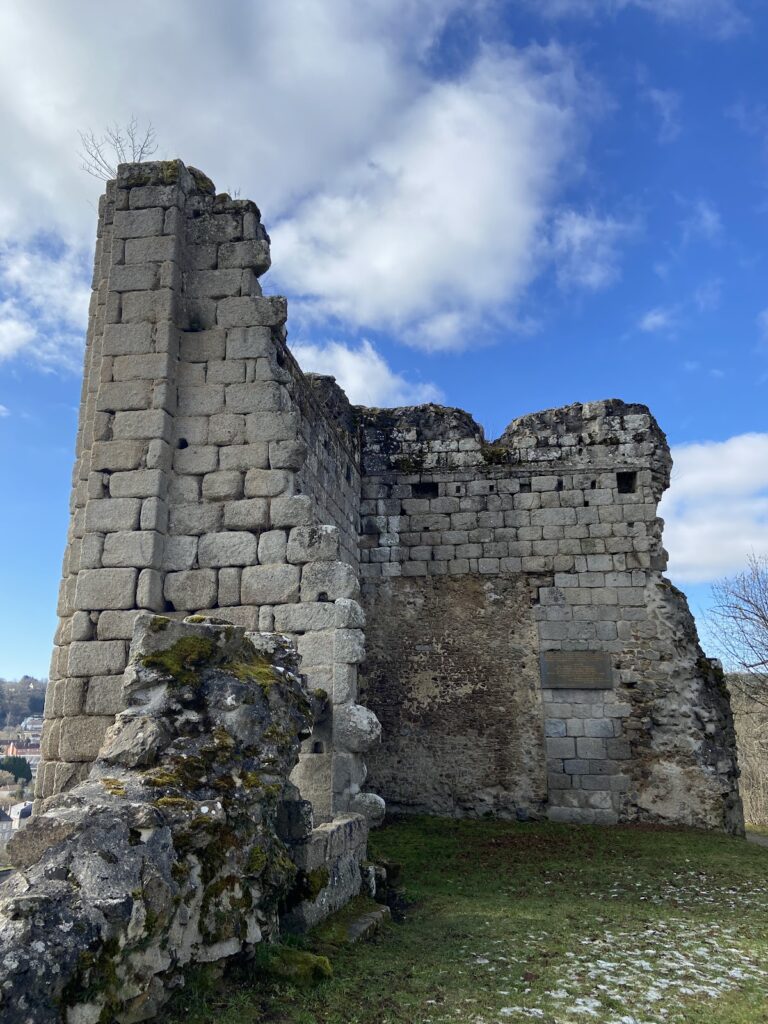
During the French Revolution, the château became a national property, meaning that it was confiscated and transferred to public ownership. It was subsequently dismantled and used as a stone quarry for the construction of the town of Monteil. The monument has been protected as a French historic monument since 19 February 1964, and restoration remains in progress.
Remains
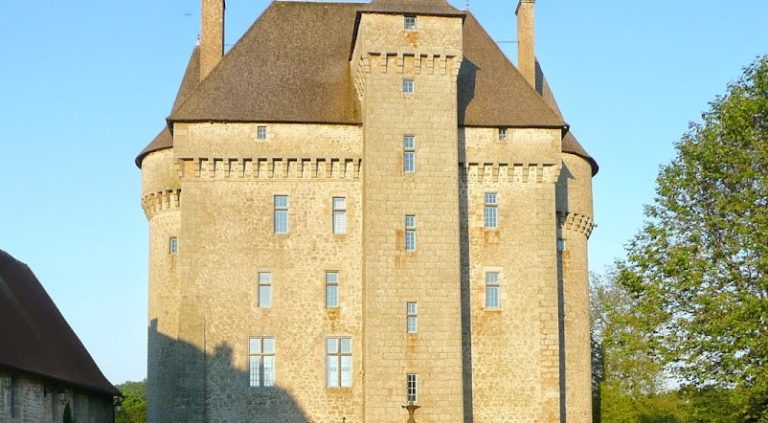
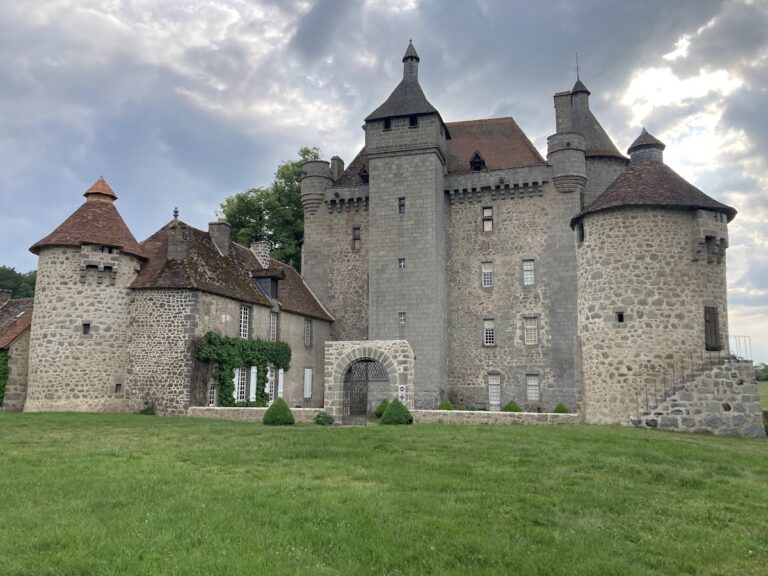
The château stands on a small plateau above the Taurion River, which runs at the foot of the castle at Pontarion. Its medieval form consisted of two large round towers, broad ditches, a residential building, and an enclosing wall. Pleasure terraces were added around the fortress at a later period.
Fortress structures
Round towers
One of the two large round towers survives in exterior views together with part of the enclosing wall. The fortress was dismantled and altered after its stone was reused, leaving the tower and associated masonry in a ruined state. Restoration work continues on the surviving remains.
Ditches, residence, and terraces
The broad ditches, residential building, and enclosing wall formed the principal elements of the medieval complex. Later pleasure terraces extended the setting around the fortress. A postcard from around 1920 depicted the château as ruins, reflecting the condition produced by its dismantling and quarry use.
Nearby sites