Artannes Castle: Residence of the Archbishops of Tours


Site at a Glance
- Rating
- 5
- Popularity
- Very Low
- Country
- France
- Primary era
- Medieval
- External website
- Open
- Eras represented
- Medieval, Modern
- Civilizations
- French
- Site type
- Domestic
- Remains
- Castle
On this page9 sections
History
Early Ecclesiastical Origins
A first church and episcopal residence were probably built at Artannes in the late sixth century by Gregory of Tours, a bishop and historian of the Frankish world. These buildings are traditionally associated with the site of the present château, although no securely identified remains of either one survive.
From Royal Estate to Barony
The Artannes estate was a royal possession administered through the Château de Tours. In 1180, Henry II Plantagenet, the English king and Angevin ruler who controlled extensive territories in France, made Artannes a barony, a feudal territorial lordship.
The Archbishops of Tours at Artannes
The château had belonged to the archbishops of Tours, senior Christian bishops responsible for an archdiocese, since at least 1426. They used it as a pleasure residence. During this period, the moat protecting the château and church was probably partly filled.
Artannes also became a place associated with the deaths of two archbishops of Tours. Hélie de Bourdeilles died there on 5 July 1494, followed by Christophe de Brillac on 31 July 1520. Other archbishops visited less frequently. Archbishop de Conzié, for example, apparently never stayed at Artannes during his 24-year episcopate in the late eighteenth century.
Revolutionary Sale and Later Protection
Ecclesiastical property was confiscated during the French Revolution, and the château was sold in the Revolution’s third year. Charles Lefèbvre, mayor of Artannes from 1791 to 1792, purchased it. His son later filled in the moats and constructed outbuildings on their former site.
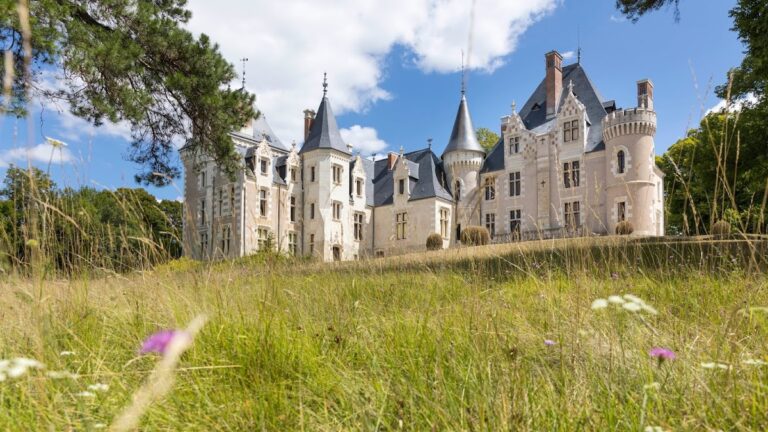
The present building dates from the fifteenth century, but it was extensively restored and substantially transformed during the nineteenth century. An order dated 14 September 1949 listed its façades and roofs as historic monuments.
Remains
Layout and Surviving Buildings
Castle and Towers
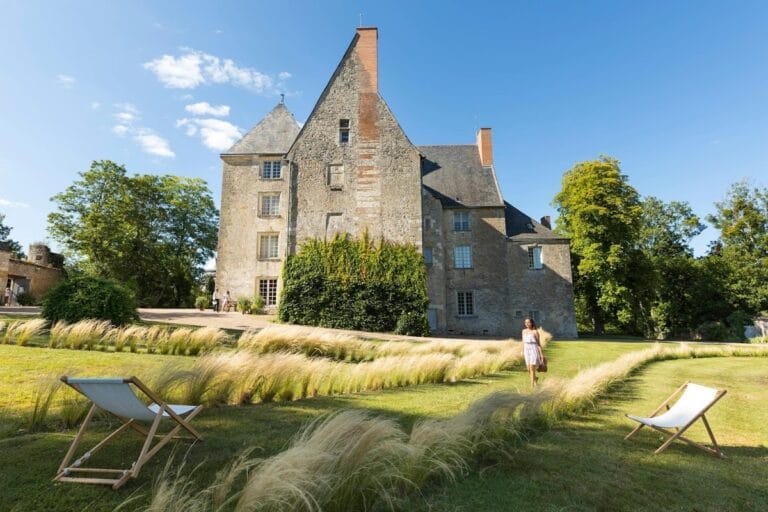
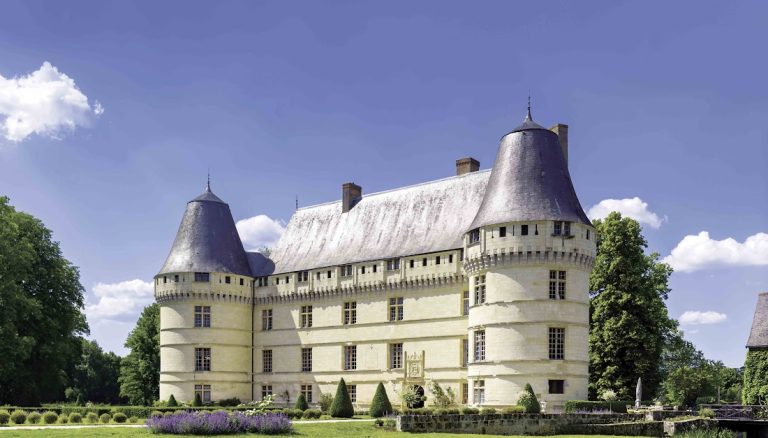
Artannes Castle stands in the centre of Artannes-sur-Indre on the right bank of the Indre. It is aligned from northwest to southeast, with its principal façade facing the river at a height of only about three metres above it. The building has a ground floor, an upper floor, and an attic. A main residential block is flanked by towers at the northeast and southeast ends.
A cadastral plan of 1821 shows three towers and a château partly enclosed by moats. Two towers survive. The north wing turns at a right angle, while a former chapel is arranged symmetrically to the south. The principal residential block has a roof structure formed by curved or shaped timbers in the profile of an inverted boat hull.
Church Connection and Porch
On the side opposite the river, the château faces Saint Maurice Church. A building joins the château’s north wing to the church’s apse, the semicircular end of the church. A porch links the two buildings and gives access from the north to the château’s principal courtyard.
On the side facing the forecourt, a gate closes the porch. Its pediment bears the arms of Hélie de Bourdeilles. During the nineteenth-century alterations, the windows lost their mullions, the vertical members that divide a window into separate sections, and received more modern small-pane frames. Their carved lintels were preserved.
Nearby sites