Château d’Empeaux: A Private Renaissance Residence in France


Site at a Glance
- Rating
- 5
- Popularity
- Very Low
- Country
- France
- Primary era
- Early Modern
- Eras represented
- Early Modern
- Civilizations
- French
- Site type
- Domestic
- Remains
- Castle
On this page6 sections
History
Origins and Early Lords
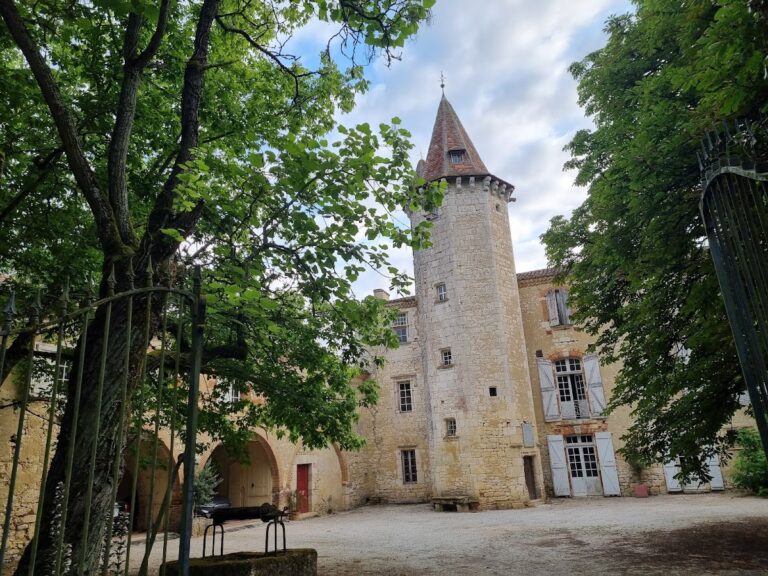
Château d’Empeaux is a private Renaissance château in Empeaux, France, probably built by the Lambès family at the end of the sixteenth century as a residence. It stands in the centre of the village beside the church and cemetery, and remains a private dwelling.
The property later passed to the Cathala, or Catellan, family, which was of Italian origin. François Cathala was lord of Empeaux and Lamasquère in 1607.
The Doujat Barony
During the first half of the eighteenth century, the château passed to the Doujat family. Gabriel Bonaventure Doujat, a councillor of the Parlement of Toulouse, a senior judicial and administrative court of the French monarchy, held that office from 1707 to 1747. He became the first member of his family to bear the title Baron of Empeaux. The title appeared in the record of his second marriage on 12 January 1740.
The barony was linked to lordship over Lambès, Saiguède, and Peyrigué, as well as to shared lordship of Labusquière. Gabriel Bonaventure Doujat also owned Château Doujat at Saint-Martin-du-Touch. His son Henri Joseph Doujat, an officer in the Auvergne Regiment, succeeded him and died at the château on 15 May 1806. The Doujats held 115 hectares of land around the residence.
Later Ownership and Restoration
The château still belonged to the Doujats in 1872, when Victoire Armandine Dadvisard, wife of the fourth Baron of Empeaux, died there. It later passed to Isidore Lautier, a jeweller from Toulouse, who retained it until his death at the age of 84 in 1917. Etienne Mathieu then acquired the property.
In 1951, the château belonged to Béranger Alaux, who lived from 1893 to 1957. Jean Secail, a surgeon and chief executive of the Céramiques d’Empeaux company, acquired it around 1980. In 1991, ownership passed to the Gelis family, owners of the local brickyard. The Doujat family retained the title Baron of Empeaux until the family became extinct in 2002, although it had ceased to own the château and its estate. The building has remained privately owned throughout its documented history.
Remains
Renaissance Brick Residence
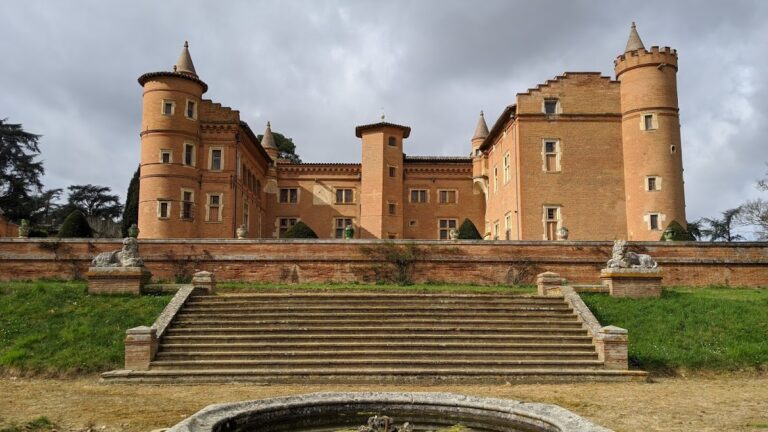
Château d’Empeaux is a rectangular, three-level building in the Renaissance style, a period that brought classical architectural forms and decorative principles into French design during the fifteenth and sixteenth centuries. Its walls are constructed of terracotta brick, giving the residence a consistent material character.
At each end of the entrance front stands a cylindrical turret carried outward from the wall by projecting supports. On the garden front, each end has a square tower adjoining a cylindrical turret of the same projecting construction. These features combine the regular form of the Renaissance residence with elements associated with medieval architecture.
Isidore Lautier restored the château in the late nineteenth century in a medievalizing style associated with Eugène-Emmanuel Viollet-le-Duc, the French architect and architectural theorist known for restoring medieval buildings and influencing nineteenth-century medievalizing restoration practices.
Nearby sites