Château de Vollore: A Historic Stronghold in France


Site at a Glance
- Rating
- 4.5
- Popularity
- Very Low
- Country
- France
- Primary era
- Early Modern
- External website
- Open
- Eras represented
- Medieval, Early Modern
- Civilizations
- French
- Site type
- Military
- Remains
- Castle
On this page9 sections
History
Château de Vollore is a historic stronghold in Vollore-Ville, France, with a history reaching back to the sixth century and a fortress core built in the twelfth century. It has been associated with the history of Auvergne since 532, when Thierry I, son of Clovis I and a Merovingian king of Austrasia, besieged the stronghold.
The Vollore and Thiers Families
The fortress that forms the oldest surviving part of the château was built in the twelfth century by the old Vollore family. When the last male member of the family died, his only daughter, Blanche, inherited the land and château. In 1248, she formed an alliance with Étienne de Thiers, a nobleman of the Thiers lineage, linking the property to another French noble house.
Later Transformation and Restoration
The château later passed to the Chazeron family. During the seventeenth century, the Montmorin family transformed the building and gave it the character associated with it today. The Montmorin family was another French noble house, and its period shaped the appearance that later restorers sought to recover.
Early in the twentieth century, the architect René Moreau directed restorations intended to restore the château’s appearance during the seventeenth-century Montmorin period. The château remains privately owned.
Remains
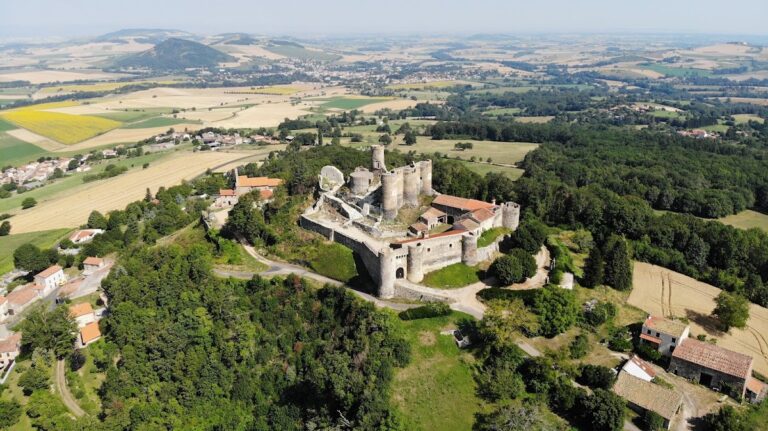
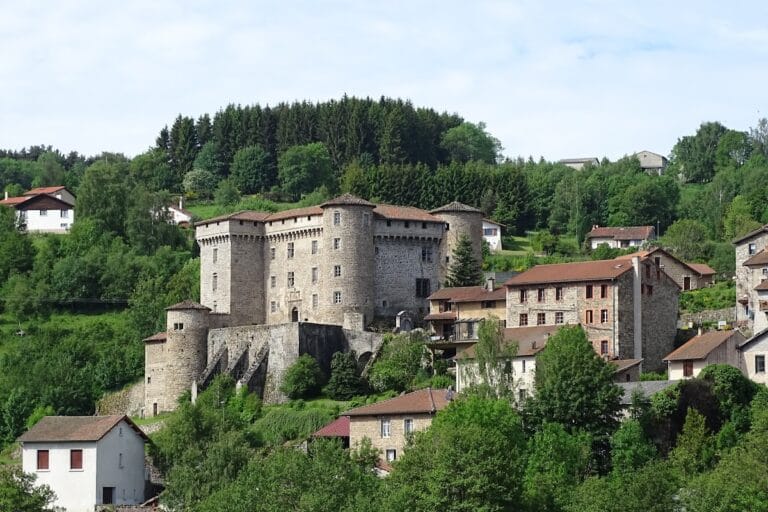
Château de Vollore stands at the western end of Vollore-Ville, separated from the village by a terraced park. Its position overlooks the Auvergne mountains, the Limagne plain, and the Dore. The complex brings together a medieval keep, a Gothic tower, and a later central block, reflecting its successive phases of construction and transformation.
Historic Buildings and Collections
Twelfth-Century Keep
The keep is the oldest element of the château and dates from the twelfth century, when the Vollore family built the fortress. It forms the medieval core of the complex.
Gothic Tower
A Gothic tower from the thirteenth century forms another surviving part of the château. Gothic architecture was a medieval style associated with pointed arches, ribbed vaults, and strong vertical emphasis.
Seventeenth-Century Central Block
The central block dates from the seventeenth century and belongs to the period when the Montmorin family transformed the château. Its presence within the complex reflects the building’s later character, which early-twentieth-century restoration sought to recover.
Interior Collections
The château contains substantial period furniture and collections of memorabilia associated with the La Fayette family and the American War of Independence. The La Fayette family was a French noble family associated with Gilbert du Motier, marquis de Lafayette, who took part prominently in the conflict in which the Thirteen American Colonies fought against British rule from 1775 to 1783.