Château de Châteldon: A Fortified Castle in France


Site at a Glance
- Rating
- 4
- Popularity
- Very Low
- Country
- France
- Primary era
- Medieval
- Eras represented
- Medieval
- Civilizations
- French
- Site type
- Military
- Remains
- Castle
On this page8 sections
History
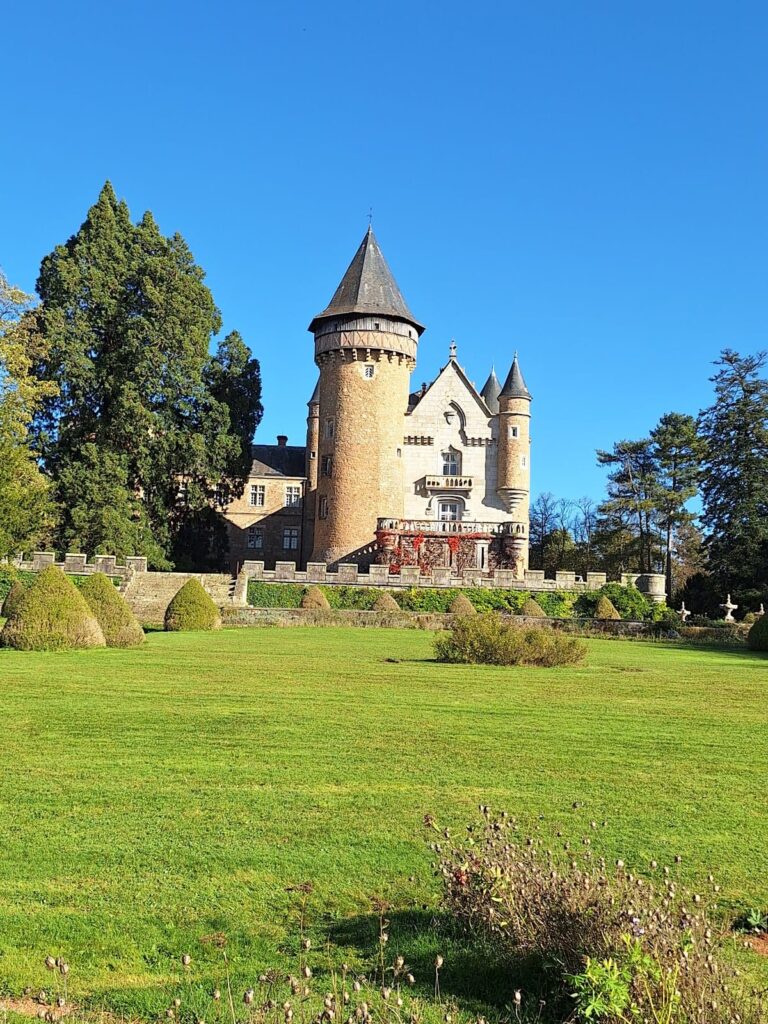
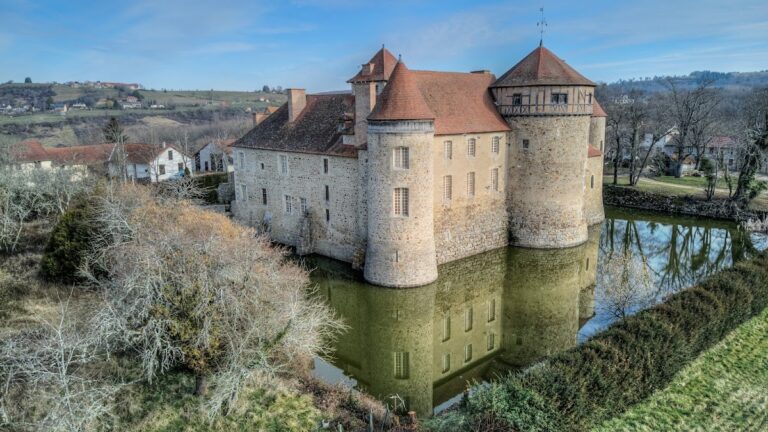
Château de Châteldon is a fortified castle in Châteldon, France, whose construction probably began in the twelfth century. Rebuilt from 1489 and partly destroyed and reconstructed in the mid-nineteenth century, it stands at the center of the village and has been protected as a French historic monument since 1926. Its chapel dates from the beginning of the fourteenth century.
Medieval lordship and fortification
The castle and lordship passed through more than 38 ownerships. Archambaud, lord of Saint Gérand, held it in 1108, followed by Humbert de Beaujeu in 1283. In 1307, Jean-Aubert Aycelin de Montaigut, abbot of the church of Clermont, purchased the lordship from Jeanne de Beaujeu, daughter of Humbert de Beaujeu and wife of Jean de Dreux, chamberlain of France. His brother Gilles Aycelin de Montaigut inherited it in 1308, and the property then remained associated with successive members of the Aycelin de Montaigut family.
In February 1309, Philip IV of France issued a charter concerning the castles of Castel-Odon and Le Breuil. Held as fiefs of the lord of Bourbon on the kingdom’s frontier toward Lyon, they could thereafter be sold or transferred only to sovereign hands. Gilles II Aycelin de Montaigut is traditionally associated with the construction of the fortified enclosure around Châteldon, undertaken as the English threat became more serious after the Battle of Crécy. In 1344, Philip VI authorized a weekly market at Châteldon. During the plague of 1348, Gilles II led an expiatory procession barefoot, with a rope around his neck, wearing a shirt and carrying a candle.
Late medieval ownership and conflict
The Aycelin succession continued through Bernard Aycelin de Montaigu, known as the Griffon of Montaigut, in 1391, Louis Aycelin de Montaigut-Listenois in 1427, and Isabeau de Montaigut-Listenois in 1433. From 1433 to 1436, the castle belonged to Rodrigue de Villandrando, a captain of routiers, the armed companies active in the conflicts of late medieval France. He was the husband of Marguerite de Bourbon, an illegitimate daughter of Jean I, Duke of Bourbon.
In 1433, an Anglo-Burgundian force besieged the castle while Villandrando held it. An Occitan song about the event states that the attackers were decisively defeated. Tradition places the death of their English leader at a site called Mort Gate and identifies a field below the castle as an English cemetery. These details remain traditional accounts rather than established facts.
After the Villandrando period, ownership passed to Philippe de Vienne in 1436, Jean de Vienne in 1462, François de Vienne in 1499, and Louis de la Fayette in 1537. Jacqueline de la Fayette held the property in 1585, followed by Philibert de la Guiche in 1616, Henriette de la Guiche in 1625, and Anne de la Guiche in 1698. Later owners included Jeanne Armande de Schomberg in 1706, Elisabeth de Rohan in 1712, Louise Armande de Melun in 1720, and Joachim de Fayn de Rochepierre from 20 July 1720.
Revolutionary and nineteenth-century ownership
The castle changed hands repeatedly during the eighteenth century. Jean Girard Le Franc de Brumpé acquired it on 30 April 1723, André Hébert on 10 December 1728, and Jean-Claude Douet in 1752. Douet was a deputy fermier général to his father from 1763 to 1778 and later a titular fermier général from 1778 to 1790. A fermier général belonged to France’s pre-Revolutionary tax-farming administration, which collected certain taxes under contract with the crown.
During the French Revolution, Douet and his wife were convicted in the trial of the fermiers généraux and guillotined on 14 May 1794. The castle was then sold as national property. Hughes Debrit, a wine merchant and mayor of Châteldon from 1810 until his death in 1818, purchased it during the revolutionary period. Later owners included Adrien François Marie Rullet de la Murette, mayor from 1840 to 1848, and Émile Genest Aubert de la Faige, a cavalry captain, Legion of Honour knight, mayor of Barrais-Bussolles, and scholar of Auvergne history who wrote about Gilles Aycelin de Montaigu and Châteldon.
The property passed through Eugène Tapon in 1857, Marie-Rose Tapon Cholet in 1884, Antoine Sauzard-Grelet in 1886, and Émile Genest Aubert de la Faige in 1892. Alfred Legras and his heirs, including Louis Benoist de Ronat, held it from 1894. Louis Léon Senèque became owner in 1925.
Pierre Laval and the postwar period
Pierre Laval, who was born in Châteldon, bought the castle in 1931 for 200,000 francs and commissioned major renovation work. He lived there from 1942 to 1944 while serving as head of the Vichy government, the French administration that collaborated with Nazi Germany during the Second World War. The castle stood about 20 kilometers from Vichy, the spa town that gave this government its name.
Laval wanted to be buried at the castle and had a mausoleum built in the courtyard for that purpose. Postwar governments repeatedly rejected his daughter’s requests for his burial there, and Laval was instead buried in Montparnasse Cemetery. At the Liberation in 1944, the castle was requisitioned to house survivors of concentration camps and former prisoners of war. A prefectural order dated 8 September 1944 placed it at the disposal of national needs under the management of Châteldon’s reception center.
The castle was returned in 1948 to Josée de Chambrun, Laval’s only daughter. After the family pursued legal proceedings concerning an illegal sale, she received 2,800,328 francs in compensation in 1951. The property is now owned by the Josée-et-René-de-Chambrun Foundation.
Remains
Château de Châteldon is a fortified château within the village of Châteldon. Its surviving fabric reflects a medieval foundation, rebuilding from 1489, partial destruction and reconstruction in the mid-nineteenth century, and later alterations associated with its owners. The chapel and the courtyard mausoleum form distinct elements within the castle complex, while the fortified enclosure extended defensively around Châteldon.
Fortified enclosure and castle
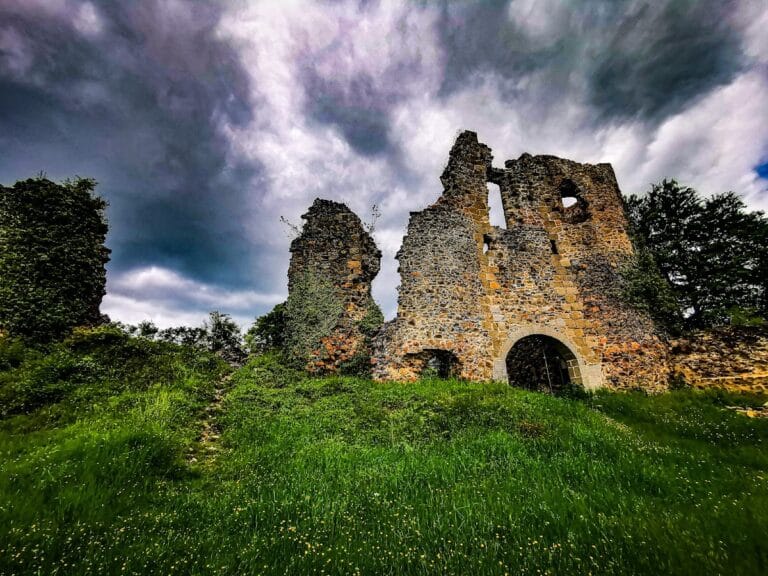
The castle occupies a fortified position in the village and is associated with an enceinte, a fortified enclosing wall or defensive circuit, constructed around Châteldon. Traditionally attributed to Gilles II Aycelin de Montaigut, the enclosure is linked to the defensive concerns that followed the Battle of Crécy and the growing threat from English forces. The castle itself probably originated in the twelfth century and was rebuilt from 1489. Part of the structure was destroyed before reconstruction in the mid-nineteenth century.
Chapel and courtyard mausoleum
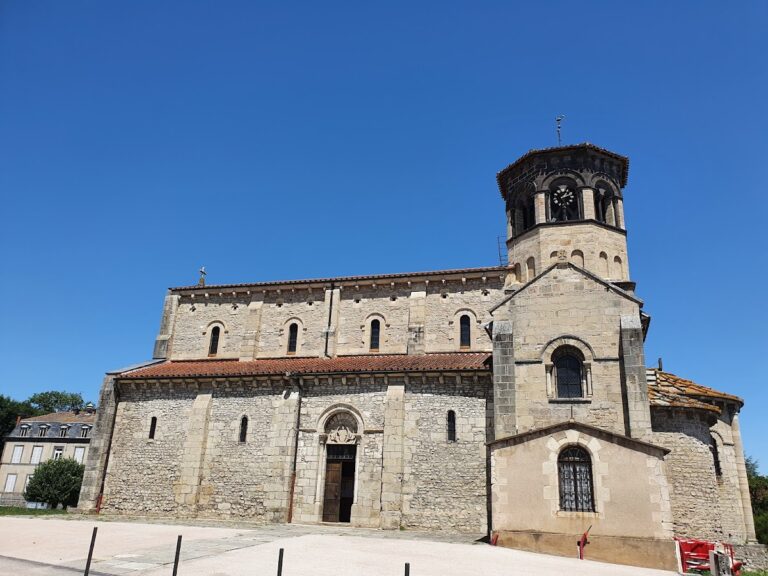
A chapel dating from the beginning of the fourteenth century forms part of the complex. In the castle courtyard, Pierre Laval commissioned a mausoleum intended to become his burial place. His burial did not occur there, following repeated postwar refusals of the family’s requests, and he was buried instead in Montparnasse Cemetery.