Château de Villevêque: An Episcopal Fortified Residence in France


Site at a Glance
- Rating
- 4
- Popularity
- Very Low
- Country
- France
- Primary era
- Medieval
- External website
- Open
- Eras represented
- Medieval, Modern
- Civilizations
- French
- Site type
- Domestic
- Remains
- Castle
On this page8 sections
History
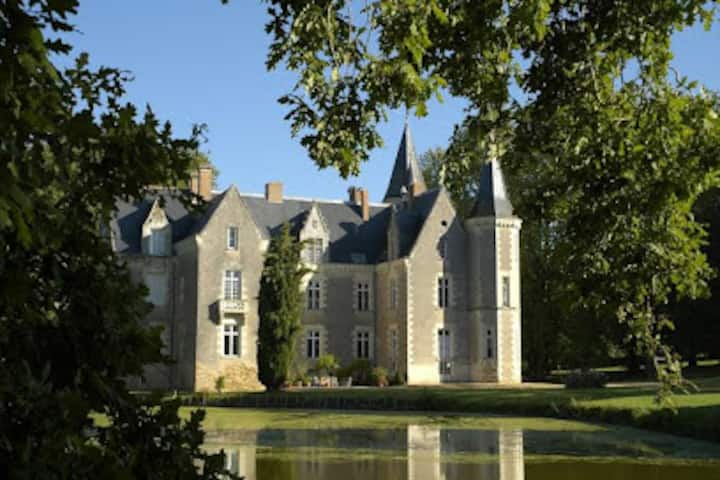
Château de Villevêque is a fortified episcopal residence in France, associated with the bishops of Angers and mentioned in 1025 by Bishop Hubert de Vendôme. Its present character reflects a fifteenth-century rebuilding that transformed a medieval fortress into a more comfortable Renaissance residence.
An episcopal residence in the Middle Ages
The residence belonged to the bishops of Angers, who used it as a dwelling as well as a locally defended stronghold. In 1317, Guillaume Le Maire, bishop of Angers, swore an oath there to Philippe V, king of France. The building therefore served both the household of the bishop and the formal obligations of his office.
War and fifteenth-century rebuilding
During the Hundred Years’ War, the prolonged conflict between the English and French crowns from the fourteenth to the fifteenth century, the fortress was besieged several times. It was dismantled and rebuilt twice. In 1428, Yolande of Aragon gave 1,000 écus to Bishop Hardouin de Bueil to reconstruct a new residential building.
Bishop Jean de Beauvau completely rebuilt the château between 1448 and 1465 after the destruction caused by the war. By the middle of the fifteenth century, its medieval fortifications had lost their original military importance. The residence was consequently remodeled in the Renaissance manner, with greater attention to comfort and ordered façades.
From episcopal property to museum
François de Rohan was among the last bishops to live at Villevêque in the early sixteenth century. He was suspected of having a secret niche made to conceal 100,000 écus. The château was sold as national property in 1791, after which the estate passed through private ownership. It was restored in 1873.
In 1960, the owner Auguste Durel installed twelve columns from the medieval Cloister of Elne in the Pyrénées-Orientales along the south wing. The industrialist Daniel Duclaux acquired the château in 1981 as a home for his art collection and extensive library. After his death in 1999, his widow, Marie Duclaux-Dickson, left the property and collection to the city of Angers. The city received them in 2003, following her death in 2002.
The Musée-Château de Villevêque opened in 2003 as an institution attached to the Musée des Beaux-Arts d’Angers, and the château was gradually developed as a museum from 2004. The bequeathed collection contains more than 900 works, including antique furniture, old books, manuscripts, books printed before about 1501, Italian and Hispano-Moorish ceramics, Limoges enamels, medieval stone and polychrome wooden sculptures, and Flemish Renaissance tapestries. Part of the collection was shown in a temporary exhibition at the Musée des Beaux-Arts d’Angers from 9 November 2018 to 24 February 2019.
Remains
Fortified residence and surviving medieval elements
Château de Villevêque is a fortified house on the Loir River at Villevêque, approximately 15 kilometres northeast of Angers. The medieval fortress survives in part through the remaining section of its moat. The fifteenth-century rebuilding changed the former defensive complex into a residential Renaissance building with articulated façades and large windows.
South wing and cloister columns
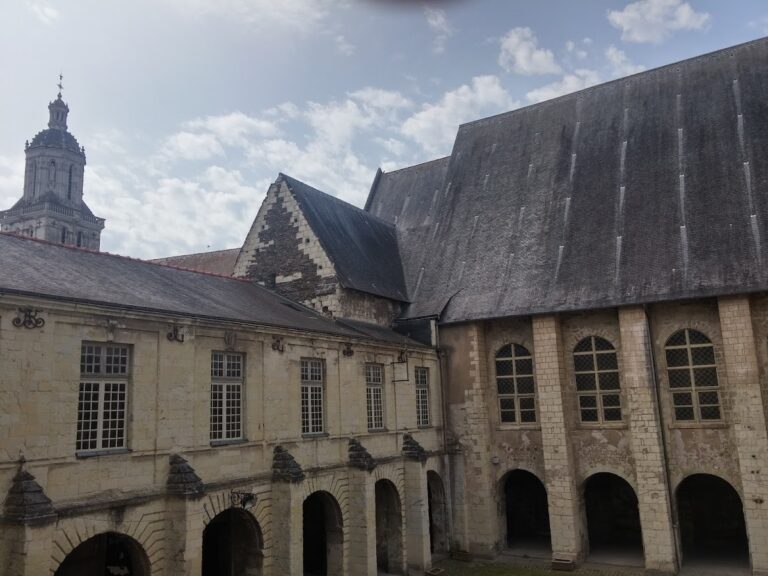
The south wing incorporates twelve columns taken from the Cloister of Elne, a medieval cloister in Elne in the Pyrénées-Orientales. Auguste Durel had them installed in 1960, making this later architectural addition part of the château’s present physical character.
Museum interiors and collection
The museum occupies the château, with the displays concentrated on its ground floor. The works shown there include sculptures, tapestries, enamels, and ceramics from across Europe, dating from the twelfth to the sixteenth century. The collection also contains bronze figures and includes a polychrome Sienese statue of the Virgin of the Annunciation from the early fifteenth century, attributed to the Italian early Renaissance sculptor Jacopo della Quercia.
Another principal work is an early sixteenth-century Tournai tapestry depicting The Condemnation of Banquet. Alongside it are examples of Limoges enamelwork, Italian and Hispano-Moorish ceramics, and medieval sculpture, giving the museum’s ground-floor rooms a material range extending from decorated objects to large woven and carved works.
Nearby sites