Château de Vibrac: A Medieval Fortress and River Island Estate in France


Site at a Glance
- Rating
- 3.9
- Popularity
- Very Low
- Country
- France
- Primary era
- Medieval
- External website
- Open
- Eras represented
- Medieval, Early Modern
- Civilizations
- French
- Site type
- Military
- Remains
- Castle
On this page13 sections
History
Château de Vibrac is a medieval fortified castle in Vibrac, France, whose origins may reach back to the thirteenth century. It stood at the centre of the ancient lordship of Vibrac and Angeac, a territory that included the parishes of Vibrac and Angeac-Charente, along with parts of Saint-Amant-de-Graves and Saint-Simon. The surviving complex reflects rebuilding in the fifteenth century and later alterations during the seventeenth and eighteenth centuries.
Early lordship and medieval origins
The earliest recorded homages paid to the lords of Vibrac date from 1290. These formal acts of loyalty suggest that a castle may already have occupied the site during the thirteenth century. The lordship also belonged to a wider landscape shaped by royal and defensive activity. In the eighth century, nearby Angeac-Charente was one of four residences associated with Louis the Pious, the Frankish emperor who ruled from 814 to 840 as Charlemagne’s son and successor.
Vibrac was also the starting point of the Fossé au Comte, a defensive earthwork excavated by the counts of Angoulême before the ninth century. The roughly 20-kilometre work connected the Charente downstream from Angoulême with the river upstream as far as Montignac and was intended to help resist Norman invasions. This early defensive feature formed part of the historical setting in which the later castle developed.
Montchaude and Mareuil ownership
During the fourteenth century, Vibrac belonged to the Montchaude family. In 1328, Hugues de Montchaude paid homage to Philip, King of Navarre. The lordship later passed by marriage to the Mareuil family, who were also lords of Villebois. In the fifteenth century, the Mareuils replaced the earlier fort with the first château. From that period until the eighteenth century, the lords of Vibrac and Angeac also held the lordship of Château de Villebois-Lavalette.
Gabrielle de Mareuil brought Vibrac to Nicolas d’Anjou-Mézières as her dowry in 1541. Around this time, the estate appears to have been raised to the status of a castellany, a territorial jurisdiction administered from a castle by a lord or castellan. Their daughter, Renée d’Anjou-Mézières, married François de Bourbon, Duke of Montpensier, in 1566, and their only son was Henri de Bourbon.
Conflict and changing proprietors
Vibrac became the scene of an armed skirmish on 13 April 1569, when troops of the Duke of Anjou fought those of the Prince of Condé. The encounter took place during the French Wars of Religion, a series of sixteenth-century conflicts shaped by rivalry between Catholics and Protestants and by competing noble factions.
In 1596, Jean-Louis de Nogaret de La Valette, Duke of Épernon and governor of Angoumois, acquired Vibrac and Villebois from Henri de Bourbon and the Marquise of Mézières. Angoumois was the historical province centred on Angoulême in southwestern France. In 1660, Bernard de Nogaret, Duke of La Valette and Jean-Louis’s heir, sold Vibrac, Angeac, and Lavalette, together with his title, to Philippe de Montaut-Bénac, Marquis of Navailles. He had no heir and had neglected the estates.
After Louis XIV, the French king known as the Sun King, removed the Duke of Navailles and La Valette from court in 1665, the duke withdrew to his estates at La Valette. At the end of the seventeenth century, the lordship of Vibrac passed by marriage to the Pompadour family. In 1727 it passed to the Courcillon family, who later became impoverished and sold it to an association of creditors known as the Courcillon creditors’ administration.
Decline and modern intervention
Vibrac was sold at auction in 1801 to Pierre François Mathias Foucaud, a merchant from Bourg-Charente. During the nineteenth and twentieth centuries, ownership passed through successive marriages to several proprietors, ending with the Viroulaud family. By that time, the château had become a ruin.
In early 2020, the purchase of the château and a restoration project became the subject of a crowdfunding campaign organized by Dartagnans. This modern initiative formed part of the site’s continuing history after centuries of alteration, changing ownership, and deterioration.
Remains
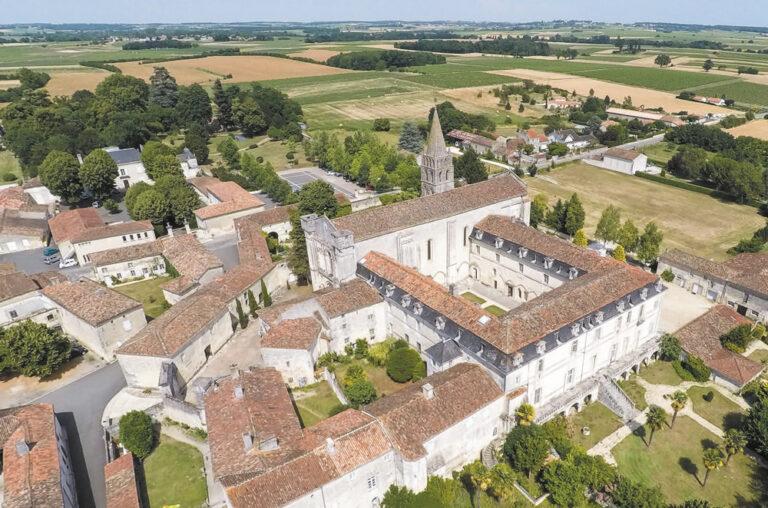
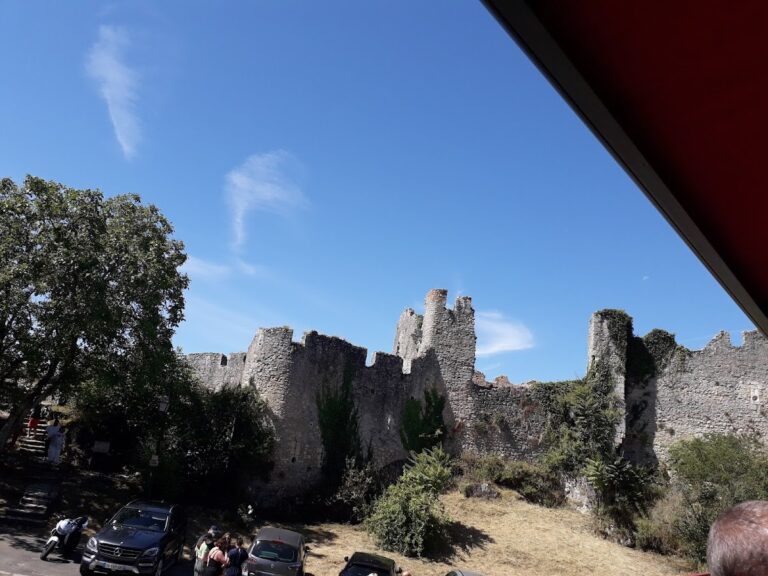
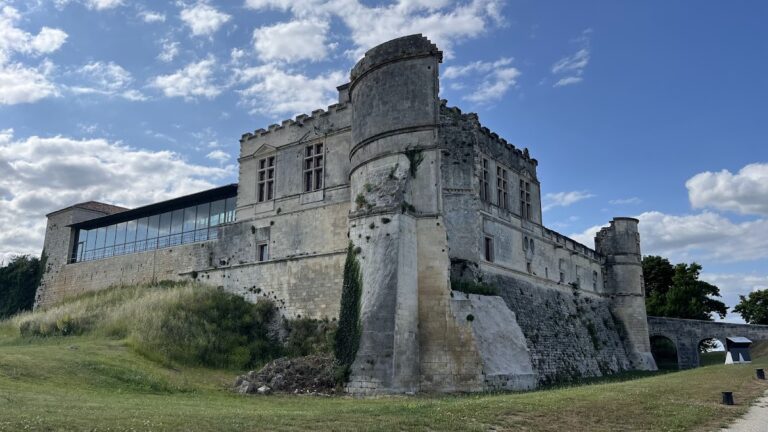
The surviving complex occupies an island in the Charente between the villages of Vibrac and Angeac-Charente. Ruins overgrown with vegetation stand alongside a chapel, a bridge, and outbuildings. The former castle precinct formed a trapezoid oriented from south to north. Its shorter southern side contained the entrance, while the château itself closed the northern side.
Entrance and principal château
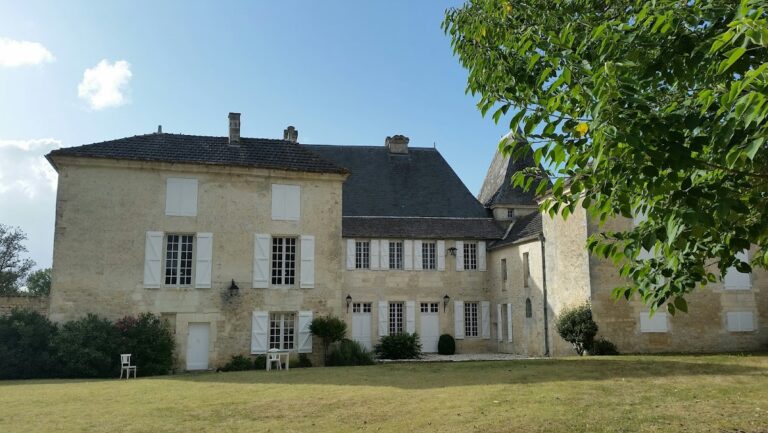
Eighteenth-century entrance façade
The surviving entrance façade dates from the eighteenth century, after the medieval castle had been rebuilt in the fifteenth century and altered during the seventeenth and eighteenth centuries. It has three basket-handle arches. Above them, the façade formerly carried a terrace whose balustrade was still in place at the beginning of the twentieth century.
Medieval tower and eastern wing
At the level of the left wing stands a medieval square tower containing a spiral staircase. The tower is divided vertically into two parts. Another tower was partly incorporated into the eastern wing, where it survives with a substantial section of the former château wall.
Former forecourt and recorded layout
Round towers and forecourt
Claude Chastillon’s depiction of the château in Topographie française, produced around 1610, presents a fifteenth-century castle flanked by round towers and preceded by a forecourt. Chastillon was a French topographer and engraver whose illustrated survey recorded towns, castles, and other sites in early modern France.
Pavilions and surviving walls
The forecourt was bordered by low buildings. Square pavilions with pyramidal roofs stood at the corners. Jean-Paul Gaillard identified the three pavilions shown by Chastillon, while also noting that the distance between the two front pavilions was exaggerated in the depiction. His identification also included several walls of the former château, including the substantial wall and partly incorporated tower that remain in the eastern wing.
Later architectural works
Two staircases covered by domes and the balustraded terrace point to eighteenth-century works associated with the Duke of Navailles. These alterations were comparable to works carried out at Château de Villebois-Lavalette, another estate connected with the lords of Vibrac and Angeac. Together with the later entrance façade, they show how the medieval fortified complex was adapted before it eventually fell into ruin.
Nearby sites