Château de Ventadour: A Medieval Castle in France


Site at a Glance
- Rating
- 4.4
- Popularity
- Low
- Country
- France
- Primary era
- Medieval
- External website
- Open
- Eras represented
- Medieval, Early Modern
- Civilizations
- French
- Site type
- Military
- Remains
- Castle
On this page13 sections
History
Château de Ventadour is a ruined medieval castle in France, southeast of Meyras, founded in the eleventh century when the fief of Meyras belonged to the Solignac family. Developed in medieval architectural traditions and repeatedly remodeled, it occupied a rocky position above important river confluences and routes between the Rhône Valley and the Massif Central. Its original name was Château de Meyras.
Solignac and Montlaur lordship
The early history of the fief is tied to the Solignac and Montlaur families. In 1185, Pons III de Montlaur, baron of Aubenas, married Miracle de Solignac. In 1195, her brother Béraud II de Solignac, lord of Meyras, transferred the fief to the couple. Another tradition attributes the transfer to Béraud I, who supposedly sold it to Pons III for thirty marks.
Pons III and Miracle’s descendant, Pons VI de Montlaur, left no children from either of his marriages. In 1272 he bequeathed Château de Meyras to his nephew Guigues IV de la Roche, the son of Jordane de Montlaur. The castle consequently entered the inheritance of the Roche-en-Régnier family before passing to the Lévis family at the end of the fourteenth century.
The Lévis inheritance
Philippe II de Lévis, vicomte of Lautrec, had married Jamague de la Roche-en-Régnier, heiress of Meyras and other lordships. Their descendants included Philippe III de Lévis, Philippe IV de Lévis, and Louis de Lévis. Louis died in 1521, leaving the castle to his son Gilbert I de Lévis-Ventadour. After Gilbert’s death in 1529, his widow Jacqueline du Mas de Lisle spent her widowhood at the castle, but later owners did not live there.
Gilbert II de Lévis followed Francis I and Henry II to the royal residences at Amboise and Fontainebleau. He instead established himself at La Voulte, where he enlarged his residence, and died in 1547. His son Gilbert III de Lévis-Ventadour married Catherine de Montmorency in 1553, became duke of Ventadour in 1578, and was made a peer of France, a high-ranking noble title, in 1589.
During the Wars of Religion, the conflicts between Catholics and Protestants in France from the 1560s to the 1590s, Gilbert III supported the moderate Catholic Montmorency faction against the Guise faction. François de Langlade served as his bailiff for Meyras-Ventadour. A bailiff administered justice and authority for a lord. Langlade was a Huguenot, meaning a French Protestant, and also acquired the Château de Hautségur at Meyras. Gilbert III died at La Voulte in 1597.
Seventeenth-century defense and decline
Anne de Lévis-Ventadour, Gilbert III’s son, married Marguerite de Montmorency in 1593 and died in 1622. Château de Meyras then became Marguerite’s dower property. In the same year, Gilbert de Vincentis defended it against a surprise assault led by his brother-in-law, Captain Barbier, who died during the attack. Annet de Vincentis later held the castle but did not reside there.
The castle had been preventively dismantled after the Edict of Nantes, the 1598 measure that granted limited rights to French Protestants. After Marguerite’s death, her son Henri de Lévis sold the lands and lordships of Jaujac and Meyras on 1 March 1663 to Claude-François de Saint-Vidal, lord of Choisinet. Ownership then passed through Christophe de Choisinet, Marie-Félicie de Launay, Jules de Launay, and Emmanuel de Launay, Count of Antraigues. The Choisinet and Launay families did not live at the castle.
An inventory from 1673 already described the castle as dilapidated. Its abandonment probably began during the eighteenth century. During the French Revolution, it was described as an old ruin that had produced no income since its destruction more than a century earlier. In 1794 it was sold as émigré property, meaning property confiscated from people who had left France during the Revolution, to André Soboul of Pont-de-Labeaume and Bernard Dusserre. Dusserre became sole owner and sold it to Louis-Hippolyte des Arcis in 1811, who sold it to Salomon Croizier in 1845.
Ventadour name and modern restoration
The name Château de Ventadour appears in the title of a painting dated 1818 and in Meyras’s cadastral register around 1830. A cadastral register records land parcels and ownership for taxation and administration. The name came from the marriage in 1472 of Louis de Lévis, baron of La Roche-en-Régnier and Annonay and holder of Meyras, to Blanche de Ventadour, heiress of the castle of Ventadour in Corrèze. Their branch thereafter used the name Lévis-Ventadour.
After purchasing the castle in 1846, the Marquis Sosthène de Chanaleilles, a distant descendant of the Langlade family, carried out restoration work until 1882. He stopped because of the scale of the undertaking. The property then passed to his daughter Marie-Isabelle, wife of Albéric de Marcieu, and remained with the Marcieu family until Amédée de Marcieu’s widow sold it to Pierre Pottier in 1968.
After the Revolution, the castle was extensively quarried for stone. Paintings by Adrien Joly de la Vaubignon, commissioned by Louis XVIII and dated 1818, and by Jules Thibon, dated 1860, show its nineteenth-century condition, although the earlier painting is partly romanticized. Since 1969, Pierre and Françoise Pottier and successive volunteer groups working through Union REMPART, a French organization associated with heritage-restoration work camps, have undertaken restoration and reconstruction. In 1997, the regional cultural affairs authority stopped its subsidies because it judged that the work had become reconstruction rather than restoration. The castle has been listed as a French historic monument since an order dated 4 May 1937.
The castle’s position gave it control over routes between the Rhône Valley and the Massif Central, including routes leading toward Le Puy through the Pal and Chavade passes. Its setting above the river confluences and near the Neyrac springs, where leprosy was treated during the Middle Ages, added to its strategic importance. It has also been identified as a possible toll castle. A medieval bridge called the Pourtalou, slightly upstream from the Fontaulière and Ardèche confluence, is being investigated as a possible toll crossing linking the left-bank road with the castle.
Remains
Rocky spur and castle plan
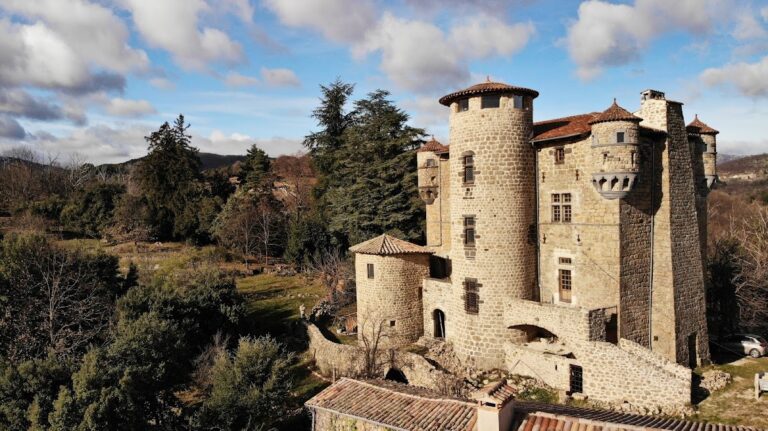
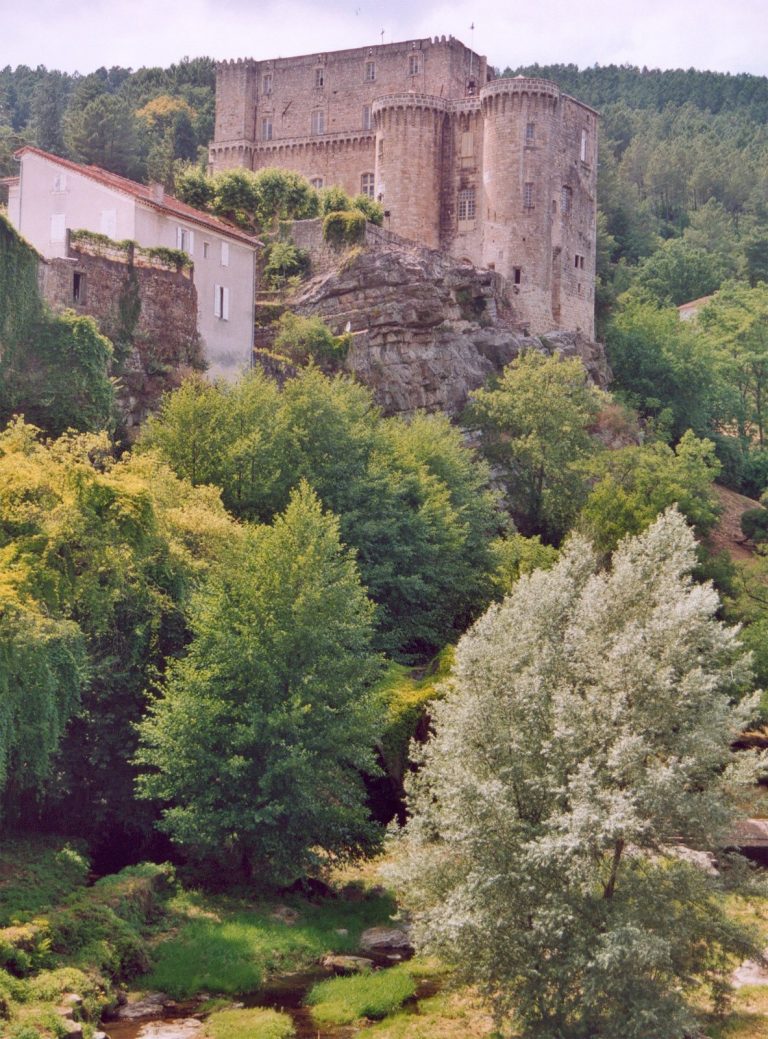
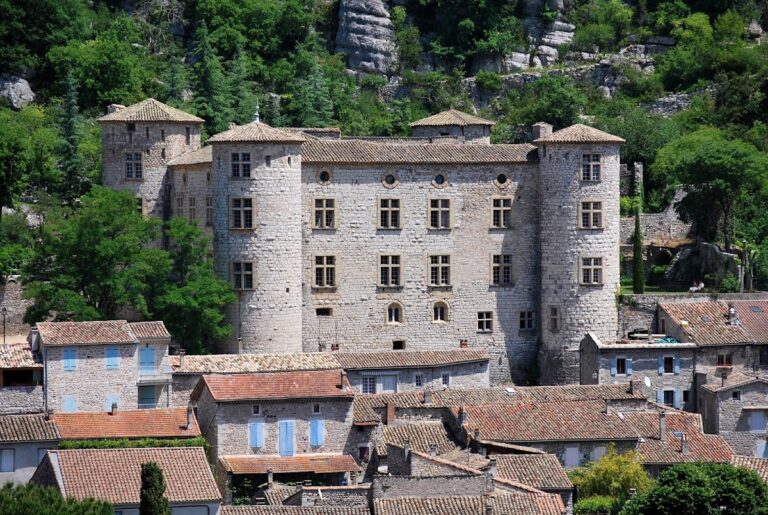
The ruined castle stands at approximately 373 metres above sea level on a rocky spur above the confluence of the Fontaulière and Ardèche rivers, near their confluence with the Lignon. Its development extended over at least five centuries, and successive constructions are interwoven, with some alterations possibly belonging to the same century. The plan follows the Savoy castle model, sometimes called a Savoy square, in which a square keep is attached to the surrounding wall. The square keep is regarded as the oldest construction.
Fortifications and buildings
Keep and towers
The castle includes a square keep, compact towers, crenellations, two pigeon lofts, and a fortified gateway. A pigeon loft housed pigeons. At the northwest corner, a square tower contains vaulted rooms. A square tower at the southwest corner is topped by two bartizans, projecting defensive turrets, and is tentatively attributed to work of the fourteenth century.
Enclosures and entrances
Three enclosures organize the fortification. The outer enclosure extends for approximately 350 metres and defines a lower courtyard. The innermost fortification was reached by a drawbridge. The southern fortification had one entrance, while the third enclosure, which completely surrounded the castle, had three gates and may have had a fourth gate on the north if the Pourtalou route is confirmed. A western postern, or small secondary entrance, was surmounted by a small watch post.
Routes and surviving approach features
Connections with Meyras
Two principal routes connected the castle with Meyras. One ran south through the places now called Les Portes and Le Meynades, while the other ran north through Le Pradel and Sabastier. Both began at the two major gates of the outer enclosure.
Pourtalou path
The Pourtalou path climbed the northern face of the rocky spur toward the castle. Remains of a paved route, occupation and construction traces, and retaining structures are scattered across the slope, which has not yet been fully surveyed. The medieval bridge of the same name remained mentioned in the sixteenth and seventeenth centuries, was destroyed by a flood in 1751, replaced by a wooden bridge in 1752, and later superseded by the nearby Rolandy bridge.
The exact medieval route of a direct pedestrian path from the western postern remains under study. The present path ends at the outskirts of Meyras on a road created in the late nineteenth or early twentieth century, which does not appear on the Napoleonic cadastral map. The surviving and restored castle fabric has been shaped by the restoration and reconstruction campaigns begun after 1969, while the nineteenth-century paintings preserve evidence of its earlier ruined appearance.