Château de Tencin: An Eighteenth-Century Pleasure Château in France


Site at a Glance
- Rating
- 4.2
- Popularity
- Very Low
- Country
- France
- Primary era
- Early Modern
- Eras represented
- Early Modern
- Civilizations
- French
- Site type
- Domestic
- Remains
- Elite Residence
On this page8 sections
History
The feudal château
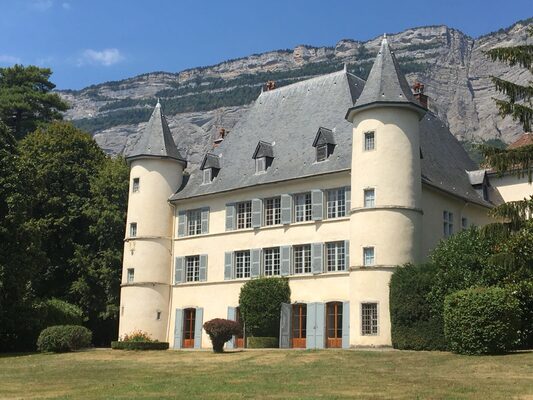
Château de Tencin is an eighteenth-century pleasure château in Tencin, France, commissioned as a seigneurial residence by Louis François de Monteynard in 1775. It is also known as Château de Cruzille and Château de Monteynard. The present building occupies the ruins of an earlier feudal château that belonged to the local lords of Tencin.
Among those associated with the earlier estate was Antoine Guérin, Lord of Tencin, who served successively as a counsellor of the Parlement and first president of the Senate of Chambéry. The feudal château was burned by Protestants during the French Wars of Religion, a series of conflicts between Catholics and Protestants in France.
Construction and interrupted completion
Louis François de Monteynard, who had served Louis XV as secretary of state for war, ordered the construction of the present château on the earlier ruins. The plans were prepared by the architect Jourdan du Mayard, and their drafting was entrusted to a Parisian whose grandfather was Jules Hardouin-Mansart, a leading architect of Louis XIV’s reign.
Interior work began in 1783, but the château remained unfinished after the French Revolution. It was then converted into a military warehouse, a use that protected the building from destruction. Monteynard himself never lived there. His heirs completed the château and occupied it during the First French Empire, Napoleon Bonaparte’s imperial regime from 1804 to 1814, with a brief restoration in 1815.
Later ownership and preservation
After remaining with the Monteynard family, the property passed to an industrialist who was chief executive of Papeteries de France and, from 2013, to a Mauritian businessman. The château and its park were listed as historic monuments by an order dated 5 October 1946.
The association La vie du château de Tencin works to safeguard the tangible and intangible historical heritage of the château and its estate.
Remains
Façade and entrance
The principal façade has the balanced character of eighteenth-century architecture. Its central projecting section is crowned by a triangular pediment bearing the arms of the two branches of the Monteynard family. In front of the façade stands a double corbelled staircase in the Fontainebleau style, installed in 1840.
Terrace and park
The original formal garden followed the French style, with symmetrical geometry, a large circular parterre, and a bridge positioned in front of the château. A parterre is a formal arrangement of geometrically shaped planting beds, commonly viewed from an elevated terrace. The terrace is the surviving element of that original garden. It opens onto a landscaped park whose lawns are planted with cedars.
Interior
Inside the château is a small green Louis XV salon decorated with Cordovan leather, a type of ornamental leather associated with Córdoba and used in furnishings and other crafted objects.