Grande Chartreuse: The Mother House of the Carthusian Order


Site at a Glance
- Rating
- 4.4
- Popularity
- Medium
- Country
- France
- Primary era
- Early Modern
- External website
- Open
- Eras represented
- Medieval, Early Modern
- Civilizations
- French, Holy Roman Empire
- Site type
- Religious
- Remains
- Monastery
On this page18 sections
History
Grande Chartreuse is the first monastery and mother house of the Carthusian Order in France, located in the commune of Saint-Pierre-de-Chartreuse at the foot of Grand Som. Founded in 1084 as a community of hermit-monks, it became the central house of an order that combines solitary life in individual cells with limited communal worship and work.
Foundation in the Chartreuse valley
Tradition places the foundation on 24 June 1084, the feast of John the Baptist, whose patronage was consequently adopted by the monastery. Bruno and six companions settled in the isolated valley under the guidance and protection of Hugues, bishop of Grenoble. The group included the laymen André and Guérin and four clerics, Étienne de Bourg, Étienne de Die, Hugues, and Laudouin.
Bruno remained at Chartreuse until 1090, when Pope Urban II summoned him to Rome. He later established another hermit community in Calabria and died there in 1101. On 9 December 1086, Bishop Hugues confirmed earlier gifts made by the lords who owned the land. The original endowment covered about 1,700 hectares and grew through subsequent donations.
The monks’ determination to protect their solitude created friction with neighboring communities. Their refusal to allow women to cross the lands and their expropriation of nearby tenants resulted in tensions, violent disputes, and litigation. The early settlement was divided between an upper house for the prior, choir monks, and one or two brothers, and a lower house, or Correrie, about four kilometers away for lay brothers, workshops, and other dependencies.
Because cultivation and grazing were impractical around the upper house, the brothers travelled there each Saturday for Sunday worship and communal life. This arrangement reflected the Carthusian system, in which choir monks lived largely as hermits while lay brothers carried out much of the practical work supporting the community.
Destruction and rebuilding in the twelfth century
On 30 January 1132, a catastrophic fall of rock and snow destroyed almost all of the first monastery and killed six monks and a novice. The event has traditionally been called an avalanche, although it is also understood as a rockfall that drove a large mass of snow down the valley.
After the disaster, Prior Guigues chose a new location about two kilometers farther down the valley. The site was more open and sunnier, closer to the lower house, and better protected from falling rock and avalanches. The monastery built there became known as the monastery of Guigues.
Construction advanced quickly. The church was consecrated on 13 October 1133 by Hugues, a former Carthusian who had succeeded Hugues of Grenoble as bishop. Guigues had also compiled the Carthusian customs in 1127, establishing a framework that balanced individual solitude with shared worship and work. The new church and chapter house were built in stone, while about twelve cells were constructed from wood.
Fires and the present monastery
The monastery of Guigues suffered eight fires between 1320 and 1676, in 1320, 1371, 1473, 1510, 1562, 1592, 1611, and 1676. Most began in chimneys. The fire of 1562 was deliberately started by troops of the Baron des Adrets during the Wars of Religion, the sixteenth-century conflicts between Catholic and Protestant forces in France.
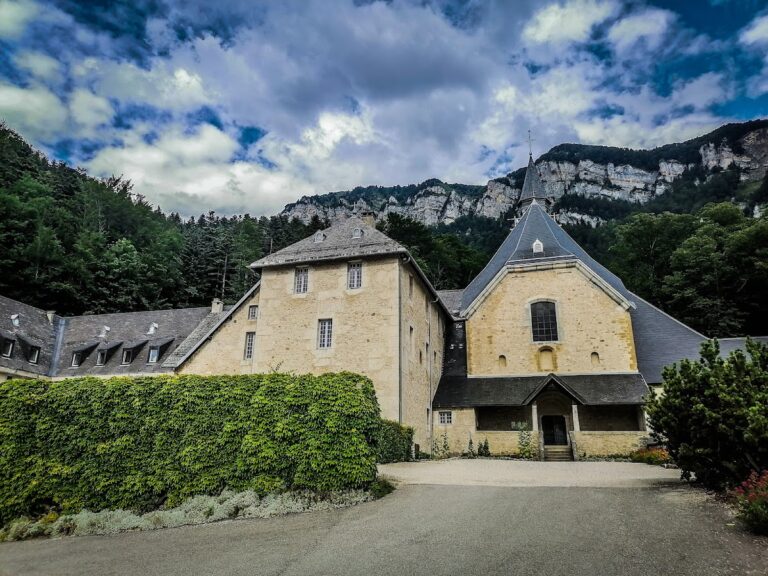
Limited firefighting resources and highly combustible spruce-wood roofing caused the destruction of nearly all burnable material in several of these disasters. After the fire of 1676, Prior Innocent Le Masson rebuilt Grande Chartreuse according to a new architectural plan. The present complex is generally dated to 1688.
Revolution, restoration, and twentieth-century expulsions
The French Revolution suppressed the community. Decrees issued on 2 November 1789 placed church and congregational property at the disposal of the nation, while the decree of 13 February 1790 prohibited monastic vows and dissolved regular religious orders. Nicolas-Albergati de Geoffroy, the order’s minister general, left Grande Chartreuse on 17 October 1792. The community disappeared, and no Carthusian house remained in France.
During the revolutionary seizures, the monastery’s library was progressively transferred to Grenoble. Its approximately 400 manuscripts and 3,500 printed works included about 300 incunabula, books printed in Europe before 1501. Among them were the Bible of Notre-Dame de Casalibus, dating from before 1132, and a twelfth-century gradual containing liturgical music for worship and the refectory. The collection was delivered to Grenoble by 1813, where it is preserved and studied, with digitized material available through the Pagella platform.
A royal ordinance of 27 April 1816 granted the order a lease of Grande Chartreuse as a place of retreat. Romuald Moissonnier returned on 16 July 1816 with several religious and restored regular monastic life. An imperial decree of 1857 created a protected reserve around the monastery to safeguard the landscape and the monks’ tranquillity.
The Carthusians avoided the first expulsions of unauthorized male congregations in 1880, but their request for authorization under the 1901 Associations Law was rejected by the Chamber of Deputies on 26 March 1903. The monks were forcibly expelled on 29 April and took refuge at Farneta in Italy. They did not return to Grande Chartreuse until 1940.
The entire monastery was classified as a historic monument on 14 November 1912. The state owns the buildings, while the religious community occupies them under a lease and carries out routine maintenance.
Return, protection, and continuing religious use
As war approached between Italy and France in 1940, Minister General Ferdinand Vidal arranged the community’s return. Religious reoccupied the complex on 29 May, although the mayor of Saint-Pierre-de-Chartreuse temporarily requisitioned it to shelter refugees. Three fathers formally took possession on 21 June. A law of 21 February 1941 recognized the Carthusians in France, and an agreement of 11 March 1941 with the Vichy administration’s fine-arts authorities allowed restoration to proceed quickly.
During the Second World War, the community sheltered Jews and other persecuted people. After the war, it also sheltered former collaborators and militiamen. Allied forces later used the complex as a hospital.
After 1945, growing tourism and improved roads threatened the isolation on which Carthusian life depended. The surrounding area was protected as a historic and natural site, tourist-aircraft overflights were prohibited, and motor traffic was halted about 1.5 kilometers from the monastery. These measures helped preserve the desert and zone of silence around the house. From 1947, Grande Chartreuse again hosted the order’s general chapter every two years.
The Correrie now contains a museum explaining Carthusian history and monastic life, while the cloistered monastery remains closed to visitors in keeping with the order’s commitment to solitude. The prior of Grande Chartreuse is also the minister general, the senior governing officer of the Carthusian Order. Dysmas de Lassus was elected to both offices in 2014 after François-Marie Velut resigned for health reasons.
Economic, cultural, and international connections
The community’s historical economic activities included sheep raising, limited cultivation, iron mining, and forging. Iron extraction, including at the Col de Bovinant, began in the twelfth century and continued until the Revolution. This work sometimes led to disputes with the Duke of Entremont.
Chartreuse liqueur later became a major source of income. In 1605, François-Annibal d’Estrées, a French marshal, entrusted the monks with the formula that was subsequently developed into the liqueur. Production and sales supported Grande Chartreuse, other Carthusian houses, extraordinary expenses, and charitable or religious projects. The order sold 1.5 million bottles in 2015.
Grande Chartreuse has also influenced literature. Chateaubriand, Stendhal, Honoré de Balzac, Alexandre Dumas, Léon Bloy, Matthew Arnold, and Antoine Godeau were associated with the monastery in their writings. Stendhal drew partly on it for The Charterhouse of Parma, while Arnold wrote Stanzas from the Grande Chartreuse. In 1999, two monks from Grande Chartreuse travelled to Seoul to establish the Notre-Dame de Corée Charterhouse, now located at Sangju in South Korea.
Remains
Grande Chartreuse consists of the rebuilt monastery established after the 1676 fire and the lower-house complex known as the Correrie. The earlier settlement lies about two kilometers above the present monastery, near the Chapel of Saint Bruno. Its physical arrangement is known from archaeological evidence and later descriptions, while the surviving complex reflects the rebuilding plan introduced by Innocent Le Masson.
The first monastery site
Early upper house
The first upper house probably consisted mainly of wooden buildings, with a stone conventual church. Its arrangement included grouped individual cells, a separate cloister, a church, chapter house, refectory, kitchen, and a building that may have accommodated some of the lay brothers on Sundays. Around 1114, Guibert of Nogent described conduits bringing running water into the cells. The exact original layout remains uncertain and was probably substantially different from the present arrangement because of the terrain.
Notre-Dame de Casalibus
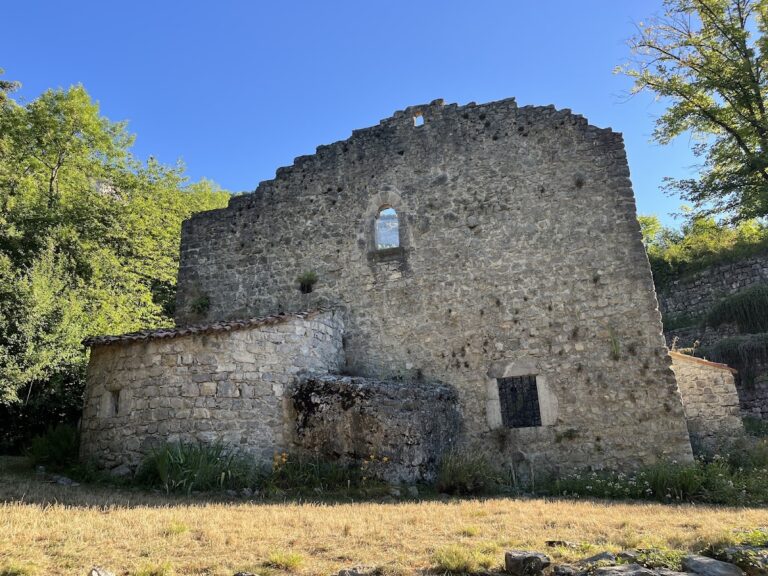
Notre-Dame de Casalibus, meaning “Our Lady of the Cabins,” stands downstream from the former upper house. Built in the fifteenth century beyond the reach of avalanches, it lies about 110 meters from the Chapel of Saint Bruno. In the seventeenth century, the Grande Chartreuse community went there to sing Mass three times each year.
Chapel of Saint Bruno
The Chapel of Saint Bruno stands upstream beside a prominent rock, probably close to the location of the original monastery. A relatively level platform beside it measures about 80 meters in diameter. Scattered rocks may be remnants of the 1132 catastrophe, although that interpretation cannot be verified without archaeological excavation.
The monastery of Guigues
Twelfth-century church and chapter house
The monastery founded by Guigues was built two kilometers below the first settlement. Its stone church has since been absorbed into later buildings. The chapter house, the room used for monastic governance, discipline, and religious business, retains its intact twelfth-century vault.
Later rebuilt complex
The post-1676 monastery follows the architectural plan introduced by Innocent Le Masson and is generally dated to 1688. Regional roofs originally used spruce-wood shingles or tiles called essendoles, a material that contributed to the severity of earlier fires. The Officers’ Cloister received roof repairs undertaken by the French state in 2021 as part of the continuing conservation of the protected complex.
The Correrie and museum collections
Lower house
The Correrie served as the lower house, containing the lay brothers’ quarters, workshops, and other dependencies. Part of the complex now houses the museum of Grande Chartreuse, where reconstructed cells illustrate the organization of Carthusian life.
Paintings and historic books
The museum presents the collection of Chartreuse maps, paintings of Carthusian monasteries produced from the late seventeenth century onward. In 1957, it also received sixteen paintings based on The Imitation of Christ, donated by the family of the painter Charles-Henri Michel. The monastery’s former library included Bibles dating from the eleventh to the fifteenth centuries, liturgical graduals, and a copy of Gratian’s Decretum. These books were removed during the Revolution and are preserved in Grenoble rather than at Grande Chartreuse.