Château de Rosières: A Historic Castle in Saint-Félicien, France


Site at a Glance
- Rating
- 4.4
- Popularity
- Very Low
- Country
- France
- Primary era
- Medieval
- External website
- Open
- Eras represented
- Medieval, Early Modern
- Civilizations
- French
- Site type
- Military
- Remains
- Castle
On this page11 sections
History
Château de Rosières is a historic castle in France, near Saint-Félicien, whose principal building was probably constructed largely during the fifteenth century. Local tradition, cited by the Ardèche regionalist poet Charles Forot, places the castle’s origins in the twelfth century. Its earliest surviving written reference dates from 1302, when Jean de Châteauneuf, a young nobleman not yet formally knighted, paid homage to Alexandre de Saint-Didier, lord of Saint-Didier and Rochefort, for his fiefs and sharecropping farms at Rozési within the territorial jurisdiction of Rochefort.
Medieval origins and reconstruction
Château de Rosières was probably badly damaged during the Hundred Years’ War, a prolonged series of conflicts between the English and French crowns fought from the fourteenth into the fifteenth century. In 1477, Jean de Châteauneuf’s descendants sold the land of Rosières to Dragonnet de Burine, also known as Bury, a notary from Boucieu-le-Roi. The principal castle was probably built largely in the fifteenth century, following the period in which the estate had suffered wartime damage.
Religious conflict and royal service
The estate entered the conflicts between Catholic and Protestant forces in the late sixteenth century. On 12 January 1580, Pierre de Rosières received a commission from Marshal de Montmorency to raise a company at Désaignes to oppose Protestant influence in the region. The following year, Pierre became the king’s governor of the town and castle of Désaignes.
In December 1587, the Protestant army of François de Châtillon, retreating after the Battle of Vire-Culs, fought a skirmish near Château de Rosières against the Rosières company. The army subsequently took refuge at Château de Retourtour in Lamastre. On 3 April 1628, Pierre’s son Christophe de Rosières received a commission from the Duke of Levis-Ventadour to raise a company of 50 men for royal service in the Vivarais, the historic region broadly corresponding to part of modern Ardèche.
Lordship and family succession
On 5 December 1637, Christophe obtained the elevation of the Rosières fief into an independent lordship, created by the dismemberment of the lordship of Rochefort. This gave him high and low justice, meaning authority over the most serious offenses and lesser civil and criminal matters, respectively. The lordship also carried the right to levy cens and double cens, forms of feudal dues, together with rights of watch and ward concerning defensive watch and guard obligations.
Christophe’s son Charles became abbot of Bonnevaux Abbey, holding the position from 1643 to 1690. The estate then passed to Charles’s sister, Magdeleine-Marthe, who brought it as her dowry when she married Antoine de Reboulet in 1654. Antoine was lord of La Bâtie d’Andaure, Ruissas, Boucieu, and Monteils.
The property later passed to their son Charles de Reboulet, who died in 1717 and left it to his sister Marie-Magdeleine under a substitution clause benefiting his nephew and godson, Charles de Reboulet. The younger Charles murdered his aunt, after which the castle passed to another nephew, Henri-César de Lestrange, Marquis of Grozon.
Henri-César’s daughter Catherine Claudine married Charles de Romanet, Baron of Beaudiner, on 3 July 1743. Through this marriage, she brought him the property of the Lestrange, Reboulet, and Rosières families. Their son Louis Charles César later became a brigadier general of the First French Republic, the republican regime established in France in 1792 after the monarchy was abolished.
The name Rosières appears in several forms, including Rozière, Rouzières, and Rouziers. It derives from Occitan, a Romance language historically spoken across parts of southern France and neighboring regions, and means “a place planted with roses.”
Remains
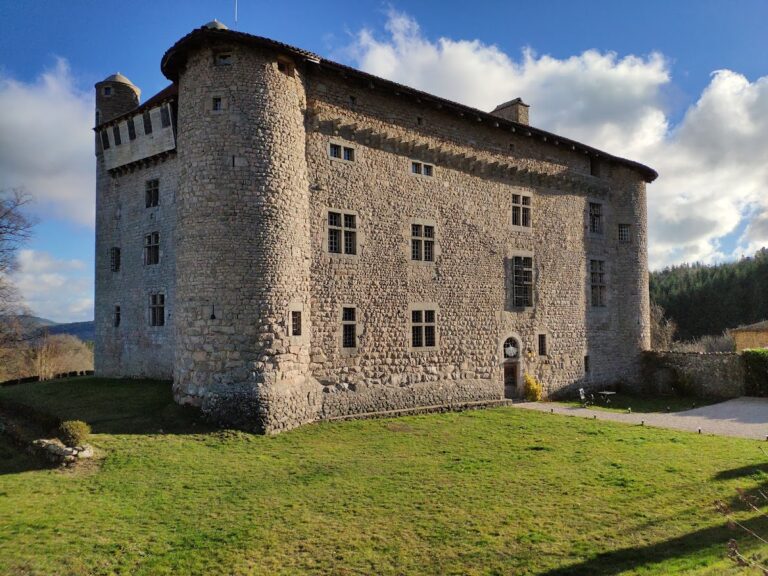
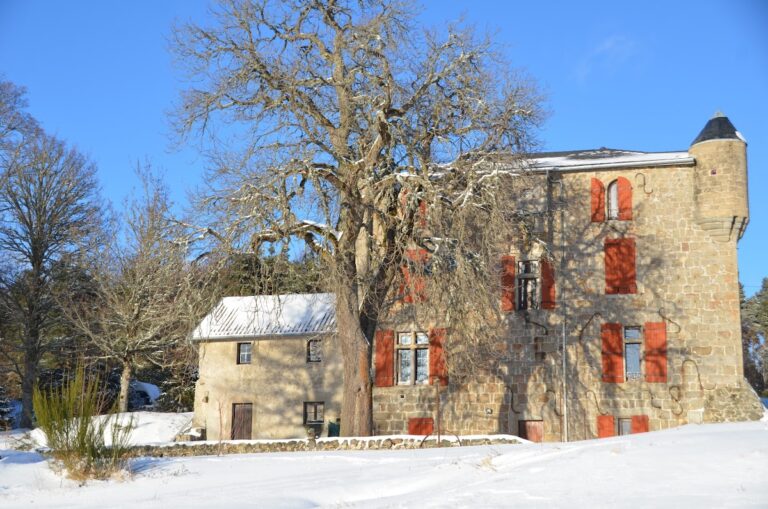
Château de Rosières stands on a rocky promontory about 2 kilometres from Saint-Félicien, above the Daronne valley. The site includes a semicircular earthwork approximately 160 metres in diameter, the principal castle with northern towers, a northern farm building with another tower, and a seventeenth-century chapel on the eastern side. Terraced gardens occupy parts of the earthwork, whose remnants preserve elements of the site’s fortified layout.
Fortified enclosure and castle
Semicircular earthwork
A semicircular earthwork surrounds the castle for approximately 160 metres in diameter. It contains remnants of fortifications and has been adapted into terraced gardens. Its broad curved boundary forms the outer defensive setting of the surviving buildings.
Principal castle
The principal castle was probably built largely during the fifteenth century. Two towers stand on its north side, and the building may have received two additional storeys at the end of the eighteenth century. The castle occupies the rocky promontory above the Daronne valley, with views west toward Pailharès, south toward the tenth-century Rochefort observation tower, and east toward the Rhône valley, the Vercors, and the Écrins.
Northern farm building
A farm building on the north side has its own tower. This tower may preserve an element of the original castle dating from the twelfth or thirteenth century, linking the later principal building with the earlier phase attributed to the site.
Eastern religious building
Seventeenth-century chapel
A chapel dating from the seventeenth century stands on the eastern side of the site. It forms a separate religious structure within the castle complex and belongs to the period when the Rosières estate had become an independent lordship.