Rowallan Castle: A Medieval Scottish Castle and Estate


Site at a Glance
- Rating
- 4.8
- Popularity
- Very Low
- Country
- United Kingdom
- Primary era
- Early Modern
- Eras represented
- Medieval, Early Modern
- Civilizations
- Kingdom of Scotland
- Site type
- Military
- Remains
- Castle
On this page12 sections
History
Rowallan Castle is a historic castle and estate in Scotland, United Kingdom, situated on the Carmel Water in East Ayrshire. Occupation at the site reaches at least the mid-12th century, when a substantial stone structure was built, and the castle is traditionally thought to have origins in the 13th century. Its ownership and tenure later passed through the medieval Mure family, the Boyle Earls of Glasgow, the Campbell Earls of Loudoun, and the Corbett Barons Rowallan.
Medieval foundations and the Mures
Archaeological investigation has identified wooden support posts beneath the earliest stone building, indicating that timber construction preceded it. The substantial stone structure was first recorded in 1263. In the late 14th century, a tower house, a fortified Scottish residence centred on a tall compact stone tower, was built over its foundations. The building was remodelled and enlarged in the early 16th century, while the earlier foundation survived up to first-storey level.
Rowallan is associated with Elizabeth Mure, who may have been born there. She was the mistress and later wife of Robert, High Steward of Scotland and Guardian of Scotland, who subsequently became King Robert II of Scotland. John Mure of Rowallan was killed at the Battle of Flodden in 1513, and the estate assumed its present form during that year.
Sixteenth- and seventeenth-century development
The southern front was erected around 1562 by John Mure of Rowallan and his wife, Marion Cuninghame of Cunninghamhead. Sir John and Sir William Muir were associated with different parts of the building, and a record was kept of completed work. They also devoted considerable attention to planting the estate’s designed grounds, known in Scotland as its policies.
William Mure built Dalmusternock House in 1615 as a dower house after his marriage to Anna Dundas. A dower house was a residence connected with the financial arrangements of a marriage and commonly provided for a married woman or widow. Tradition also associates Rowallan with a visit by King James I of Scotland while he travelled from Edinburgh towards England. Another tradition holds that the earliest lute music was written at Rowallan.
Rowallan and the Covenanters
Sir William Mure was an ardent Covenanter. The Covenanters were Scottish Presbyterians who opposed royal and episcopal control of the Church of Scotland during the 17th century. Mure opposed the execution of Charles I, wrote an elegy on the king’s death, allowed conventicles to meet at Rowallan, and protected his tenants as far as possible from government troops. Conventicles were often-illegal religious gatherings held outside officially authorised church structures. Mure was imprisoned several times because of these activities, while William Guthrie of Fenwick preached on several occasions in the castle’s “Auld Kirk.”
During the 1640s, Alasdair Mac Colla, a military commander sent by Montrose to suppress support for the Covenanting cause, used Kilmarnock as a base while plundering the Ayrshire countryside. Rowallan suffered considerable damage. Sir William Mure was fined 1,000 merks for preventing further plundering at the estate. A merk was a historical Scottish unit of money used in monetary assessments and fines.
Decline, repair, and changing ownership
The Campbells of Loudoun occupied the estate from about 1690 into the 19th century. Between the late 17th and mid-18th centuries, the castle was used intermittently and increasingly deteriorated. Several vaults later collapsed, partly because stone was removed from the building. The Hearth Tax records of 1691 listed 22 hearths in the castle and 18 other dwellings connected with the castle and its lands.
The 10th Countess of Loudoun was particularly attached to Rowallan and spent substantial sums repairing it during the 19th century. Her work helped the building survive into the modern period. In 1989, ownership returned to the Campbell family when Niall Campbell purchased the castle. The building was removed from the guardianship of Historic Scotland in 2015 after a protracted and controversial legal process.
Rowallan Castle was placed in Category A of Scotland’s listed buildings in 1971. Category A is the highest grade of statutory listing for buildings of special architectural or historic interest in Scotland. The estate was added to the Inventory of Gardens and Designed Landscapes in Scotland in 1987. In June 2015, consent was granted for the castle’s conversion to guest accommodation, subject to conservation and monitoring conditions. After the change of use, listed-building designation was to take precedence over scheduled-monument status, with conservation matters becoming the responsibility of the local authority.
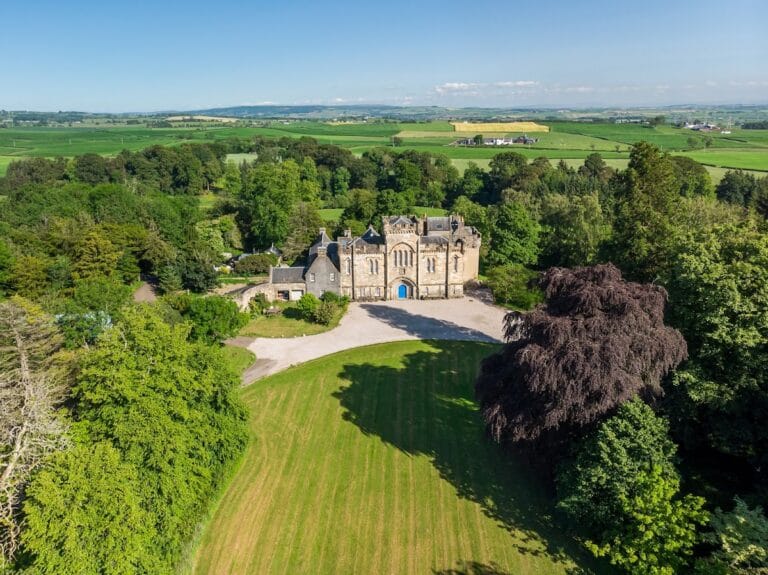
A second castle on the grounds was modernised and its surroundings were relandscaped between 1902 and 1906 by Sir Robert Lorimer after the estate was acquired by Archibald Corbett, a property developer and Liberal politician. The earlier 16th- and 17th-century castle was retained within the wider estate complex. Charles Rennie Mackintosh is said to have modelled Scotland Street School in Glasgow partly on Rowallan Castle and Falkland Palace.
Remains
Rowallan Castle is arranged around a small knoll that formerly stood within a small loch or swampy area fed by the Carmel Burn. The Carmel Water may once have flowed much nearer the eminence, a circumstance that may explain the older name “Craig of Rowallan.” The surviving complex incorporates the early stone structure, the later tower house, the enlarged castle, and associated estate features.
The medieval and early modern castle
Early tower and southern front
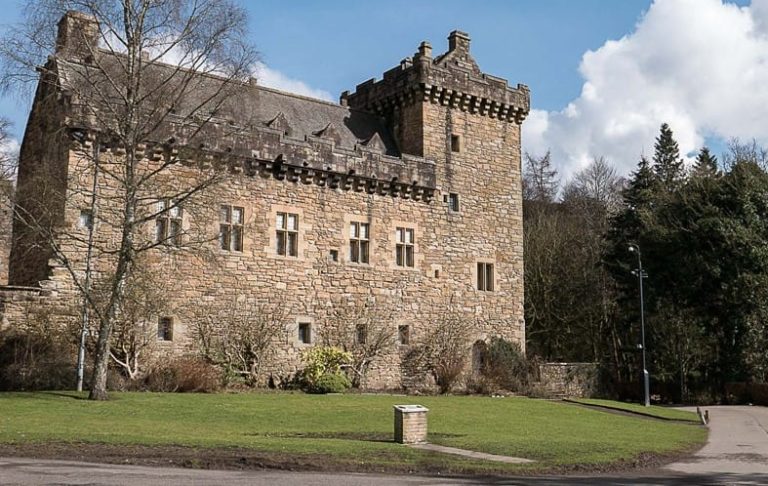
The late-14th-century tower house was probably a square-plan, three-storey building of rubble stone. Its foundations were retained up to first-floor level when the structure was remodelled and extended in the early 16th century. Later restoration followed periods of decline and structural collapse, and the original castle remains intact within the wider estate complex.
The southern front carries a marriage inscription dated 1562, naming John Mure and Marion Cuninghame. A family coat of arms is carved beside the inscription, with a sculpted Moor’s head and the Mure family crest nearby. The Moor’s head may be a rebus, or visual wordplay, on the name Mure. It has also been interpreted as a possible reference to an exploit during the Crusades.
Entrance and interior rooms
The main entrance bears the Royal Arms of Scotland, together with shields of the Cumin family, from whom the Mures claimed descent. A stone above the ornamented gateway carries the date 1616. Above the porch doorway is a Hebrew inscription translating as “The Lord is the portion of mine inheritance and of my cup,” from Psalm 16, verse 5. Doctor Bonar, moderator of the Free Church of Scotland, deciphered and translated the inscription. The Free Church of Scotland is a Presbyterian denomination formed in the 19th century after a major division within the Church of Scotland.
Within the castle, a room known as Lord Loudoun’s sleeping apartment has been identified. Visitors inscribed names, addresses, poems, and accounts of their visits on the walls of rooms throughout the house. Another room, called the “Woman’s House,” has been identified as a rare space associated with women’s specialist work involving clothing and linen, offering evidence for gender-separated domestic activity within the castle.
Estate features and traditions
Mounting stones, wells, and gardens
The castle formerly had a loupin-on-stane, a stone mounting block placed beside a building or route to help riders mount horses. Rowallan also had a fine well with abundant pure water, while King William’s Well lies within the estate policies. The old garden contained a large box hedge, probably planted around 1687. It was still described as magnificent around 1817 and had greatly decayed by 1847.
Marriage tree and stair tradition
Near the castle, a tree known as the marriage tree stood above a chasm through which the Carmel runs, on a bank called Janet’s Kirn. Tradition holds that Dame Jean Mure of Rowallan married William Fairlie of Bruntsfield beneath the tree during a planned elopement, for which the suitor brought a minister.
A crack in the stair leading to the principal doorway is traditionally attributed to a rent made by the Devil. The crack is said to be most visible in wet weather. These traditions form part of the castle’s accumulated historical associations alongside its surviving masonry, inscriptions, rooms, and designed estate landscape.