Château de Rochechouart: A Medieval and Renaissance Castle in France


Site at a Glance
- Rating
- 4.2
- Popularity
- Medium
- Country
- France
- Primary era
- Medieval
- External website
- Open
- Eras represented
- Medieval, Early Modern
- Civilizations
- French
- Site type
- Domestic
- Remains
- Castle
On this page19 sections
History
Château de Rochechouart is a medieval and Renaissance castle in Rochechouart, France. It originated around 1000, when the Viscounts of Limoges fortified a rocky spur above the Graine. The complex developed under the Viscounts of Rochechouart, a noble family associated with the castle for about 800 years, and its present form largely reflects rebuilding after the Hundred Years’ War, the series of conflicts between the English and French crowns fought from 1337 to 1453.
Early Lords and Medieval Fortification
Until 1470, the castle’s castellany, meaning the territory and jurisdiction administered from a castle, was held as a fief by a junior branch of the Viscounts of Limoges. The Viscounts of Rochechouart were vassals of the Count of Poitiers. Aymeric VI of Rochechouart, who lived from 1170 to 1230, built the medieval castle, including its keep, the principal fortified tower, and its entrance châtelet, a fortified gatehouse controlling access to the castle.
The Rochechouart family also participated in wider military and political affairs. Aymeric IV joined the First Crusade, the late-eleventh-century expedition that captured Jerusalem in 1099. Aymeric IX took part in the French expedition to Aragon in 1283, while Simon and Jean I fought in Flanders in 1304 and 1328. Jean I fought at Crécy in 1346 and died at Poitiers in 1356 while defending King John II.
During the Hundred Years’ War, the castle became a centre of resistance to the English. Louis, chamberlain to Charles V, led this effort, followed by his son Jean II and his grandson Geoffroy, who was a companion of Joan of Arc. These military associations placed the castle within the regional and royal conflicts that shaped western France during the later Middle Ages.
Transfer of the Viscounty and Renaissance Rebuilding
In 1470, Anne, the only daughter of Viscount Foucaud de Rochechouart, married Jean de Pontville, chamberlain to Charles of France, Duke of Guyenne and brother of Louis XI. A chamberlain was a senior official responsible for aspects of a ruler’s household. Through this marriage, the viscounty passed out of the main Rochechouart family, although related branches of the family continued elsewhere.
After the war, the castle was enlarged and substantially rebuilt. The work took place especially in the late fifteenth and early sixteenth centuries, when Jean de Rochechouart-Ponville restored the residence in the Renaissance style. The transformation retained medieval defensive elements while creating a more spacious aristocratic residence.
The family’s fortunes suffered a severe reversal in 1512. François de Rochechouart-Pontville arranged the murder of Pierre Bermondet, lord of Boucheron and Saint-Laurent-sur-Gorre, because he wanted Bermondet’s lands. The royal legal case that followed ruined the Pontville family. Authorities ordered the keep levelled and the high timber forests cut, and François’s family had to build a funerary monument for the victim at Panazol. François was condemned to exile.
Other members of the family continued to hold military and courtly roles. Claude, François’s son, served as a companion-in-arms of Constable Anne de Montmorency, a constable being a high-ranking military officer. Claude was wounded and captured at the Battle of Saint-Quentin in 1557. Viscount Foucaud, who lived from 1440 to 1472, had served as an adviser to Louis XI, while Françoise-Athenaïs de Rochechouart, better known as Madame de Montespan, later became a favourite of Louis XIV.
The Lion Tower Tradition
A tradition associated with the castle concerns Aymeric VII and his wife, Alix. According to the story, an intendant falsely accused Alix of adultery. Aymeric supposedly confined her in a dungeon with a lion received during a Crusade expedition. When she was found alive with the lion lying at her feet, her innocence was accepted and the intendant was given to the animal. The tradition connects this episode with a stone lion set into the wall of the tower of the oubliettes, or underground prison chambers. The tower thereafter became known as the Lion Tower.
Revolution, Restoration, and Public Ownership
The castle was used as a prison in 1793, during the Reign of Terror, the period of revolutionary emergency and political repression in France. Revolutionary authorities also attempted to demolish it that year. They succeeded in removing the tops of the two towers framing the southeast façade. Viscountess Marie-Victoire de Rochechouart was arrested during the same period, imprisoned in Paris, and guillotined in 1794.
General Louis-Victor-Léon de Rochechouart, who lived from 1788 to 1858, served in the Napoleonic campaigns in Russia, Germany, and France, including the retreat and Battle of Berezina. Under Louis XVIII, he became a maréchal de camp, a senior army rank, and governed Paris from 1814 to 1821. He bought the castle in 1825 and sold it in 1836 to the Haute-Vienne department. The dependencies were sold to the town.
The Haute-Vienne department began restoration after acquiring the castle, with the aim of reproducing its earlier appearance. The Historic Monuments service led further campaigns in 1858 and 1859 under Napoleon III, adapting the building to accommodate the subprefecture and town hall. The castle was classified as a Monument historique in 1840, and its façades have been undergoing a major restoration campaign since 2015.
Museums and Administrative Uses
The Society of Friends of the Sciences and Arts of Rochechouart was founded in March 1889 under Albert Masfrand. After beginning excavations at Cassinomagus that year, it organized an anthropology and ethnography exhibition in the castle in 1890. A permanent museum opened on 1 July 1894 in four rooms on the second floor of the north wing. Its collections grew through the excavations, and selected objects were sent to the 1900 Paris Exposition Universelle.
The Masfrand Museum closed when the contemporary-art museum opened in 1984 or 1985. Its collections were moved in 1991 and ultimately transferred to the Cassinomagus archaeological base in 2011. The castle has housed the Haute-Vienne Departmental Museum of Contemporary Art since 1985. Inaugurated by the Haute-Vienne departmental council, it is recognized as a Musée de France, a French legal designation for museums meeting national standards for public collection care and access.
The castle served as the subprefecture until 2008, when the Rochechouart and Bellac administrative districts were paired under a single subprefect based at Bellac. The appointment of a subprefect at Rochechouart in 2025 did not return the subprefecture to the castle. The building remains owned by the Haute-Vienne departmental council.
Remains
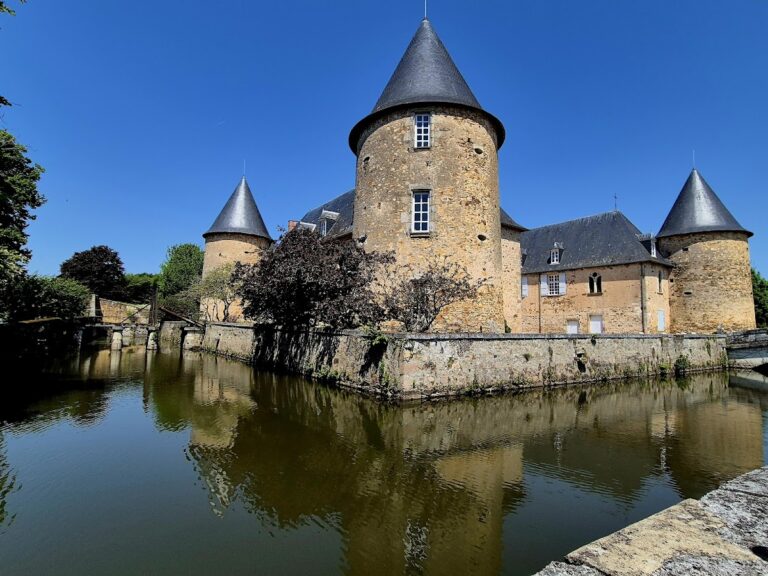
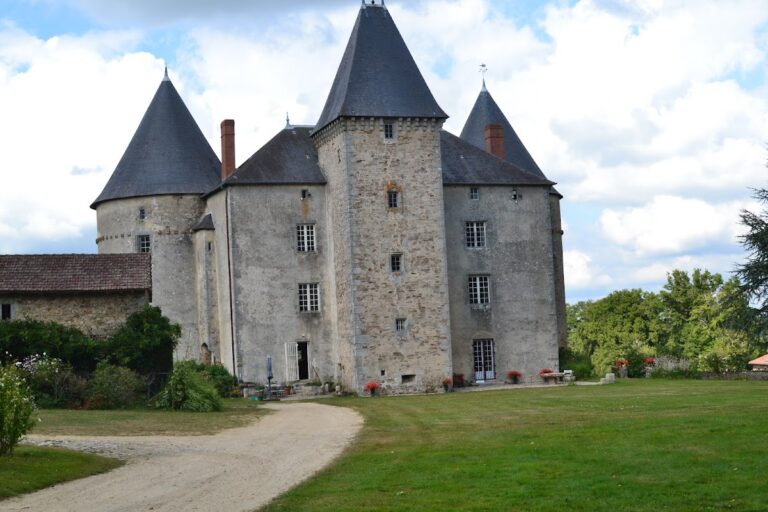
The castle occupies a rocky spur above the confluence of the Graine and Vayres. Its surviving complex combines a twelfth-century keep with a building whose main body belongs to the fifteenth century. The postwar rebuilding followed a pentagonal plan. At the foot of the castle, a natural area identified for ecological, faunal, and floral interest covers more than seven hectares and shelters some bat species. The Rochechouart-Chassenon Astrobleme national nature reserve surrounds the castle except on the northeast, town-facing side. An astrobleme is a geological structure formed by the impact of a meteorite or another extraterrestrial body. The reserve covers the entire spur and extends across the southwest bank of the Graine.
Fortifications and Entrance
Keep and Towers
The twelfth-century keep formed part of Aymeric VI’s medieval castle. In the later pentagonal rebuilding, the northwest tower served as the principal tower or master keep. It was later levelled following the royal judgment of 1512. The two towers framing the southeast façade were truncated during the attempted demolition of 1793, leaving their altered upper profiles as part of the building’s surviving revolutionary history.
Entrance Châtelet
The entrance châtelet retains a drawbridge and one flanking tower from the thirteenth century. It is the only surviving part of the earlier fortress. Its position at the entry to the complex preserves the relationship between the medieval approach and the later residential buildings.
Lion Tower
The Lion Tower is associated with the tradition of Alix and the lion. A stone lion was set into the tower wall, linking the feature to the story of Alix’s confinement in the oubliettes and the recognition of her innocence. The tower’s name preserves that connection between the physical remains and the family tradition.
Residential Buildings and Interior Decoration
Residential Wing and Courtyard Gallery
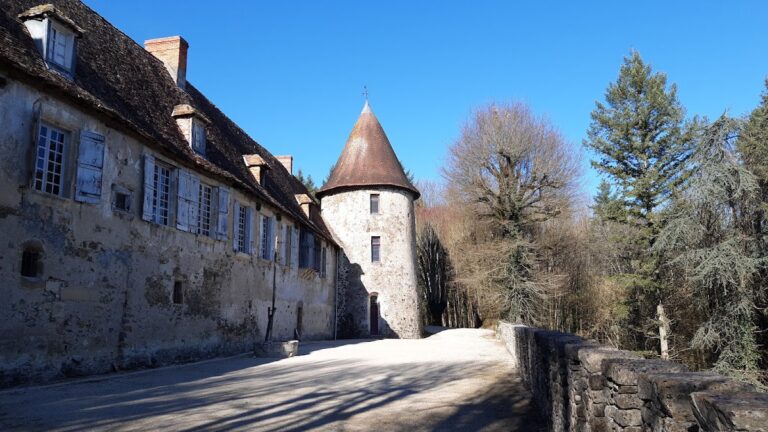
The residential corps de logis, the principal residential block of a castle, has large bays crowned by through-dormers, windows that extend through the slope of the roof. In the main courtyard, a gallery is supported by columns with moulded, twisted shafts. These features belong to the Renaissance character given to the residence during its late fifteenth- and early sixteenth-century rebuilding.
Hunting Room
The Hunting Room contains polychrome wall paintings from the beginning of the sixteenth century. Their several colours depict a stag hunt, providing a surviving example of the decorative programme associated with the Renaissance residence.
Hercules Room
The Hercules Room preserves grisaille murals from the middle of the sixteenth century. Grisaille is a painting technique that uses shades of grey to imitate relief sculpture. The murals form part of the castle’s later interior decoration.
Collections and Artillery Remains
Archaeological Objects
The former Masfrand Museum displayed objects connected with the archaeological work undertaken in the region. Among them was a seated, cross-legged Gaulish deity statue found in 1895. The museum later displayed a distaff decorated with a sculpted rooster at one end. These objects are now associated with the collections transferred to the Cassinomagus archaeological base.
Contemporary Art Collections
The contemporary-art museum displays the Raoul Hausmann collection and works by Giuseppe Penone, Richard Long, Christian Boltanski, and Tony Cragg. Hausmann was an Austrian-born artist and writer associated with Dada, an avant-garde cultural movement that emerged during the First World War.
Castle Cannon
The town preserves a small cannon associated with the castle’s artillery and once used for ceremonial salutes. The piece is said to date from the fifteenth century and was reportedly one of four artillery pieces at the castle in the early nineteenth century. Two were used to reconstitute imperial artillery after the retreat from Russia, while one of the remaining two exploded during nineteenth-century honour salutes. The last cannon received a modern carriage, the supporting framework on which an artillery piece is mounted, in 1870. It is no longer fired because of its fragility.
Nearby sites