Castle of Montbrun: A Medieval Fortified Residence in France


Site at a Glance
- Rating
- 4.2
- Popularity
- Low
- Country
- France
- Primary era
- Medieval
- External website
- Open
- Eras represented
- Medieval
- Civilizations
- Duchy of Aquitaine, French
- Site type
- Domestic
- Remains
- Castle
On this page8 sections
History
Castle of Montbrun is a medieval fortified castle in France, at Dournazac, whose stone phase was built in the twelfth century in the Romanesque style. Its earlier history reaches back to the eleventh century, when a raised earthwork known as a motte supported a fortified building beside the present castle.
Medieval origins and lords
The stone castle belonged during the second half of the twelfth century to the Boschaud de Brie family, a noble lineage associated with Château de Brie, less than 5 kilometres away. Guillaume II was among the family members connected with Montbrun during this period.
In 1199, Pierre Brun, lord of Montbrun, commanded the garrison of Châlus-Chabrol alongside the knight Pierre Basile. Their command took place during the siege in which Richard I of England, known as Richard the Lionheart, died. The event linked the lordship of Montbrun with one of the best-known military episodes in the region’s medieval history.
Rebuilding and later changes
Fire led to the castle’s near-total rebuilding in the fifteenth century. Pierre of Montbrun enlarged it in 1438, creating the basis of the late-medieval residence that survives today.
During the French Revolution, the castle was seized, sacked, and looted. It underwent restoration in the nineteenth century, but another fire in 1917 brought further extensive rebuilding, described in some accounts as almost complete. Additional restoration took place in the mid-twentieth century.
Protection and ownership
The interior was entered on the French register of historic monuments on 20 September 1946. The exterior and associated parcels received classification on 10 April 1990. Since 1995, the castle has been inhabited by Maarten Joost Lamers of the Netherlands. He was identified as the owner in 2015, and the castle was offered for sale in 2023 with its 168-hectare estate and outbuildings.
Remains
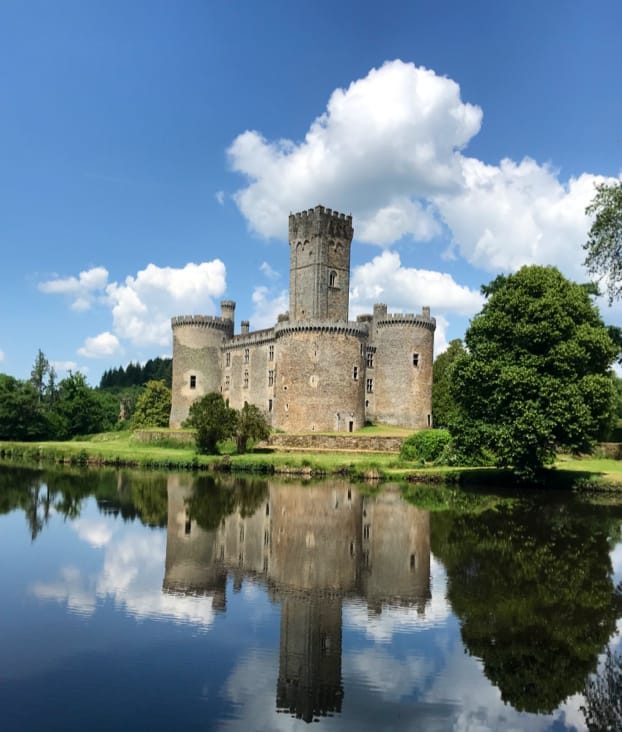
Castle of Montbrun occupies a lowland setting at about 341 metres in the valley of the Dournaujou, a small right-bank tributary of the Dronne. The stream and a smaller branch on its right bank were dammed beside the castle, forming defensive ponds. The surviving arrangement includes an island platform and ponds dating from the twelfth to the fourteenth centuries. Behind the present building are the earlier motte, the ponds, remains of houses used by the castle’s knights, and the late-medieval castle.
Early fortifications
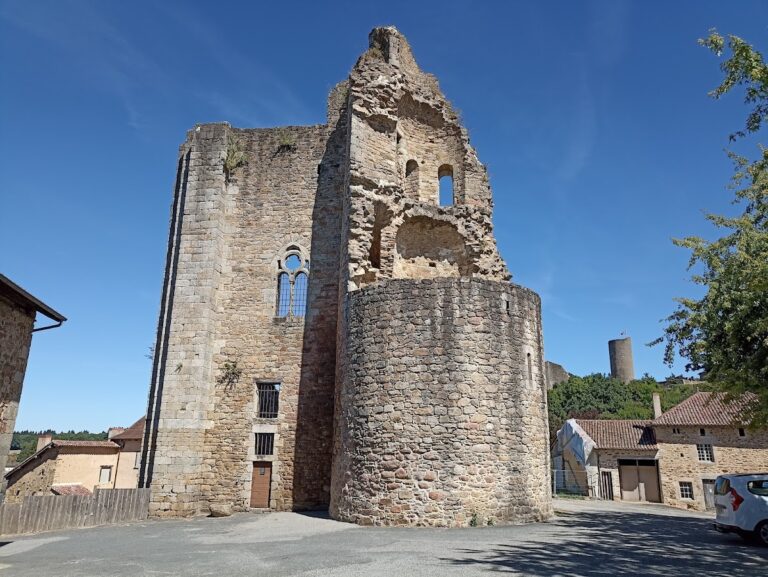
The eleventh-century motte is a raised earthwork that supported an early fortified structure. It may contain an underground arrangement of galleries with small cavities cut into the walls. The twelfth-century stone castle retains a tall Romanesque donjon, the principal fortified tower of a medieval castle. In the fourteenth century, the tower was crowned with machicolations, projecting parapets with openings through which defenders could attack people below.
Late-medieval residence
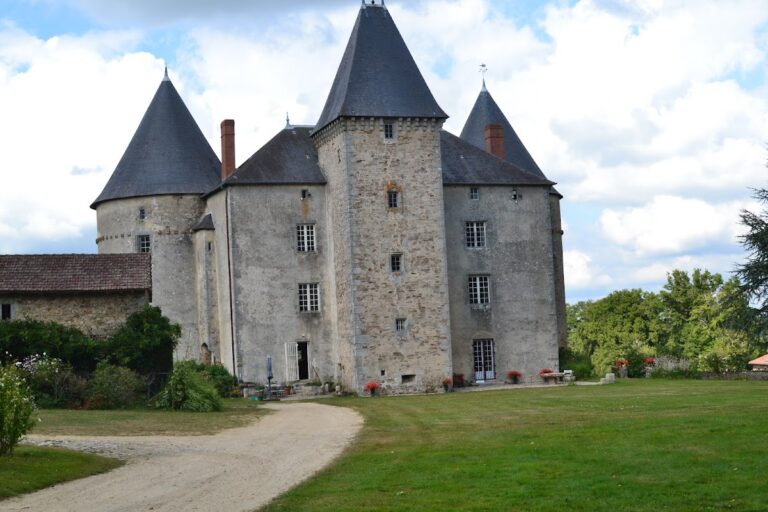
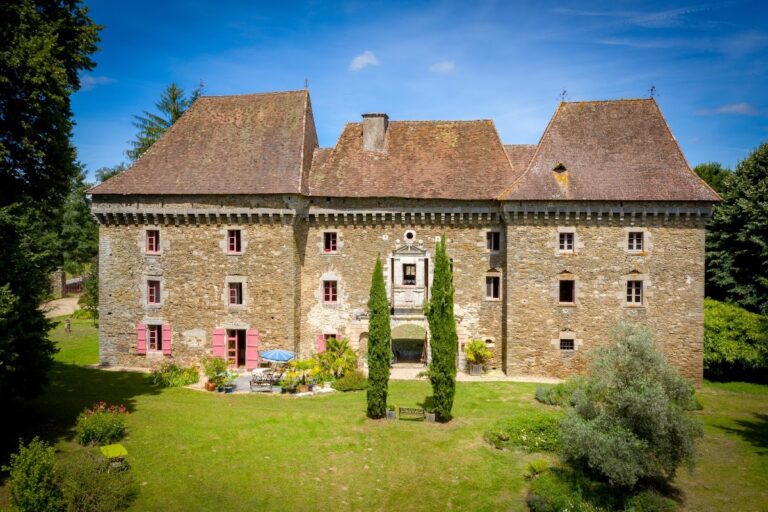
The principal residential building dates from the fifteenth century and is enclosed at its four corners by substantial round towers. Large mullioned windows, divided into separate lights by vertical stone members, open along its sides. Their difficult defensibility reflects a building designed mainly for residence and leisure while retaining the appearance and elements of a fortified castle.
Geological setting
The castle stands on highly metamorphic, foliated augen gneiss, a transformed rock containing conspicuous lens-shaped mineral crystals. This rock belongs to the Lower Gneiss Nappe of the Limousin, a large sheet displaced over other rocks during tectonic deformation. Its foliation strikes north-northwest and dips about 40 degrees toward the east-northeast. Visible stretching lineations plunge 20 to 30 degrees toward the east-southeast. The original rocks, or protoliths, were probably granite porphyries or very immature arkoses, sandstones rich in feldspar.
Nearby sites