Pougy Castle: Former Fortified Residence of the Lords of Pougy


Site at a Glance
- Rating
- 4.9
- Popularity
- Very Low
- Country
- France
- Primary era
- Medieval
- External website
- Open
- Eras represented
- Medieval
- Civilizations
- County of Champagne, French
- Site type
- Military
- Remains
- Castle
On this page8 sections
History
Pougy Castle was a former fortified castle in France and the seigneurial residence of the lords of Pougy. It was probably built in the late eleventh or early twelfth century as a medieval stronghold and was modified repeatedly over the following centuries.
Medieval Rebuilding
Marie of France, Duchess of Bar, repurchased the lordship of Pougy in 1399 and ordered the castle to be rebuilt. The fortress later suffered during the passage of English forces in the Hundred Years’ War, a prolonged series of conflicts between the English and French monarchies fought mainly from the fourteenth to the fifteenth century.
Sixteenth- and Seventeenth-Century Residence
In 1553, Charles de Luxembourg, Count of Brienne, directed another reconstruction, including work on the towers. In 1607, François de Luxembourg, the first holder of the ducal title of Piney-Luxembourg, was living at Pougy Castle. He later purchased a seigneurial house at Piney, established it as the seat of his duchy, and ordered the market hall beneath his windows to be rebuilt. He died at the castle in 1613.
The building’s condition became increasingly difficult to manage. Louis-Henri de Loménie de Brienne commissioned an estimate for repairs in 1669, but the work was not undertaken. In 1691, concern about the castle’s state led his steward to declare it uninhabitable. Louis-Henri’s son, André-Louis-Henri de Loménie, obtained another repair estimate in 1705, though its proposals were also left uncompleted.
Demolition
The castle was demolished shortly before 1742, during the first half of the eighteenth century. Many of its dressed stones were reused in the construction of Château de Brienne, carrying material from the former stronghold into another noble residence.
Remains
Castle Mound and Moats
The castle stood at the entrance to Pougy on the Verricourt side, east of the church and near the left bank of the Auzon. It occupied a position beside the road toward Arcis. The original arrangement consisted of a castle mound, an artificial or partly artificial earthen elevation used as the defensive base of a medieval stronghold, topped by a keep, its principal fortified tower. The defenses were later strengthened.
Two moats enclosed the site. One surrounded the castle and its bailey, the enclosed outer area associated with the main castle, while the other protected the castle itself. Their water came from a former pond beside the Auzon, whose site has since become meadowland. The remains of the mound, known as the Tertre du Guet, and the moats can still be perceived, while the lane alongside the site retains the name Old Castle Lane.
Chapel and Later Church
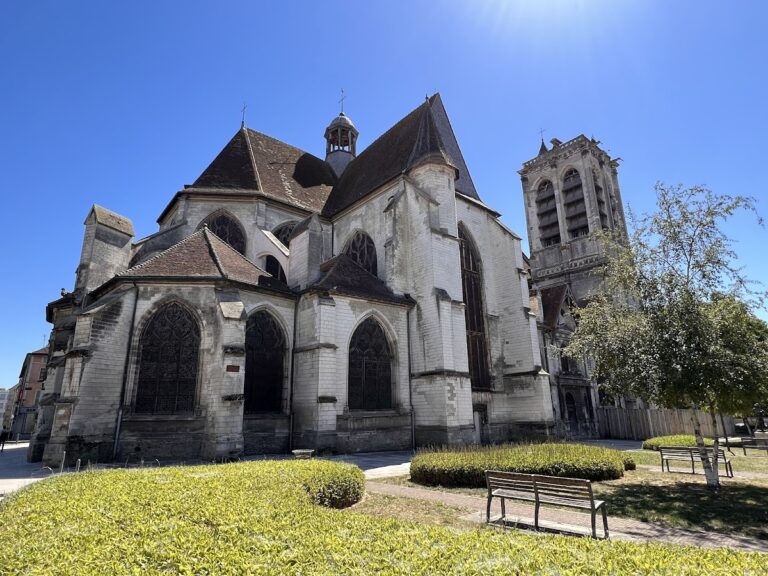
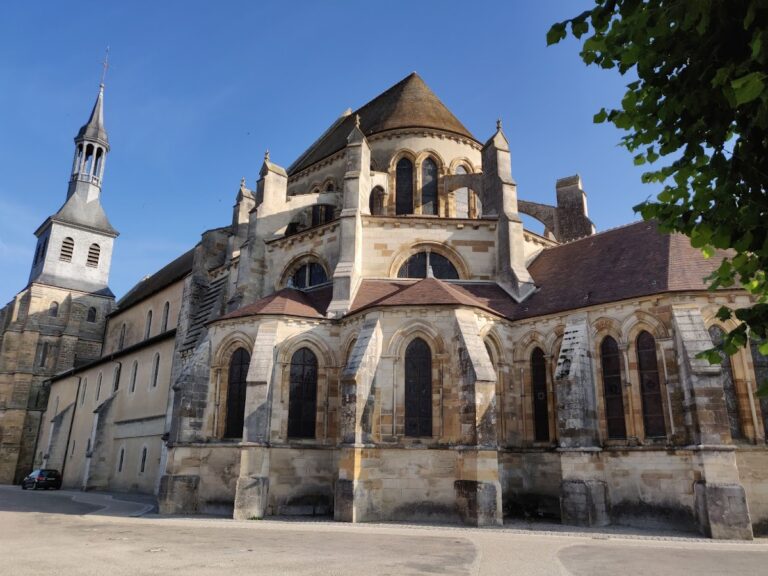
The castle chapel stood within the bailey. It later became a collegiate church, meaning a church served by a college of clergy rather than by monks or a cathedral chapter, and subsequently developed into the present Church of Saint Nicholas.
Park and Heronry
The lords of Pougy are said to have brought a fondness for falconry back from the Crusades and to have established a heronry near the castle. At the beginning of the eighteenth century, this area was transformed into a park with an orchard, planted areas, and a labyrinth.
Nearby sites