Château de Nanteuil: A Historic Estate in Huisseau-sur-Cosson, France

Site at a Glance
- Rating
- 4.3
- Popularity
- Very Low
- Country
- France
- Primary era
- Early Modern
- External website
- Open
- Eras represented
- Early Modern
- Civilizations
- French
- Site type
- Domestic
- Remains
- Castle
On this page8 sections
History
Early tradition and the Courtin lordship
Château de Nanteuil is a historic château in France, located at Huisseau-sur-Cosson in the Loir-et-Cher department. The present building dates from the eighteenth century and stands on earlier underlying bases beside the north bank of the Cosson. Its history is associated with successive noble families, wartime resistance, and the château’s later role as accommodation for English students learning French.
A document dated 30 December 1749 refers to Geoffroi Barbelle as lord of Nanteuil and places his life around 1151. This early association belongs to a historical tradition and does not establish the date when the château was founded. By the sixteenth century, the lordship was held by Jean Courtin, an esquire, a member of the lesser nobility. The Courtin descendants retained Nanteuil from father to son until the eighteenth century.
Jean Courtin, born in Blois on 2 December 1577, was lord of Nanteuil, La Grange-Rouge, Clénord, La Beausserie, and Beuvrière. He also served as the king’s counsellor and procurator, an official who performed legal and administrative work for the Crown, at the bailiwick, a territorial judicial district, the presidial court, a higher royal court, the Chamber of Accounts, and the administration of the waters and forests of the County of Blois. He died in Blois on 6 May 1626 and was buried in the Courtin chapel at Sainte-Solenne Church.
Jacques Courtin later held Nanteuil and Clénord while serving as counsellor and procurator of the king at the bailiwick and presidial court of Blois. His noble status was confirmed on 27 January 1667 by an ordinance issued by d’Aubray, Count of Offémont and intendant of Orléans. An intendant was a royal administrative official. Jacques Courtin died between 1707 and 1714. François Antoine Courtin, another member of the family, was a knight, lord of Nanteuil and La Morandière, and lieutenant colonel of infantry.
Changes of ownership
The estate was seized in 1738 and later passed to the Chevalier family. Jean-Baptiste Chevalier left for Chandernagore in 1751, and his son sold the château to Laurent Lefèvre in 1810. The nineteenth century brought further changes of ownership. Marquis Sosthène Gonzalve de Broc and his son Hervé held the property from 1863 to 1876, followed by Baron Hamelin in 1891, the Margueritte family from 1891 to 1904, and the Count and Countess of Belot, of the Jacob family, from 1905 to 1921.
War, resistance, and postwar life
William Gardnor-Beard, an Englishman, purchased Château de Nanteuil in 1921. With his wife, Anne-Marie Denisane, he welcomed English students who came to improve their knowledge of French. After his death in 1938, Anne-Marie married Count Pierre de Bernard de la Fosse.
During the Second World War, the German army occupied the château. Count and Countess de Bernard were members of the Buckmaster network, a British-organized resistance network operating in occupied France. They were arrested in September 1943 for receiving parachute drops and possessing weapons. Count de Bernard was deported to Buchenwald, a Nazi concentration camp. Countess de Bernard was deported in January 1944 in a transport associated with the “27,000,” a reference to the prisoner numbers, and sent to Ravensbrück, a Nazi concentration camp established primarily for women. There she met Geneviève Anthonioz-de Gaulle, a French Resistance member who later became a prominent human-rights activist.
While the owners were away, the château was managed by the English nursemaid of the countess’s two daughters. The daughters were themselves involved in the Resistance. The count and countess were liberated in April 1945 and returned to Nanteuil in July of that year. They continued to host English students at the château until 1968. General Charles de Gaulle, who led Free France during the Second World War and later became president of France, made a private visit on 24 October 1949. Anne-Marie de Bernard was appointed a knight of the Legion of Honour, France’s highest national order of merit, in August 1955.
Château de Nanteuil was modified during the nineteenth century and restored in 1975. It remains privately owned and is used as guest accommodation.
Remains
Principal building and estate structures
Château building
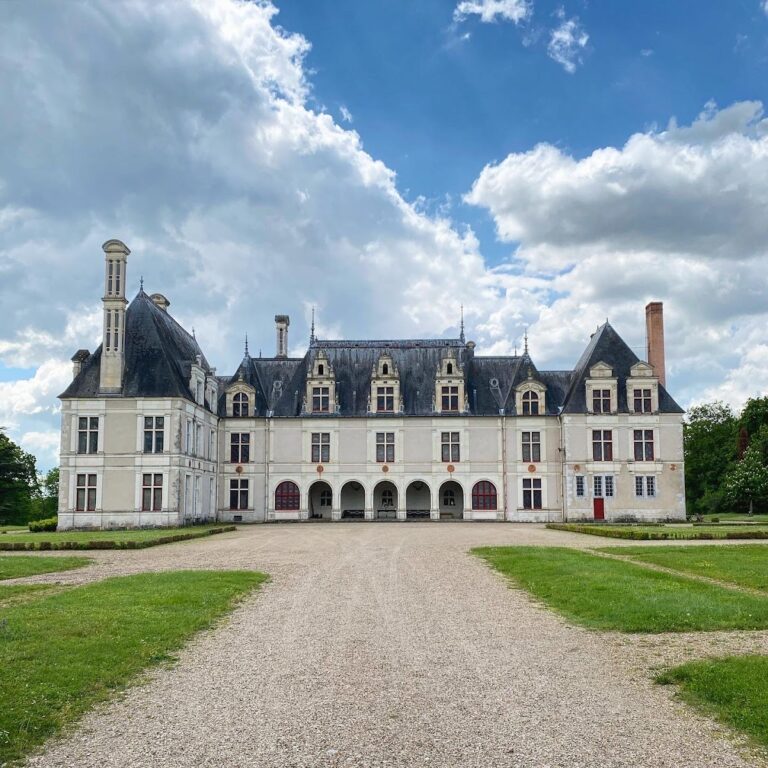
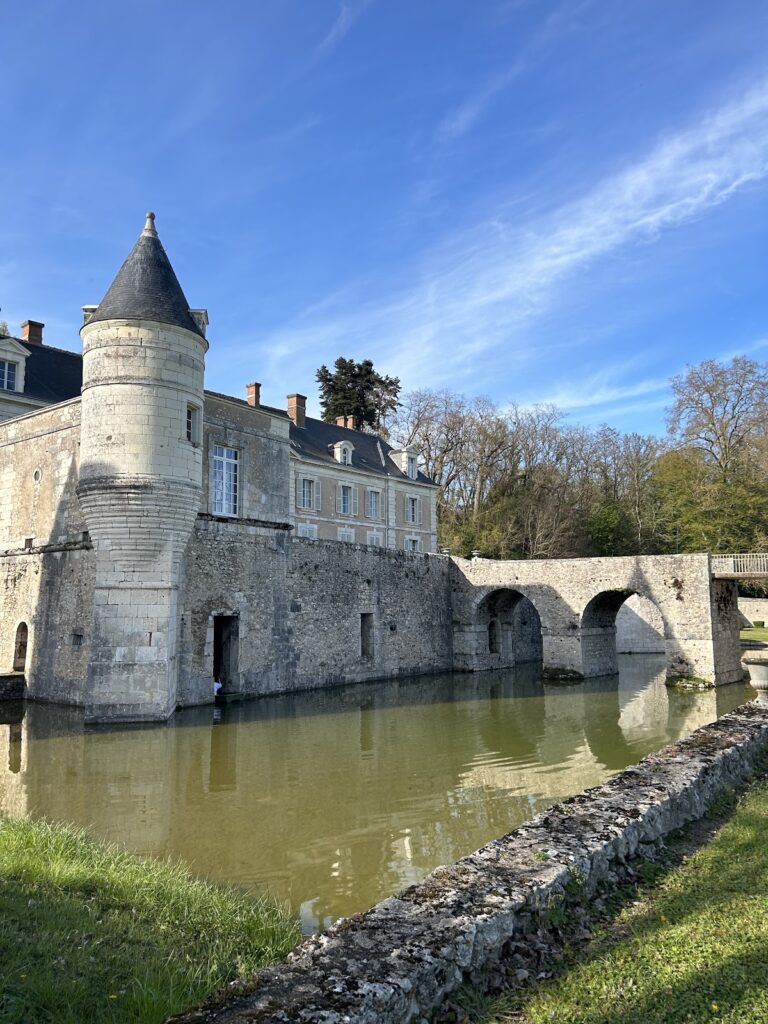
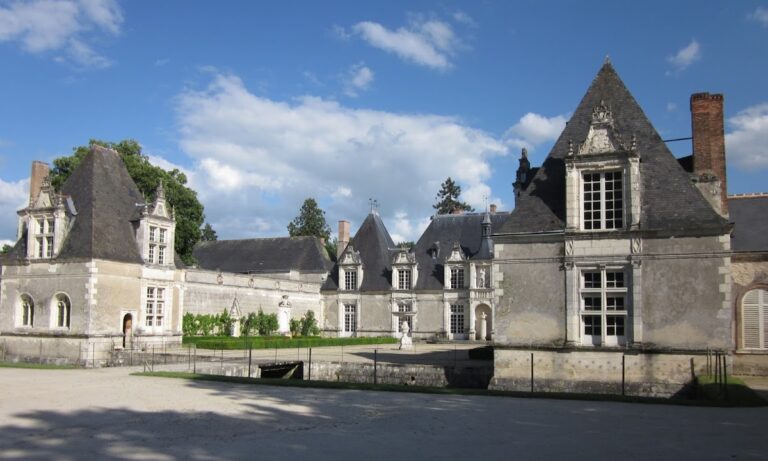
The surviving château is an eighteenth-century building raised on earlier underlying bases beside the north bank of the Cosson. Its principal block has two storeys and eight bays, meaning eight vertical divisions in the facade, with a lower pavilion, or attached wing, on the east side. Above the main levels is an attic storey beneath a slate roof. The entrance projects from the centre of the facade and is framed by two columns. It is crowned by a triangular pediment, a triangular architectural feature above an entrance or window. Nineteenth-century modifications and the restoration of 1975 form part of the building’s present appearance.
Stables and icehouse
The estate also includes stables and a former stone icehouse covered with earth. Together with the principal château, these structures form the surviving architectural complex associated with the estate.